Ruzzola and Cheese-Wheel Throwing in Italy
A wheel of pecorino rolls across a square in Pienza, heading for a fixed target.
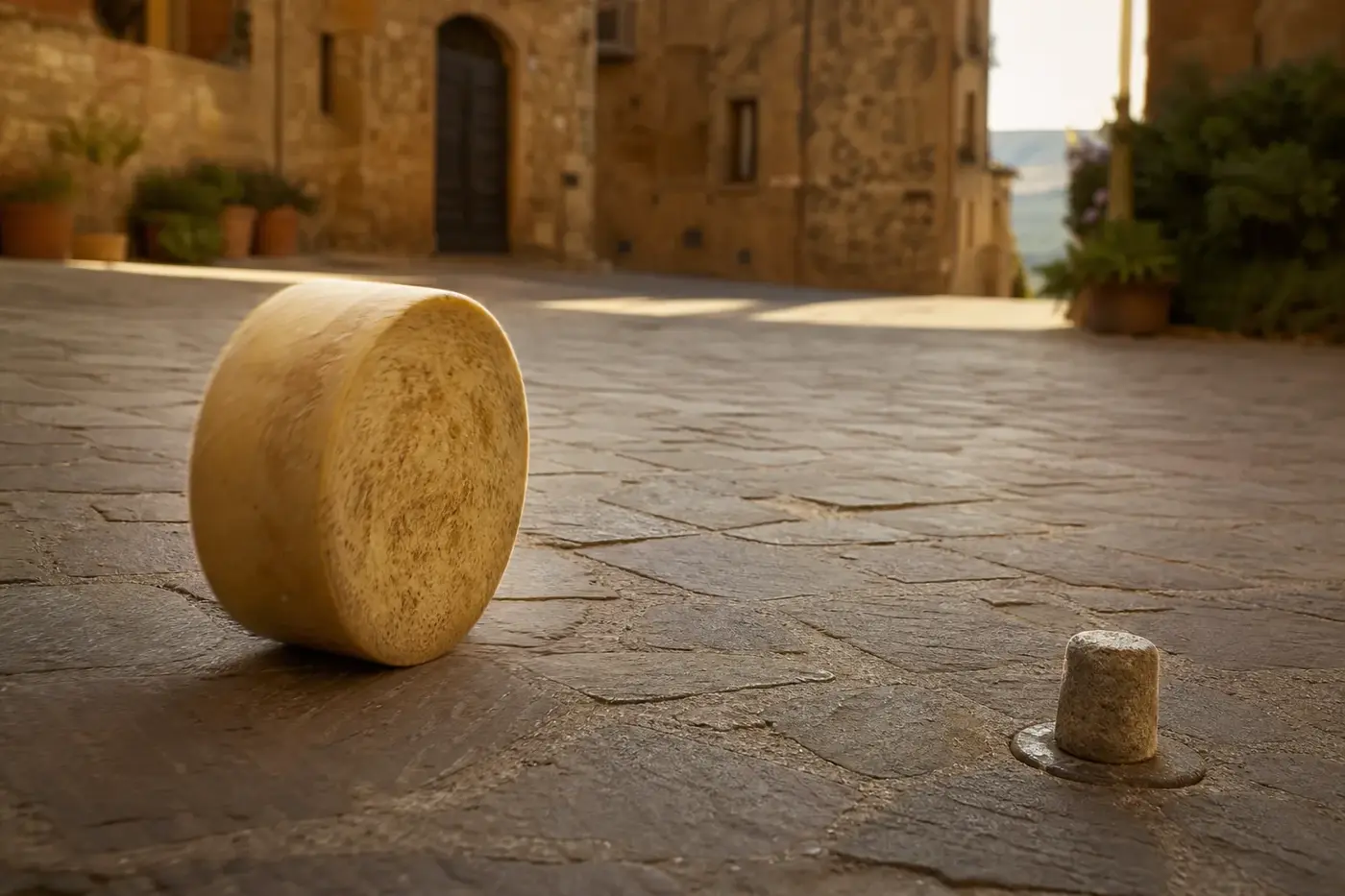
A wheel of pecorino rolls across a square in Pienza, heading for a fixed target. In Pontelandolfo, cheese wheels travel through the town.[5][6] If you usually keep a watchful eye on the cheese board, this takes the habit somewhere new.
You might expect the biggest launch to steal the show. But the real challenge is holding a line and leaving a useful position for the next throw. Ruzzola belongs to a family of Italian rolling games played with cheese wheels or wooden discs, where distance, direction and local rules matter more than a spectacular launch.[2][4]
First, keep your eye on the cord
Look at the player's hand before you follow the wheel. A cord called a spago or fettuccia winds around its circumference, then unwinds during the launch to give it spin. Under the cheese-throwing rules published by UISP, the Italian sport-for-all association, the cord attaches to a finger or wrist. The wheel leaves the hand and runs on its edge along the chosen line.[2][3]
The ruzzolone rules reproduced by the Selva-Poscargano club describe a more elaborate arrangement. A wrist loop, cord wrapped around the disc and a small grip held with the fingers all play their part. Arm and body move together, sending the disc away as the grip is released. Watch closely: the cord launches the wheel; it is not a tether trailing behind it.[7]
A mighty throw is not always a good throw
A shorter, controlled throw can serve you better than a grand launch that leaves the wheel awkwardly placed. In one familiar format, players tackle an agreed course in as few throws as possible. Each attempt starts where the previous one stopped. Every landing hands the player another decision.[2][3]
In another format, players have a fixed number of throws and compete to cover the greatest distance. FIGeST's 2023 ruzzola rules use this comparison, giving competitors equal numbers of launches. UISP's cheese rules explicitly distinguish it from the course-completion game. Before you try to follow the score, find out which contest you are watching.[1][2]
Before you admire the cheese, check it is cheese
A programme announcing ruzzola leaves one important question hanging: what will the players throw? Everyday accounts use overlapping names, but organised sport makes distinctions. FIGeST lists lancio della forma di formaggio, lancio della ruzzola and lancio del ruzzolone as separate disciplines.[10]
Under FIGeST's 2023 rules, the ruzzola is wooden. Its nominal dimensions are 13 cm in diameter and 4.5 cm in thickness, with a nominal weight of 600 g. Each measurement has specified tolerances. Those are federation equipment standards; in local tradition, the name has a broader life.[1]
The ruzzolone rules reproduced by a club describe a wooden disc travelling along marked routes. Compulsory passing posts called biffi, plus separate start and finish gates, shape its journey. The applicable edition remains an open question.[7]
Follow the wheels into central Italy
Central Italy gives you a good place to begin. UISP names Umbria and the Marche alongside Tuscany, Abruzzo and Lazio, while recording a wider distribution. Its account roots the game in rural communities. Local variations are part of that inheritance, not loose ends awaiting a national rulebook.[4]
Put Pienza in Tuscany beside Pontelandolfo in Campania and you can see why place matters. One brings cheese rolling into a square towards a target; the other sends wheels along a town route. The rolling cheese connects them. Their courses, scoring and community settings give each spectacle its own character.[5][6]
Meet the legends, the skates and the rulebooks
An Etruscan origin is among cheese throwing's most intriguing proposed beginnings. FIGeST's 2019 handbook calls it “probable”. Keep that qualification attached when you tell the story. The possibility is part of the fascination.[3]
Pontelandolfo has a legend of its own. The visitor portal recounts a dispute between a landowner and a labourer that becomes an endlessly renewed cheese match. It also reproduces an image captioned 1914, with uncertainty surrounding both the image and its date.[5]
Then comes a wonderfully practical recollection preserved in the Accademia della Crusca's oral material. A speaker remembers taking wooden wheels from improvised skates and using them for ruzzola, with the longest throw winning. You glimpse people adapting what they had for play, rather than one standard object passing unchanged through the generations.[9]
The modern documentary trail gives you clear dates. The federation's illustrated sports handbook appeared in 2019, followed by the ruzzola revision approved on 6 May 2023. Read them alongside local accounts and you can follow inherited games acquiring equipment checks, competition formats and written procedures.[1][3]
Why pecorino, and where does it go afterwards?
Well aged pecorino wheels were one traditional playing object, alongside discs of hard, resistant wood, according to UISP's historical account.[4] Firmness helps the object withstand launching; its wheel shape does the rolling work. If that leaves you curious about production, explore how cheese is made.
Whether a playing wheel is eaten or awarded after a match is a question for the relevant local organisers. Cheese may be at the heart of the spectacle, but its appearance on the course tells you nothing about what happens afterwards.
In Pienza, the formal prize is a painted cloth, according to the official tourism account. The winning district receives something other than the cheese at the centre of the contest. In wooden-disc competition, meanwhile, the object is sports equipment, however hopefully a cheese lover might regard its outline.[6][7]
Let the route tell you the game
In Pontelandolfo, the townscape supplies both the course and its turning point. The published route runs from the fountain in Piazza Roma to the corner of the church of San Rocco, then returns. According to the visitor portal, two teams compete to finish with fewer throws. You are following a journey out and back, not simply a test of strength.[5]
Pienza's cacio al fuso poses a different challenge: how close can the pecorino wheel finish to the fuso, the target fixed in the square? District colours and the shared public space shape the occasion. Put distance down a road out of your mind. Here, the telling detail is the wheel's final position beside the target.[6]
Under FIGeST rules, organised ruzzola can use asphalt, unsurfaced roads or other suitable ground. Junctions and passing places need marked limits. The federation's team format normally has five players, with reserves specified in the competition programme. Singles, pairs and triples also exist.[1]
Even then, the wheel's visible position does not tell you the whole story. UISP's cheese rules specify where officials should mark a wheel that disappears off course or passes outside a required post. The club-published ruzzolone rules also distinguish prohibited areas from neutral ground. Watch the officials' marking before you declare the furthest wheel the winner.[2][7]
Meet the people keeping it rolling
Federation competition and local celebration both keep the game alive. FIGeST's November 2026 website lists ruzzola, ruzzolone and cheese throwing separately, alongside reports of national competitions. To find players, start with the federation, its affiliated clubs and local organisers. A general festival list is not your best first stop.[10]
In Pienza, the official visitor portal names the Pro Loco, the local community association, and the districts as organisers, with municipal support or co-organisation. It describes experienced older specialists, competition for younger players and the ceremonial selection of the playing cheese. Here, sporting skill and neighbourhood representation come together. Different generations have their part to play.[6]
Plan your visit and give the wheel room
Start with the discipline and the place, then contact the organiser. A festival announcement, a club match and a national championship can lead you to quite different experiences. Before you commit to a journey, settle these essentials:
- Get the current details. Ask the club, Pro Loco or municipal tourism office for the date, exact venue, public access arrangements and any booking requirement. Use older programmes as leads to an organiser.
- Know what you will see. Ask whether players throw cheese or wood, and whether scoring measures distance or completion of a fixed course. Find out whether visitors can only watch or may join an organised introduction.
- Choose your viewing arrangements. Ask about designated spectator areas, step-free access, the ground underfoot and toilets. Establish whether spectators move between positions. Confirm any weather-related changes with the organiser.
- Follow the officials' guidance. Stay outside launch and rolling areas, respect barriers and cross only when directed. Leave retrieval to players or stewards. Ask permission before entering the course for a photograph.[8]
UISP's ruzzola rules prohibit launching while people occupy the designated forward safety area. They also require a clear run-up and allow officials to stop a throw with a whistle. Protection is required wherever discs can roll or jump out of the playing area. Choose the organiser's designated viewing position, not simply the spot closest to the action.[8]
Throwing cheese is a different game from chasing it
In these Italian course games, competitors launch their own playing object and build a result through successive throws. The skill lies in the launch, the rolling line and the position left for the next attempt. Downhill cheese-chasing instead centres on people pursuing a released wheel down a slope. Runner and cheese have a different relationship there.
On your first visit, watch where the wheel stops and what the official marks. Then look back at the next player's preparation. Cord, release, rolling wheel, stopping point, another decision: the sequence soon makes the game readable. Between one throw and the next, you begin to appreciate just how much thought goes into that rolling line.[2]
Questions people ask
How do you play ruzzola?
Players launch a wheel or disc using a cord wound around its circumference. In one format, they complete an agreed course in as few throws as possible, starting each throw where the previous one stopped.
Is ruzzola played with cheese or wood?
Local use of the name varies, and games in the family use either cheese wheels or wooden discs. Under FIGeST's 2023 rules, the ruzzola is wooden, with a nominal diameter of 13 cm.
How is the winner decided?
In one format, the winner completes a course in the fewest throws. In another, competitors have equal numbers of throws and the greatest distance wins.
Where did cheese throwing in Italy begin?
An Etruscan origin has been proposed, but FIGeST's 2019 handbook calls it probable rather than certain. Pontelandolfo has a local legend about a dispute between a landowner and a labourer that becomes an endlessly renewed cheese match.
How can I find and safely watch a game?
Contact a federation, affiliated club or local organiser to check the date, venue and public access. UISP's ruzzola rules prohibit launching while people occupy the designated forward safety area, and the page advises spectators to use the organiser's designated viewing position.
Sources
- FIGeST, Regolamento lancio della ruzzola, rulletto, revision 2023, approved by the Federal Council on 6 May 2023. Articles 2, 5 and 6 establish the cited equipment, course and competition provisions. Official rules.
- UISP, Giochi, Regolamento lancio del formaggio, undated online edition, retrieved November 2026. Articles 1, 3 and 11 cover launching equipment, competition formats and marking. Published rules.
- FIGeST, Libro presentazione FIGeST, edition 2019. Sections “Lancio del Ruzzolone” and “Lancio della Forma di Formaggio” describe cord-assisted launching, traditional prizes and the federation's proposed ancient ancestry. Federation handbook.
- UISP, Giochi, Ruzzola, published 18 February 2022. The account describes geographical distribution, well-aged cheese and wooden equipment, and the preservation of local variations. Sport background.
- Visit Pontelandolfo, La Ruzzola del Formaggio, undated online edition, retrieved November 2026. Records the local legend, photograph caption, route, two-team format and eating custom. Local visitor account.
- Pienza Welcome, Portale Turistico di Pienza, Fiera del Cacio, online account referring to the 2025 edition, retrieved November 2026. Describes the target game, organisers, community activities and painted-cloth prize. Official tourism account.
- A.S.D. Ruzzolone Selva-Poscargano, Regolamento nazionale del lancio del ruzzolone, undated club reproduction, retrieved November 2026. Articles 8 to 14, 17, 26 and 29 describe course features, wooden equipment and the cord-assisted throw. Club-published rules.
- UISP, Giochi, Regolamento Ruzzola-Rulletto, undated online edition, retrieved November 2026. Article 37 includes launch-area restrictions, whistle intervention and protective barriers. Published rules.
- Accademia della Crusca, Vocabolario Fiorentino, entry “rùzzola”, undated online entry, retrieved November 2026. Includes transcribed recollections of wooden wheels repurposed for play. Dictionary and oral testimony.
- FIGeST, Specialità and federation home page, live editions retrieved November 2026. List the separate disciplines and document continuing national competition activity. Disciplines and federation news.
This piece was researched through published sports rules, federation records, local visitor accounts and recorded oral testimony, with historical traditions distinguished from dated documentation.
Last checked: November 2026
Last checked November 2026.
The editors suggest you read next
Cheese Festivals Around the World
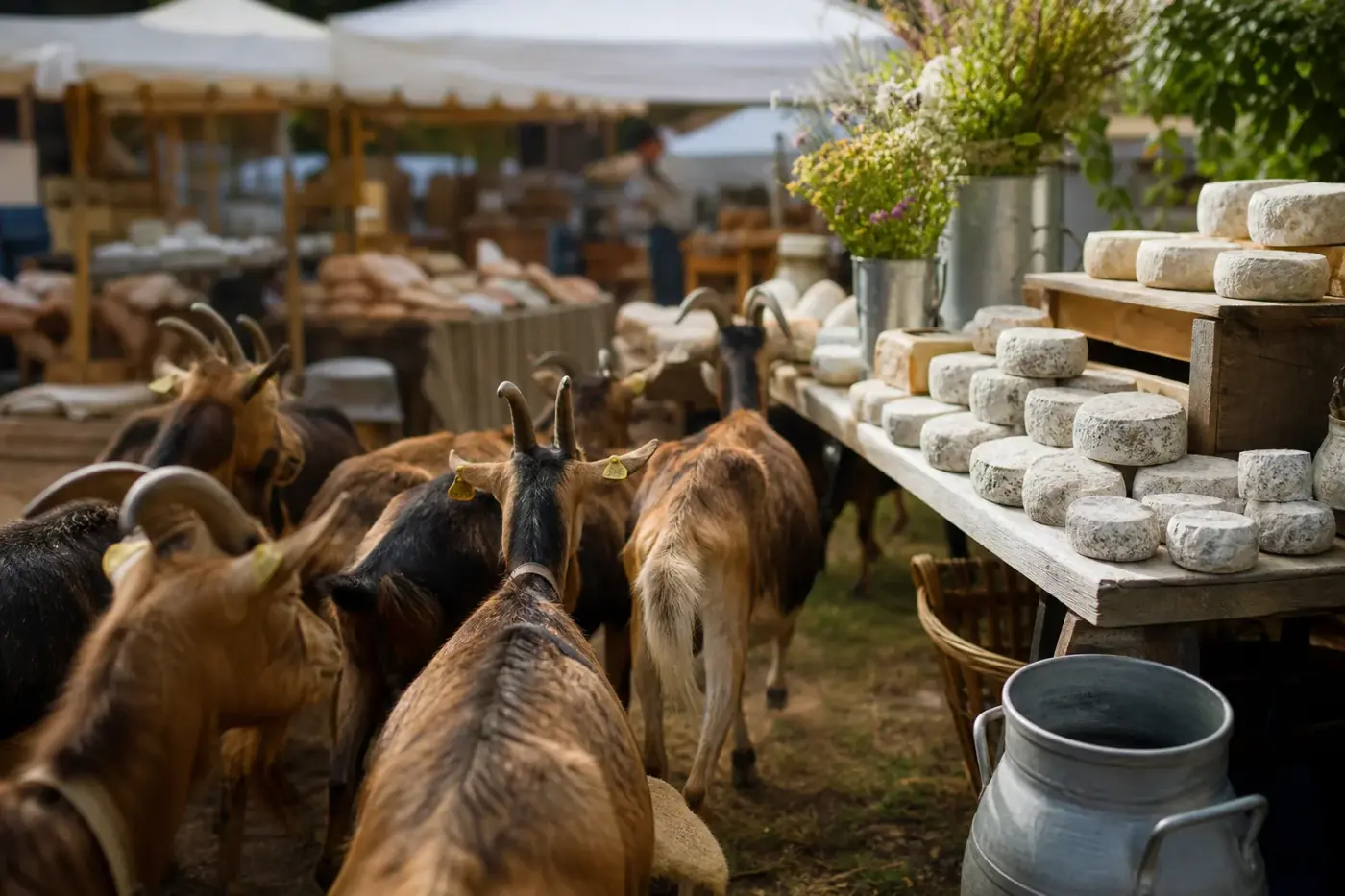
A herd of goats arrives at Rocamadour's cheese festival.