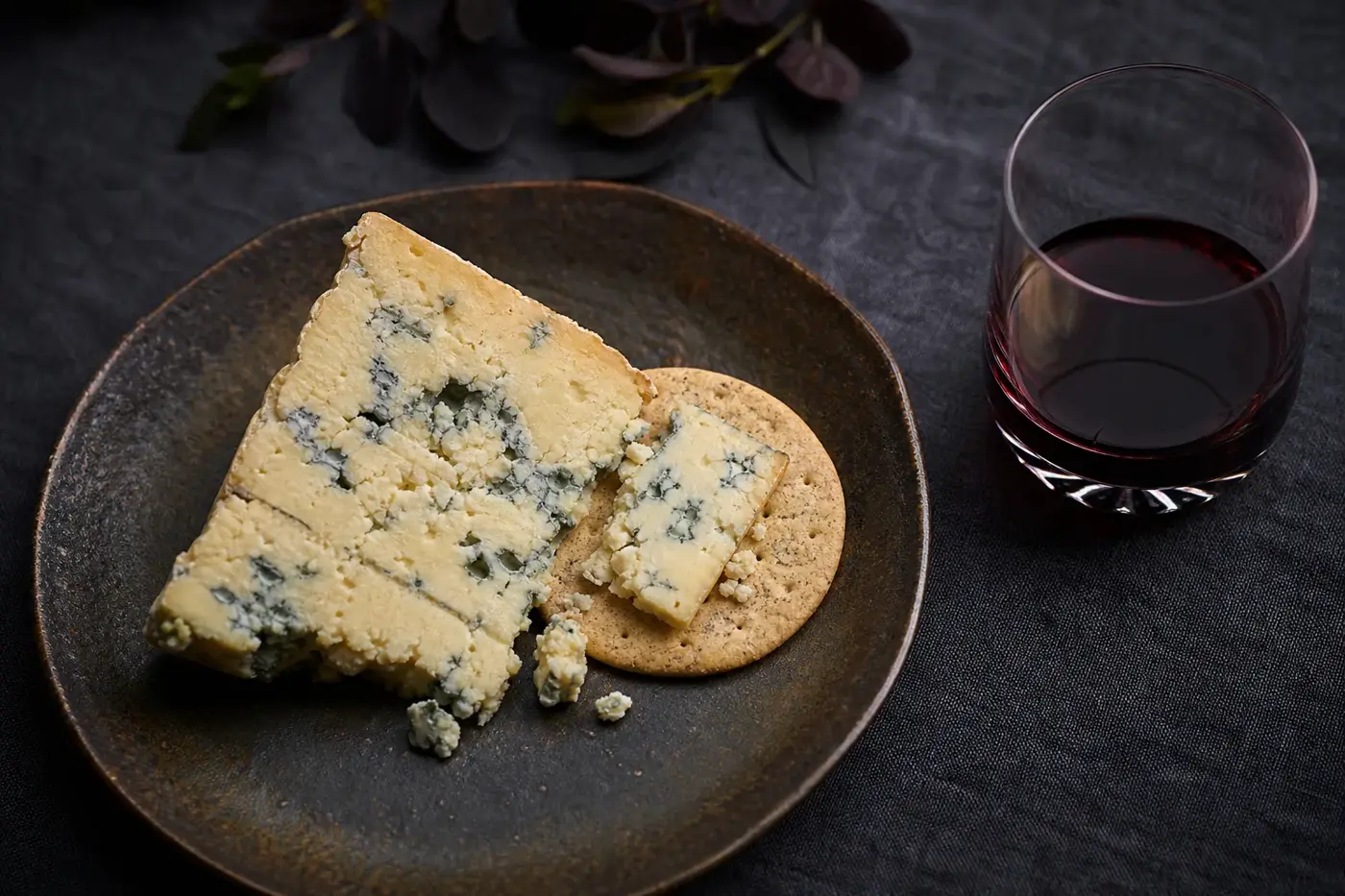
Take a bite of Blue Stilton, then a sip of Port. First comes the crumble, the slight sharpness, the milky background beneath salt and blue mould.[3] Then sweetness changes the scene. Ruby brings fruit; tawny offers wood-aged flavours and dried fruit, so you can give the same wedge a different character simply by changing the glass.[1][2]
Let sweetness pull up a chair beside salt
You are looking for contrast, not a wine that tastes like the cheese. The Stilton Cheesemakers’ Association recommends sweet wines with Stilton and says the two should balance in depth of flavour. Choose a bottle that can hold its own beside your wedge, rather than one whose greatest charm is delicacy.[1]
Four elements shape each mouthful. Salt gives the cheese its savoury edge, while sweetness answers from the glass. Fat brings texture and substance; the blue character adds another layer. Standard Blue Stilton’s slightly crumbly, slightly sharp character and milky background give sweetness plenty to work with, without anything needing to taste alike.[3]
The pleasure comes as you move between those sensations. Salt stays salty and wine stays sweet: neither chemically cancels the other. You want to notice both, rather than have one take charge of every mouthful.
Port gets its sweetness during fermentation. The Instituto dos Vinhos do Douro e do Porto, or IVDP, explains that grape spirit stops grape sugar turning into alcohol, leaving residual sweetness. Its account gives a usual finished alcohol content of 19 to 22% by volume, another good reason to keep your pour small.[4]
Want to get a feel for that balancing act? The cheese and wine pairing guide takes you through the wider principles.
Meet the wedge from three counties
Your Blue Stilton begins with pasteurised, full-cream cows’ milk. Its specification calls for a cylindrical cheese, no applied pressure and a naturally formed crust. It must be made within Derbyshire, Leicestershire or Nottinghamshire.[3]
The milk normally comes from those three counties too. During shortages, however, the specification permits supplies from specified surrounding counties. Where your cheese is made and where its milk may come from are two distinct requirements.[3]
In Great Britain, Stilton Blue Cheese is the registered name on the government’s Protected Designation of Origin register as of November 2026. That Great Britain PDO designation ties the name to its defined production area and specification. The register records UK scheme registration on 31 December 2020 and original EU registration on 21 June 1996.[5]
At the counter, ask about character before age. The association describes standard Blue Stilton as open-textured, with a tangy finish; its descriptions of mature versions emphasise a mellower finish. Older is not automatically better for your palate. Ask your cheesemonger which description fits the wedge being cut, then choose the character you want beside your wine.[6]
That name tells you something about place, not just the producer. The guide to protected names explains how a regional designation differs from a brand.
Ruby or tawny? Choose your kind of pleasure
Start with a simple question: do you fancy fruit or wood-aged flavour? Port has two broad red-wine families. Ruby producers aim to preserve deep colour, fruit and youthful strength, while tawny styles blend wines matured for different periods in casks or vats. You are choosing a direction, not working your way up a ranking.[7]
The table brings together IVDP’s style descriptions and practical pairing suggestions. Use it to find the character you would like in your glass.
| Port style | What awaits in your glass | Try it with your Stilton |
|---|---|---|
| Ruby or ruby reserve | Youthful fruit and deep colour define the ruby family; IVDP describes reserve examples as full-bodied and fruity.[2][7] | Start here for a clear fruit-led contrast with standard Blue Stilton. |
| Late bottled vintage, or LBV | A single-harvest ruby style, bottled after four to six years in wood, according to IVDP.[2] | Choose it for a more substantial fruit-led partner, and follow the bottle’s serving instructions. |
| Vintage | A single-harvest wine bottled two to three years after harvest, then developing in bottle.[2] | Consider its age and delicacy before serving an especially forceful cheese beside it. |
| Tawny | Wood-matured styles include reserve and age-indicated wines; IVDP describes older examples through dried-fruit and wood-derived aromas.[2][7] | Let dried fruit, rather than youthful red fruit, lead your pairing. |
Give Vintage and LBV a little attention before opening. IVDP describes sediment developing in Vintage Port as it ages and notes that some LBVs keep developing in bottle. Read your individual label: LBVs are not all interchangeable.[2]
With tawny, follow your taste. Longer maturation changes how the wine sits beside the cheese, but age alone does not make a better pairing. You might love that dried fruit, or find yourself reaching back for ruby’s youthful fruit.
Begin with ruby reserve and a plain biscuit
Start with ruby reserve Port with standard Blue Stilton, accompanied by plain biscuits. The ruby family’s preserved fruit meets the cheese’s tangy finish, putting contrast at the centre of your first taste. Those published descriptions of the wine and cheese give you a useful starting point.[6][7]
Keep your first mouthful simple. Taste a little cheese alone, then take a small sip of wine. Next, put the cheese on a biscuit and return to the glass. You should still recognise both clearly.
If the cheese takes over, make your next bite smaller before changing the bottle. Want less emphasis on fruit? Try tawny next, changing one element at a time so you can tell what makes the difference.
You do not need several open bottles to make a useful comparison, however persuasive your inner cheese enthusiast becomes. Try another style on a different occasion, with a cheese described in similar terms. That keeps things manageable and gives each combination room to show its character.
A familiar partnership, made your way
Port and Stilton have enthusiastic advocates on both sides of the table. The Stilton Cheesemakers’ Association names Port as a favoured sweet-wine partner and includes tawny among its recommendations. In Portugal, IVDP places Port with cheese towards the end of a meal and recommends tawny with strong cheeses and walnuts.[1][8]
Those published recommendations describe the modern association, rather than telling you when or how it began. They also leave plenty of room for personal taste. The cheese association suggests other dessert wines, while IVDP distinguishes between Port styles according to the food alongside them.[1][8]
Bring that flexibility to your table. Keep the familiar partnership, but choose the Port to suit your cheese and your preferences. A famous pairing need not turn one bottle category into a compulsory choice.
Keep Stilton chilled, then prepare your portion
Keep Stilton refrigerated, then take it out one hour before serving so its flavour can develop. That is the association’s December 2023 guidance. Once opened, it advises wrapping the cheese in foil or cling film and keeping it in an airtight box in the fridge.[6]
For food-safety limits, the UK Food Standards Agency guidance cited here applies to England, Northern Ireland and Wales. It recommends a fridge temperature between 0 and 5 °C (32 to 41 °F) and following the packaging’s storage instructions. Keep chilled food out for the shortest possible time, with a maximum of four hours during preparation.[9]
Take out only the cheese you intend to serve. Count its warming period as time outside refrigeration, serve promptly, and follow the pack’s use by date and instructions after opening. Leave the rest refrigerated until you need it.[9]
You are aiming to take off the refrigerator chill, following the association’s one-hour preparation advice. Your cheese does not need to become warm throughout. Preparing a serving portion is enough.[6]
A little planning keeps the rest ready for another occasion. See storing cheese at home for the broader storage routine.
Keep your Port cool and pour with care
IVDP recommends 12 to 16 °C (54 to 61 °F) for ruby-style Port and 10 to 14 °C (50 to 57 °F) for tawny-style Port. Use those ranges as starting points. In a centrally heated dining room, your wine could otherwise become considerably warmer.[8]
A small wine glass with a gently narrowing bowl is a practical choice. Pour a little and leave room above it so you can smell the wine comfortably. Specialist glassware is not your admission ticket to this pairing.
Decanting means transferring wine to another vessel to separate it from sediment. Mature Vintage Port deserves particular care. IVDP describes its increasing deposit with age and recommends carefully decanting old Vintage before drinking.[2][8]
Read the producer’s instructions, especially for an older or bottle-matured LBV. If decanting is advised, handle your bottle gently and stop pouring before the deposit reaches the receiving vessel. The aim is clear wine without sediment, rather than an elaborate table ceremony.
Small wedges and good company
Serve a small wedge per person and keep more in the fridge for replenishment. Modest bites let you control the balance with each sip. A biscuit buried under cheese makes that rather harder.
Plain biscuits make a useful first choice because you can compare the cheese and wine easily. Add sliced pear for freshness, or put walnuts in a separate bowl so your guests can choose them. IVDP specifically pairs walnuts and strong cheeses with a chilled ten-year-old tawny.[8]
Leave several preserves and strongly seasoned crackers off your first plate. Starting simply helps you discover what you like about the central pairing before another flavour joins in. After that, you can choose accompaniments for what they bring, rather than letting them distract.
Serve Port only to adults of legal drinking age, and keep pours small. Give water and an alcohol-free option equal care on your table. Every guest deserves a considered drink beside their cheese.
Leave the Port in your glass
Keep the wine in the glass and the Stilton on the plate. Pouring Port into the cheese commits both ingredients to one combination. Serve them separately and everyone can choose their own balance of bite and sip.
You also spare a large piece of cheese from an experiment some guests may not enjoy. Cut what you need, pour modestly and replenish only when wanted. Your pairing stays easy to adjust throughout.
A bite of blue cheese followed by a sip of sweet wine brings the two together directly enough. You can still change the biscuit, reduce the cheese portion or taste the Port without food. Each ingredient remains yours to enjoy alone as well as alongside the other.
Find your gentler, sweeter or alcohol-free route
For a gentler introduction, ask for Blue Stilton described as mellow rather than strongly flavoured. The association’s published distinctions can help you explain what you want. A mild, soft-textured cheese is another option: IVDP recommends ruby reserve or LBV with mild, creamy cheeses.[6][8]
Fancy a different wine? The Stilton Cheesemakers’ Association suggests dessert wines including Muscat and sweet examples of Gewürztraminer. Check your particular bottle for sweetness rather than relying on the grape name alone.[1]
For an alcohol-free choice, offer pear juice with sparkling water served separately. Your guests can adjust the sweetness and dilution themselves. You keep a sweet-fruit element beside the cheese, in a distinctly different drink.
Enjoy these as choices in their own right, not substitutes judged by how closely they resemble Port. The useful question is which combination makes you want another thoughtful bite.
General information only, not medical advice: follow the official guidance where you live.
Questions people ask
Why do Port and Stilton go well together?
The sweetness of Port contrasts with the salt and blue character of Stilton. The Stilton Cheesemakers’ Association recommends sweet wines that balance the cheese in depth of flavour.
Which Port should I try with Stilton?
Ruby reserve is a fruit led starting point with standard Blue Stilton. Tawny offers a different direction, with older examples showing dried fruit and wood derived aromas.
How should I store and prepare Stilton?
The Stilton Cheesemakers’ Association advises refrigerating Stilton and removing it one hour before serving. For food safety, consult the UK Food Standards Agency guidance for England, Northern Ireland and Wales, which recommends a fridge temperature of 0 to 5 °C and a maximum of four hours out of refrigeration during preparation.
How should Port be served with Stilton?
The Instituto dos Vinhos do Douro e do Porto recommends serving ruby styles at 12 to 16 °C and tawny styles at 10 to 14 °C. It also recommends carefully decanting old Vintage Port to separate it from sediment.
What can I serve with Stilton instead of Port?
The Stilton Cheesemakers’ Association suggests dessert wines including Muscat and sweet examples of Gewürztraminer. For an alcohol free option, the page suggests pear juice with sparkling water served separately.
Sources
[1] Stilton Cheesemakers’ Association, Enjoying Stilton, undated web guidance, retrieved November 2026. Sections “Serving tips” and “What wines go best with Stilton?”.
Read at stiltoncheese.co.uk
[2] Instituto dos Vinhos do Douro e do Porto, Special Categories, undated web guidance, retrieved November 2026. Sections on Vintage, LBV, ruby reserve and tawny styles.
Read at ivdp.pt
[3] Department for Environment, Food & Rural Affairs, Product Specification: “Stilton Cheese”, undated document currently linked from the GB register, retrieved November 2026. Sections 4.2 and 4.3.
Read at assets.publishing.service.gov.uk
[4] Instituto dos Vinhos do Douro e do Porto, The Winemaking, undated web guidance, retrieved November 2026. “Red Port”.
Read at ivdp.pt
[5] Department for Environment, Food & Rural Affairs, Stilton Blue Cheese, GB protected food and drink names register, published 4 January 2021, retrieved November 2026.
Read at gov.uk
[6] Stilton Cheesemakers’ Association, Good Labelling Practice for Stilton Cheese, December 2023 revision. “Cheese descriptors” and “Storage and serving ideas”.
Read at stiltoncheese.co.uk
[7] Instituto dos Vinhos do Douro e do Porto, Introduction, undated web guidance, retrieved November 2026. “Ruby style” and “Tawny style”.
Read at ivdp.pt
[8] Instituto dos Vinhos do Douro e do Porto, Choose And Enjoy, undated web guidance, retrieved November 2026. Food pairings, decanting and serving-temperature table.
Read at ivdp.pt
[9] Food Standards Agency, How to chill, freeze and defrost food safely, published 18 December 2017, current retrieved text November 2026. Applies to England, Northern Ireland and Wales.
Read at gov.uk
Researched through official cheese specifications, government registration records, institutional wine guidance and published food-safety advice; pairing choices are identified as editorial recommendations.
Last checked: November 2026
Last checked November 2026.
The editors suggest you read next
Cheese and Wine Pairing: The Complete Guide
A bite of long-matured Comté, then a sip of vin jaune.