Cheese and Wine Pairing: The Complete Guide
A bite of long-matured Comté, then a sip of vin jaune.
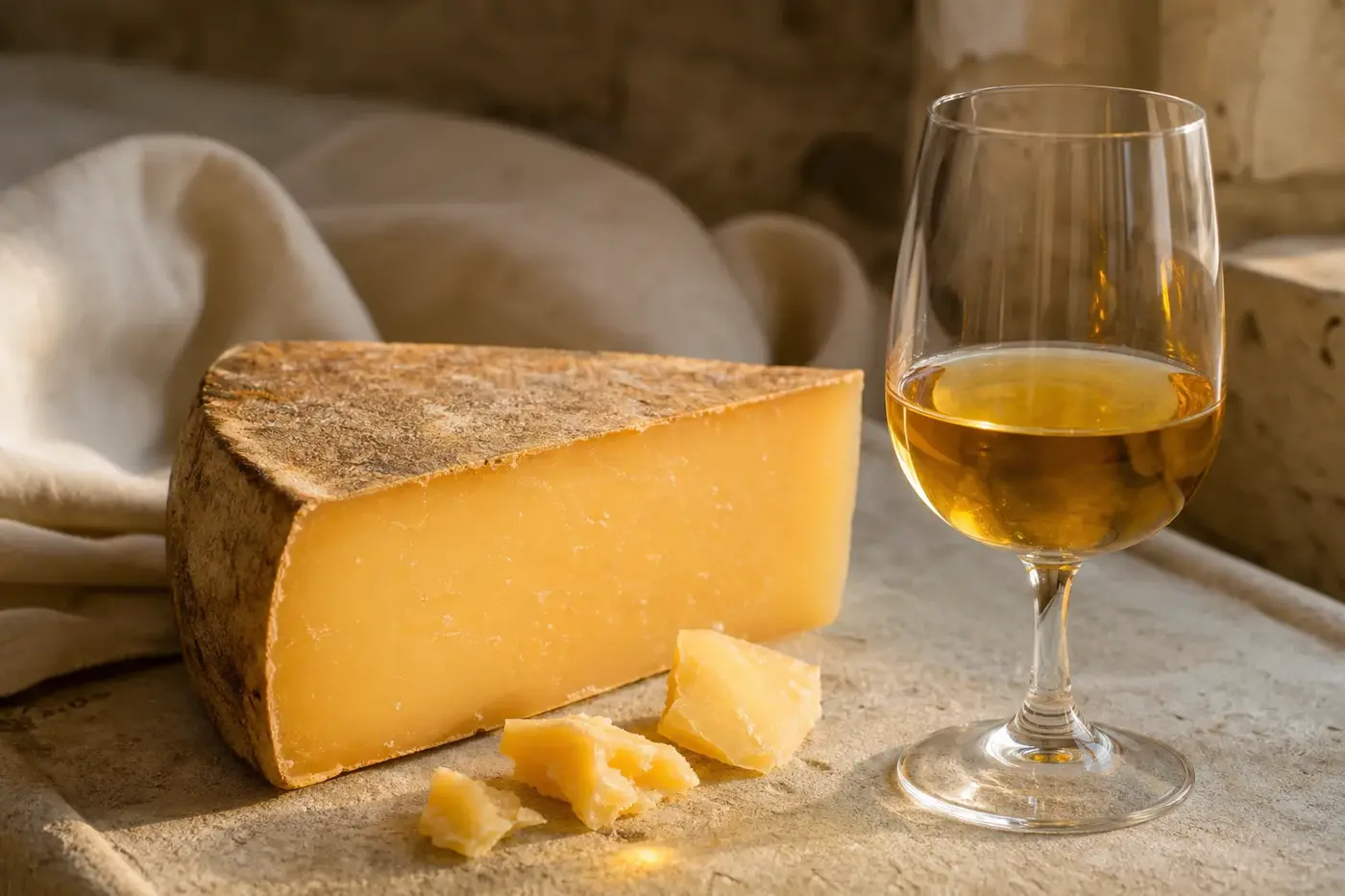
A bite of long-matured Comté, then a sip of vin jaune. Pause over the dried-fruit and spice aromas they share. This regional partnership has the Comté industry body's backing; Stilton's makers, meanwhile, point you towards Tawny Port and sweet dessert wine. [1,2]
Good places to begin, but your taste buds get the casting vote. Cheese can change how a wine feels and tastes, and your preferences matter as much as a pairing's reputation. Start with the cheese's intensity and texture, and a wine you actually enjoy. [1,2,3]
One bite, one sip: let your palate decide
Start small: one cheese, one drink. Taste them separately, then follow a bite with a small sip. Does the wine seem softer, sharper, fruitier or less appealing? Keep plain water alongside and change just one thing at a time.
You are looking for both cheese and wine to remain enjoyable. The Stilton Cheesemakers' Association recommends balancing their depth of flavour; the Comté industry body (CIGC) stresses that individual cheeses, wines and personal tastes differ. Use these suggestions as a beginning, then let your own comparisons guide you. [1,2]
| Your starting cheese | Wine to try | What makes it worth a taste? | Where the advice comes from |
|---|---|---|---|
| Firm cheese: Comté | Jura Poulsard or Trousseau | CIGC distinguishes lighter Poulsard matches from more intense Trousseau matches. | Industry recommendation [1] |
| Long matured firm cheese: Comté | Vin jaune | CIGC favours long maturation for this regional pairing. | Industry recommendation [1] |
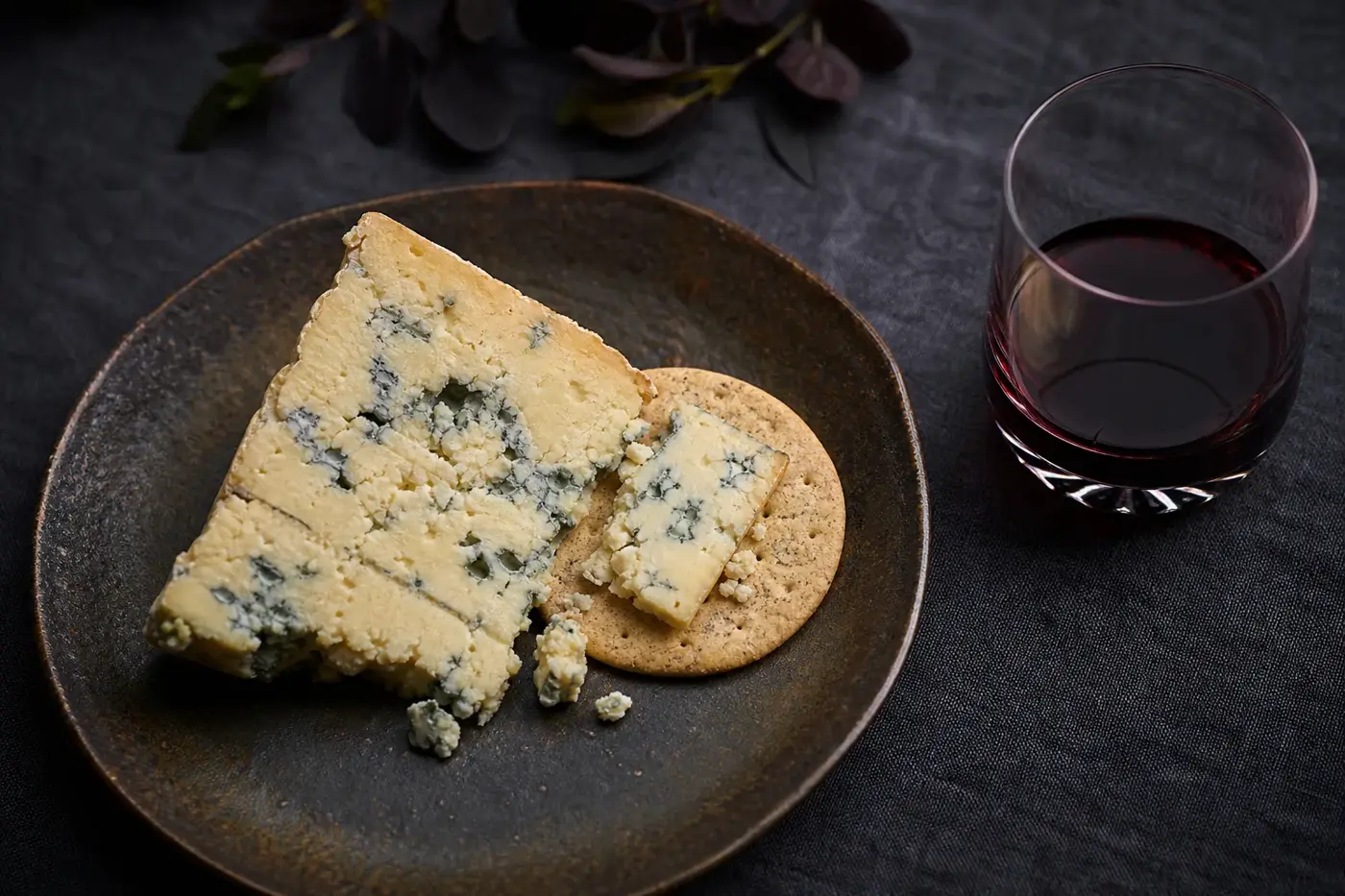
| Blue cheese: Stilton | Tawny Port or sweet dessert wine | The Stilton association recommends both with Stilton. | Industry recommendation [2] |
| Blue cheese: Roquefort | Sweet, fruity dessert wine | One combination scored highly in a restaurant test with 45 consumers; five wines were assessed separately in the laboratory. | Research [5] |
| Firm cheese: Cheddar | Shiraz | Cheddar reduced astringency and flavour length in ten Australian Shiraz wines. Pair preference appeared to follow liking for the wine. | Research [6] |
| Less intensely aromatic Comté | Jura crémant | CIGC recommends a fairly soluble texture and restrained aromas with these sparkling wines. | Industry recommendation [1] |
That drying grip: what cheese does to your wine
You know the drying grip a red wine can leave in your mouth? It comes partly from tannin, which contributes to astringency. A bite of cheese can change how long that sensation lasts. [4]
In Galmarini and colleagues' 2016 study, 31 French consumers tasted Pacherenc, Sancerre, Bourgogne and Madiran with Époisses, Comté, Roquefort and Crottin de Chavignol. With Madiran, all four cheeses shortened the dominance of astringency and sourness. The red-fruit aroma, meanwhile, stayed dominant for longer. [4]
Fat offers one possible explanation. In 2021, Saad and colleagues studied a grape tannin interacting with fat droplets in a model emulsion; their sensory tests found that dietary oils reduced astringency from tannin solutions. That suggests a mechanism, rather than predicting what will happen with your particular cheese and wine. Cheese contains proteins, salt and aromatic compounds too. [7]
Saltiness also has a part to play. In Galmarini and colleagues' 2018 study, 60 Dijon consumers assessed Comté, Époisses and Chaource with Pouilly-Loché, Maranges and Beaujolais. Salty sensations helped liking in two combinations, while sourness, bitterness and astringency were negative drivers, mostly associated with wine. Sweet-wine research offers another perspective, which you will find below. [3]
Keep the people and products tested in mind as you read. The 2016 authors caution that their consumer sample was small for broad conclusions about preference. A shorter spell of astringency is not the same measurement as a more enjoyable pairing. [4]
Choosing red? Go for pleasure, not power
Pick a red you enjoy, rather than the most powerful bottle. In Bastian, Collins and Johnson's 2010 study, Cheddar met ten Australian Shiraz wines. The cheese reduced astringency and flavour length, but preference for the combinations appeared to follow liking for the wine itself. [6]
With a mixed board, start with the cheese that matters most to you. Try it with the wine, then see how the other pieces respond. For Stilton, its association recommends robust Shiraz. Let the cheese's character help you choose which suggestion to explore. [2]
White wine and Comté: start with its age
For long-matured Comté, vin jaune gets CIGC's strongest endorsement. Those shared dried-fruit and spice aromas are the attraction. For younger Comté with lactic aromas, its regional advice points instead towards floral white wines. Before you choose the bottle, ask about the cheese's maturity. [1]
White wine also featured in Galmarini and colleagues' 2017 study. Here, 31 consumers tried Époisses, Chaource and two Comté cheeses with white and red Burgundy, rosé des Riceys and Beaujolais. The wines changed the dominance of saltiness and some aromas, yet preference for the cheeses stayed unchanged. At home, give your cheese as much attention as your wine. [8]
Blue cheese: make room for something sweet
Before you automatically reach for red wine, consider Roquefort with a sweet, fruity dessert wine. That combination scored highly for liking in Nygren, Nilsen and Öström's 2017 study, with neither product dominating. The work included a restaurant test with 45 consumers and laboratory analysis of five wines with Roquefort. [5]
Alongside that research sits the customary partnership of Port and Stilton. The Stilton association names Tawny Port among its favourites, together with sweet dessert wines and sweet dark Oloroso Sherry. If you choose Sherry, keep “sweet” firmly in the description. That is the style the association recommends. [2]
Champagne and sparkling wine: talk texture with your cheesemonger
Choosing Comté for sparkling wine? Ask your cheesemonger about texture and aromatic intensity, not just age. CIGC's precise Jura example pairs crémant with cheese whose texture is fairly soluble and whose aromas are relatively restrained. Age alone tells you less. [1]
If you already have Champagne, taste the cheese and wine separately, then together. Decide whether you prefer the combination, and note the actual bottle and cheese. “Sparkling with hard cheese” leaves rather a lot unsaid. Those details will give you a more useful comparison next time.
Beyond wine: give tea and coffee their own moment
Tea, coffee and soft drinks deserve to be chosen for their own flavours. They do not need to audition as wine substitutes. These suggestions come from cheese industry bodies, reflecting both their pairing advice and their promotional interest in cheese. [9,10,11]
| Your starting cheese | Alcohol free drink to try | What the source likes about it | Where the advice comes from |
|---|---|---|---|
| Young, fruity Comté | Long Jing green tea | Comté's Belgian site describes toasted and dried-fruit notes bringing out honeyed and milky flavours. | Expert view [9] |
| More mature Comté | Sri Lankan black tea, served cold | The same site pairs prune and cocoa aromas with spicy, roasted cheese notes. | Expert view [9] |
| Comté | Gently roasted, softly brewed coffee | CIGC favours these preparations for aromas it finds easier to harmonise with cheese. | Expert view [10] |
| Blue cheese | Alcohol free root beer | Real California Milk suggests sweetness alongside blue cheese's salty and umami flavours. | Expert view [11] |
| Young Cheddar | Apple or pineapple juice | Real California Milk suggests their combination of sweetness and acidity. | Expert view [11] |
For coffee, CIGC suggests beginning with Comté aged 8 to 15 months. It favours coffees that are neither heavily roasted nor too green, and generally gentler brewing methods. With tea, compare the aroma in your cup with the cheese. The examples above draw on shared roasted, fruity or milky notes. [9,10]
Two pairing habits you can leave at the door
Assuming red wine always wins. Familiarity cannot do your tasting for you. In the 2018 Dijon study, sourness, bitterness and astringency were negative drivers of liking in several combinations, mostly from wine. Choose by what happens in your glass and on your plate. [3]
Treating a regional pairing as a scientific result. Geography gives you documented starting points, including Comté with Jura wines. Sensory research measures what happens with particular products under specified conditions. Tradition, industry recommendations and measured effects all have a place, but they answer different questions when you decide what to try. [1,3]
A welcoming table, with responsible serving
These wine suggestions are for adults of legal drinking age who choose to drink. Keep servings small and give alcohol free choices equal standing. Avoid alcohol when driving, taking medicines that interact with it, or recovering from alcohol dependence. [12,13,14]
Ask a pharmacist about medicines. UK NHS advice is to avoid alcohol during pregnancy. [12,13,14]
In pregnancy, UK NHS advice, last reviewed 15 June 2026, limits caffeine to 200 mg daily from all sources, including tea and coffee. It advises against eating mould ripened soft cheeses, soft blue cheeses and unpasteurised soft ripened goats’ cheese unless cooked until steaming hot all the way through. Before choosing your board, check the official guidance for your country and circumstances. Ask your midwife about pregnancy questions. [12]
General information only, not medical advice: follow the official guidance where you live.
Questions people ask
What wine goes with Comté?
The Comté industry body recommends vin jaune with long matured Comté, noting their shared dried fruit and spice aromas. For younger Comté with lactic aromas, it suggests floral white wines.
What should I drink with Stilton?
The Stilton Cheesemakers' Association recommends Tawny Port and sweet dessert wines. It also names sweet dark Oloroso Sherry and robust Shiraz.
Does cheese make red wine less astringent?
In one study, Cheddar reduced astringency and flavour length in ten Australian Shiraz wines. Preference for the combinations appeared to follow how much people liked the wine itself.
What alcohol free drinks go with cheese?
Real California Milk suggests root beer with blue cheese and apple or pineapple juice with young Cheddar. The Comté industry body suggests gently roasted, softly brewed coffee with Comté.
What does the NHS advise about cheese and drinks during pregnancy?
The UK NHS advises avoiding alcohol and limiting caffeine to 200 mg daily from all sources, including tea and coffee. It advises against mould ripened soft cheeses, soft blue cheeses and unpasteurised soft ripened goats’ cheese unless cooked until steaming hot all the way through. Check the NHS pregnancy guidance and ask your midwife about your circumstances.
Sources
- Comité Interprofessionnel de Gestion du Comté. Comté et Vins du Jura AOC. Undated live edition; sheet records 22 September 2021. Sections on white, red and sparkling wines. Verified source.
- Stilton Cheesemakers' Association. Enjoying Stilton. Undated live edition. Serving tips and wine recommendations. Verified source.
- Galmarini, M. V., Dufau, L., Loiseau, A.-L., Visalli, M. and Schlich, P. Wine and Cheese: Two Products or One Association? A New Method for Assessing Wine-Cheese Pairing. Beverages, 2018, 4(1), 13. DOI: 10.3390/beverages4010013. Published paper deposited in HAL INRAE. Verified paper.
- Galmarini, M. V., Loiseau, A.-L., Visalli, M. and Schlich, P. Use of Multi-Intake Temporal Dominance of Sensations (TDS) to Evaluate the Influence of Cheese on Wine Perception. Journal of Food Science, 2016, 81(10), S2566 to S2577. DOI: 10.1111/1750-3841.13500. Verified publisher record and abstract.
- Nygren, T., Nilsen, A. N. and Öström, Å. Dynamic changes of taste experiences in wine and cheese combinations. 2017. DOI: 10.1080/09571264.2017.1284655. Publisher abstract.
- Bastian, S. E. P., Collins, C. and Johnson, T. E. Understanding consumer preferences for Shiraz wine and Cheddar cheese pairings. Food Quality and Preference, 2010, 21(7), 668 to 678. DOI: 10.1016/j.foodqual.2010.02.002. Author abstract reproduced in FAO AGRIS. Verified abstract record.
- Saad, A., Bousquet, J., Fernandez-Castro, N., Loquet, A. and Géan, J. New Insights into Wine Taste: Impact of Dietary Lipids on Sensory Perceptions of Grape Tannins. Journal of Agricultural and Food Chemistry, 2021. DOI: 10.1021/acs.jafc.0c06589. Verified PubMed abstract.
- Galmarini, M. V., Loiseau, A.-L., Debreyer, D., Visalli, M. and Schlich, P. Use of Multi-Intake Temporal Dominance of Sensations (TDS) to Evaluate the Influence of Wine on Cheese Perception. Journal of Food Science, 2017. DOI: 10.1111/1750-3841.13932. Author manuscript in the CONICET institutional repository. Verified manuscript.
- Comté, Belgian promotional website. Accords. Undated live edition. Sections on hot and iced tea. Verified source.
- Comité Interprofessionnel de Gestion du Comté. Comté et café. Undated live edition. Verified source.
- California Milk Advisory Board, Real California Milk. Cheese & Drinks. Undated live edition. Blue cheese and root beer recommendation; young Cheddar entries in the pairing chart. Verified source.
- NHS. Foods to avoid in pregnancy. Live edition retrieved November 2026. Cheese, caffeine and drinks sections. Official advice.
- US Centers for Disease Control and Prevention. What You Can Do to Prevent Impaired Driving. 28 January 2026. Driving plans and medicine interactions. Official advice.
- NHS. Alcohol-use disorder. Live edition retrieved November 2026. Treatment and recovery advice. Official advice.
This desk-researched guide compares published sensory findings with attributed industry recommendations and official health advice.
Last checked: November 2026
Last checked November 2026.
The editors suggest you read next