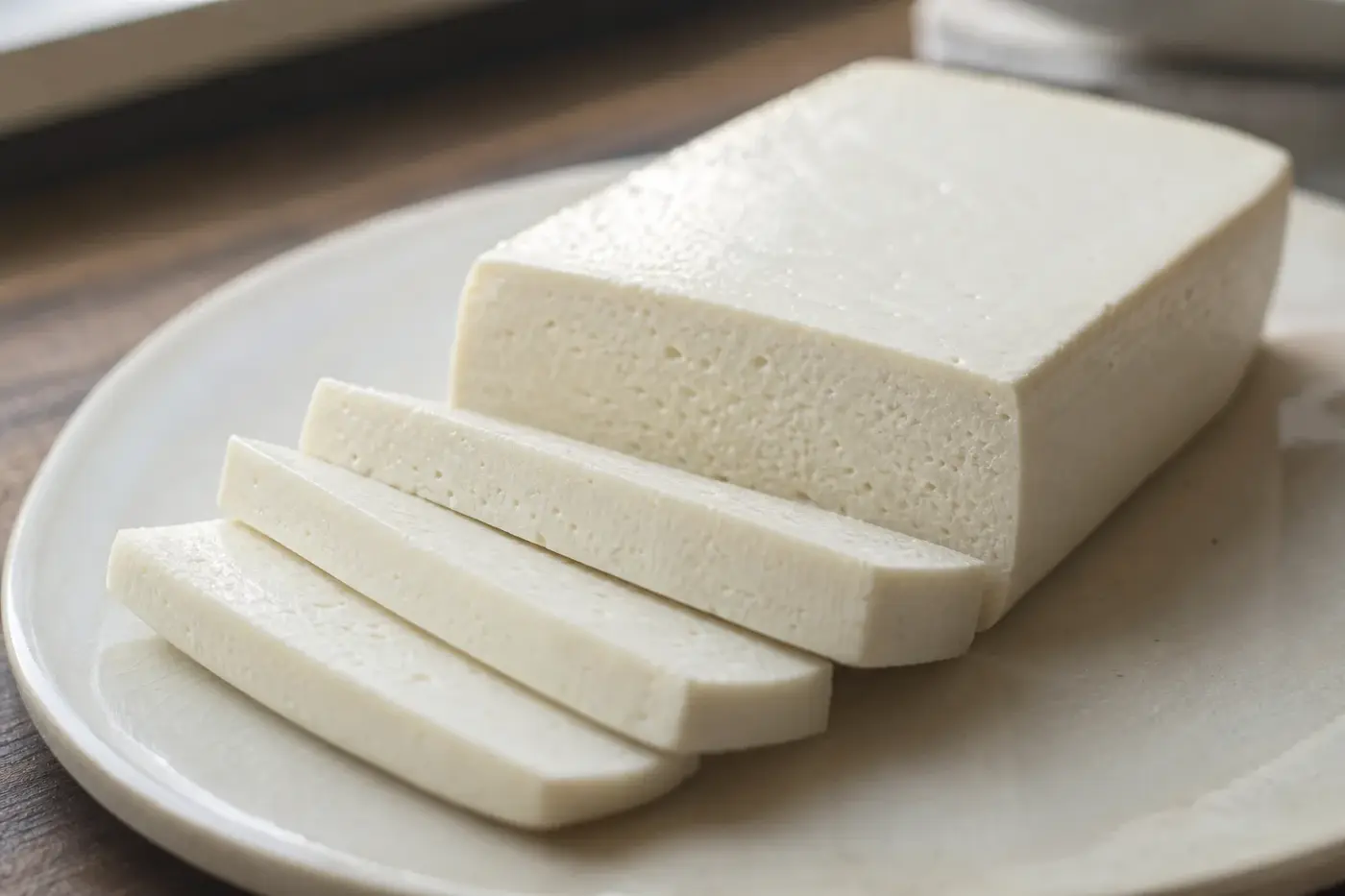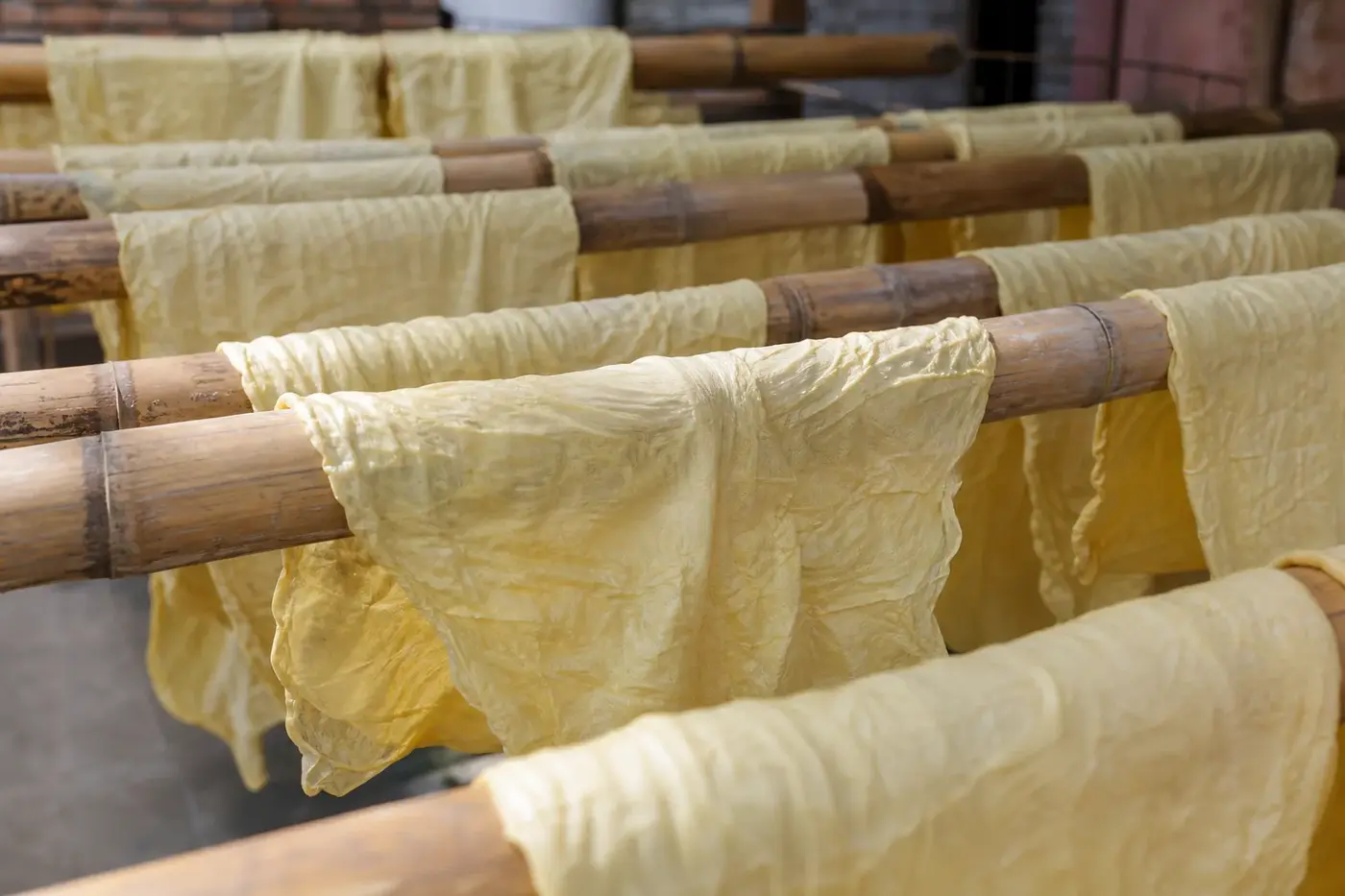
Watch a small mass of curd meet a pair of large chopsticks. In Yunnan's Bai communities, hands pull and stretch it, then drape it over parallel bamboo poles to dry into a thin “milk fan”. This is Rushan: cow's milk cheese made with a sour coagulating liquid, ready for grilling or frying, often with something sweet. The chopsticks are doing rather more work than yours at dinner.[1,2,7]
| Your quick guide | What to look for |
|---|---|
| Name | Rushan, 乳扇.[5] |
| Traditional home | Dali, Yunnan, China, particularly Eryuan and Dengchuan.[2,3] |
| Milk | Cow's milk; check the treatment for each product.[2,3] |
| How it sets | Heat and sour liquid, including fermented whey in documented production.[2] |
| Shape | Thin stretched sheets, dried on bamboo supports.[1] |
| Rind | No developed ripened rind; the surface is the dried sheet.[1,7] |
Meet the milk fan of Dali
You can see where the name comes from. Rushan means “milk fan”, the usual translation of its Chinese name, 乳扇, describing its broad, thin form rather than a mould or wheel. Drying can leave the sheet folded, curved or gathered, though, so the fan in front of you might look more like a loose ribbon.[5,7]
Its traditional home is Dali, especially Eryuan County and Dengchuan. In 2021, a production study collected milk, whey and cheese from fourteen households around Eryuan; a separate 2018 study worked with residents in Eryuan, Weishan and Jianchuan. These records bring you close to a regional cheesemaking tradition that reaches beyond any single village.[2,3]
Family workshops keep that tradition in plain sight. In February 2026, CNR visited one on Dengchuan Street, where fresh milk and sour liquid were heated, gathered into a mass, stretched and hung on racks. A customer had travelled from Jianchuan to buy Rushan for festive meals. Here was the maker's daily work, destined for the table when relatives gathered.[4]
Follow the curd onto the bamboo
The transformation begins with sour liquid. In the household process described in the Journal of Dairy Science, acid whey includes liquid kept from earlier cheesemaking and Chinese flowering quince juice. Milk meets the heated acidic liquid and coagulates, separating into solids, the curd, and liquid, the whey. The curd is then worked smooth.[2]
There is more than one documented way to prepare that acidity. The 2018 research used liquid made from fruit botanically identified as Chaenomeles sinensis, alongside commercial UHT milk, under controlled conditions. Local residents made the cheeses at each study location. This describes a research protocol, rather than the full variety of household practice.[3]
Now comes the part you would want to linger over. First-hand photographs show curd pulled with large chopsticks, stretched with fingers and draped across parallel bamboo poles, which hold it open as it dries. A small, pliable mass becomes a broad sheet. Its thickness and outline take shape in the maker's hands.[1]
A maker interviewed by China Tourism News in 2020 described saving sour liquid from one production for the next. For her, the balance of milk and sour liquid, clean working and drying weather were crucial. A handsome fan is only part of the achievement: you need workable curd and a successful drying day, too.[6]
If you want to untangle coagulation, draining and shaping, visit how cheese is made. With Rushan, you can see those stages unusually clearly in the finished cheese.[1,2]
Look closely, then follow that milk aroma
What you see on Rushan's surface is the cheese itself, not a developed mould coating. Published descriptions range from cream-coloured sheets to the more golden cheese recorded at the Dengchuan workshop. Whatever the colour, you are looking for a thin, worked layer, not a thick paste hidden inside a separate rind.[4,5,7]
Drying changes that layer considerably. The 2021 study found a substantial drop in moisture between fresh and dried Rushan: smooth curd that can be kneaded and stretched becomes a firmer, leathery sheet. Heat changes it again. That gives you three textures to explore: fresh curd, dried fan and cooked snack.[2,7]
For a flavour guide, listen to the maker interviewed by China Tourism News. She described a pronounced milk aroma, slight sourness at first and sweetness afterwards, and valued a soft, yielding, light texture with strands. These were her preferences for her own production. They also give you useful things to notice as you taste Rushan prepared in different ways.[6]
She linked her sheets' outlines to her handling of the sour liquid, too. Using slightly less, she said, gave thinner, lighter sheets without pronounced corners. The milk fan has a recognisable shape, but the maker still has plenty of say in how it turns out.[6]
Pick your pleasure: a soft roll or a crisp puff
Picture a sheet of grilled Rushan, warmed until soft and rolled around a stick. Rose petal jam is a reported filling, bringing floral sweetness inside the warm cheese. You get a thin layer wrapped around a sweet spread, not a pool of melted cheese. If that is the version you fancy, ask for it grilled.[7]
Frying takes you somewhere quite different. The Shanghai government information office's food account describes Rushan puffing in hot oil into a light, crisp snack. Ask which version is being served: grilling gives you a softened roll; frying gives you an expanded, crisp texture. This is a useful question to settle before your appetite answers for you.[5,7]
Sugar is a familiar companion, but sweetness is not compulsory. Rushan also appears in savoury dishes with vegetables, pork or Yunnan ham. That thin sheet has more than one role in the kitchen.[5,7]
It belongs at the tea table, too. First-hand documentation records Rushan in Bai three-course tea, alongside its grilled and fried uses. If you know it only as a prepared street snack, you still have a kitchen and a tea tradition to discover.[1]
Rushan or Rubing? Start with the shape
Look at what happens to the curd. Rushan is stretched into thin sheets; Rubing, another Yunnan cheese whose Chinese name is commonly translated as “milk cake”, is drained and pressed into a thicker cake. The Shanghai account describes goat's milk as traditional for Rubing, but records cow's milk versions too. Shape is your first clue, rather than milk species alone.[5]
Find the right sheet for your kitchen
Search for both Rushan and 乳扇, then get curious about the cheese in front of you. Where was it made, is it fresh or dried, and what treatment did the milk receive? Ask how the maker intends you to cook it, too. A useful supplier should pass on storage and preparation instructions for the actual pack, rather than relying on its name.
Follow the producer's storage instructions, including anything that changes after opening. In England, Wales and Northern Ireland, the Food Standards Agency advises keeping your home fridge between 0 and 5 °C and following the packaging's storage information. Keep the original label with the cheese so its date, batch and handling details stay available.[8]
Under UK guidance, a use-by date concerns safety; a best before date concerns quality. Follow your pack's date and any shorter limit after opening, remembering that incorrect storage can make food unsafe before its use-by date. A dried-looking sheet is no substitute for handling instructions; reading a cheese label helps you distinguish the details.[9]
At the stove, use the maker's directions for your particular sheet, especially about whether it needs softening first. Grill for the rolled presentation or fry for the puffed version, keeping accompaniments simple enough for you to taste the cheese. With refrigerated products, take out only what you are preparing and return the rest promptly.[5,7,8]
Get to know the milk treatment
The name Rushan cannot tell you whether the milk was pasteurised, so check the product. The NHS defines pasteurisation as heat treatment used to kill bacteria and prevent food poisoning, and advises checking labels because some cheeses use unpasteurised milk. Rushan research covers both household production with raw milk and a controlled method using UHT milk.[2,3,10]
For pregnancy in the UK, NHS guidance consulted in November 2026 lists pasteurised or unpasteurised hard cheeses among foods you can eat. Some pasteurised soft cheeses are listed as suitable, too. It advises avoiding mould ripened soft cheeses, soft blue cheeses and soft cheeses made with unpasteurised milk unless cooked until steaming hot all the way through.[11]
Check the current NHS advice for the particular cheese, and ask your midwife or doctor about your circumstances. The category matters more than the name on its own.[11]
The NHS also identifies groups particularly vulnerable to food poisoning and offers advice on unpasteurised milk and some dairy products; consult its guidance for the groups and products covered.[10] Outside the UK, turn to your own national agency's advice. For the distinctions between milk treatments, see raw, thermised and pasteurised cheese.
General information only, not medical advice: follow the official guidance where you live.
Questions people ask
What is Rushan cheese?
Rushan is a cow’s milk cheese from the Dali area of Yunnan, China. Its name means “milk fan”, after its broad, thin form.
How is Rushan made?
Milk is coagulated with heat and sour liquid, and the curd is worked until smooth. It is then stretched into thin sheets and dried on bamboo supports.
How is Rushan eaten?
Rushan can be grilled until soft and rolled around a stick, sometimes with rose petal jam. It can also be fried until puffed and crisp, or used in savoury dishes with vegetables, pork or Yunnan ham.
What is the difference between Rushan and Rubing?
Rushan is stretched into thin sheets, while Rubing is drained and pressed into a thicker cake. Goat’s milk is traditional for Rubing, though cow’s milk versions are also recorded.
Can you eat Rushan during pregnancy?
The name Rushan does not establish whether its milk was pasteurised, so check the product. The NHS advises avoiding mould ripened soft cheeses, soft blue cheeses and soft cheeses made with unpasteurised milk unless cooked until steaming hot all the way through. It lists hard cheeses and some pasteurised soft cheeses as suitable. Check the current NHS advice for the particular cheese and ask your midwife or doctor about your circumstances.
Sources
- YunnanExplorer. Making Rushan 制作乳扇. Undated photographic production record, accessed November 2026.
- American Dairy Science Association. Shifts in diversity and function of bacterial community during manufacture of rushan. Journal of Dairy Science, volume 104, issue 12, 2021.
- Frontiers in Microbiology. Bacterial Diversity in Chinese Rushan Cheese From Different Geographical Origins. Volume 9, article 1920, 20 August 2018.
- CNR. 邓川乳扇:指尖上的“非遗”奶香 飘往天南地北的指尖乡愁. Workshop reporting, 4 February 2026.
- Shanghai Municipal Government Information Office. Rushan a key ingredient in Bai people’s tea ceremony. Published food account, 23 February 2018.
- China Tourism News. “老和”乳扇的良心. Maker interview and workshop account, page 7, 9 June 2020.
- Wikipedia. Rushan cheese. Retrieved revision dated 7 January 2026; secondary compilation used for reported grilled presentation and accompaniments.
- Food Standards Agency. How to chill, freeze and defrost food safely. Published 18 December 2017, current retrieved guidance checked November 2026. Applies to England, Northern Ireland and Wales.
- GOV.UK. Understanding food labelling: Best before and use-by dates. Current online guidance, checked November 2026.
- NHS. Dairy and alternatives in your diet. Current online guidance, checked November 2026.
- NHS. Foods to avoid in pregnancy. Current online guidance, checked November 2026.
This desk-researched article brings together production studies, documented workshop observations, attributed maker descriptions and UK official food safety guidance.
Last checked: November 2026
Last checked November 2026.
The editors suggest you read next