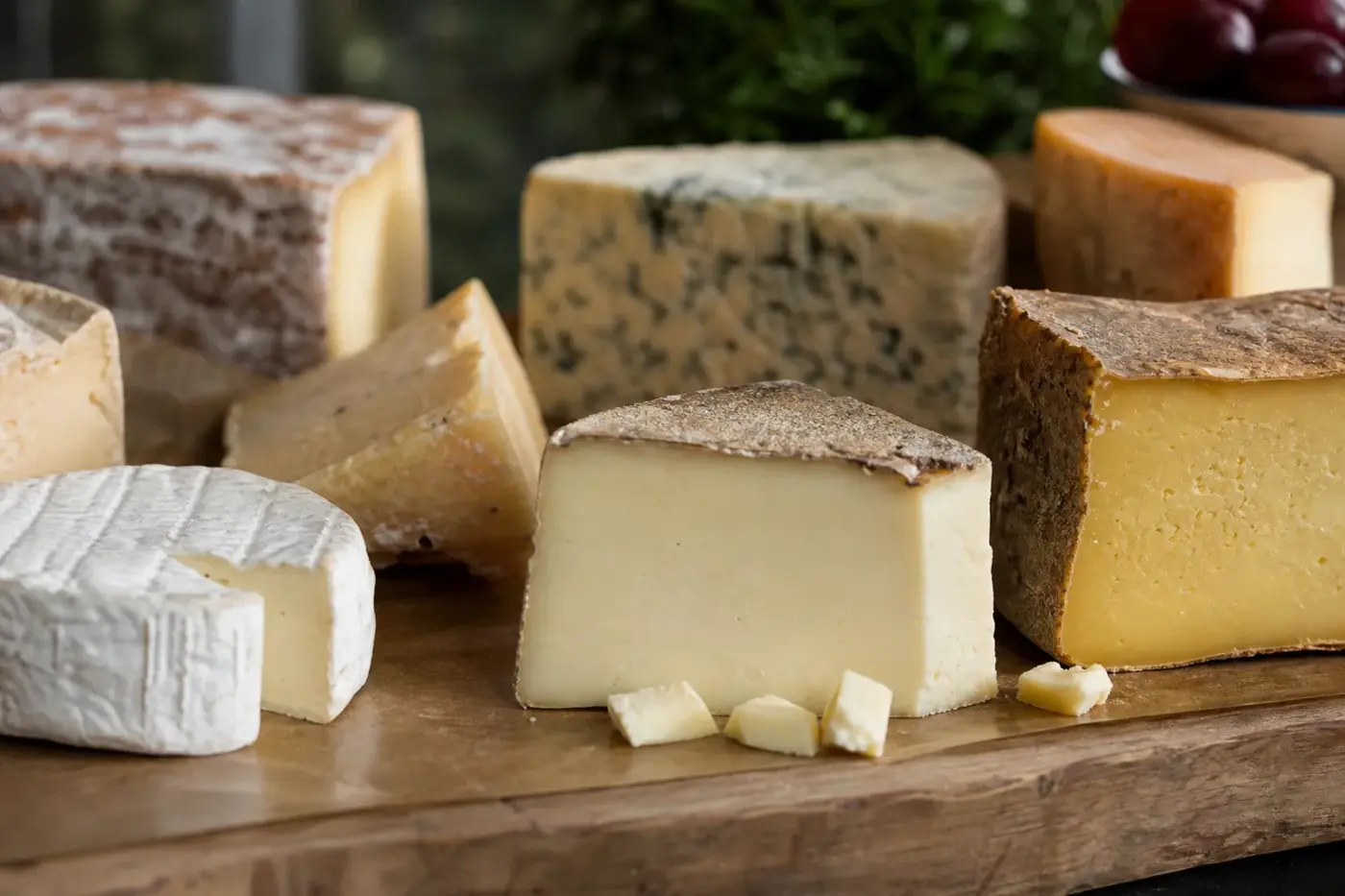
You turn the cheese over. Then over again. You are looking for the ingredients, but there is no list to be found. That can be perfectly legal: certain EU cheeses need no ingredients list, and its absence tells you nothing about vegetarian suitability.[1]
The useful clues are elsewhere. Start with the food name, then milk, allergens, date and storage instructions. Give origin, maturation and farming claims a separate look: their legal meaning depends on where you buy the cheese.[1][2][9]
Find the cheese behind the brand
The biggest name on the pack may be the brand, not the food. Turn it over and find the legal or descriptive name. In the EU, this follows Article 17 of Regulation 1169/2011; Great Britain uses its assimilated version, while Northern Ireland follows EU food labelling rules.[1][2]
In the United States, a standard of identity sets requirements for a named food. For example, 21 CFR 133.113 specifies Cheddar cheese's composition and permitted ingredients. Read the whole name, including words such as “pasteurised process”: a picture of cheese does not make every product the same food.[3]
Give yourself a simple reading order: identity, milk and allergens, handling, origin, then voluntary claims. That puts the information you need ahead of the packaging's sales pitch. The handsome lettering can wait its turn.
Turn the pack over and get your bearings
TEACHING EXAMPLE, NOT A REAL PRODUCT
Here, the bracketed wording and zero values stand in for a real product's details. Use them to find your way around the pack.
| Label line | What to look for |
|---|---|
| Cheese [food description] | Find the food name, not just the brand. |
| MILK [animal; treatment], [other ingredients] | Look for the milk source, treatment and full allergen information. |
| Net quantity: 000 g | This is the food's weight, without its packaging. |
| Best before: 00/00/0000 | Read the wording as well as the date. |
| Storage: [product instructions] | Find instructions for unopened storage and after opening. |
| Operator: [name and address]; batch: 0000 | Find the responsible business and the batch. |
For EU and GB prepacked food, mandatory information also includes nutrition information unless an exemption applies. Origin or ingredient quantities must appear where required too. Give the sides, back and any peel-back panel a look: the front cannot tell you everything.[1][2]
Start with the milk, then read the allergens
Cow, goat, sheep or buffalo? Perhaps your cheese uses a blend. If the milk source matters to you but is not shown, ask the seller. In France, Décret 2007-628 requires the animal species alongside the food name for milk from animals other than cows, or from several species.[4]
In the EU, milk is an Annex II allergen. Where an ingredients list is required, milk ingredients must stand out, often in bold. Without that list, the allergen needs a separate declaration unless the food's name already refers to it.[1]
Article 19(1)(d) allows some EU cheeses to omit the ingredients list. This exemption covers specified dairy ingredients, essential enzymes and cultures, plus necessary salt for cheeses other than fresh and processed cheese. It does not tell you whether the cheese is vegetarian.[1]
Across the Atlantic, look beyond bold lettering. US FALCPA rules identify milk through ingredient wording or an adjacent Contains statement; bold type is not the defining requirement. In Canada, milk allergens use the prescribed source name in the ingredients or a Contains statement. Read every added ingredient and precautionary statement too.[5][6]
Raw milk: the words that matter
“Made with raw milk” is required wording under EU Regulation 853/2004 for products made from raw milk whose manufacturing process includes no heat treatment or physical or chemical treatment. Great Britain's assimilated regulation retains this wording. Northern Ireland follows the EU rule.[7][8]
In Canada, Health Canada recommends “made from raw or unpasteurized milk” for soft and semi soft cheese made from unpasteurised milk. That is voluntary guidance.[9] If the treatment matters to your choice and the pack leaves you guessing, ask the maker.
Make the fat figures speak the same language
Fat in dry matter and fat per 100 g measure different things. The first expresses fat as a proportion of the solids left after removing water. The second measures it against the whole cheese, water included. Check the basis before you compare labels.[3][10]
Try the arithmetic with 100 g of cheese containing 40 g of water. That leaves 60 g of dry matter. If its fat in dry matter is 50%, you have 30 g of fat per 100 g of whole cheese. A little arithmetic before lunch, but useful arithmetic.
Canada requires milk fat and moisture percentages on the principal display panel of specified cheeses. France's “double crème” and “triple crème” descriptions use dry matter thresholds. Read those differently from the fat per 100 g on a nutrition panel.[4][9]
Which tempting words have rules behind them?
“Fermier”, “affiné” and “vegetarian” deserve a closer look before you choose. Their meaning depends on the jurisdiction, as the November 2026 distinctions below show. A word within a registered name may carry more specific requirements than the same word standing alone.[4][11][12]
| Term | Where it applies | What it tells you |
|---|---|---|
| Fermier | France | Décret 2007-628, Article 9-1: a farm producer makes cheese on the holding from its own milk, using traditional techniques. Rural Code L641-19 separately addresses traditional maturation away from the farm and additional consumer information under implementing conditions.[4][11] |
| Lait cru | France | Décret 2007-628, Article 14: milk not heated above 40 °C or given an equivalent non-thermal treatment. Exceptions apply to particular cheese classes.[4] |
| Affiné | France | The cheese has ripened, but the word alone has no single statutory minimum age. Look at the named cheese's rules for a required minimum.[4] |
| Affiné | Canada | Under SFCR 249 and Table 2 of the incorporated Descriptive Words, Expressions and Identification Names for Specific Foods, affiné means ripening throughout the cheese; affiné en surface means ripening from the surface inwards.[9][12] |
| Farmhouse | Great Britain | Ask the producer what the claim means for this cheese. |
| Vegetarian | UK | No statutory definition, according to Defra's published position. This voluntary claim must not mislead.[13] |
| Vegetarian | Canada | CFIA guidance excludes ingredients derived from slaughter and distinguishes different vegetarian diets. This is guidance on claims.[14] |
Follow PDO, PGI and TSG to their meaning
Those three EU designations protect different things. PDO, protected designation of origin, means all production steps take place in the defined area, subject to the regulation's specific exceptions. PGI, protected geographical indication, requires at least one production step there, with the required geographical link.[15]
TSG, traditional speciality guaranteed, takes a different route. It concerns a traditional product or method, rather than a required production area.[15]
Read the registered name alongside the logo: EU rules require the Union symbol and registered name to appear together when the symbol is used. In Great Britain, GB food names registered before 1 January 2021 needed the UK logo on products sold there by 1 January 2024. Later GB registrations require it from sale as a GI product.[15][16]
Northern Ireland follows the EU scheme. EU logo rules apply to EU registered names sold there.[16]
Find the birthplace, not just the address
An operator's address tells you which business is responsible. It does not necessarily tell you where the cheese was made. Look separately for the place of cheesemaking, the milk's origin and where the cheese was matured or packed. Each can describe a different stage in your cheese's journey.[1][9]
EU and GB general rules require origin information where leaving it out would mislead. Voluntary country names, flags and regional pictures must be truthful too. Under EU Article 26(3), stating the food's origin can trigger information about a primary ingredient with a different origin.[1][2]
Canada expressly requires “Product of” followed by the country of origin for imported prepackaged dairy products covered by its rules. Specified standardised cheese packed in Canada from imported bulk cheese also needs that origin declaration on the principal display panel.[9]
Read the date with the storage instructions
In the EU and UK, use-by concerns safety; best before concerns quality. Follow the stated storage conditions and any instructions for after opening. The UK Food Standards Agency advises against eating food after its use-by date, even if it looks or smells normal.[1][17]
US date wording has no uniform federal meaning equivalent to that EU distinction. FDA supports “Best if Used By” for quality dating. Read US labels within their own rules and follow the product's handling instructions, rather than automatically translating the phrase.[18]
Choosing vegetarian cheese? Go beyond rennet
Rennet is the enzyme preparation that sets milk into curd. For vegetarian suitability, look for an explicit product claim or ask the producer about the coagulant and other ingredients. “Enzymes” alone leaves their origin unclear: US Cheddar rules expressly allow animal, plant and microbial enzymes to share that declaration.[3][14]
Ask about the whole cheese, including added flavourings, rather than rennet alone. Name the exact cheese and the market where it is sold. Then ask whether the finished product is suitable for your diet.
Questions people ask
How can I tell if cheese is vegetarian?
Look for an explicit vegetarian claim or ask the producer about the coagulant and other ingredients. The word “enzymes” alone does not identify their origin, and added flavourings matter too.
What is the difference between fat in dry matter and fat per 100 g?
Fat in dry matter is measured against the cheese solids after removing water. Fat per 100 g is measured against the whole cheese, including water.
Can I eat cheese after its use by date?
In the EU and UK, use by concerns safety, while best before concerns quality. The UK Food Standards Agency advises against eating food after its use by date, even if it looks or smells normal; consult its guidance.
What do PDO, PGI and TSG mean on cheese?
PDO means all production steps take place in the defined area, subject to specific exceptions. PGI requires at least one production step there and the required geographical link. TSG concerns a traditional product or method rather than a required production area.
Does the address on a cheese label show where it was made?
The operator’s address identifies the responsible business, not necessarily where the cheese was made. The places where the milk originated and where the cheese was made, matured or packed can differ.
Sources
-
European Parliament and Council. Regulation (EU) No 1169/2011 on the provision of food information to consumers. Consolidated text dated 1 April 2025, particularly Articles 9, 17, 19, 21, 24, 26 and 36, and Annex II. Official consolidated text.
-
Defra and Food Standards Agency. Food labelling: giving food information to consumers. Updated 20 September 2022. Official guidance.
-
US Food and Drug Administration. 21 CFR Part 133: Cheeses and Related Cheese Products. Live eCFR text retrieved November 2026, particularly sections 133.113 and 133.169. Federal standards.
-
République française. Décret n°2007-628 du 27 avril 2007 relatif aux fromages et spécialités fromagères. Version displayed as in force on 6 November 2026, particularly Articles 9-1 and 12 to 14. Official text.
-
US Food and Drug Administration. Food Allergen Labeling and Consumer Protection Act of 2004 (FALCPA). Public Law 108-282, Title II, particularly section 203. Act reproduced by FDA.
-
Canadian Food Inspection Agency. List of ingredients and allergens on food labels. Live guidance retrieved November 2026, including references to Food and Drug Regulations B.01.010.1. Official guidance.
-
Food Safety Authority of Ireland. Labelling of milk and milk products. Live guidance retrieved November 2026, reproducing the raw milk labelling provision in Regulation 853/2004, Annex III, Section IX, Chapter IV. Official guidance.
-
Food Standards Agency. Food law practice guidance (England). Official PDF retrieved through indexed passages in November 2026; edition date requires confirmation. Official document.
-
Canadian Food Inspection Agency. Labelling requirements for dairy products. Live guidance retrieved November 2026, particularly country of origin, milk fat and moisture, cheese descriptions and voluntary raw milk statements. Official guidance.
-
Codex Alimentarius Commission. General Standard for Cheese, CXS 283-1978. Retrieved English PDF records amendments through 2013; section 7.2 explains alternative fat declaration bases. International reference, not independently binding national law. Retrieved edition.
-
République française. Code rural et de la pêche maritime, Article L641-19. Wording effective from 12 June 2020; retrieved version dated 10 April 2026. Official article.
-
Canadian Food Inspection Agency. Descriptive words, expressions and identification names for specific foods. Amended 27 March 2023, Table 2. Incorporated document.
-
UK Parliament, written answer from Defra. Vegetarianism, question 24340, answered 3 May 2024. Published answer.
-
Canadian Food Inspection Agency. Food composition and quality claims. Live guidance retrieved November 2026, section on vegetarian and vegan claims. Official guidance.
-
European Parliament and Council. Regulation (EU) 2024/1143 on geographical indications and traditional specialities guaranteed. 2024, particularly Articles 37, 46, 54 and 70. Official regulation.
-
Defra. Adding a logo to a protected food or drink name: follow the rules. Updated 13 March 2025. Official guidance.
-
Food Standards Agency, GOV.UK. Understanding food labelling: Best before and use-by dates. Live guidance retrieved November 2026. Official consumer advice.
-
US Food and Drug Administration. How to Cut Food Waste and Maintain Food Safety. Consumer information PDF, retrieved November 2026. Official document.
This desk-researched guide compares official legislation and regulator guidance, using an annotated teaching label and a jurisdiction-specific terminology table.
Last checked: November 2026
Last checked November 2026.
The editors suggest you read next