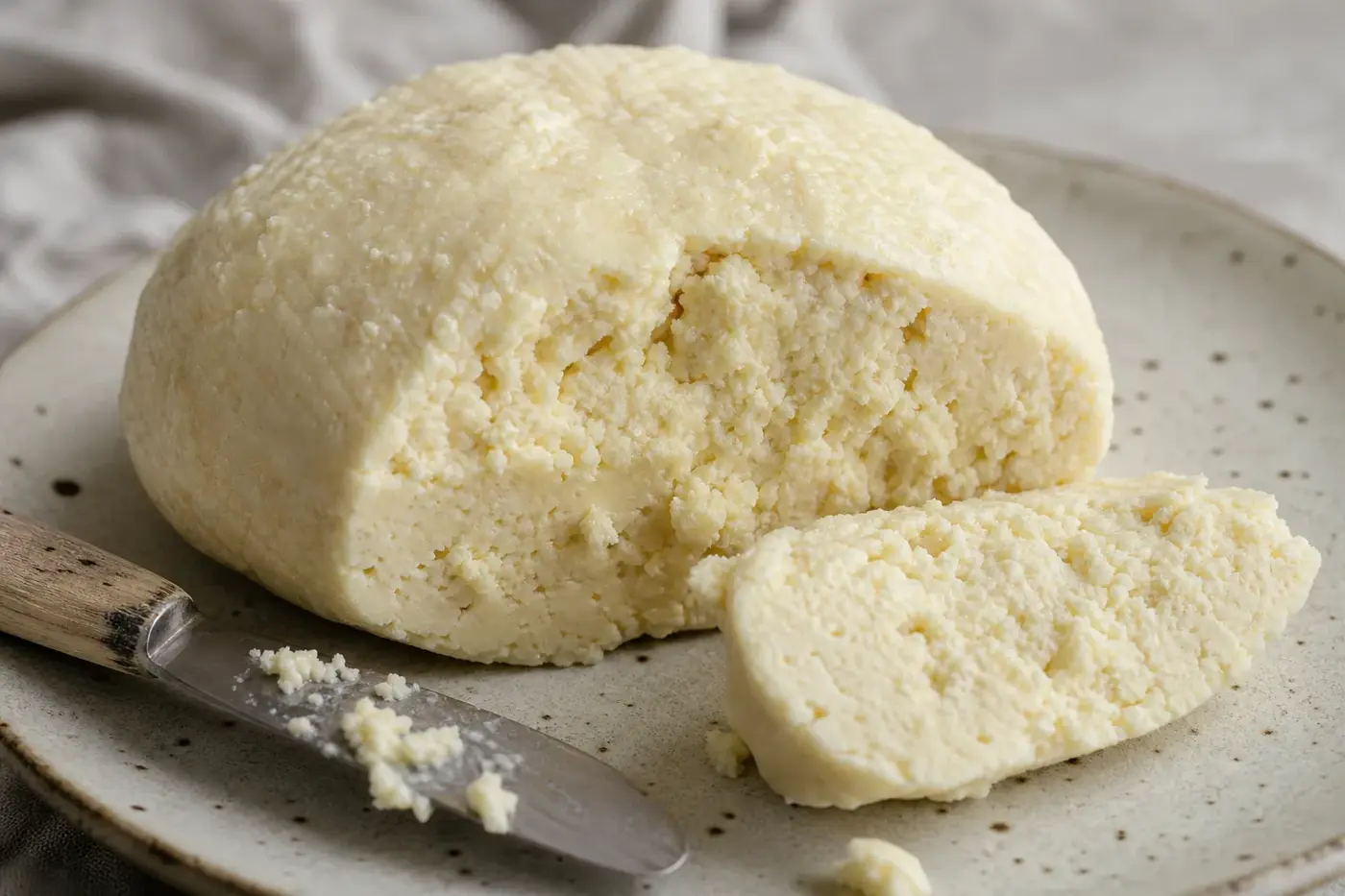
First comes the kneading. Then hands pack the soft cheese into pig bladders and stitch them closed: this cheese gets its shape from its own rather particular tailoring. You are looking at Brânză frământată de Teaca, a Romanian raw cow’s milk cheese from Teaca, in Bistrița-Năsăud County. Its European geographical indication application describes matured curds worked with salt into a soft, dense mass, named for the work that makes it. [1]
| What to know | The details |
|---|---|
| Name to look for | Brânză frământată de Teaca. [1] |
| Where it comes from | Teaca village, Teaca commune, Bistrița-Năsăud County, Romania. [1] |
| The milk | Raw, unpasteurised cow’s milk. [1] |
| What makes it distinctive | Curd fermentation and maturation, followed by mincing, salting and kneading. [1] |
| How you will find it packed | Natural pig-bladder casing, unwaxed or protected with cheese wax; also sold sliced. [1] |
| Typical whole-piece weight | Approximately 0.4 to 2 kg, depending on the casing. [1] |
| EU application identifier | PGI-RO-03380; application published on 19 May 2026. [1] |
| Current EU registration status | Consult the current EU register. |
| Legal minimum ageing | Consult the full specification. |
| Product-specific storage period | Follow the instructions supplied with your cheese. |
A name that puts hands to work
“Kneaded cheese from Teaca” gives you a direct rendering of the name. The Romanian verb a frământa means to knead, pressing and mixing material into a homogeneous mass; frământată means kneaded. By the time this work begins, the milk has already become curd. [1, 2]
That second working holds the key to the texture. The maker forms the curd, drains it and lets it develop, then breaks it down and brings it together again. Rather than simply pressing fresh curd into a mould, they build the cheese from developed curds. The application specifies both salted and unsalted matured curd in the mixture. [1]
If you would like to untangle the language of curds and whey, start with how cheese is made. It takes you through the wider vocabulary of curd formation and whey separation.
Meet Teaca through its households and market
Here, Teaca means a particular village, not the whole county. The application defines the geographical area as Teaca village within Teaca commune, in Bistrița-Năsăud County, and proposes that every manufacturing stage happen there. The name on your cheese is therefore more precise than a general reference to cheese from Bistrița-Năsăud. [1]
That connection lives in reputation and knowledge passed between generations. In written recollections collected for the application, residents describe making cow’s milk curd, fermenting it, putting it through a mincer and kneading it with salt. Others remember taking kneaded cheese to Teaca’s market. Through these accounts, you get the small, telling details of local practice. [1]
A local monograph cited in the application records permission for a weekly market in 1734. That date belongs to the market’s history; the collected accounts of making and selling the cheese provide its more specific connection to Teaca. Together, they place cheesemaking among household tasks and local exchanges. [1]
Take a knife to that soft, dense centre
Cut a whole piece and you meet a contrast. A cream to golden-yellow exterior surrounds a uniformly milk-white to yellowish-white interior. The application describes irregularly oval or round cheeses, their outlines following their natural casings rather than the tidy symmetry of a regular wheel. [1]
Inside, the cheese is compact and cohesive, with a grainy appearance. It clings to the casing and sticks slightly to your knife as you cut. The application describes it as soft, smooth and dense, with visible fine particles left by kneading. [1]
On your palate, the application’s description points to a predominantly cow’s milk flavour, slightly salty and sweet, with mild acidity. The aroma is milky and buttery, with sourness and slight pungency at its edges. These sensory descriptions come from the application, rather than a fromage.co.uk tasting. [1]
The casing has a say in appearances, too. Unwaxed, its surface is described as dry and non-sticky, from semi-glossy to matt; protective cheese wax makes it glossier. When you compare photographs or whole pieces, bear in mind that the finish reflects the packaging. [1]
Cow’s milk gives you the starting point
Raw cow’s milk defines this cheese in the application. Sheep’s milk, goat’s milk and mixed-milk versions sit outside that description. The local testimony also explicitly connects Teaca’s kneaded cheese with cows’ milk. [1]
Within that boundary, you can still find variation in colour, size, surface finish and the balance of the stated sensory characteristics. Natural casings explain differences in outline and weight. Waxed and unwaxed versions give you another distinction to spot in whole pieces. [1]
To compare makers, you need individual product records. The certification body CERTIND’s August 2024 register identifies LACTO SINELLI SRL at Teaca as a producer associated with the applicant group, Asociația Brânzarilor din Bistrița-Năsăud. That gives you a dated producer connection, not a complete present-day list of makers. [3]
Milk treatment deserves a closer look of its own. You can explore those distinctions in raw, thermised and pasteurised cheese.
Follow the curd from milk to kneading
The defining transformation happens after the curd has formed. The official application sets out the production sequence, while local accounts bring the hand skills into focus. Together, they let you follow developed curd as it becomes a finely worked cheese, ready for its flexible casing. [1]
Begin with the curd, then let the whey go
The milk is filtered and prepared for renneting. Rennet is the coagulant, helping turn milk into a gel that can be worked into curds. The application lists curd processing, reheating the curds and whey, and forming the intermediate curd used for the kneaded cheese. [1]
Local accounts describe breaking the coagulated milk by hand and draining away the whey. They also recall animal rennet made from lamb or milk-fed calf stomachs. Those memories describe earlier practice; for the coagulants permitted in current production, you need the full specification. [1]
Give the curd time before mincing and salting
Colour, consistency, smell and taste guide the workers as the intermediate curd ferments and matures. The Romanian document calls it caș bașchiu. The application connects its developing qualities with the finished cheese’s yellowish colour and discreet fermented character. [1]
Once developed, the curd is finely minced and combined with salt and matured curd. Both salted and unsalted matured curds go into the finished cheese. Local accounts describe laying curd and salt in layers before working everything together. [1]
Look for the thread, then fill and stitch
An uninterrupted thread of cheese tells the workers that the kneading has reached the required texture. In the application, this signals the connected, elastic consistency achieved during handling. What began as separate ingredients has become one cohesive mass. [1]
Next, the cheese is worked into pig bladders, with trapped air removed before the openings are sewn closed. According to the application, careful filling and stitching help preserve its soft consistency and limit drying during maturation. For exact production times and temperatures, you need the full specification. [1]
There is more to the casing than its shape
The pig-bladder casing belongs to the cheese’s documented identity, rather than simply holding it together. Its size helps determine the finished piece and gives whole cheeses their natural range of outlines. The application describes plain natural casings, casings protected with cheese wax and cheese offered in slices. [1]
Look for those presentations, rather than expecting a standard wheel or a deliberately cultivated rind. If you buy a cut portion, ask for the original product information so you keep the maker, milk treatment, storage instructions and date to hand. The guide to reading a cheese label explains those practical distinctions.
Hands matter throughout this process. Producers judge the curd’s development, mince and combine the ingredients, work the cheese into its casing and stitch it shut. The application places this connected set of skills, rather than one isolated ingredient, at the heart of the cheese’s local reputation. [1]
Put Teaca beside other kneaded cheeses
Kneaded cheese names a method, not this product alone. The word frământată tells you that kneading is involved. The Teaca application supplies the particulars: raw cow’s milk, matured curds, a specified geographical area and presentation in pig bladders. [1, 2]
When you compare Romanian kneaded cheeses, begin with four questions. Which milk is used, and how is the curd developed? What goes into the mixture, and how is the cheese packed? Similar wording on a label gives you only part of the story.
Slovak bryndza needs a comparison grounded in its own specification. You should not treat the two names as interchangeable without reference to the particular products concerned.
Let your first taste have the floor
Start with a small piece, plain bread and water. This suggested serving gives you room to notice the milk flavour, mild acidity and dense texture described in the application. It is serving advice drawn from the cheese’s documented character, with little else competing for your attention. Bread is good at keeping its opinions to itself. [1]
Plain boiled potatoes make another restrained accompaniment. Add a little cheese, taste, then decide whether you need any salt. The application describes the cheese as slightly salty and proposes a maximum salt content of 3.5%. [1]
These are simple ways for you to explore the cheese, not documented traditional pairings. The available primary material tells you more about household production and market sales than about particular dishes or drinks served alongside it.
Keep the main portion refrigerated and take out only what you intend to serve. For advice on keeping chilled food out of refrigeration in England, Wales and Northern Ireland, consult the Food Standards Agency’s current guidance. [4]
Keep it chilled and follow raw milk guidance
Follow the storage instructions and date supplied with your particular cheese. In England, Wales and Northern Ireland, the Food Standards Agency advises keeping a domestic fridge between 0 and 5 °C and refrigerating dairy products. It also directs you to follow the instructions on the packaging. [4]
This cheese is made with unpasteurised milk. For pregnancy in the UK, consult the NHS guidance on cheese, milk and other dairy products, including its current categories and exceptions. [5]
The Teaca application describes a soft cheese. During pregnancy, use that texture information and the milk treatment when consulting official guidance, rather than judging by the casing or apparent age. [1, 5] You can find further background in Listeria and cheese safety.
General information only, not medical advice: follow the official guidance where you live.
Questions people ask
What does Brânză frământată de Teaca mean?
The name means kneaded cheese from Teaca. The Romanian verb a frământa means to knead.
Where is Brânză frământată de Teaca made?
The application defines the area as Teaca village, within Teaca commune in Romania. It proposes that every manufacturing stage take place there.
What milk is used and how is the cheese made?
It is made from raw cow’s milk. The curd is fermented and matured, then finely minced, salted and kneaded before being packed into a casing.
What does Brânză frământată de Teaca taste like?
The application describes a predominantly cow’s milk flavour that is slightly salty and sweet, with mild acidity. Its aroma is milky and buttery, with sourness and slight pungency.
Can I eat this cheese during pregnancy?
The cheese is made with unpasteurised milk and is described as soft. For pregnancy in the UK, consult the NHS guidance on cheese, milk and other dairy products, including its current categories and exceptions.
Sources
[1] European Commission. Publication of an application for registration of a geographical indication pursuant to Article 15(4) of Regulation (EU) 2024/1143. Single document for Brânză frământată de Teaca, PGI-RO-03380, Official Journal C/2026/2804, 19 May 2026. Sections 4 to 6 cover the product, production, geographical area and supporting local testimony.
[2] Romanian Academy dictionary material reproduced by dexonline. Frământa, including the Dicționarul explicativ al limbii române, 2009 edition, and Dicționar ortografic, ortoepic și morfologic, third edition, 2021.
[3] CERTIND. Registrul certificatelor de conformitate DOP-IGP-STG, August 2024. Entry 18, certificate 25 IGP, identifies the applicant association and LACTO SINELLI SRL.
[4] Food Standards Agency. How to chill, freeze and defrost food safely, published 18 December 2017, current page retrieved November 2026. Applies to England, Northern Ireland and Wales.
[5] NHS. Foods to avoid in pregnancy, reviewed 15 June 2026, current page retrieved November 2026. See “Cheese, milk and other dairy”.
This draft brings together the published European application, its attributed local accounts, a dated certification record and official UK food guidance. The source links must be verified and added before publication.
Last checked: November 2026
Last checked November 2026.
The editors suggest you read next
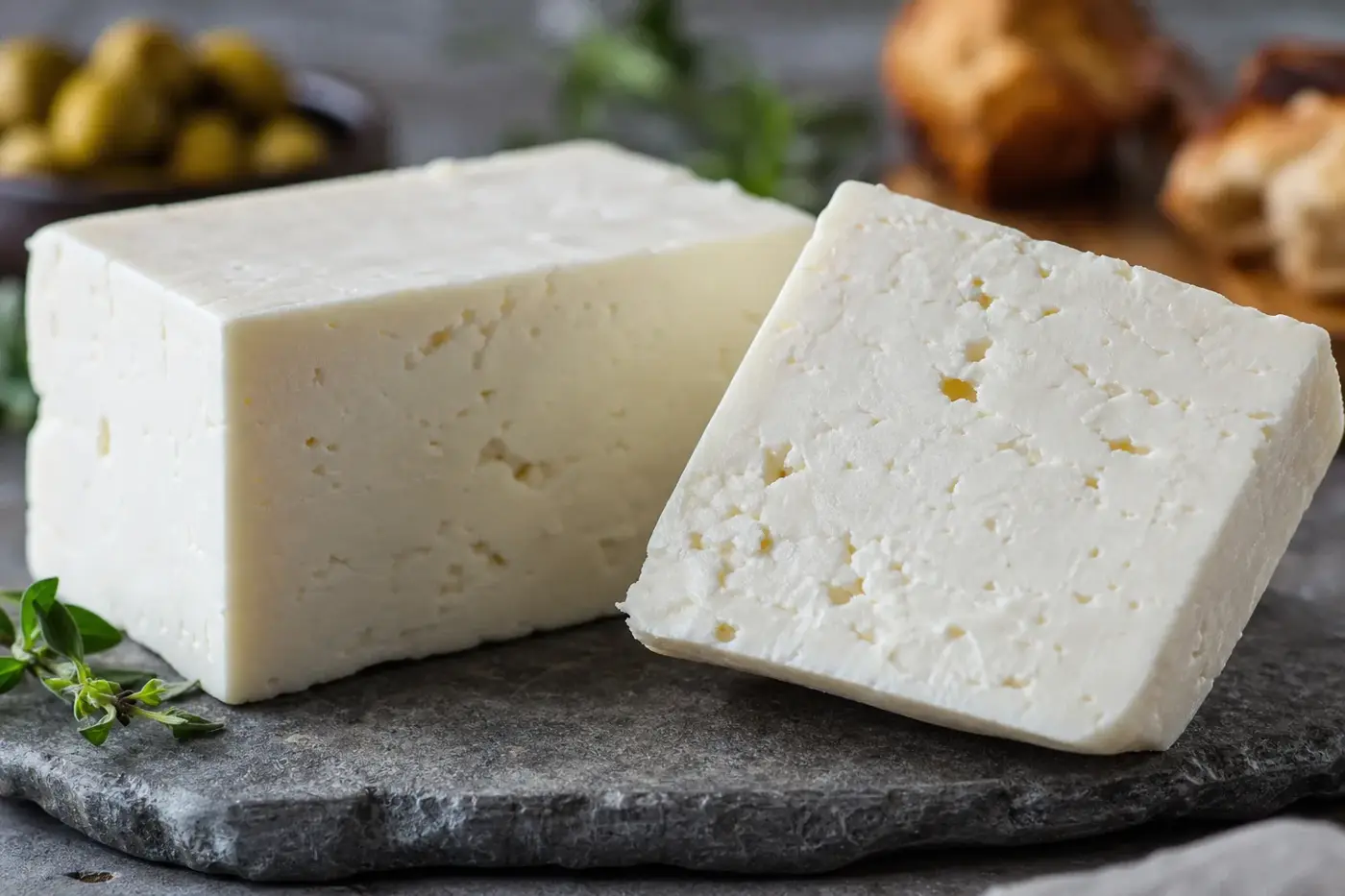
Telemea
Taste the salt at Ibănești and you have a thread to follow: naturally occurring spring brine from Orșova gives Telemea its local signature.