Romanian Cheese
At a Carpathian stână, a summer shepherds’ camp, one batch of milk has several destinations.
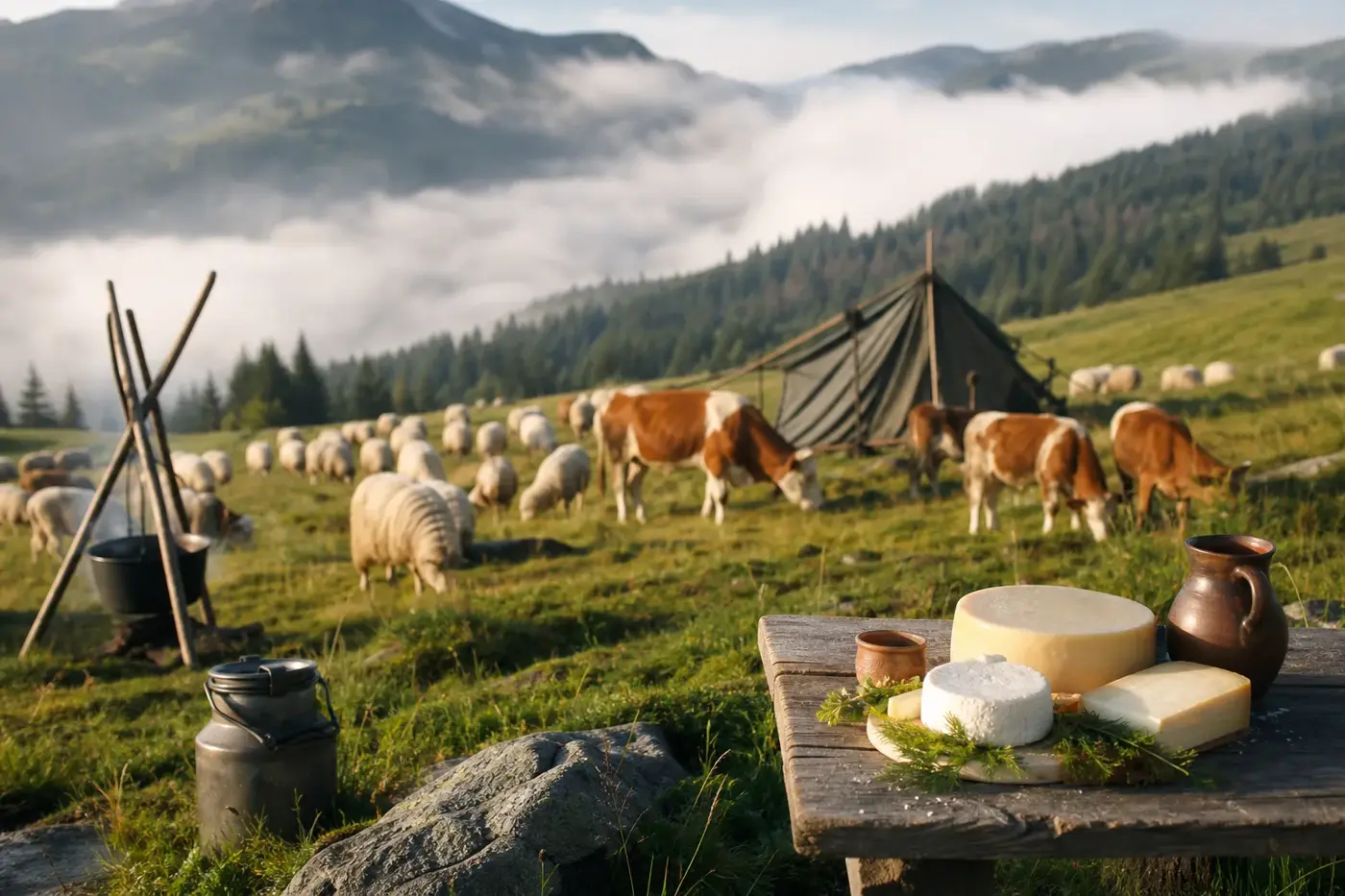
At a Carpathian stână, a summer shepherds’ camp, one batch of milk has several destinations. Fresh caș comes from the curd, urdă from the whey, and salted, kneaded cheese is made to keep. Follow the milk and you find a whole cast of cheeses, not a solo act.[8,9]
That connected craft runs through Romanian cheese. Beyond the camp, you find white blocks of brined telemea and stretched-curd cașcaval, made across mountain districts, villages and lowland dairying areas. The pleasure is in discovering how they belong together.[8,9]
Your first taste of Romanian cheese
| What you might ask | A useful starting point |
|---|---|
| Which country? | Romania.[8] |
| Whose milk? | Sheep, cows, goats and buffalo.[10] |
| How is it made? | Fresh curd, whey recovery, brining, curd stretching and kneading.[3,8,10,11] |
| Where does this guide take you? | Romania; name protection below refers to the European Union.[2,4,5,6,7] |
Follow one batch of milk
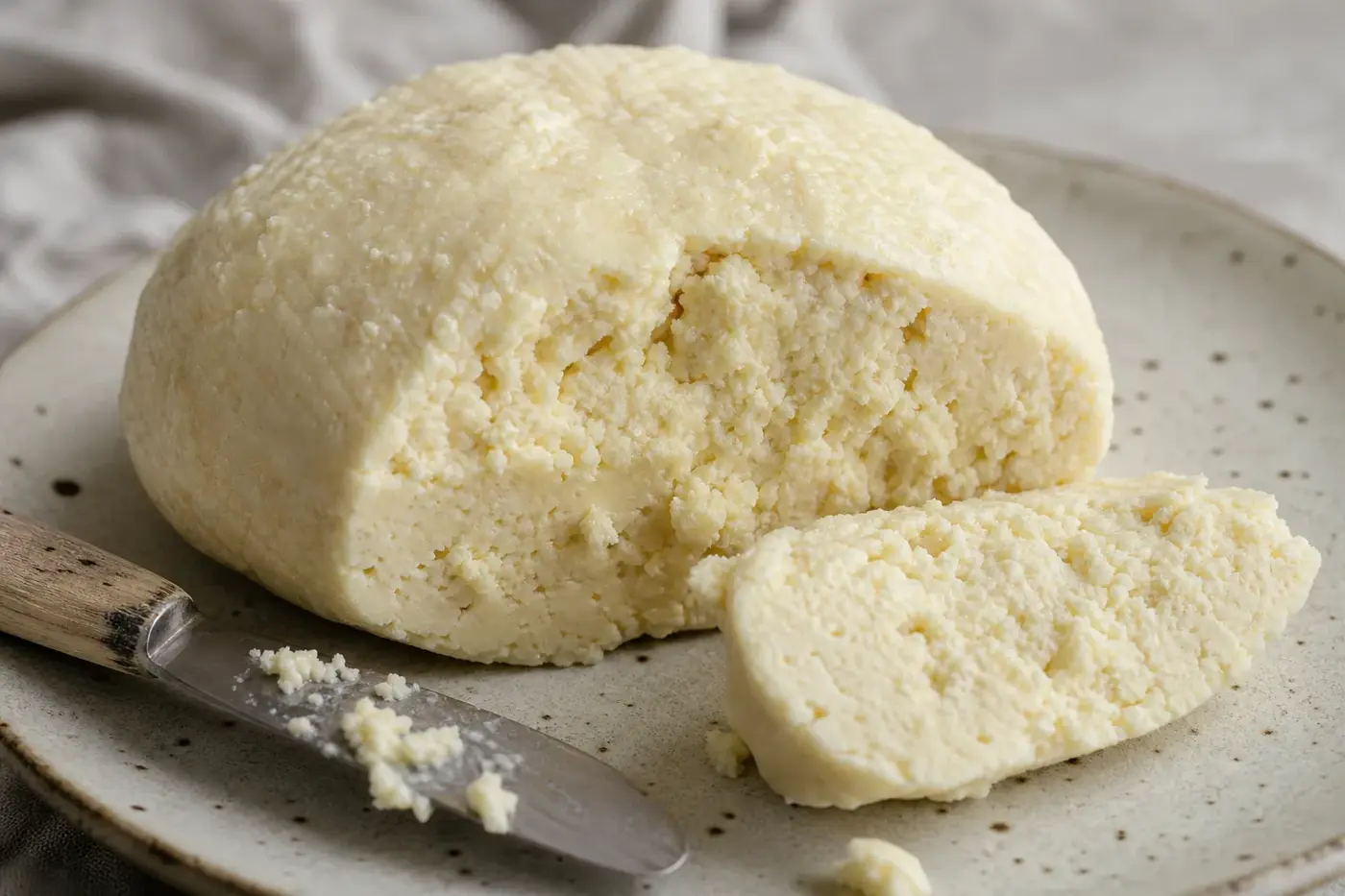
Begin with caș. You can eat it as fresh curd cheese, but it also provides the raw material for burduf. The whey left from curd-making becomes urdă, giving you another cheese from the same beginning.[8,11]
At the stână, these are stages of one craft rather than separate stories. Each decision about the milk leads towards a different texture, keeping quality or use. Once you follow that thread, the names become easier to remember.[8,11]
Then take your curiosity beyond the mountain sheepfold. Northern Botoșani has its own raw cow’s milk cașcaval, while Teaca’s kneaded cheese belongs to a village tradition of cattle keeping. Set these beside Sibiu’s sheep’s milk cheeses and the seasonal products of the Carpathians, and a fuller picture of Romanian dairying emerges.[3,5,7]
From summer pasture to the kitchen door
Sheep’s milk is central to mountain shepherding, but cows share the summer pastures. Slow Food’s account of the Bucegi describes both animals accompanying the herders, with mixed milk used for local burduf. If you picture only sheep, leave room for the cows.[9,11]
The European Commission’s account of present-day transhumance follows the seasons. In spring, herders move towards high grazing; summer is spent in the mountains, before autumn brings the return to the valleys. That rhythm places the cheese firmly in its landscape.[9,11]
In villages, the story begins closer to the kitchen door. The ADEPT Foundation records cows milked in household courtyards in Târnava Mare, where sheep, goats and buffalo also supply milk and cheese. Ask the maker which milk went into yours, because a white cheese’s colour and shape reveal far less.[10]
Height above sea level tells only part of the story. Telemea de Ibăneşti’s account connects cattle feed with the Gurghiu Valley and identifies local natural brine as essential to salting and keeping the cheese. For Săveni, the documented connection is local milk and generations of processing skill in northern Botoșani.[3,6]
Five names worth taking to the counter
Learn these five names and a Romanian cheese counter starts to feel much more welcoming. Each takes milk, curd or whey in a different direction. For the wider picture, explore the guide to cheese styles.
Caș begins with fresh curd. Milk coagulates into solids, the curd, and liquid, the whey; the curd is then drained. Do not assume caș always means fresh, though: Romanian heritage documentation also records smoked and matured versions, so ask which you are being offered.[8,11]
Urdă gives the leftover whey its own turn. Heating the whey from cheese-making produces this cheese, rather than another batch of ordinary drained curd. Taste caș and urdă together and you can explore how differently that shared beginning turns out.[8]
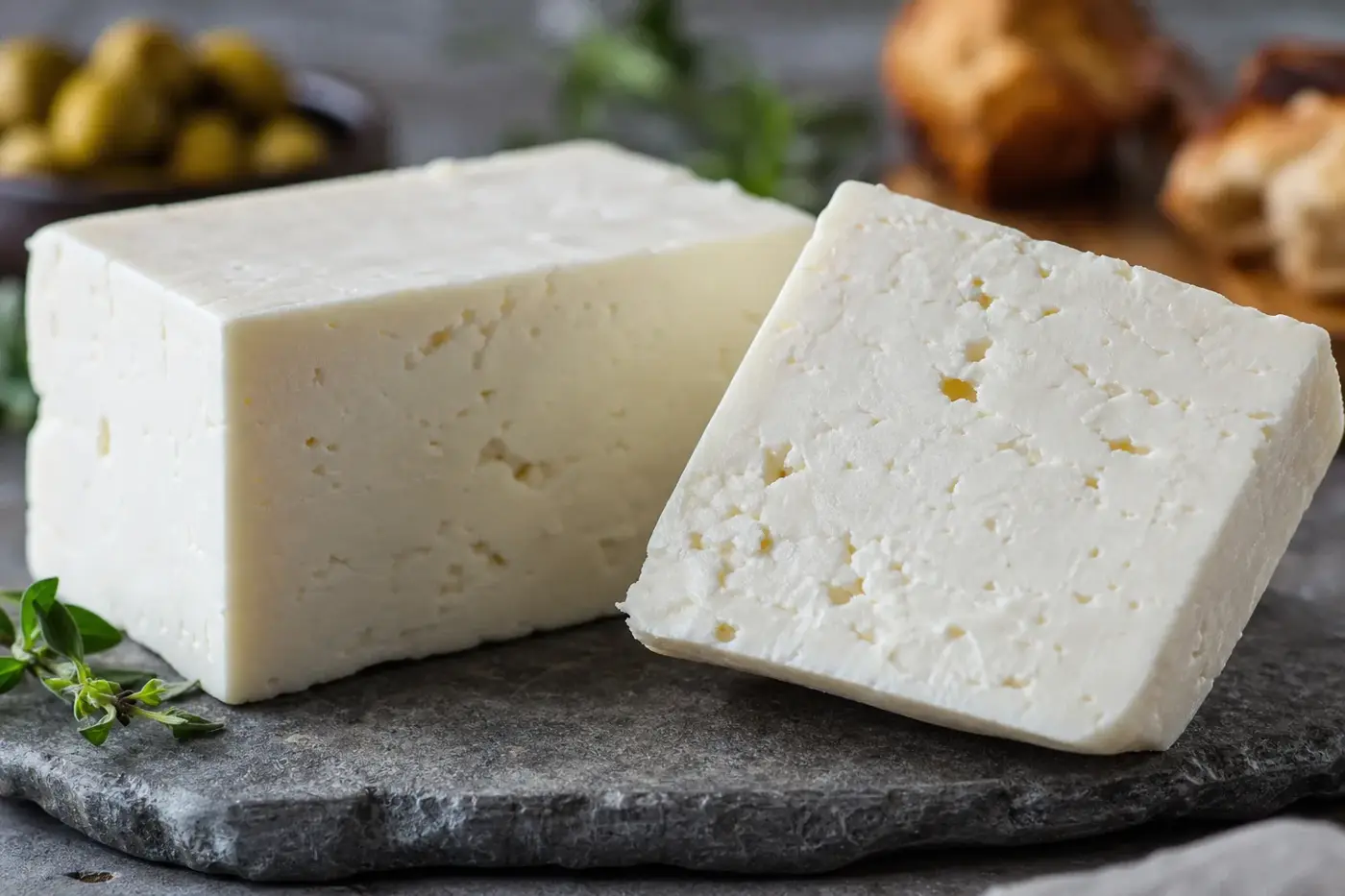
Telemea is the brined family, familiar as white blocks kept in salt water. Ask about the milk and the maturation. The two protected examples below use different milks, and Sibiu’s specification distinguishes fresh cheese from matured cheese.[6,7,10]
Cașcaval takes scalded, stretched curd in a different direction. Working it after scalding creates a cohesive cheese, quite unlike crumbly fresh curd. Săveni’s specification describes slices separating into strips without breaking, so you have something distinctive to look for as you taste.[3]
Brânză de burduf is kneaded cheese. Traditional methods allow caș to develop before it is broken up, mixed with salt and packed into a casing. Recorded containers include sheep’s stomach, prepared sheepskin and bark: the casing belongs to the regional method, so bark is one possibility, not a universal requirement.[8,10,11]
Follow the fir-bark scent of burduf
In the Bucegi method documented by Slow Food, salted curd is packed into cylinders of fir bark. Its account describes pronounced resinous notes from the bark, with piquancy increasing as the cheese ages. If that is what you are after, ask whether the cheese matured in bark, rather than merely enjoying its company on the counter.[11]
Read the name right to the end
The full name matters here. PDO means protected designation of origin; PGI means protected geographical indication. These EU schemes have different geographical requirements, explained in protected names.[1,2,4,5,6]
The table distinguishes established EU designations from the Ibănești burduf product name. Sharing a place name does not make two products the same cheese, or give them the same designation.[1,2,4,5,6]
| Name | EU designation | EU identifier | Where to find the details |
|---|---|---|---|
| Brânză frământată de Teaca | PGI | Regulation (EU) 2026/2017.[4,5] | |
| Caşcaval de Săveni | PGI | PGI-RO-02361 | Regulation (EU) 2021/657.[2,3] |
| Telemea de Ibăneşti | PDO | Commission’s product account.[6] | |
| Telemea de Sibiu | PGI | Commission’s product account.[7] |
EU designation information: November 2026.
Get to know Mirdatod’s Brânză de burduf de Ibăneşti
Cow’s milk caș, urdă and salt make up the Ibănești burduf listed by Mirdatod. The producer declares pasteurised milk for this kneaded cheese and describes natural pig’s bladder packaging as well as tube formats. These details belong to Mirdatod’s product, distinct from the rules for Telemea de Ibăneşti PDO.[12]
Discover the handwork behind Brânză frământată de Teaca
In Teaca, kneaded cheese starts with raw cow’s milk. The Commission describes curdling, fermentation, maturation, salting and kneading, followed by packing in a natural pig’s bladder. Local makers’ visual and tactile judgement is particularly important throughout: this is craft guided by eyes and hands.[5]
The EU registration regulation was adopted on 2 September 2026 and published on 9 September 2026. It entered into force on 29 September 2026, the twentieth day after publication. Brânză frământată de Teaca is therefore a newly registered PGI, not an application still awaiting a decision.[4]
Look for the spring in Caşcaval de Săveni
Săveni’s published single document gives you plenty to notice: a springy paste, cream to pale yellow, with a sweet-salty taste and slight bitterness recalling walnuts. This PGI comes from the northern half of Botoșani County. Specified local cow’s milk becomes scalded-curd cheese matured for at least 60 days.[2,3]
The protection covers the compound name Caşcaval de Săveni as a whole. The registration regulation expressly allows continued use of cașcaval under the applicable EU rules. At the counter, distinguish the cheese family from this particular protected name.[2]
Let two telemeas show you their places
Put Telemea de Ibăneşti beside Telemea de Sibiu and you discover how much variety one cheese family can hold. Ibăneşti’s PDO account centres on cow’s milk from the Gurghiu Valley and natural brine from Orșova. Sibiu’s PGI uses raw sheep’s milk, with every stage from raising the sheep to making and maturing the cheese kept within Sibiu County.[6,7]
Sibiu comes fresh or matured, with the matured version requiring at least 21 days. The Commission describes dense white blocks, a subtly tangy, salty flavour and a smooth aftertaste. Its Ibăneşti account describes a slightly salty cheese with a soft to semi-hard body: try them together and let milk and texture guide your comparison.[6,7]
Pull up a chair at the Romanian table
Start with burduf, bread and fresh tomato. Mirdatod suggests that combination for its cheese, or serving it with mămăligă and smântână, sour cream. These maker’s suggestions give you a straightforward introduction to kneaded cheese, with its texture so different from a slice of cașcaval.[12]
Mămăligă, maize polenta, belongs in mountain herders’ cooking as well as on restaurant menus. Slow Food records herders using caș to fill balls of polenta. When you order a polenta-and-cheese dish, ask which cheese the kitchen uses and you have a small connection back to the dairy.[11]
For pastry, turn your attention to Plăcintă dobrogeană. The Commission’s account emphasises preparation skills passed between generations in Dobrogea. Ask the bakery whether the filling contains salted cheese or fresh curd, and whether it is savoury or sweet, rather than expecting every cheese-filled pastry to follow the same script.[6]
Travel the old routes behind the cheese
Transhumance, the seasonal movement of flocks, linked mountain grazing with winter pasture and trading places. Romania’s national intangible heritage inventory includes milk processing within that knowledge, alongside shepherding skills and vocabulary. UNESCO’s Romania listing records transhumance among the elements inscribed in 2023.[8,13]
A 2014 field study in the journal Pastoralism followed four sheep-farming families responding to changing conditions. Some continued long journeys; others moved animals by lorry or kept them nearer home. The study recorded cheese-making as family work and followed telemea from village households, through traders, to urban customers.[14]
Hold both scenes in mind: the summer sheepfold and the everyday business of selling cheese. Seasonal mountain dairying is a compelling part of the history. But village cows, lowland milk supplies and the urban table matter just as much if you want to understand how Romania makes and eats cheese.[3,9,10,14]
Find a good counter, then plan your journey
Begin somewhere you can ask questions. A produce market lets you compare fresh curd, brined blocks and kneaded cheese; a specialist dairy shop offers another chance to learn about maker and batch. In a restaurant, ask for the cheese’s name rather than settling for “local cheese”.
Arrange any farm or stână visit directly before you travel. Ask whether visitors are welcome, whether animals and cheese-making are currently on site, what the route involves and whether a tasting is possible. ADEPT’s published account specifically asks visitors to pre-book rural activities and notes that they are seasonal.[10]
Let the cheese help shape your route. Look to Sibiu for sheep’s milk telemea, the Gurghiu Valley for Ibăneşti’s telemea, northern Botoșani for Săveni’s cașcaval, and Teaca for kneaded cheese. Use those origins as starting points for enquiries, then confirm stock and visiting arrangements with the business before setting out.[3,5,6,7]
Ask four questions, then tuck in
Appearance gets you only so far. These four questions bring you closer to the cheese in front of you:
- Which milk? Ask whether it is sheep’s, cow’s, goat’s, buffalo milk or a mixture.
- Raw or pasteurised? Find out how the milk was treated. The guide to raw and pasteurised milk explains the terminology.
- How old is it? Ask when it was made and, for telemea, whether it is fresh or matured.
- Who made it, and where? Note the producer as well as the cheese name; reading a cheese label helps you distinguish those details.
For your first tasting, choose fresh caș or urdă, one telemea, a slice of Săveni cașcaval and a little burduf. That puts the different methods side by side. Before concentrating on salt, acidity and aroma, notice what each cheese does: does it break, bend, crumble or spread?
Write down the maker’s name and the cheese’s age. Next time, compare fresh and matured telemea, or burduf packed in different casings. You will learn more from that focused tasting than from searching for one flavour to represent an entire country. Besides, your next visit to the cheese counter now counts as research.
Questions people ask
What is the difference between caș and urdă?
Caș is made from drained curd and can be eaten fresh. Urdă is made by heating the whey left from cheese making.
What is the difference between Telemea de Ibăneşti and Telemea de Sibiu?
Telemea de Ibăneşti is made with cow’s milk from the Gurghiu Valley and natural brine from Orșova. Telemea de Sibiu uses raw sheep’s milk and comes fresh or matured, with at least 21 days required for the matured version.
What is brânză de burduf made from?
Traditional methods allow caș to develop before it is broken up, mixed with salt and packed into a casing. Recorded casings include sheep’s stomach, prepared sheepskin and bark.
What is Caşcaval de Săveni?
Caşcaval de Săveni is a protected cheese from the northern half of Botoșani County. It is made from local cow’s milk, with scalded curd, and matured for at least 60 days.
How is Romanian cheese served?
Mirdatod suggests serving its burduf with bread and fresh tomato, or with mămăligă and smântână. Slow Food also records caș being used to fill balls of polenta cooked by herders.
Sources
-
European Commission, Directorate-General for Agriculture and Rural Development. Geographical indications and quality schemes explained. Live guidance, accessed November 2026. Official guidance.
-
European Commission. Commission Implementing Regulation (EU) 2021/657 of 21 April 2021 entering a name in the register of protected designations of origin and protected geographical indications (‘Caşcaval de Săveni’ (PGI)). Official Journal L 137, 22 April 2021. Binding registration act.
-
European Commission. Caşcaval de Săveni: single document, EU No PGI-RO-02361, published with application 2020/C 15/05, 16 January 2020. Sections 3 to 5. Published single document.
-
European Commission. Commission Implementing Regulation (EU) 2026/2017 of 2 September 2026, registering Brânză frământată de Teaca as a PGI. Official Journal, 9 September 2026. Romanian edition, Articles 1 and 2. Binding registration act.
-
European Commission Representation in Romania. Comisia aprobă o nouă indicație geografică din România. 9 September 2026. Commission announcement and product account.
-
European Commission Representation in Romania. Indicații geografice și sisteme de calitate: produse românești protejate în UE. Undated live overview, accessed November 2026. Entries for Telemea de Ibănești, Telemea de Sibiu and Plăcintă dobrogeană. Official Romanian product overview.
-
European Commission, Directorate-General for Agriculture and Rural Development. Telemea de Sibiu PGI. Undated live product account, accessed November 2026. Sections “Origins” and “Production”. Official product account.
-
Romanian national intangible cultural heritage inventory. Carpathian transhumance: element of traditional pastoralism. English-language inventory document, undated edition retrieved November 2026, especially pages 12 and 13. National heritage inventory document.
-
European Commission, Directorate-General for Agriculture and Rural Development. The Romanian farm keeping transhumance alive. 19 June 2026. Contemporary pastoral account.
-
ADEPT Foundation. Meet the producers: food and culture tours. Undated brochure, especially “Cheese & Milk” and the visitor-booking guidance. Historical regional account, accessed November 2026. Foundation brochure.
-
Slow Food Foundation for Biodiversity, Ark of Taste. Bucegi Mountains Brânză de Burduf. 2014 documentary account, hosted by Google Arts & Culture. Documented regional method and sensory description.
-
Mirdatod. Brânză de Burduf. Undated live product page, accessed November 2026. Manufacturer’s ingredient, milk-treatment, packaging and serving declarations; a commercial primary source for its own product. Manufacturer’s product account.
-
UNESCO Intangible Cultural Heritage. Romania: elements on the lists. Live country listing, accessed November 2026, including the 2023 transhumance inscription. UNESCO country listing.
-
Pastoralism. După coada oilor: long-distance transhumance and its survival in Romania. Volume 4, article 4, 2014. Qualitative field research, including the family case studies and cheese-trading observations. Open-access research article.
Researched through desk comparison of EU legal publications, official product accounts, Romanian heritage documentation, published field research and an attributed manufacturer’s declaration.
Last checked: November 2026
Last checked November 2026.
The cheeses of Romania
The editors suggest you read next

French Cheese: The Complete Guide
Picture Normandy’s pastures, then follow the milk towards the Loire’s goat dairies, the Jura’s shared cheesemaking traditions and the sheep country of the Pyrenees.


