Brie
Cream, butter, hazelnut: bring a fully ripe wedge of Brie de Meaux close and those are the aromas its specification tells you to expect.
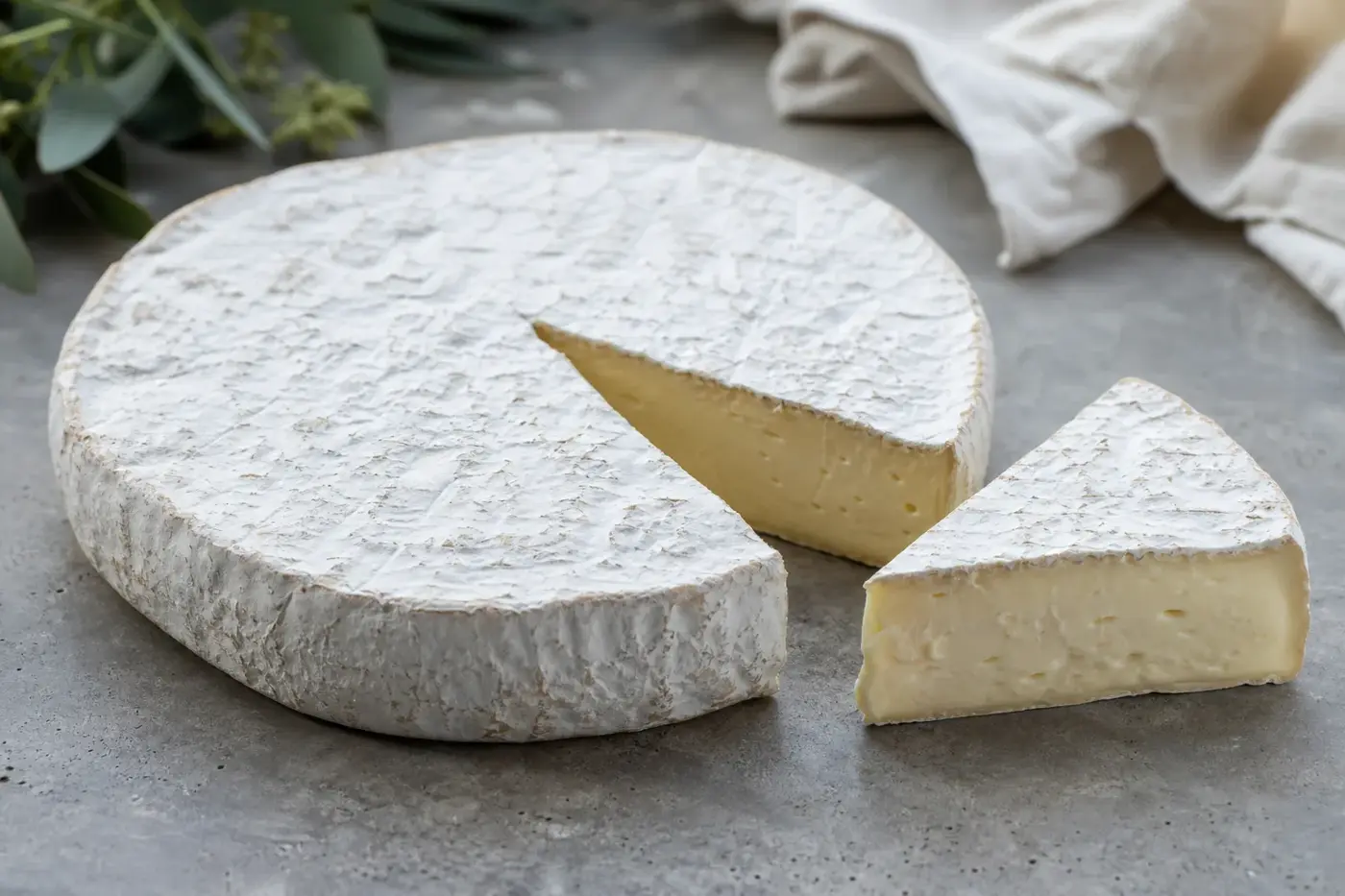
Cream, butter, hazelnut: bring a fully ripe wedge of Brie de Meaux close and those are the aromas its specification tells you to expect. At six to eight weeks, beneath the predominantly white mould rind, the paste grows more supple as ripening works towards the centre. This is a cheese worth giving your full attention, even if your bread is getting impatient.[4]
But which Brie is on your plate? Brie is a family of soft cheeses, not one recipe: the name alone describes a style. Brie de Meaux and Brie de Melun are specific French cheeses registered as protected designations of origin (PDOs) in the EU, each requiring raw cow's milk, defined formats and minimum maturing periods. Simply Brie on the label does not promise those things.[1,2,3,4,5]
Your Brie essentials at a glance
| What to look for | What you need to know |
|---|---|
| Family | Soft, surface-ripened cheese with a predominantly white mould rind.[1] |
| Generic reference | Codex CXS 277-1973, Standard for Brie, amended 2022.[1] |
| Registered EU names | Brie de Meaux, PDO-FR-9110; Brie de Melun, PDO-FR-0111.[2,3] |
| EU registration date | Both 21 June 1996.[2,3] |
| Milk | Both PDOs require raw cow's milk; generic Brie follows applicable product rules.[1,4,5] |
| Origin | PDO production areas in the Paris basin, each with defined boundaries.[4,5] |
| Register snapshot | November 2026.[2,3] |
Read past the picture of the French village
A triangular wedge and a picture of a French village can only tell you so much. Your supermarket may stock both Brie de Meaux and cheese labelled simply Brie, so the shop itself is no guide to the cheese. Read the product name, country of manufacture and milk treatment together.[1,2,3,4]
For generic Brie, Codex CXS 277 describes a flat cylinder, or sectors of one, made from cows' or buffaloes' milk and products obtained from them. This international reference standard gives manufacturers room for different versions within relevant national rules. It is not a law automatically governing every cheese sold worldwide.[1]
The two PDO names tell a more particular story, with individual specifications and defined French production areas. You may also see AOP, short for appellation d'origine protégée, the French abbreviation for PDO. What matters is the distinction between the general cheese name and those two registered names, each with its own production requirements.[2,3,4,5]
Put Brie, Meaux and Melun side by side
Milk, size and time help you make sense of the differences. The generic column below summarises Codex, not a worldwide legal minimum; the PDO columns follow the French production specifications. The dimensions describe the moulds, rather than every finished wheel.[1,4,5]
| What differs | Generic Brie, Codex [1] | Brie de Meaux PDO [4] | Brie de Melun PDO [5] |
|---|---|---|---|
| Milk | Cows' or buffaloes' milk, or mixtures | Raw cow's milk | Raw cow's milk |
| Milk treatment | Raw | Raw | |
| Whole-cheese format | Approximately 500 g to 3.5 kg | 2.6 to 3.3 kg | 1.5 to 2.2 kg at five weeks |
| Mould diameter | 36 to 37 cm | 27 to 28 cm | |
| Ripening | Normally from 10 days; alternative conditions permitted | At least four weeks from renneting | At least five weeks from renneting |
| Minimum fat in dry matter | 40% | 45% | 45% |
One figure needs a little unpacking. Fat in dry matter measures fat after the water is excluded, while your nutrition panel's fat per 100 g measures something different. You cannot compare those percentages directly with that label figure.[1,4,5]
Two cheeses, two ways of coaxing milk into curd
For Brie de Meaux, picture the pelle à brie: a broad, perforated skimmer used to transfer curd into the mould. The specification requires it, along with bovine rennet. This large cheese takes a rennet-led route: rennet is the enzyme preparation that turns milk into curd, the gel from which whey drains.[4]
Melun takes its time differently. Its route is predominantly lactic, with acidity doing more of the work of setting the milk. The approved specification requires at least 16 hours for coagulation, or curd formation. A smaller format and longer minimum maturing period accompany this different approach.[5]
The map changes too. Melun's territory covers Seine-et-Marne and specified communes in Aube and Yonne, while Meaux's reaches farther across the Paris basin. These are production territories: neither name means every cheese must be made inside the town of Meaux or Melun.[4,5]
Drought and heat have also shaped the rules. Temporary amendments to both PDO specifications apply from 1 October 2026 to 30 September 2027, adjusting herd-feeding requirements in response. They leave the milk treatment, formats and minimum maturing periods compared here unchanged.[6,7]
Look beneath the white bloom
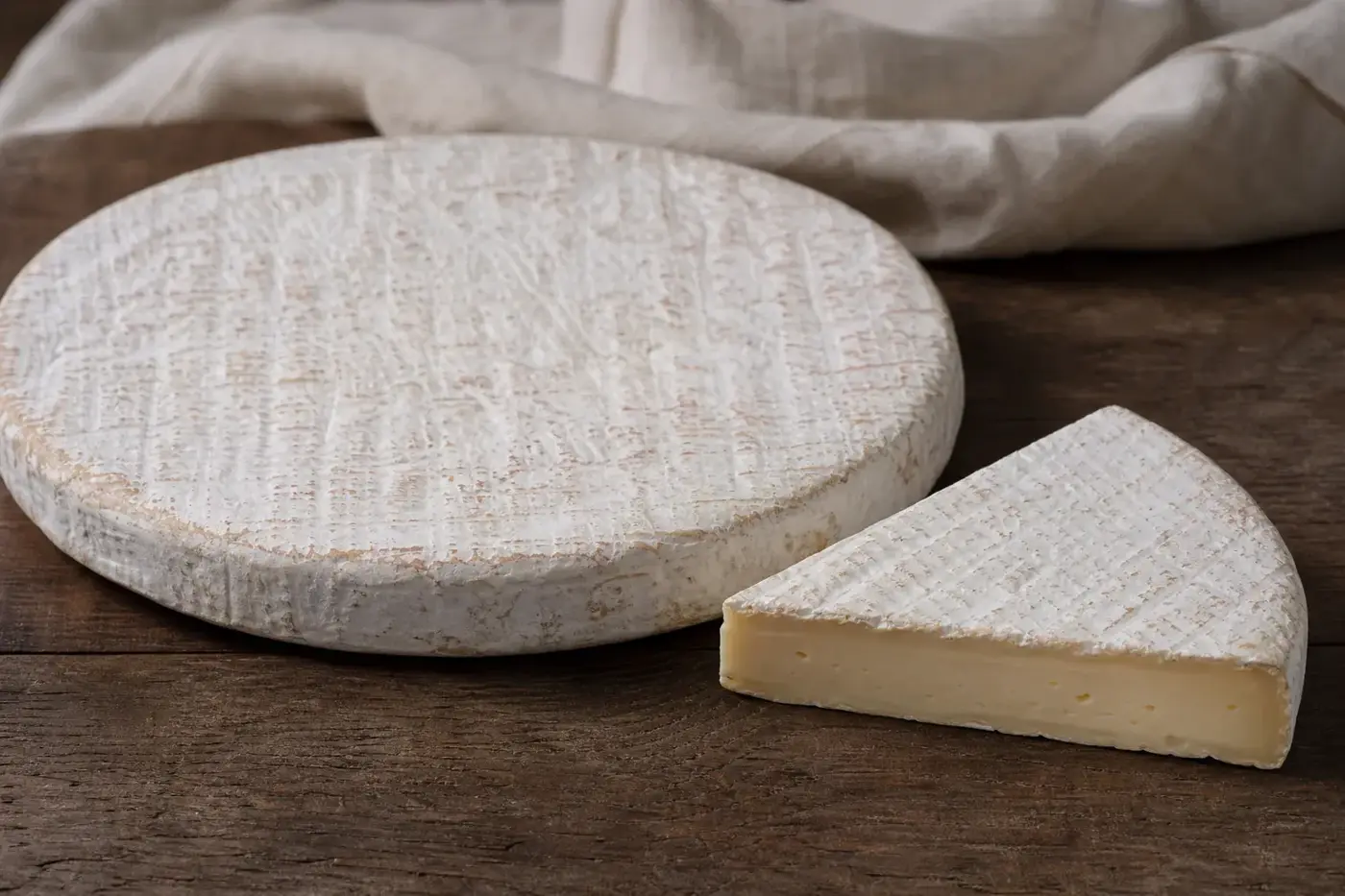
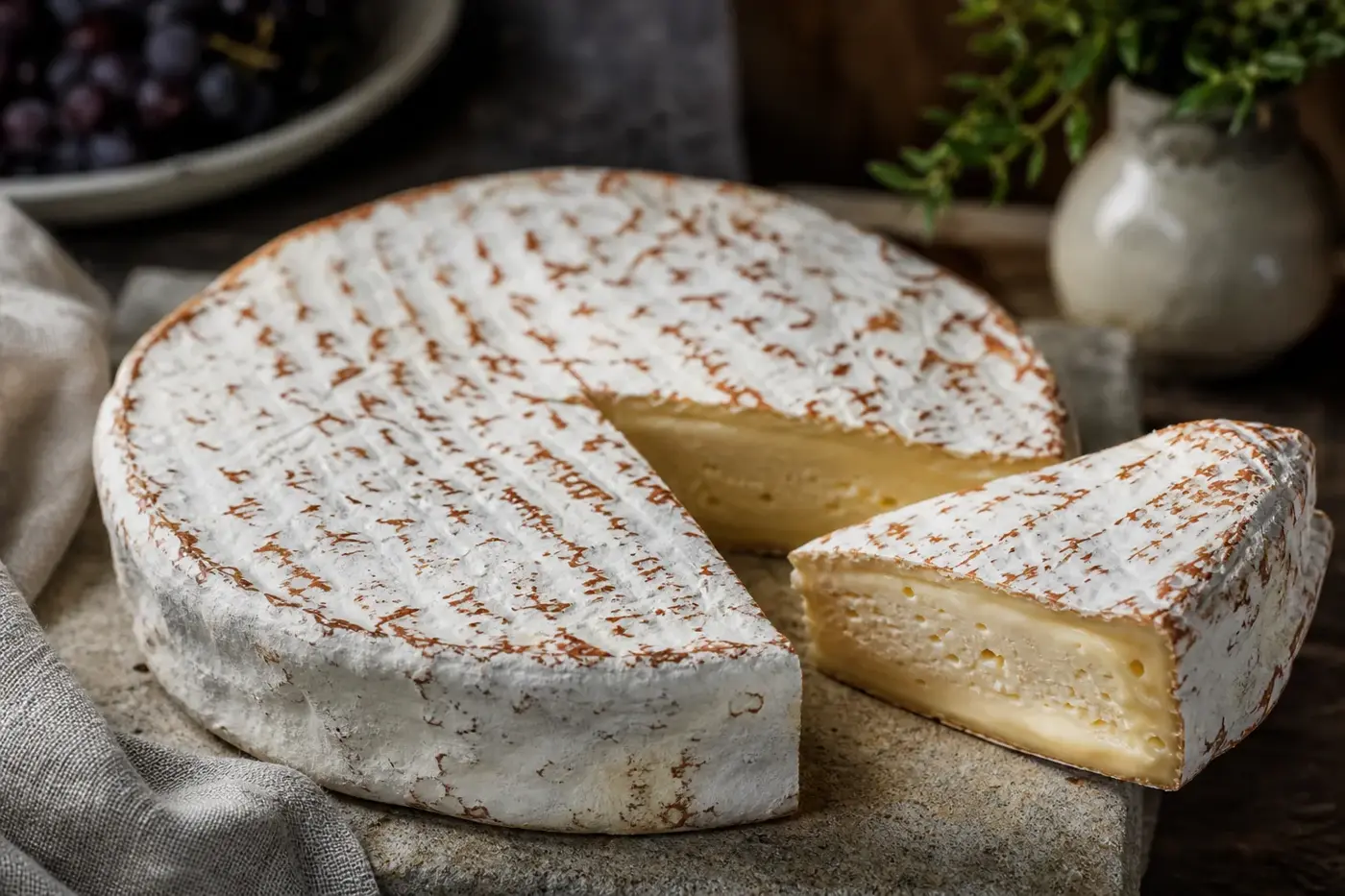
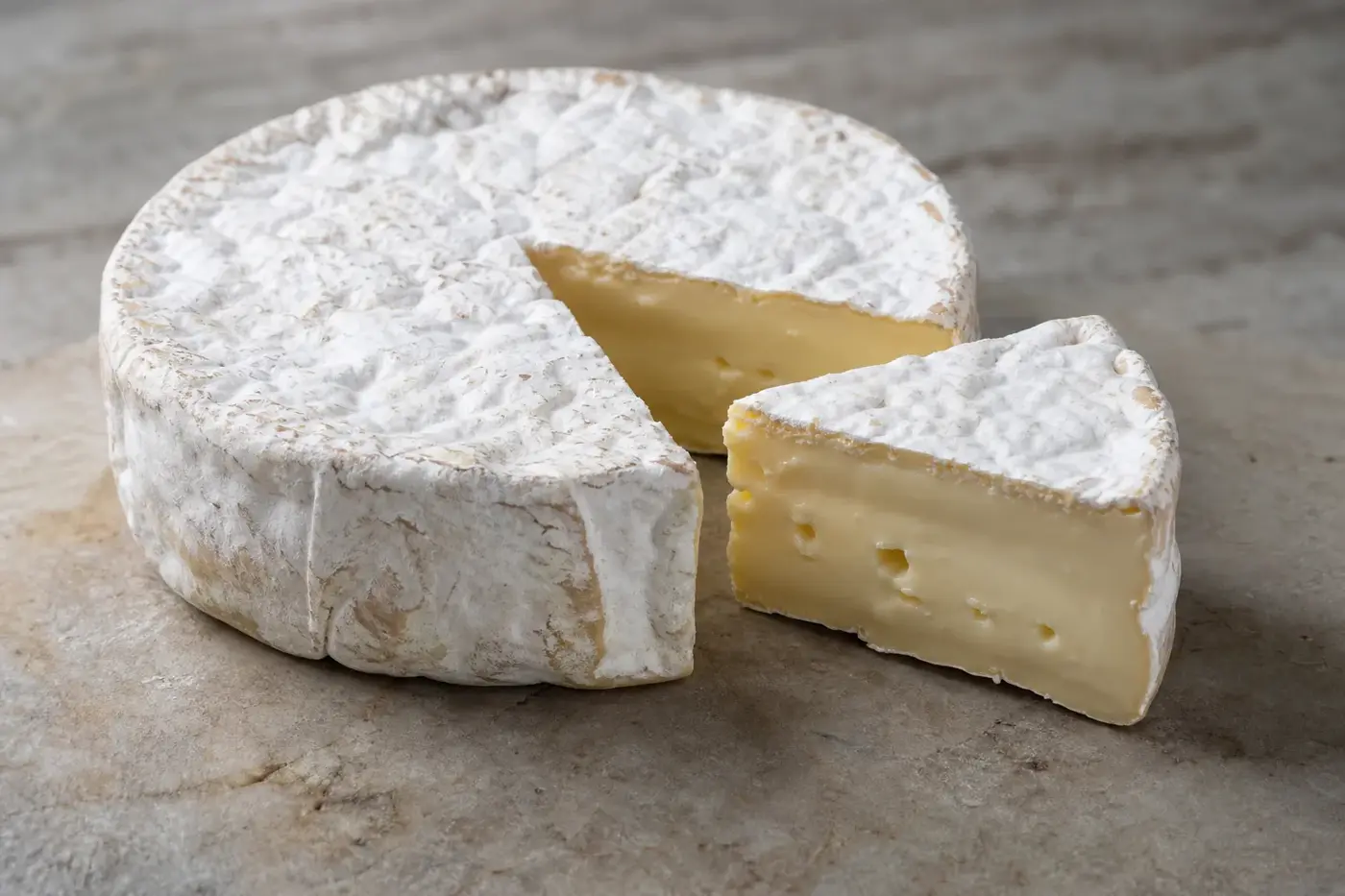
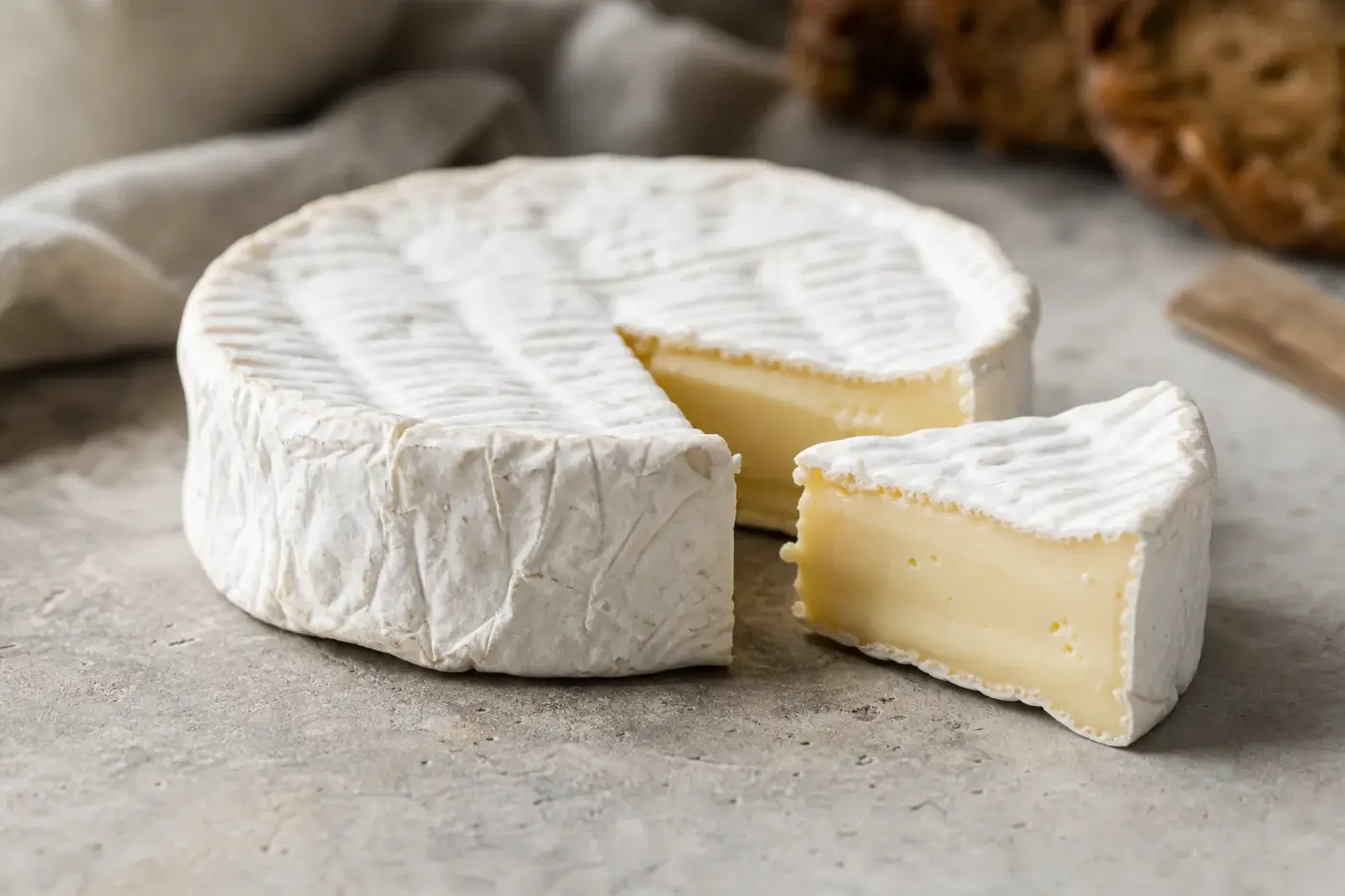
That white rind is part of Brie's intended development, not merely its wrapping. “Bloomy rind” means the soft surface covering produced by ripening moulds. Codex describes a pale interior, ripening from the outside towards the centre, and a white rind that may also develop reddish, brownish or orange spots.[1]
Time changes what you taste and feel. At four weeks, the Brie de Meaux specification describes a lactic taste, sometimes slightly salty, with a hint of bitterness. Between four and six weeks, the paste grows more supple as ripening moves inwards. At six to eight weeks, full ripeness brings those aromas of cream, butter and hazelnut.[4]
So four weeks is Meaux's minimum release age, not a promise of fully ripe texture. Wedges sold at different stages can feel different on your palate. Tell your cheesemonger when you plan to serve it, and ask how far the cheese has ripened. A little diary consultation is entirely reasonable where Brie is concerned.[4]
Where the full names carry protection
With cheese names, borders matter as much as spelling. Registration and treaty coverage are different things, and the treatment of Brie de Meaux or Brie de Melun is distinct from that of Brie alone. Here is the position by jurisdiction, as at November 2026.[2,3,8,9,10,11,12,13]
| Where you are | Brie de Meaux | Brie de Melun | Basis, November 2026 |
|---|---|---|---|
| EU, including France | Registered PDO | Registered PDO | eAmbrosia; both registered 21 June 1996.[2,3] |
| Great Britain | Registered PDO | Registered PDO | UK register; both registered 31 December 2020.[8,9] |
| Northern Ireland | EU PDO protection | EU PDO protection | EU GI scheme applies.[10] |
| Switzerland | Protected under the EU and Switzerland agreement | Protected under the EU and Switzerland agreement | Annex 12, Appendix 1; neither name appears on the Swiss register page. Mutual protection began 1 December 2011.[17,18,19] |
| United States | Status unspecified | Status unspecified | Status unspecified |
| Canada | Listed in CETA Annex 20-A | Status unspecified | CETA agreement list.[11] |
| New Zealand | Listed under the EU and New Zealand Free Trade Agreement | Status unspecified | In force from 1 May 2024, implemented through New Zealand's geographical indications legislation.[12,22] |
| Australia | Status unspecified | Status unspecified | The EU and Australia agreement was not yet in force; DFAT says the EU is not seeking protection of Brie alone under it.[13] |
Australia and Canada make the distinction particularly clear. Australia's DFAT expressly includes brie among the common terms for which the EU is not seeking protection under their trade agreement. Canada's CETA list names Brie de Meaux specifically. If you look only for Brie, you can miss the legal difference.[11,13]
Meet the maturers behind Meaux's history
Roads and railways helped Brie de Meaux reach across a larger territory. From the mid nineteenth century, its specification records, affineurs bought young cheeses from the eastern Paris basin. These specialists in maturing cheese ripened them, then sold them as Brie de Meaux.[4]
The specification also records a separation in the late nineteenth century between larger rennet-set cheeses and smaller lactic ones. In 1980, both Brie de Meaux and Brie de Melun received French appellation d'origine recognition. When you read those two names, you are looking at different cheesemaking histories as well as different rules.[4,5]
This page summarises published guidance from the official sources it cites. It is not medical advice. Guidance differs between countries and changes over time, so check the current source for where you live, and ask your doctor, midwife, pharmacist or dietitian about your own circumstances.
Give your Brie good storage, and follow the safety advice
Keep your Brie refrigerated. Follow the pack's storage instructions, any instructions after opening and its use-by date. For households in England, Wales and Northern Ireland, the Food Standards Agency recommends a fridge temperature between 0 and 5 °C.[14]
If you are preparing food in England, Wales or Northern Ireland, follow the FSA's advice on chilled food. Keep it out of the fridge for the shortest possible time.[14]
For pregnancy in the UK, the NHS advice, last reviewed 15 June 2026, says: “pasteurised or unpasteurised mould-ripened soft cheeses with a white coating on the outside, such as brie, camembert and chèvre: these must be thoroughly cooked”. It lists “any cheese that's been cooked until steaming hot” as safe.[15]
For Australia and New Zealand, FSANZ advises people who are pregnant, elderly or have weak immune systems to avoid “soft, semi-soft and surface-ripened cheeses such as brie, camembert, ricotta, blue and feta (unless thoroughly cooked)”. The page shows no date.[16]
In Canada, Health Canada's September 2026 guidance advises pregnant people, adults aged 60 and over and people with weakened immune systems to avoid uncooked soft cheeses such as Brie, even when made with pasteurised milk. Thoroughly cooked cheese is its recommended safer choice.[20]
In the United States, CDC advice for people at higher risk, dated 31 January 2025, says to avoid “Any type of cheese when made with (raw) unpasteurized milk”. Both PDO specifications require raw milk.[4,5,21]
Choose the guidance that fits your country and circumstances. If you have personal questions about pregnancy or weakened immunity, ask a doctor, midwife or dietitian.
Questions people ask
What is the difference between Brie de Meaux and Brie de Melun?
Both are French cheeses with protected designations of origin, but they have different formats and production methods. Meaux is larger and relies on rennet to set the milk, while Melun is smaller and follows a predominantly lactic method.
Is all Brie made with raw milk?
No. Brie de Meaux and Brie de Melun must both be made with raw cow’s milk, but a cheese labelled simply Brie does not automatically follow those requirements. The Codex reference standard for generic Brie does not specify milk treatment.
How long does Brie de Meaux take to ripen?
Its minimum maturing period is four weeks from renneting. At six to eight weeks, its specification describes it as fully ripe, with aromas of cream, butter and hazelnut.
How should Brie be stored?
Keep Brie refrigerated and follow the pack’s storage instructions, any instructions after opening and its use by date. For households in England, Wales and Northern Ireland, the Food Standards Agency recommends a fridge temperature between 0 and 5 °C.
Can I eat Brie during pregnancy?
The NHS advises that white coated mould ripened soft cheeses such as Brie, whether pasteurised or unpasteurised, must be thoroughly cooked during pregnancy. It lists cheese cooked until steaming hot as safe. See the [NHS guidance](https://www.nhs.uk/pregnancy/keeping-well/foods-to-avoid/) for details.
Sources
- FAO/WHO Codex Alimentarius Commission. Standard for Brie, CXS 277-1973. Revised 2007, amended through 2022. Sections 2, 3 and 7.
- European Commission. eAmbrosia registration record: Brie de Meaux, PDO-FR-9110. Live register, November 2026.
- European Commission. eAmbrosia registration record: Brie de Melun, PDO-FR-0111. Live register, November 2026.
- French Ministry of Agriculture. Cahier des charges de l'appellation d'origine « Brie de Meaux », Bulletin officiel 2020-30, following Implementing Regulation (EU) 2020/914. Read alongside the European Commission's single document in Official Journal C 64, 27 February 2020, retrieved through its indexed official text.
- European Commission. Brie de Melun amendment application and single document, Official Journal C 83, 13 March 2020. Amendment approved by Commission Implementing Regulation (EU) 2020/1103 of 22 July 2020.
- European Commission. Communication of approval of a temporary amendment: Brie de Meaux, PDO-FR-9110-TEMP01. Reference Ares(2026)9197656, 29 September 2026.
- European Commission. Communication of approval of a temporary amendment: Brie de Melun, PDO-FR-0111-TEMP01. Reference Ares(2026)8755282, 15 September 2026.
- Defra. [Brie de Meaux](../brie-de-meaux/), protected food name register. Published 4 January 2021; live record checked November 2026.
- Defra. [Brie de Melun](../brie-de-melun/), protected food name register. Published 4 January 2021; live record checked November 2026.
- Defra. Protected geographical food and drink names: UK GI schemes. Updated 8 March 2024.
- Global Affairs Canada. Comprehensive Economic and Trade Agreement: Annex 20-A. Agreement text, French cheese entries.
- New Zealand Ministry of Foreign Affairs and Trade. EU and New Zealand Free Trade Agreement: Annex 18-B, Lists of geographical indications. Agreement text.
- Australian Department of Foreign Affairs and Trade. Dairy geographical indications. Online government statement, November 2026.
- Food Standards Agency. How to chill, freeze and defrost food safely. Published 18 December 2017; current retrieved guidance applies to England, Northern Ireland and Wales.
- NHS. Foods to avoid in pregnancy. Current online edition, November 2026, cheese and dairy section.
- Food Standards Australia New Zealand. Listeria and food. No date shown; checked November 2026.
- European Union. Decision 2011/738/EU, Annex 12. 2011.
- Swiss Federal Office for Agriculture. AOP and IGP register. Published 2025; checked November 2026.
- Association suisse des AOP IGP. AOP IGP au niveau international. 2023.
- Health Canada. Food safety for pregnant people. Modified 2025.
- CDC. Preventing Listeria infection. 2025.
- New Zealand Ministry of Foreign Affairs and Trade. EU and New Zealand free trade agreement implementation. No date shown; checked November 2026.
Last checked: November 2026
Last checked November 2026.
The editors suggest you read next