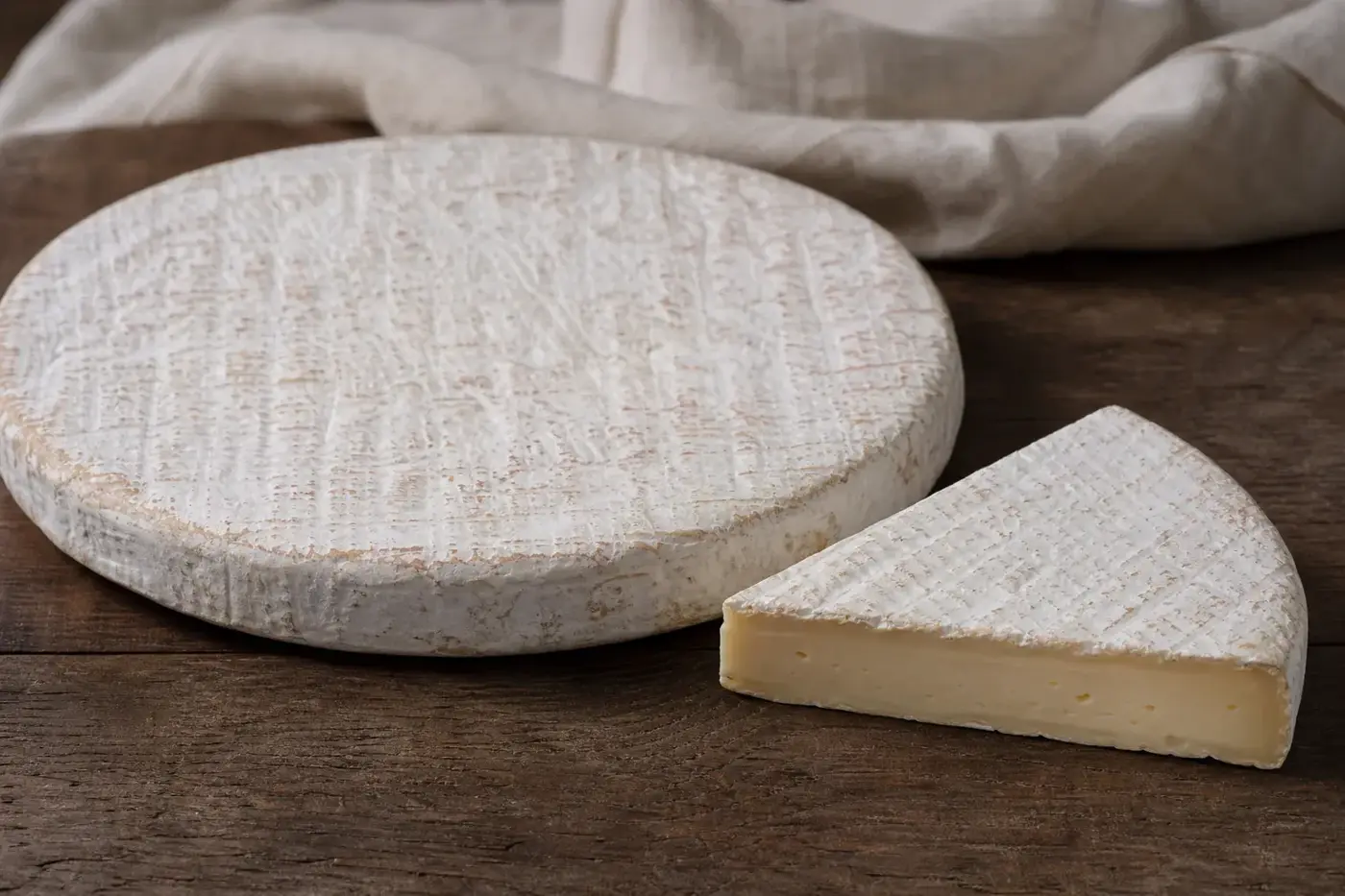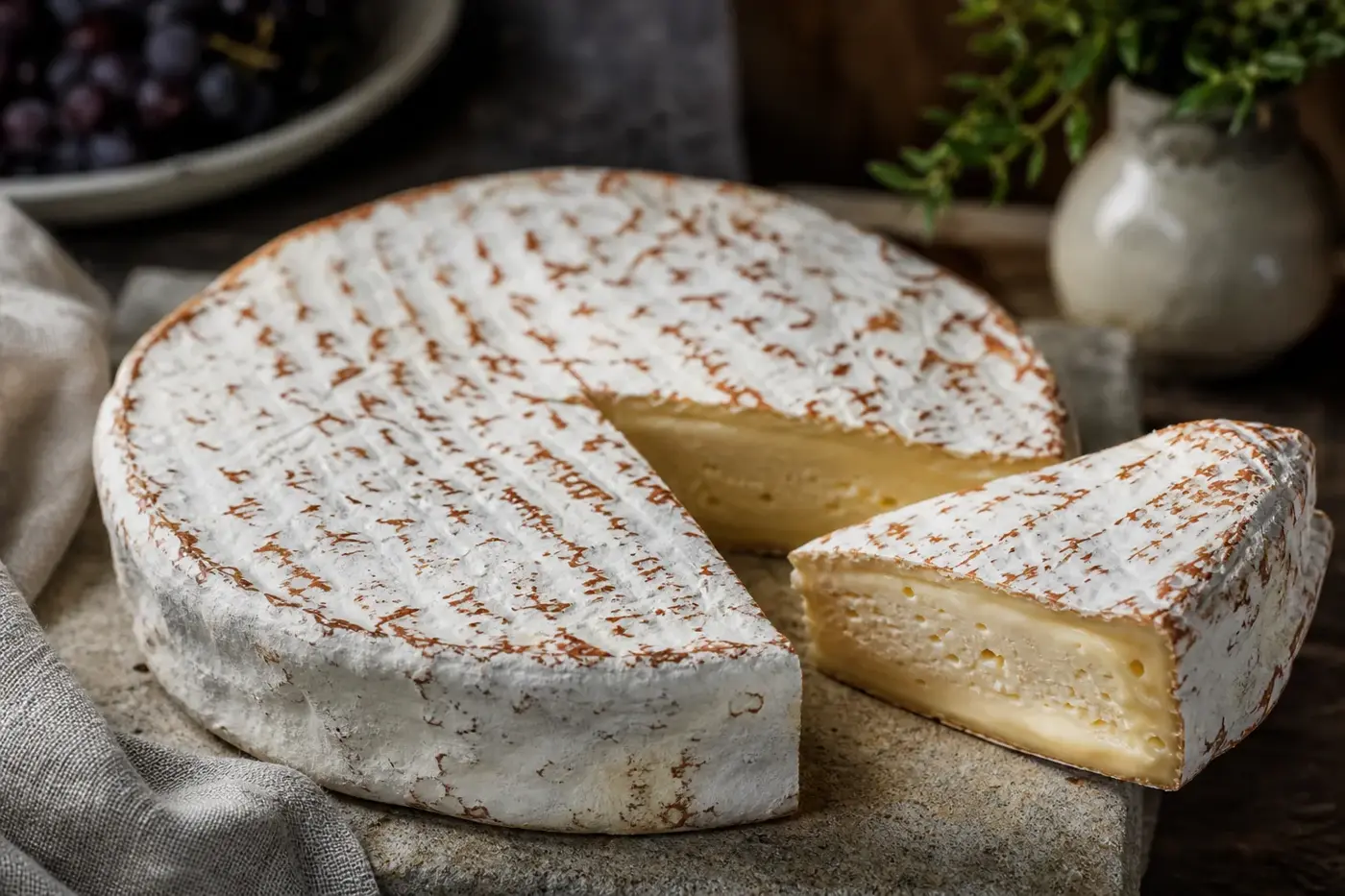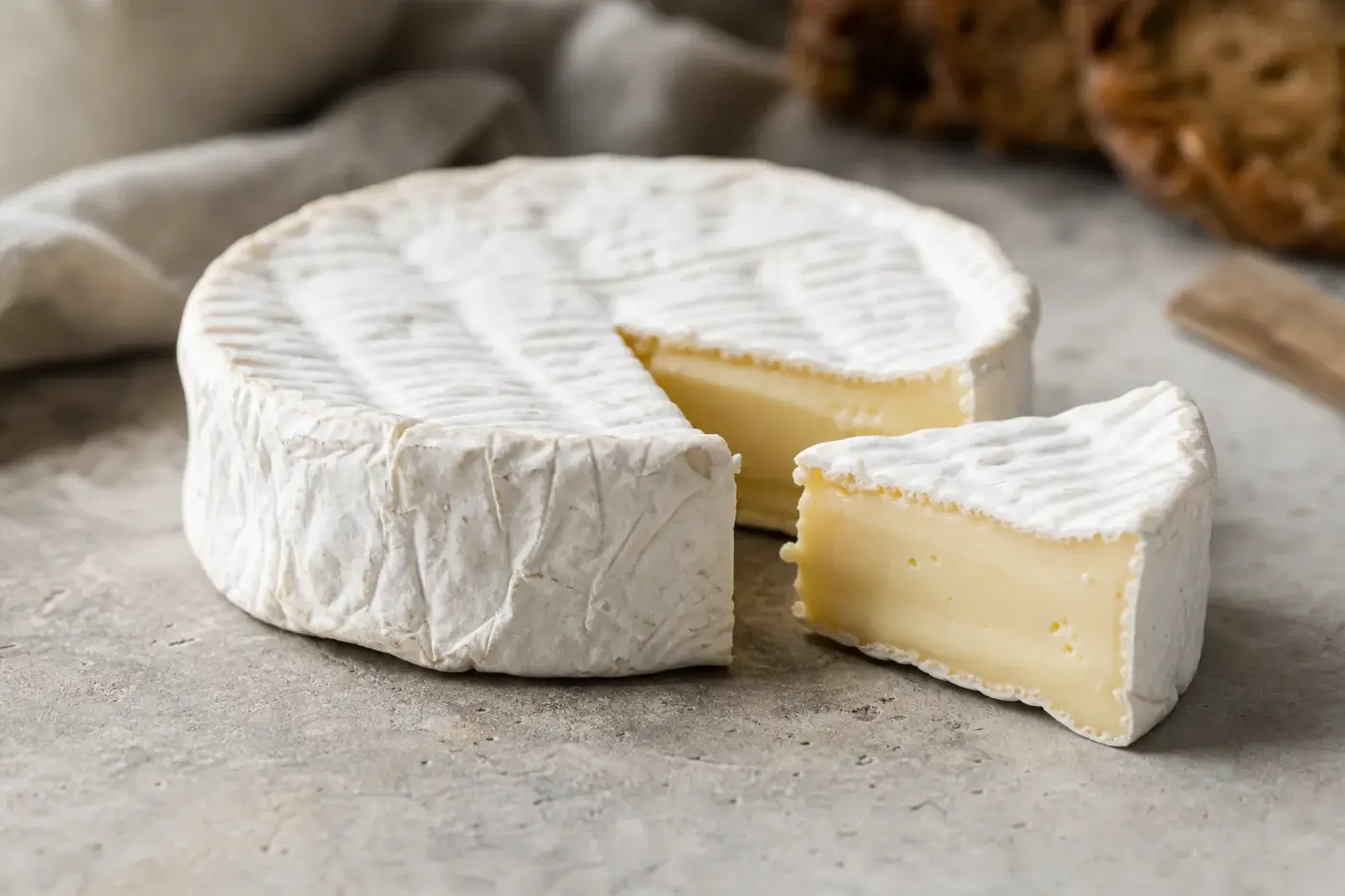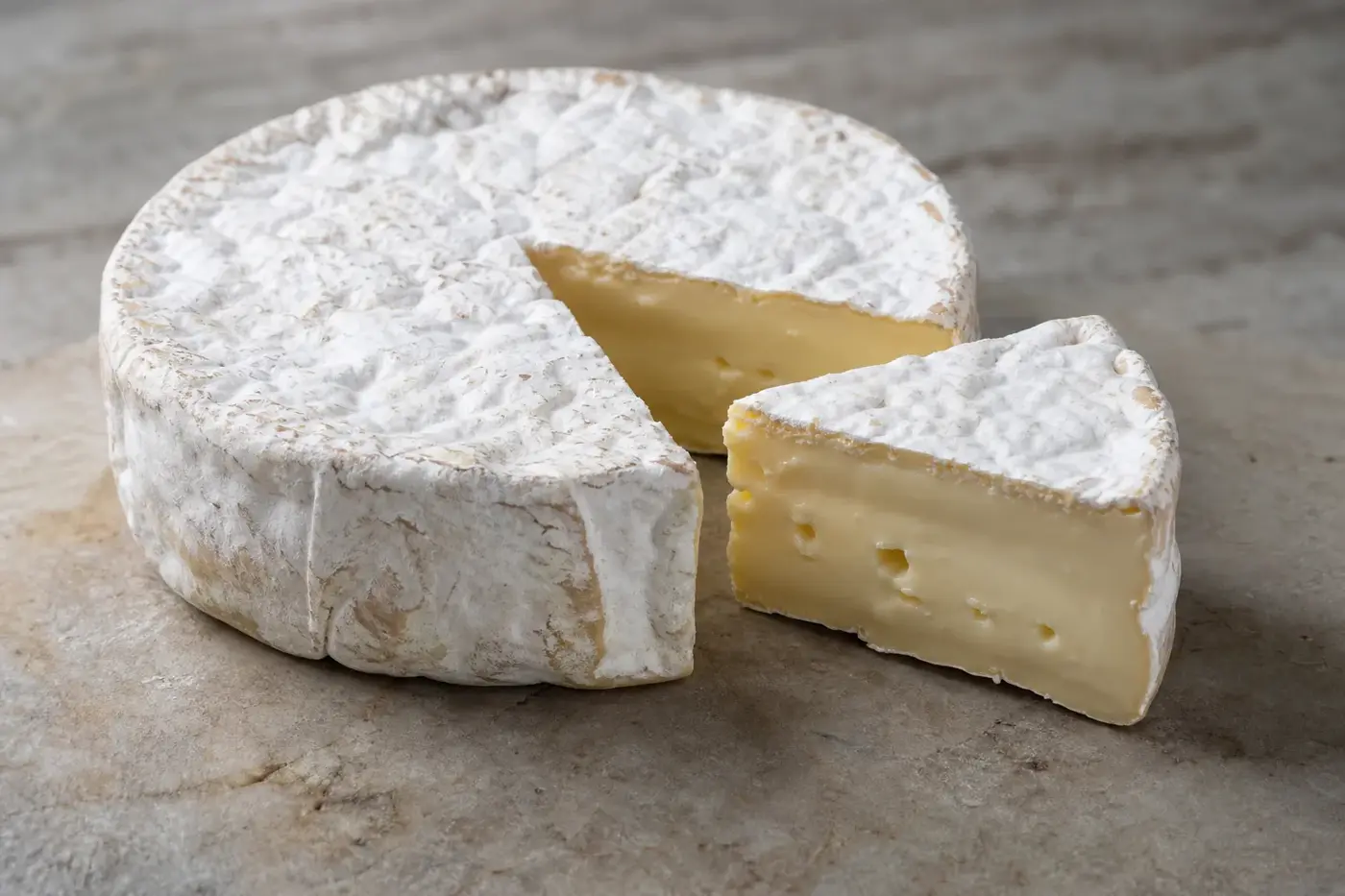
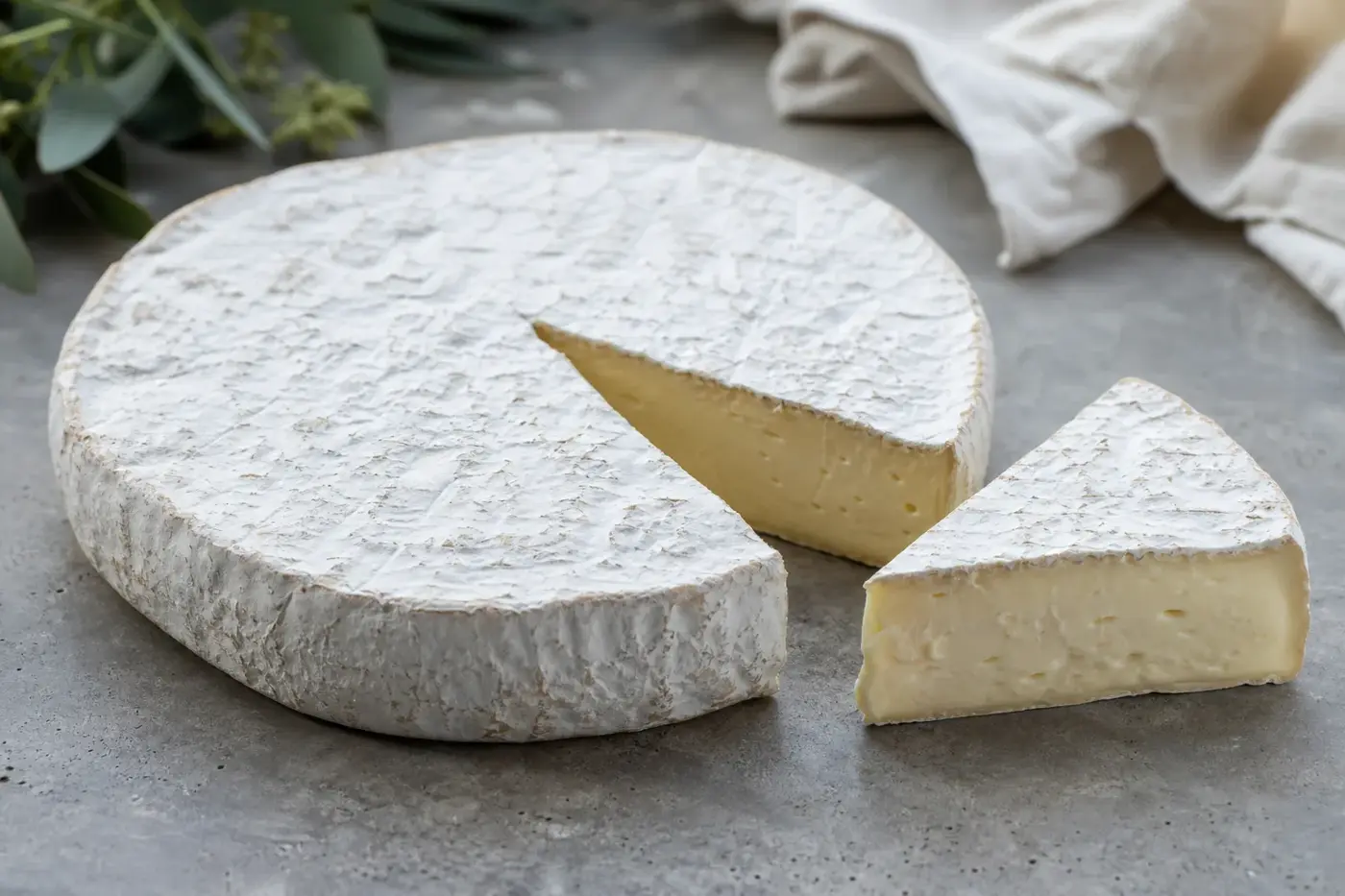
A ladleful of curd settles into a mould. Then comes the wait: at least 40 minutes before the next deposit, with at least five needed to shape Camembert de Normandie. Patience earns its keep here, as the protected Norman cheese develops a smooth, supple centre and a flavour that travels from milky mildness to something more pronounced and fruity. [3]
That white rind, though, tells only part of the story. You will find Camembert as a general style of soft, mould-ripened cheese, as well as under the specific Norman appellation. The full name, Camembert de Normandie, carries an EU protected designation of origin, or PDO, requiring raw cows’ milk and a defined production area. [1,2,3]
Two Camemberts, one important distinction
| What to look for | Generic Camembert | Camembert de Normandie |
|---|---|---|
| Name on the label | Camembert | Camembert de Normandie [1,2] |
| Reference | Codex CXS 276-1973, international reference standard | EU PDO, file PDO-FR-0112 [1,2] |
| Milk | Cows’ or buffaloes’ milk, or mixtures | Raw cows’ milk [1,3] |
| Where it comes from | Country of manufacture declared under Codex | Defined Norman production area, France [1,3] |
| Legal status | Style name, separate from the PDO | EU registered 21 June 1996; GB registered 31 December 2020 [2,6] |
Beneath the rind, things are moving
Camembert ripens from the outside towards the centre. Beneath that soft, white-mould-covered rind, Codex describes a near-white to light-yellow paste: soft, never crumbly. Reddish, brownish or orange spots are permitted, and there is even a square version, Carré de Camembert. Not every Camembert feels obliged to go round in circles. [1]
Think of Codex as the family’s international reference, rather than the final word in your local shop. National rules govern what can be sold as Camembert in each market. Under Codex, the country of origin is where the cheese was manufactured, not the country that gave it its name. [1]
For Camembert de Normandie, the specification brings you closer to the mouthful. Ripened through, its ivory to pale-yellow paste is smooth and supple. You can expect a little salt, with milky mildness giving way to a more pronounced, fruity flavour as ripening continues. [3]
A full name with plenty behind it
Milk, method and origin separate the PDO from the wider style. This November 2026 comparison puts Codex for generic Camembert alongside the approved 2013 specification for Camembert de Normandie. [1,3,5]
| What matters | Generic Camembert, Codex | Camembert de Normandie PDO |
|---|---|---|
| Production area | No Norman area requirement | Delimited area in Normandy [1,3] |
| Milk treatment | No raw-milk-only requirement | Raw milk only [1,3] |
| Moulding | No PDO ladling schedule | At least five deposits, at least 40 minutes apart [1,3] |
| Fat in dry matter | Minimum 30%; reference range 45 to 55% | Minimum 45% [1,3] |
Those fat percentages need a moment’s explanation. Fat in dry matter measures fat after the water has been removed. The fat per 100 g on your nutrition panel uses a different basis, so these are not nutrition-panel figures. [1,3]
“Ladle moulding” sounds straightforward, but it does not necessarily mean someone holding a ladle. The PDO specification allows curd, the set milk solids, to be lifted with either hand ladles or articulated moulding heads. [3]
Follow the full name beyond the dairy and you arrive at the farm. INAO describes herds with at least 50% Normande cows and grazing for at least six months of the year. Together with the manufacturing rules, those requirements make the PDO about much more than where your cheese went into its box. [4]
What changed in the Normandy label dispute?
Between 2018 and 2021, labelling enforcement changed, but the proposed broader PDO did not take effect. Two separate questions were involved: whether the PDO should allow other milk treatments, and how non-PDO Camembert could mention Normandy on its packaging. [4,8,9]
- 21 February 2018: According to the Normandy Chamber of Agriculture, an agreement in principle envisaged allowing pasteurisation within a broader PDO. In exchange, makers would abandon “camembert fabriqué en Normandie”, with a distinct mention for raw milk cheese moulded by ladle. Actalia describes proposed tiers with different milk treatments and requirements. [8]
- 29 January 2020: The Normandy sector rejected the proposed specification, according to Actalia. The 2018 agreement therefore did not deliver the planned expanded PDO. [8]
- 9 July 2020: The DGCCRF, France’s consumer protection authority, issued its notice about prominent use of “fabriqué en Normandie” on cheese outside the PDO. Operators had until 31 December 2020 to make their labels comply. [9]
- 2021: Enforcement followed that grace period. This was the practical change behind reports of new Camembert rules; the PDO remained raw-milk-only. [4,9]
- 22 July 2022: The Conseil d’État rejected challenges to the notice. Its decision confirmed the administration’s position on protecting the appellation against unlawful evocation. [9]
If you are reading a label, one distinction matters. A ministerial answer published on 11 April 2024 explained that there is no general, absolute ban on every reference to Normandy. Authorities consider labels case by case, looking at wording, imagery and their arrangement. [10]
Your clearest guide is the full registered name. A Norman address or the words “made in Normandy” means something different from meeting the Camembert de Normandie specification. [3,10]
Where the Camembert name travels
The complete geographical name carries the protection, and the market matters. This November 2026 overview separates “Camembert” from the full appellation, helping you follow those distinctions across borders. [2,6,7,11,12,13,14,15,16]
| Market | Camembert alone | Camembert de Normandie |
|---|---|---|
| France and EU | Generic component of the name | Registered EU PDO since 21 June 1996 [2,9] |
| Great Britain | Separate from the registered PDO | Registered GB PDO since 31 December 2020 [6] |
| Northern Ireland | Separate from the registered PDO | EU GI scheme applies [2,7] |
| Switzerland | Status not established | Mutual protection under Annex 12 of the EU and Switzerland agricultural agreement since 1 December 2011; absent from the cited Swiss register page [23,24] |
| United States | No Camembert-specific standard in 21 CFR Part 133 | Name protection: status not established [12] |
| Canada | National compositional standard exists | Listed in CETA Annex 20-A [11,13] |
| Australia | DFAT identifies it as a common name excluded from the EU’s protection request | Full name status not established [14] |
| New Zealand | Separate from the listed geographical name | Listed in Annex 18-B of the EU and New Zealand agreement, in force since 1 May 2024; individual register entry status not established [15,16] |
Canada brings another set of numbers to the table. Its compositional standard sets a maximum moisture of 56% and minimum milk fat of 22%, both measured in the whole cheese. Those composition limits are separate from geographical protection for a particular name. [13]
Marie Harel, a lasting legend and that wooden box
LEGEND: Marie Harel invented Camembert. It is a memorable story, but historian Pierre Boisard’s investigation challenges it, as discussed in Kolleen M. Guy’s H-France review of Camembert: A National Myth. The accompanying tale of a fugitive priest sharing a secret recipe is also disputed as an explanation of the cheese’s origin. [17]
A documented visit to Harel’s tomb gives you a different story to consider. Joseph Knirim went there in March 1926; Guy reports Boisard’s argument that this American visitor helped make Harel a public figure in France. That strengthened the bond between cheese, heroine and region, helping explain why the legend endured rather than proving who invented Camembert. [17]
Then there is the wooden box: familiar, handsome and not merely there to charm the cheese lover. The PDO specification requires whole Camembert de Normandie to be individually packed in wood. A specified wood-fibre composite is permitted for the label-bearing top. [3]
The legal milestones offer firmer ground than the origin legend. French AOC recognition came in 1983, followed by EU PDO registration on 21 June 1996. The specification amendment approved by Implementing Regulation (EU) No 1209/2013 was published on 28 November 2013. [2,4,5]
Your fridge, your kitchen and the guidance that matters
Keep your Camembert refrigerated and follow the packaging instructions, including those for after opening. For home storage in England, Wales and Northern Ireland, the Food Standards Agency recommends a fridge temperature of 5 °C or below. [18]
If you are pregnant in the UK, the NHS advice, reviewed 15 June 2026, says: “pasteurised or unpasteurised mould-ripened soft cheeses with a white coating on the outside, such as brie, camembert and chèvre: these must be thoroughly cooked”. The NHS says cheese cooked until steaming hot is safe. [19]
In Canada, Health Canada's September 2026 guidance advises pregnant people, adults aged 60 and over and people with weakened immune systems to avoid uncooked Camembert. That includes Camembert made with pasteurised milk. Thoroughly cooked cheese is a safer choice for these groups. [20]
In Australia and New Zealand, the undated Food Standards Australia New Zealand advice in this November 2026 overview addresses people who are pregnant, elderly or have weakened immunity. It advises avoiding “soft, semi-soft and surface-ripened cheeses such as brie, camembert, ricotta, blue and feta (unless thoroughly cooked)”. [21]
In the United States, the CDC advises people at increased risk of listeriosis to avoid cheese made with raw milk, in advice dated 31 January 2025. Camembert de Normandie requires raw milk. [3,22]
During pregnancy or when your immunity is weakened, follow your country’s official guidance and ask your midwife, doctor or dietitian for individual advice. Before eating or cooking the cheese, check any recall against its product name, maker and batch. [19,20,21,22]
General information only, not medical advice: follow the official guidance where you live.
Questions people ask
What is the difference between Camembert and Camembert de Normandie?
Camembert is a broader cheese style, while Camembert de Normandie is a protected designation of origin. The Norman cheese must be made with raw cows’ milk in a defined area of Normandy.
Did the rules for Camembert change in 2021?
Labelling enforcement changed after a grace period ended on 31 December 2020. A proposed broader designation that would have admitted other milk treatments did not take effect, and Camembert de Normandie remained a raw milk cheese.
Did Marie Harel invent Camembert?
The familiar account that Marie Harel invented Camembert is a legend challenged by historian Pierre Boisard. The story of a fugitive priest passing on a secret recipe is also disputed.
Can I eat Camembert during pregnancy?
The NHS advises that Camembert must be thoroughly cooked during pregnancy, whether it is made with pasteurised or unpasteurised milk. It says cheese cooked until steaming hot is safe. See the NHS guidance at https://www.nhs.uk/pregnancy/keeping-well/foods-to-avoid/.
How should Camembert be stored?
Camembert should be kept refrigerated, following the packaging instructions, including those for use after opening. For home storage in England, Wales and Northern Ireland, the Food Standards Agency recommends a fridge temperature of 5 °C or below.
Sources
- FAO/WHO Codex Alimentarius, Standard for Camembert, CXS 276-1973, revised 2007, amended through 2022. Sections 2, 3 and 7. Read at fao.org
- European Commission. Camembert de Normandie, PDO-FR-0112. Registered geographical indication. Official eAmbrosia register. Checked November 2026.
- French Ministry of Agriculture, Cahier des charges de l’appellation d’origine « Camembert de Normandie », approved by Décret n°2013-1059, Bulletin officiel n°48-2013, published 29 November 2013.
- INAO, Camembert de Normandie, product description and regulatory document list, online edition checked November 2026.
- European Commission, Commission Implementing Regulation (EU) No 1209/2013 of 25 November 2013, Official Journal L 317, 28 November 2013.
- Defra, Camembert de Normandie, Great Britain protected food name register, published 4 January 2021, live record checked November 2026.
- Defra, Protected geographical food and drink names: UK GI schemes, online guidance checked November 2026.
- Actalia, AOP camembert de Normandie, 2020 account of the proposed reform and its rejection.
- Conseil d’État, Décision n°447234, 22 July 2022, particularly the account of the notice, compliance deadline and judgment.
- French Sénat, Exploitation des références du camembert de Normandie, written question n°08521, ministerial answer published 11 April 2024.
- Global Affairs Canada, Comprehensive Economic and Trade Agreement, Annex 20-A, agreement text, online edition checked November 2026.
- US Government Publishing Office and Office of the Federal Register, 21 CFR Part 133: Cheeses and Related Cheese Products, current online edition checked November 2026.
- Canadian Food Inspection Agency, Canadian Food Compositional Standards, Volume 7: Dairy Products, online incorporated document checked November 2026.
- Australian Department of Foreign Affairs and Trade, Dairy geographical indications, EU and Australia trade agreement information, online edition checked November 2026.
- New Zealand Ministry of Foreign Affairs and Trade, List of Geographical Indications, EU and NZ agreement materials, item 643, retrieved November 2026.
- Intellectual Property Office of New Zealand, European Union Geographical Indications and changes to legislation, online guidance checked November 2026.
- Kolleen M. Guy, review of Pierre Boisard’s Camembert: A National Myth, H-France Review, volume 4, number 120, December 2004.
- Food Standards Agency, Food safety in a heatwave: advice for consumers, online government guidance checked November 2026.
- NHS, Foods to avoid in pregnancy, online edition checked November 2026.
- Health Canada, Safer food choices for people at greater risk of food poisoning, online edition reached through the former pregnancy guidance address, checked November 2026.
- Food Standards Australia New Zealand, Listeria in food, online edition checked November 2026.
- US Centers for Disease Control and Prevention, Preventing Listeria Infection, 31 January 2025, checked November 2026. Read at cdc.gov
- European Union, Decision 2011/738/EU, Annex 12, 20 October 2011, checked November 2026. Read at eur-lex.europa.eu
- Association suisse des AOP IGP, AOP IGP au niveau international, 6 March 2023, checked November 2026. Read at aop-igp.ch
This desk-researched article compares the Codex standard with the approved French specification, official registration records, the French court decision and national safety guidance.
Last checked: November 2026
Last checked November 2026.
The editors suggest you read next
Brie
Cream, butter, hazelnut: bring a fully ripe wedge of Brie de Meaux close and those are the aromas its specification tells you to expect.