Cheese Fraud, Adulteration and Origin Authentication
You pick up a cheese labelled “sheep’s milk”, with a named valley lending a little romance to the wrapper.
You pick up a cheese labelled “sheep’s milk”, with a named valley lending a little romance to the wrapper. Sheep DNA can tell you something about the milk. It cannot put the cheese in that valley, however picturesque the label. For that, investigators need delivery records, production logs and laboratory results. [1, 8, 10]
The task is to compare the label’s story with independent evidence. Genetic tests investigate milk species. Chemical measurements explore composition and origin, while records connect the cheese to its claimed history. You need each piece to see the fuller picture. [1, 8, 10]
A wrong label starts the questions
Food fraud means intentional deception about food for economic gain. The Food Standards Agency’s published definition includes deliberately substituting, adding to or misrepresenting food, ingredients or packaging. It also includes misleading statements about a product. Its term food crime covers serious fraud and related criminality in food supply chains. [1]
The crucial ingredient is intent. A wrong species declaration deserves investigation, but it does not establish that someone deliberately deceived you. Records, communications and repeated discrepancies help investigators distinguish fraud from a labelling mistake. [1, 2]
What has really gone into your cheese?
Something added without being declared? That is adulteration. Something used in place of the stated food or ingredient? That is substitution. Dilution means reducing the proportion of an expected ingredient by adding another material. [1, 2]
These forms can overlap. Misrepresentation, meanwhile, can change a food’s story without changing the food itself. Your cheese may be physically untouched while the claim on its label is inaccurate. [1, 2]
For cheese, those distinctions lead to precise questions. Does a product declared as sheep’s milk contain another species’ milk, and does its fat composition match the stated ingredients? Do the dairy’s records support its claimed production method? These are questions to investigate, not findings that a particular cheese has been falsified. [2, 8]
Cheese alternatives need an honest introduction
A food made to resemble cheese can be sold honestly. Its description and presentation must identify it accurately and meet the naming rules where it is sold. Fraud enters the picture when a seller deliberately presents one product as another. [2, 3]
How it looks, how it behaves in your cooking and what it can lawfully be called are separate matters. In Great Britain, Article 7 of the assimilated Regulation (EU) No 1169/2011 prohibits misleading food information about identity, composition, origin and methods of manufacture. That covers presentation and advertising, not just the product name. For everyday help, see how to read a cheese label. [3]
Protected names promise more than a place
A protected cheese name is more than a familiar name on your label. It comes with a specification, the document setting out the requirements for using it. Resemblance is not the test, however convincing the cheese might look. [4, 5]
Investigators compare the cheese and its production history with the applicable specification. Defra’s guidance requires verification against that specification before a producer uses a protected food name. Here is how the schemes apply. [4, 5]
| Where you are | Which rules apply | Where to find guidance | Guidance date |
|---|---|---|---|
| Great Britain (England, Scotland and Wales) | UK GI schemes govern registered food names. | Defra scheme and enforcement guidance [4, 5] | November 2026 |
| Northern Ireland | EU GI schemes apply to protected names. | Defra guidance and European Commission overview [4, 6] | November 2026 |
False claims about origin and method take recognition away from producers who meet those requirements. They also deny you an informed choice. A packing address, a regional illustration and the place of manufacture tell different things. For geographical protection versus traditional methods, see protected names explained. [1, 4]
This page summarises published guidance from the official sources it cites. It is not medical advice. Guidance differs between countries and changes over time, so check the current source for where you live, and ask your doctor, midwife, pharmacist or dietitian about your own circumstances.
When a false story raises safety questions
Fraud and food safety are different questions, although an investigation may need to examine both. A false claim about place can deceive you without introducing a new hazard. Adulteration can introduce substances whose identity and suitability need investigation. [1]
Undeclared allergens deserve particular attention. The FSA’s July 2026 guidance for England, Wales and Northern Ireland says businesses must provide information about specified allergenic ingredients, including milk, eggs and soya. Relevant additives and processing aids present in the final food are covered too. [7]
Article 21 and Annex II of Regulation (EU) No 1169/2011 provide the underlying allergen provisions. The assimilated version applies in Great Britain. Declaration rules have specific exceptions, including where the food’s name clearly refers to the allergen. [3, 7]
For your own circumstances, follow the current official guidance and professional advice identified above. If you want to understand the distinction between the conditions, see cheese allergy vs lactose intolerance. They are different questions too. [3, 7]
Follow the claim, then follow the cheese
First, pin down the exact claim and the batch it concerns. Where your cheese was made, how long it matured and which species supplied its milk each need different evidence. Investigators compare supplier specifications, delivery records, production logs and certification documents. The question is whether they describe the same material at successive stages. [4, 8]
Traceability makes that journey possible. Defra’s protected food guidance asks for records tracing products and raw materials to their geographical source, alongside checks at production stages. Supplier checks and site inspections test whether the paperwork matches what a business receives, makes and dispatches. False documents are themselves a recognised category of food crime. [2, 4, 5]
If you are checking a supplier, ask four direct questions. Which claim is guaranteed, which site made the cheese, which records identify the batch, and who verified any protected name compliance? Request evidence tied to the product supplied, not a general account of the business. Certification of one activity does not establish every claim for a different product. [4, 5]
Sampling needs just as much precision. One retail portion represents the material sampled; assessing a wider batch or supplier needs an appropriate sampling plan. Documenting collection, identification, storage and transfer establishes which sample reached the laboratory and helps preserve its evidential value. Analysts need that history to interpret the result. [8]
DNA can name the animal, not the valley
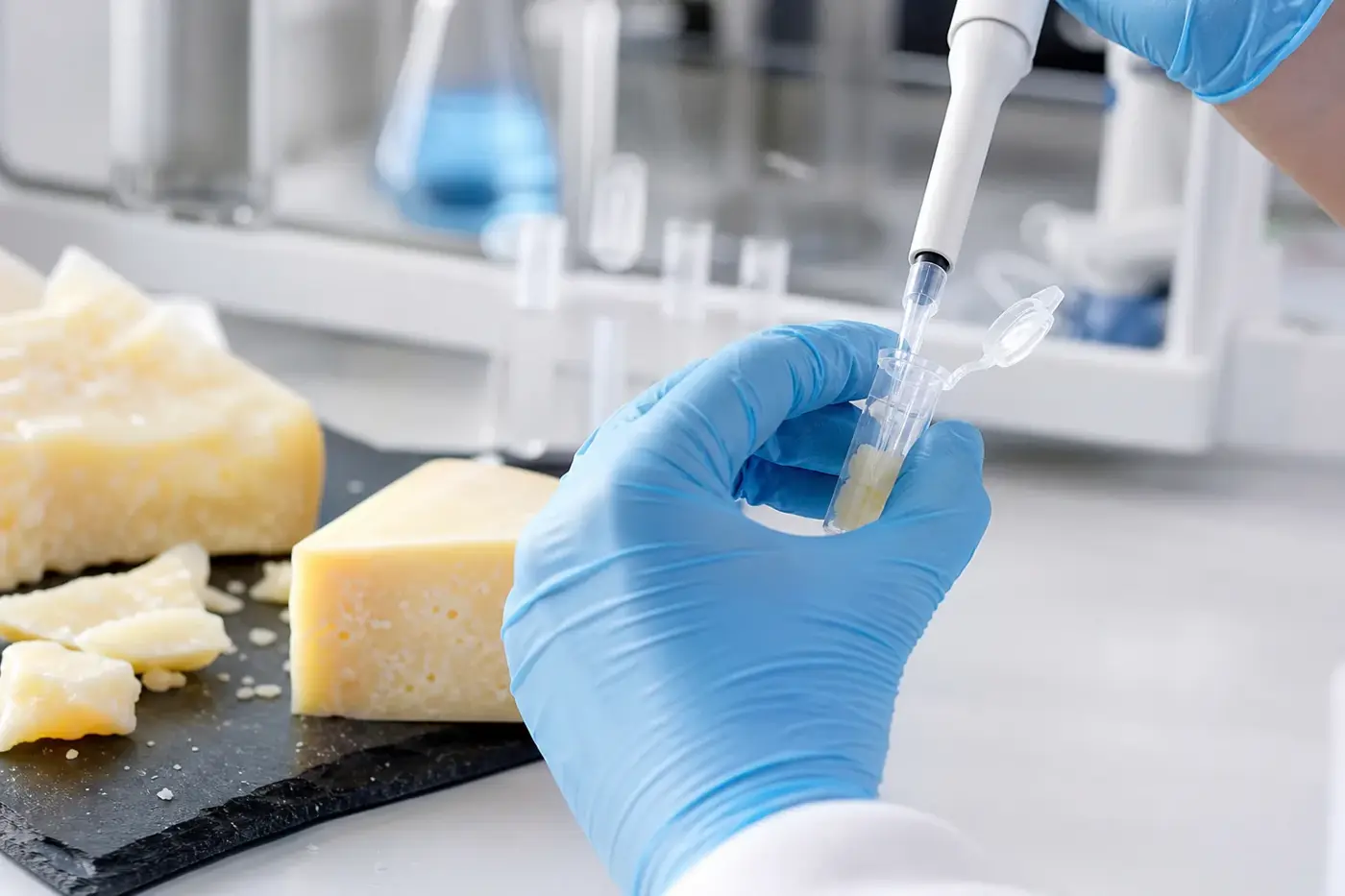
DNA analysis looks for genetic sequences associated with particular animal species. With a suitable method, it can help establish whether your cheese contains milk from a declared or undeclared species. The laboratory must choose an assay suited to both the product and the species under investigation. [8, 9]
That is not quite as simple as pressing a button. Processing can affect the amount and condition of recoverable DNA, and ingredients can interfere with analysis. Mixtures add another challenge: a stronger DNA signal does not automatically tell you the proportion of each milk used. [8, 9]
Extraction efficiency, the target sequence and calibration all matter. A negative result must be read against the method’s detection capability and controls. You need that context to understand what the result means. [8, 9]
Finding sheep DNA answers a question about the animal source. It is not a travel diary. A named valley, dairy or production method needs separate evidence, and the conclusion must stay within the question the test was validated to answer. [8, 9]
The chemical clues tucked inside a cheese
A cheese can offer chemical clues to its origins. Stable isotope analysis measures naturally occurring differences in the forms of elements. Researchers use those differences to investigate connections between food and geographical source. [10]
In dairy products, that fingerprint may reflect environmental influences and feeding practices. Suitable reference material is therefore essential to interpreting it. A pattern needs something meaningful to be compared with. [10]
A 2023 University College Dublin study analysed five elements in casein, a milk protein, isolated from 197 dairy products, including 96 cheeses. A statistical model classified the samples into four broad geographical groups with 88% overall accuracy. Performance differed between the four groups, so those figures describe that dataset and that classification task. [10]
Other methods examine elemental composition, chemical compounds or patterns in how a sample interacts with light. Spectroscopy can provide a screening fingerprint. Chromatographic methods separate compounds for closer examination. The choice depends on your question: milk fat, another ingredient or consistency with a claimed geographical origin. [9]
Elemental profiles need particular care. The measured pattern must connect to the product’s history and the reference population. Combining methods can strengthen an investigation when they offer genuinely complementary evidence. It still starts with a clearly stated claim for the laboratory to test. [9, 10]
Every fingerprint needs a fair comparison
A chemical fingerprint is only useful alongside a trustworthy comparison collection. Reference samples need documented origins and must represent the variation relevant to the claim. That includes season, feeding system and production conditions. [9, 10]
Without that range, a model may learn what distinguishes the collected samples rather than what reliably distinguishes geographical areas. It is a subtle difference, but it changes what you can conclude. The comparison collection matters as much as the pattern being compared. [9, 10]
Validation establishes whether a method performs reliably for its intended purpose. It considers the product types examined, relevant mixtures, repeatability and the risk of incorrect classification. Food Authenticity Network’s government research and methods hub explicitly warns that listing a procedure does not approve it for a particular purpose or guarantee its performance in practice. [8]
The strongest origin assessment brings the label, documented supply chain and appropriately validated analysis together. Consistency with a reference group does not establish every stage required by a protected specification. An unexpected result sends investigators back to the records and sampling before they decide what happened. [4, 8, 10]
A compositional discrepancy is not, by itself, a finding of dishonesty. Investigators must establish how it arose and who knew about it. That helps separate accidental mixing, incorrect paperwork and deliberate substitution. [1, 8]
Something looks wrong? Here is where to turn
You can report suspected food crime in England, Wales and Northern Ireland to the FSA’s National Food Crime Unit. In Scotland, Food Standards Scotland’s Scottish Food Crime and Incidents Unit gathers intelligence and investigates serious or complex dishonest conduct. It supports local authorities where appropriate, while product verification bodies and local enforcement services also have roles in protected name compliance. [5, 11, 12]
Food Standards Scotland assesses seriousness through potential public safety risks, substantial gain or loss, offending across regions or borders, and significant public concern. Its intelligence office analyses information from consumers, businesses and whistleblowers. Your report about one packet may therefore contribute to an investigation involving other suppliers or places. [11, 13]
The reporting authority assesses the information and decides the appropriate response. You do not need to identify an offence or decide whether conduct reaches that threshold. A factual account lets the authority investigate the wider pattern. [11, 13]
Keep the exact wording of the claim, photographs of the packaging and the batch identification. Add details of where and when you obtained the product. Separate what you observed from what you suspect: a discrepancy is useful information even when you cannot identify its cause.
For reporting routes, the November 2026 details are:
- Scotland: use Food Standards Scotland’s reporting page or the Scottish Food Crime Hotline, 0800 028 7926. Consumers and businesses can both report concerns. [13]
- Food hygiene problems: official UK reporting guidance directs you to the local council; Food Standards Scotland likewise directs consumers to their local authority. [12, 13]
Businesses should also follow the relevant incident reporting route when an authenticity concern involves food safety. Food Standards Scotland directs businesses to contact their local authority and provides an incidents contact. For you as a consumer, the starting point is simple: the label and a clear, factual report to the appropriate authority. [13]
Questions people ask
Is a wrongly labelled cheese always food fraud?
No. Food fraud involves intentional deception for economic gain. Records, communications and repeated discrepancies can help investigators establish whether a wrong declaration was deliberate.
Can a DNA test show how much of each milk is in a cheese?
The strength of a DNA signal does not automatically give the proportion of each milk in a mixture. Extraction efficiency, the target sequence and calibration all matter.
How do investigators check a protected cheese name?
They compare the cheese and its production history with the applicable specification, rather than relying on resemblance. Defra guidance requires verification against that specification before a producer uses a protected food name.
Where can I report suspected cheese fraud in the UK?
In England, Wales and Northern Ireland, report suspected food crime using the National Food Crime Unit form or call 0800 028 1180. In Scotland, use Food Standards Scotland’s reporting page or call 0800 028 7926. Keep the claim wording, packaging photographs, batch identification and details of where and when you obtained the product.
Can a cheese alternative be sold without being fraudulent?
Yes. Its description and presentation must accurately identify it and comply with the naming rules where it is sold. Fraud arises when a seller deliberately presents one product as another.
Sources
-
Food Standards Agency, The cost of food crime, project FS 301065, 3 June 2020, particularly section 1.3. Published report.
-
UK Government, Food crime: reporting and preventing it: Overview, live guidance, publication date not displayed. Official guidance.
-
The National Archives, Regulation (EU) No 1169/2011 on the provision of food information to consumers, consolidated UK PDF retrieved in November 2026. Article-level verification remains outstanding as recorded below. Legislative text.
-
Department for Environment, Food & Rural Affairs, Protect a geographical food or drink name, published 2020, updated 6 January 2021. Official guidance.
-
Department for Environment, Food & Rural Affairs, Using a protected geographical food or drink name: UK GI scheme rules, published 2020, live version retrieved November 2026. Official guidance.
-
European Commission, Your Europe, Protection of geographical indication in the EU, live guidance retrieved November 2026. Commission overview.
-
Food Standards Agency, Allergen guidance for food businesses, updated 17 July 2026, applying to England, Northern Ireland and Wales. Official guidance.
-
Food Authenticity Network, Research & Methods, 2026 website version. This is a research and method locator, not validation evidence for a particular cheese assay. Research and methods hub.
-
Food Authenticity Network, Compendium of Analytical Techniques and Locate methods for authenticity testing, live resources retrieved November 2026. These are starting points for the outstanding laboratory checks recorded below. Analytical techniques; method locator.
-
University College Dublin research team, Verifying origin claims on dairy products using stable isotope ratio analysis and random forest classification, Food Chemistry: X, volume 19, article 100858, 2023. The published abstract was inspected. Research record and abstract.
-
Food Standards Scotland, The Scottish Food Crime and Incidents Unit, live remit statement, publication date not displayed. Official remit.
-
UK Government, Food crime: reporting and preventing it: Report food crime, live reporting guidance. Official reporting page and form.
-
Food Standards Scotland, Report a food or feed problem, live guidance for consumers and businesses. Official reporting routes.
This desk research brings together official fraud definitions, protected name controls, reporting guidance and published dairy authentication research; outstanding legal and laboratory verification is recorded for the editor below.
Last checked: November 2026
Last checked November 2026.
The editors suggest you read next
Cheese Law Around the World: The Complete Guide
GRUYERE reached an American legal border and lost its exclusivity.