AOP and AOC: French Cheese Protection
Step into the limestone caves of Roquefort-sur-Soulzon and you feel the place before you taste its cheese.
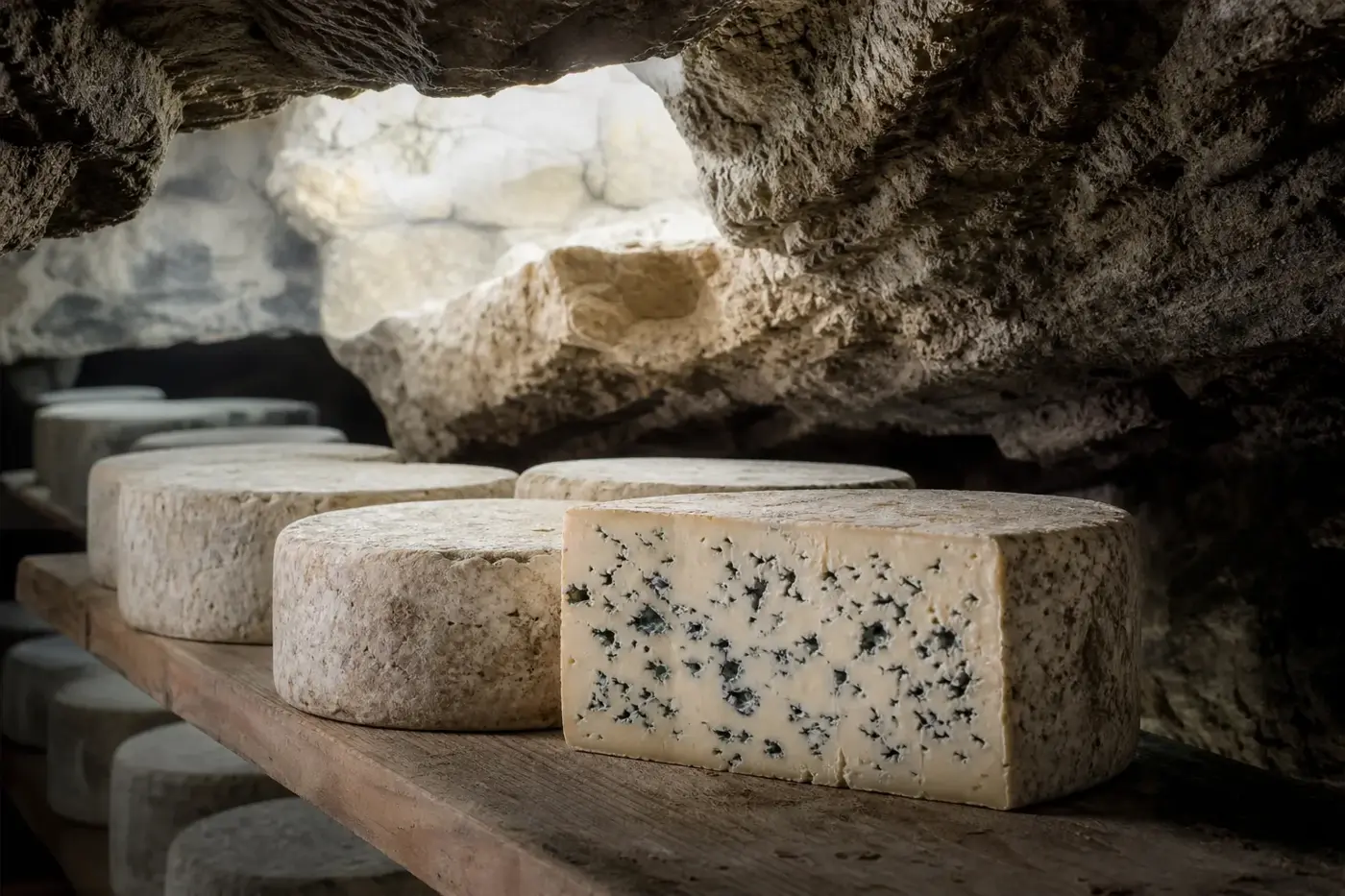
Step into the limestone caves of Roquefort-sur-Soulzon and you feel the place before you taste its cheese. Cool, humid air moves through natural fissures called fleurines. Those openings help define the place where Roquefort must ripen. [2]
With Camembert de Normandie, the story moves to raw milk and successive ladling of curd. AOC and AOP bind places and practices like these to protected names. AOC gives French national recognition; AOP brings European registration and protects the name throughout the European Union. [1][2][3]
Two sets of initials, one distinction worth knowing
AOC stands for appellation d’origine contrôlée, or controlled designation of origin. AOP means appellation d’origine protégée, the French wording for protected designation of origin, abbreviated PDO in English. AOP and PDO belong to the same European scheme, not different rungs on a cheese ladder. [1][4]
For French cheese, the distinction comes down to recognition and legal territory. INAO describes AOC recognition as a required national stage before European AOP registration. Approval in France and registration by the European Commission are separate decisions, each with its own procedures and records. [1][6]
Start with the cheese’s name rather than the prestige of its initials. Which name has recognition, where does protection apply, and what specification must its producers follow? Those questions bring you closer to what matters on your plate. For the wider European picture, turn to protected names explained. [1][4]
Roquefort’s head start in the history books
Roquefort’s recognition in 1925 came before the 1935 framework associated with AOC. That distinction matters: INAO explains that recognising appellations of origin and creating the controlled appellation system were separate legal stages. European protection followed later. [5]
- 6 May 1919: French legislation gave civil courts responsibility for recognising appellations of origin, drawing on established local usage. [5]
- 1925: Roquefort became the first cheese recognised as an appellation of origin. [5]
- 30 July 1935: A decree-law established the controlled appellation category and its national committee, initially centred on wine and spirits. [5]
- 1990: INAO’s responsibilities expanded to AOCs across agricultural and food sectors. [5]
- 1992: The European system introduced protected designations of origin for agricultural products and foodstuffs. [5]
- 2024: Regulation (EU) 2024/1143 replaced Regulation (EU) No 1151/2012 as the principal European geographical indications framework. It entered into force on 13 May 2024, with specified provisions applying later. [4]
How producers give a shared name its protection
The process begins with producers explaining why their cheese belongs to its place. A producer group describes the product, its production area and the rules that preserve that connection. INAO examines the application, including the proposed specification. [1][6]
French recognition comes before submission to the European Commission. The Commission then considers whether the conditions for European registration are met. These are separate stages, each with its own decision to make. [1][6]
Think of one shared name carrying shared obligations. If you join an existing appellation, opening a dairy inside its boundary is not enough. Your location and method must both comply: the right address cannot replace the required cheesemaking, or vice versa. [1][4]
Registration also changes what belongs on the packaging. France’s DGCCRF states that the AOC logo may no longer appear on products registered as AOP. Older references to AOC recognition remain useful history, but present packaging rules follow the cheese’s European status. [6]
Follow the place all the way to the ripening room
A designation of origin protects a defined relationship between a product and its place. Article 46 of Regulation (EU) 2024/1143 requires the product’s qualities or characteristics to be essentially or exclusively due to a particular geographical environment, including natural and human factors. All production steps must happen within the defined area, subject to the regulation’s specified exceptions. [4]
For cheese, that connection runs from milk production through cheesemaking to ageing. The specification draws the boundaries, sometimes distinguishing a wider milk-producing territory from a smaller ripening zone. To understand the whole story, follow each operation rather than stopping at the regional name. [1][2]
Roquefort brings those boundaries into sharp focus. Milk production and cheesemaking take place in a defined area spanning parts of six departments in southern France. Cave ripening belongs specifically to the delimited limestone scree of the Combalou mountain at Roquefort-sur-Soulzon. [2]
Here, the fleurines carry cool, humid air through the caves. As the cheese moves towards maturation, its protected geography narrows. The landscape is part of the method, not simply a handsome backdrop. [2]
Three cheeses, three very particular rulebooks
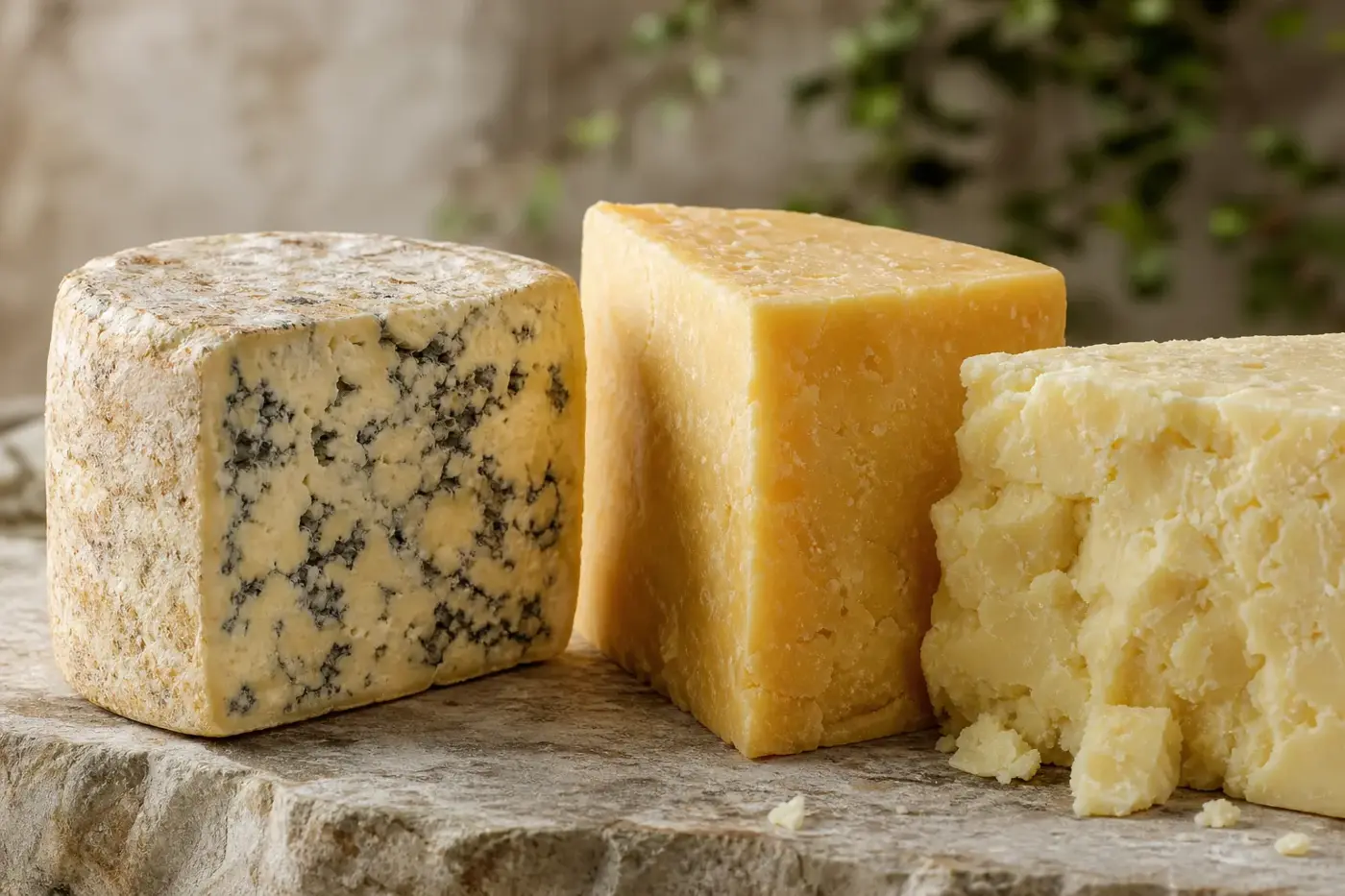
The specification, or cahier des charges, turns the geographical connection into concrete requirements. It can cover animals, feeding, milk treatment, manufacture, dimensions and maturation. Comté, Roquefort and Camembert de Normandie show why you need the individual document rather than a sweeping assumption about French cheese. [1][2][3][7]
Comté: begin with the farm, not the wheel
Comté’s rules reach beyond the finished wheel to the organisation of production. The Comité Interprofessionnel de Gestion du Comté, the appellation’s industry body, reports revised rules covering farm milk production, dairy size and grazing area. The operative EU specification and its application date remain open questions here. [7]
The CIGC’s descriptions show how an appellation can shape farming, cheesemaking and affinage, the skilled management of ripening. Read them as the industry body’s account of its revised rules. Different documents have different roles, even when they concern the same cheese. [7][8]
Its document collection also lists a revised control plan dated January 2026. That gives you another document to explore when looking at the appellation’s compliance arrangements. The production rules and the arrangements for enforcing them deserve separate attention. [7][8]
Roquefort: sheep’s milk, blue veins and limestone
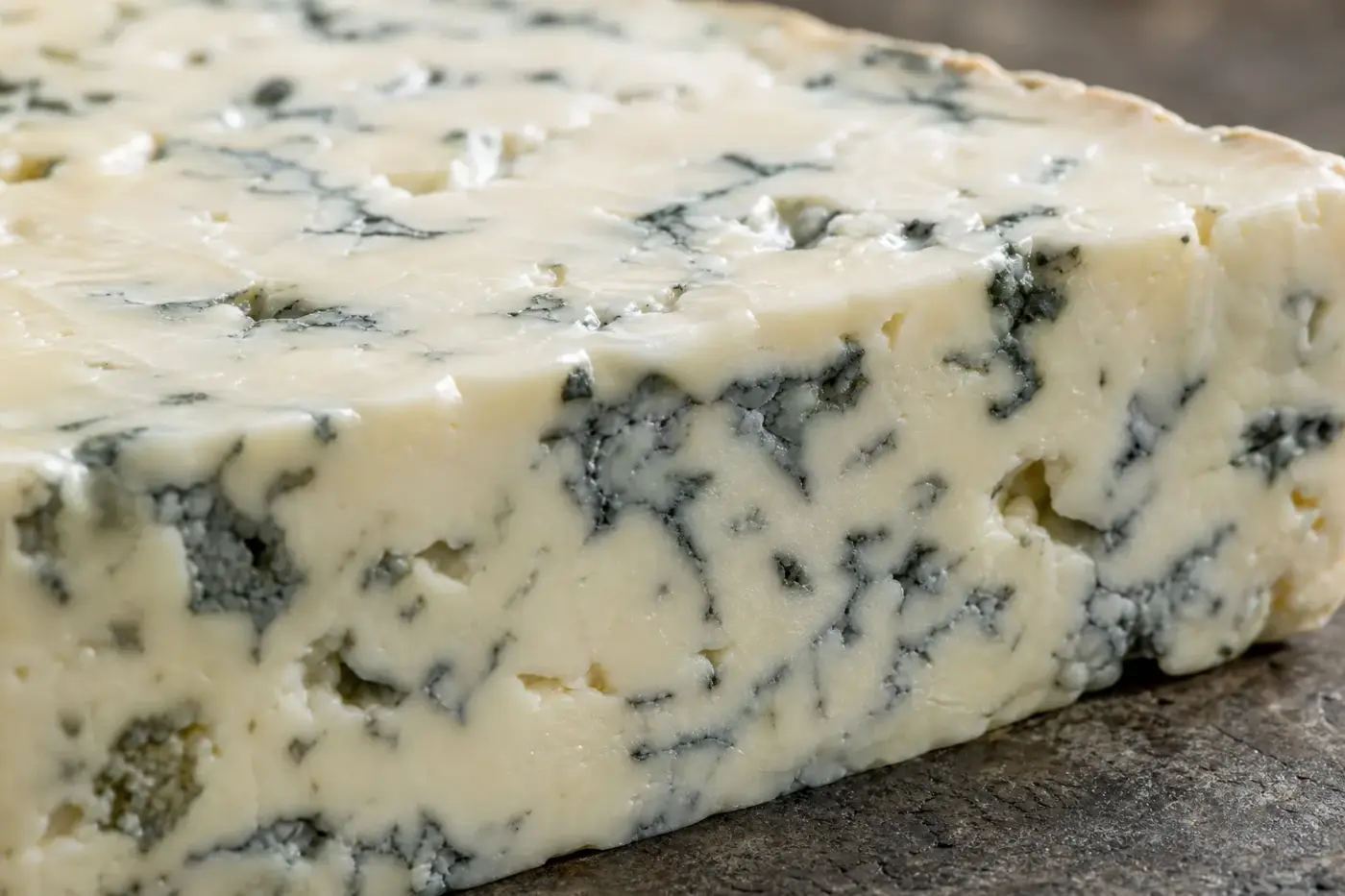
Raw, whole sheep’s milk is required by the Roquefort specification homologated by French order on 6 February 2026. Its status as the operative EU specification remains an open question here. The cheese is seeded with Penicillium roqueforti, the mould responsible for its blue-green veining. [2]
The shape is part of the specification too. It fixes a cylindrical format measuring 19 to 20 cm in diameter and weighing 2.5 to 3 kg. Those details belong alongside the milk and making requirements, not outside them. [2]
INAO’s product record identifies Lacaune sheep and describes at least 90 days of ripening and maturation. Milk, manufacture and that tightly defined maturing environment together form the protected identity. Those memorable caves are a production condition, not an optional bit of atmosphere. [9]
Camembert de Normandie: take time over five ladlings
Five successive additions of curd, separated by 40 minutes, help define Camembert de Normandie. France’s agriculture ministry describes this repeated ladling as part of making the raw cows’ milk cheese in its defined Normandy production area. Curd is the coagulated milk that becomes the body of your cheese. [3]
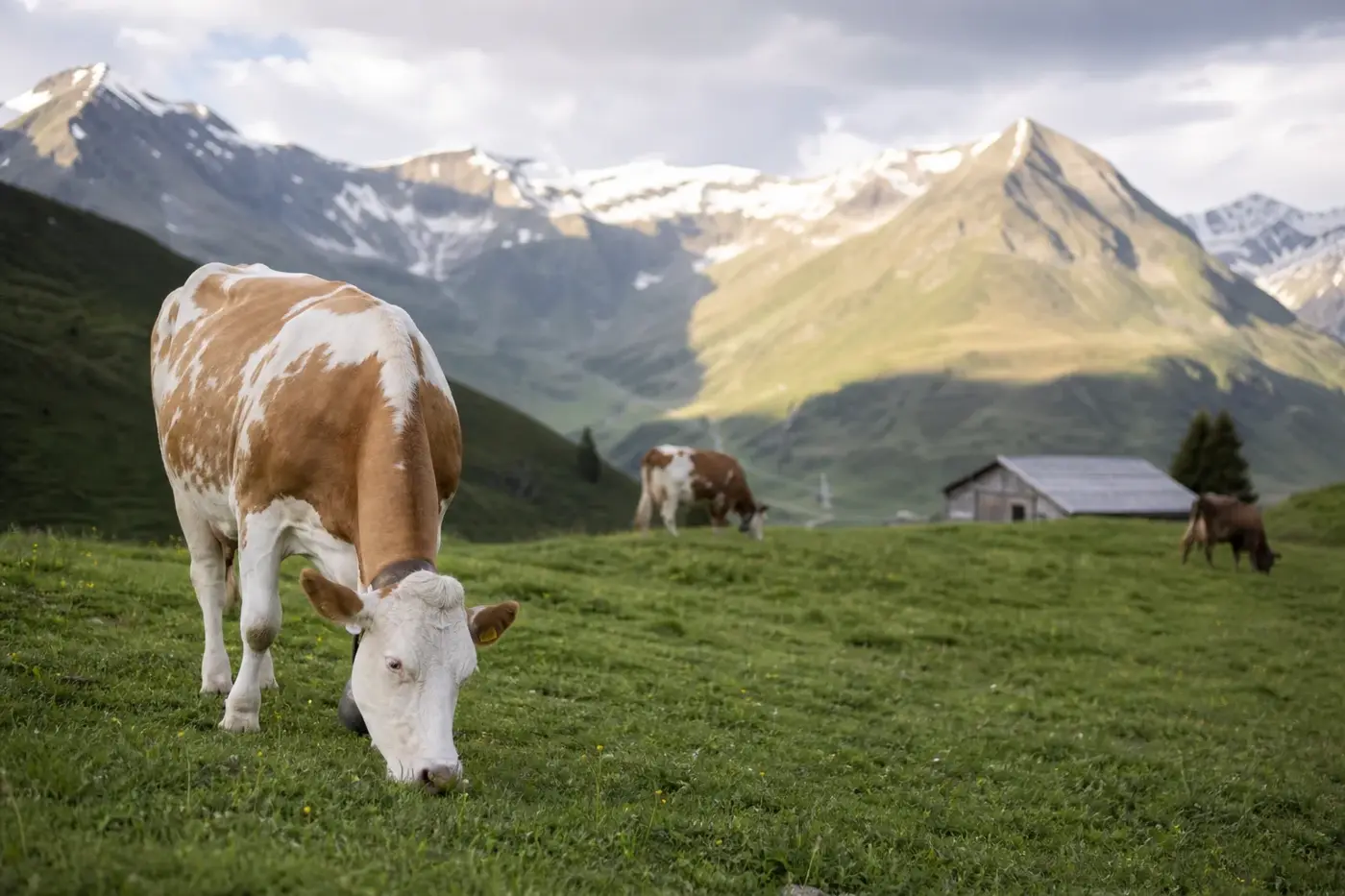
The ministry also describes cattle grazing for at least six months annually and maturation lasting at least three weeks. The finished cheese must weigh at least 250 g and comes in wooden-box packaging. You can trace the requirements from pasture management right through to that small finished cheese. [3]
Put these details beside Comté’s farm and dairy organisation and Roquefort’s cave geography. Each appellation preserves something particular to its cheese. There is no single production recipe hiding behind those shared initials. [3][7][9]
When you choose, look for the full protected name. The broader Camembert style describes a familiar cheese type; Camembert de Normandie identifies production governed by an appellation’s requirements. Those extra words on the label bring rules with them. [3][6]
Meet the rule makers and the inspectors
Producers help develop the shared specification through their representative group. INAO, the Institut national de l’origine et de la qualité, examines recognition applications and oversees France’s official quality and origin system. Each has a distinct part to play. [1][6]
Representation and inspection are separate responsibilities. The producer organisation speaks for the appellation’s participants, while an independent control body checks compliance. Sharing a name does not mean marking your own homework. [1][6]
The DGCCRF describes two levels of official checking in France. Before marketing, certification bodies accredited by COFRAC and approved by INAO check compliance with specifications. On the market, the DGCCRF examines labelling, composition, traceability and misuse of protected names, covering presentation as well as production requirements. [6]
Let the label lead you to the full story
On French AOP cheese marketed in the EU, look for the European PDO symbol and the exact registered name. The familiar red and yellow emblem carries the designation in an EU language. INAO states that the symbol must accompany the registered name and is compulsory for agricultural food products covered by the scheme. [1]
Use the full name on the pack to find the official record. A retailer’s shortened description gives you a less useful starting point. Keep the specification alongside amendment notices, so an older download does not quietly become your go-to version.
- Find the full name in eAmbrosia. Search the Commission’s public register. Make sure the entry concerns the cheese and designation you mean, rather than a similarly worded name. [10]
- Look at the record’s status. Registration, an application and an amendment procedure are different events. Note the document date and jurisdiction before using the information. [4]
- Read the production rules stage by stage. Look separately at milk origin, milk treatment, manufacture and maturation. Apply each clause to the stage it governs, rather than stretching it across the whole process. [2]
- Compare INAO’s technical documents. Product records link specifications and regulatory texts. Roquefort’s record, for example, separates current specification material from earlier amendments and temporary measures. [9]
- Return to your pack. Compare the protected name with the producer’s identity and product information. For the wider packaging task, use how to read a cheese label.
The single document gives you a useful summary, particularly of the production area and geographical link. For technical questions about feed, milk treatment or a manufacturing limit, continue to the full specification and its amendments. Let your question decide how deeply you read: a summary and a detailed production rule do different jobs. [4]
What the initials promise, and what your palate decides
An AOP identifies cheese made under defined origin and production requirements, with compliance checks. It is not one universal scale of flavour or quality. Flavour belongs within the protected identity, but your preferences still matter. [1][9]
Among compliant cheeses, you can choose the texture, maturity and strength you enjoy. Read the individual product description alongside the appellation, especially when comparing ages or makers. The protected name tells you something important, but it cannot choose your favourite for you. [1][9]
Raw milk is another question for the individual specification, not a blanket promise from the letters AOP. Roquefort’s specification expressly requires it; the agriculture ministry describes the same requirement for Camembert de Normandie. Read raw, thermised and pasteurised milk for the treatments, then turn to the rule for your named cheese. [2][3]
Where name protection reaches, and where trademarks fit
Within the EU, Article 26 protects registered names against specified commercial misuse, imitation and evocation, as well as misleading indications of origin. Stating the true production location or adding wording such as “style” does not automatically avoid infringement. The question is how the registered name is used, not simply whether the label also says where the product was made. [4]
Keep territory firmly in view. November 2026 is the reference date for this guide to the French and EU systems. If you are planning labels or exports, consult the operative law for your particular product and market. [1][4]
| What you need to understand | Where it applies | Official source to consult | Reference date |
|---|---|---|---|
| AOC recognition | France | INAO’s AOP/AOC guidance [1] | November 2026 |
| AOP registration and EU name protection | European Union | Regulation (EU) 2024/1143 [4] | November 2026 |
| Protection in another market | Destination jurisdiction | Relevant local law and applicable agreements [4] | November 2026 |
Outside the EU, protection depends on the destination’s law and applicable international arrangements. Treat EU registration as your starting point for investigating overseas rights, not the final answer. Before claiming protection abroad, establish the exact name, territory and agreement coverage, including exceptions. Each market needs separate attention. [4][5]
A trademark identifies a producer’s commercial identity. An AOP identifies a product meeting collective geographical and production conditions, so several producers can share an appellation while selling cheese under their own brands. Earlier trademarks and geographical indications can raise a separate legal question, and that relationship needs its own assessment. [4]
Take the names back to the cheeseboard
- Protected Names Explained: PDO, PGI and TSG: get to know what the different European schemes are there to do.
- Comté: follow one appellation from its production rules to the cheese itself.
Questions people ask
What is the difference between AOC, AOP and PDO?
AOC is French national recognition, while AOP is European registration protecting a name throughout the EU. AOP and PDO are French and English names for the same European scheme.
Does AOP cheese have to be made with raw milk?
Raw milk is a matter for the individual cheese’s specification, not a promise made by the letters AOP. Roquefort’s specification requires raw milk, and the French agriculture ministry describes the same requirement for Camembert de Normandie.
What is the difference between Camembert and Camembert de Normandie?
Camembert describes a broader cheese style, while Camembert de Normandie is governed by an appellation’s requirements. The French agriculture ministry describes it as a raw cows’ milk cheese made in a defined Normandy area using successive ladlings of curd.
How can I recognise an AOP cheese on the label?
Look for the exact registered name and the red and yellow European PDO symbol. France’s DGCCRF states that the AOC logo may no longer appear on products registered as AOP.
Is an AOP cheese name protected outside the EU?
Outside the EU, protection depends on the destination’s law and applicable international arrangements. The exact name, territory and agreement coverage, including any exceptions, need a separate check for each market.
Sources
- INAO. Appellation d'origine protégée / contrôlée (AOP / AOC). Undated web guidance, retrieved November 2026. Definitions, national recognition, specifications, controls and labelling.
- French Ministry of Agriculture. Cahier des charges de l’appellation d’origine protégée « Roquefort ». Homologated by the order of 6 February 2026, published in the Journal officiel on 11 February 2026 and the ministry’s Bulletin officiel No 2026-07 on 12 February 2026.
- French Ministry of Agriculture. Camembert de Normandie AOP : le goût unique du lait cru et des pâturages. 16 March 2026. An official explanatory account, rather than the registered specification.
- European Parliament and Council. Regulation (EU) 2024/1143 of 11 April 2024 on geographical indications for wine, spirit drinks and agricultural products, as well as traditional specialities guaranteed and optional quality terms for agricultural products. Original act and consolidated text dated 18 March 2026, particularly Articles 2, 26, 31, 37, 46, 49, 50 and 90.
- INAO. Exposition 90 ans : Aux origines des SIQO et de l’INAO. Undated historical exhibition, retrieved November 2026.
- Direction générale de la concurrence, de la consommation et de la répression des fraudes. Les signes officiels de la qualité et de l’origine des produits alimentaires. 19 December 2025. National and European recognition, certification, market surveillance and packaging.
- Comité Interprofessionnel de Gestion du Comté. Nouveau cahier des charges, même recette. Page dated 19 November 2025, containing an account of publication on 7 January 2026. Industry-body statements are attributed in the article.
- Comité Interprofessionnel de Gestion du Comté. Documents officiels. Live document catalogue, retrieved November 2026; lists the January 2026 specification and control plan.
- INAO. Roquefort. Product record and linked regulatory documents, retrieved November 2026.
- European Commission. eAmbrosia geographical indications register. Live register interface, retrieved November 2026; linked as the official register by the DGCCRF guidance in source 6.
This desk-researched article compares official explanations, legislation and retrieved production documents, with industry statements identified separately.
Last checked: November 2026
Last checked November 2026.
The editors suggest you read next
Cheese Law Around the World: The Complete Guide
GRUYERE reached an American legal border and lost its exclusivity.