DOP: Italian Cheese Protection
Look closely at a piece of Gorgonzola: blue-green or grey-blue veins thread through the cheese.
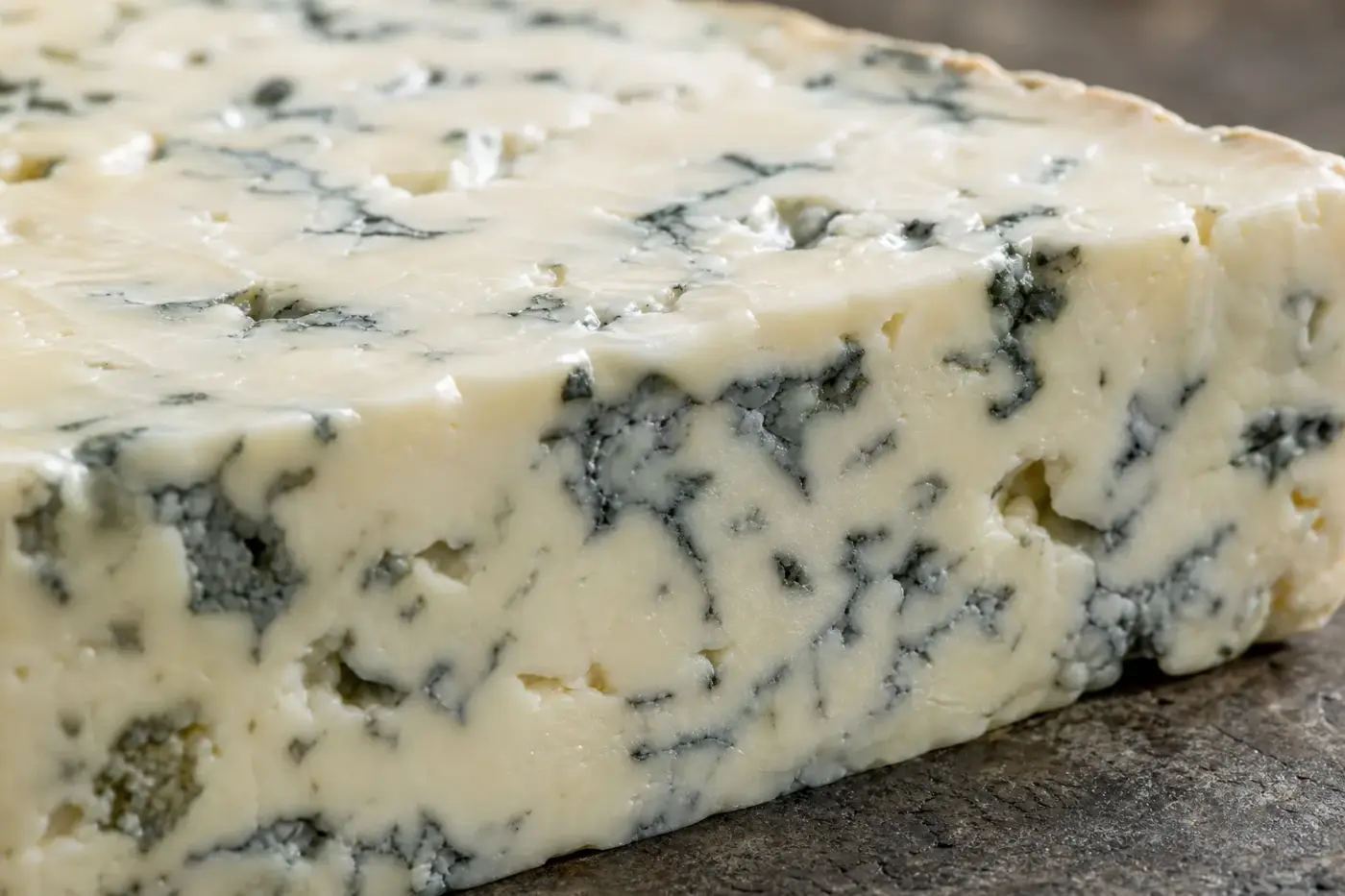
Look closely at a piece of Gorgonzola: blue-green or grey-blue veins thread through the cheese. Even those colours have a place in its production specification, alongside the milk and maturation that shape each piece. You might have come for lunch, but there is rather a lot to read in that slice. [5]
Behind the three letters DOP sits Denominazione di Origine Protetta, the Italian name for the EU’s protected designation of origin, or PDO. Its promise is specific: the milk, the make and the maturation belong to a defined place. The registered name ties the cheese to its geographical environment, with a binding production specification behind it. This protection goes beyond the name on your label. [1,2]
A sense of place, down to the last detail
Place means landscape, but it also means the skills of the people working there. Article 46 of Regulation (EU) 2024/1143 requires a PDO product’s qualities or characteristics to be essentially or exclusively attributable to its geographical environment, including natural and human factors. Every production stage must happen within the defined geographical area. [1,2]
For cheese, that joins the landscape supplying the milk to the knowledge that turns it into the specified product. A regional story is not enough: the registration application must demonstrate the geographical link through the cheese’s characteristics and production method. If you see DOP on one cheese and PDO on another, these are the same EU designation in different languages, not different levels of prestige. [1,2]
Through the dairy door, with the rulebook
The disciplinare di produzione, or production specification, turns a protected name into instructions people can work by. Under Article 49, it must identify the product, draw its geographical boundaries and explain the link between them. It must also describe production and provide for verification and any specific labelling rules. [1]
Follow those instructions into the dairy and the questions become wonderfully particular. Which animals supply the milk, and where are their farms? Is the milk raw or heat-treated, and which coagulant goes into it? The rules cover curd handling and maturation too, and can prescribe wheel identification and the presentation of portions or grated cheese. [5,6,7]
Producers must document that they meet these operating conditions. For you, these are the commitments behind the name, but each belongs to its particular cheese. The next three examples show why a milk treatment or maturation rule for one DOP cheese is not a rule for them all. [5,6,7]
Three cheeses with their own way of doing things
Parmigiano Reggiano’s map takes you through Parma, Reggio Emilia and Modena, then Bologna on the left bank of the Reno and Mantua on the right bank of the Po. Its specification describes a hard, cooked-curd cheese made with raw cows’ milk, partly skimmed by natural creaming. The consortium identifies the current specification as effective from 24 April 2025. You can follow its production and maturation in the individual cheese profile. [7,8]
Gorgonzola follows another route, requiring whole pasteurised cows’ milk from an area spanning parts of Piedmont and Lombardy. In Alessandria, that means named municipalities, not the entire province. Its dolce, piccante and piccola piccante formats have minimum maturation periods of 50, 80 and 60 days respectively. The specification sets maximum periods too, and describes those unmistakable blue-green or grey-blue veins. [5]
Pecorino Romano reaches beyond the place its name might suggest: Sardinia, Lazio and the province of Grosseto in Tuscany. It requires whole sheep’s milk, permits thermisation and specifies lamb rennet paste from animals reared and slaughtered within the area. Minimum maturation is five months for table cheese and eight months for grating cheese. Three names, three distinct sets of boundaries, methods and identities. [6]
How a local name earns its place
A producer group representing the product normally starts the application. In Italy, the national process involves MASAF, the Ministry of Agriculture, Food Sovereignty and Forestry, alongside the relevant regions or autonomous provinces. The group prepares a proposed specification, supporting evidence and a single document summarising the essential product rules and geographical link. A familiar regional name still needs to demonstrate that connection. [1,3,4]
National scrutiny includes an opportunity for opposition. After a favourable Italian decision, the application goes to the European Commission for Union scrutiny, with publication for opposition at EU level another stage along the way. Registration follows the applicable examination and opposition procedure. An application under examination is not yet a registered name: legally, these remain distinct states. [1,3]
If you are following an application, dates matter. Italy’s current procedural decree was adopted on 22 December 2025, published on 16 March 2026 and entered into force on 17 March 2026. Earlier national provisions still govern applications submitted to the ministry by 31 March 2026. That transition tells you which procedure applies when you follow an older application through public records. [4]
Meet the people looking after the name
A consorzio di tutela represents producers, with recognised functions including promotion and protection of the name. Italy’s June 2026 decree also provides for market surveillance under ICQRF coordination. A consortium can defend the designation and help you understand it while representing producers’ collective interests. Verification and public oversight are separate responsibilities. [9,10]
| Who is involved | Their role in Italy | Legal source | Reference date |
|---|---|---|---|
| Recognised consortium | Promotes and protects the name; carries out assigned surveillance under public coordination. | Ministerial Decree 3 June 2026, Articles 17 and 18 [9] | November 2026 |
| Authorised control body | Checks compliance with the specification through the authorised control system. | Regulation (EU) 2024/1143, Article 39; Italian official controls framework [1,10] | November 2026 |
| MASAF and ICQRF | Provide public oversight; ICQRF manages delegated GI controls and coordinates consortium surveillance. | Italian official controls framework; Ministerial Decree 3 June 2026 [9,10] | November 2026 |
The ministry’s published framework and consortium decree keep those responsibilities distinct: producer representation, conformity verification and public oversight. The body assessing conformity works within the official control framework. Promoting a cheese does not make a consortium its regulator. [9,10]
As a buyer, you want to know whether the cheese falls within the authorised verification system. For producers, conformity also means keeping records. Pecorino Romano’s specification expressly requires documented inputs and outputs, registered operators and declared production quantities so the cheese can be traced. [6,9,10]
At the counter, look beyond the branding
Start with the registered name and the EU PDO symbol on Italian DOP cheese marketed in the EU. Look for the circular red and yellow designation seal, rather than the producer’s branding or a consortium mark. Article 37 makes that EU symbol mandatory for EU-origin agricultural products marketed under their GI, including these cheeses. The protected name must appear in the same field of vision. [1,2]
Since 14 May 2026, Article 37(5) has also required the producer’s or qualifying operator’s name in the same field of vision as the GI. The Commission’s October 2026 FAQ explains that a retailer’s brand alone normally will not do. A small-pack exception applies: on packaging or containers whose largest surface is less than 10 cm², the producer or operator indication is voluntary. [1,11]
You may also see Denominazione di Origine Protetta written out, or the abbreviation DOP. Unlike the mandatory symbol, these are optional indications under EU law. Individual specifications add their own identification requirements: Pecorino Romano’s sets out an official distinctive mark for prepacked cheese. A consortium mark can offer useful information, but it is not interchangeable with the EU seal. [1,6]
Buying a counter-cut piece? Ask to see the original wheel identification or its accompanying information. For packaged cheese, read the protected name alongside the producer details and any stated age or type. The guide to reading a cheese label helps you make sense of the other information alongside the designation.
Let DOP guide you, then follow your appetite
DOP gives you a defined origin and production framework, backed by verification. As these three specifications show, that framework accommodates very different milk treatments, wheel formats and maturation schedules. It says nothing about producer size: operators meeting its conditions can use the designation, whether or not they are small dairies. [1,5,6,7]
Your appetite still gets a vote, and it rarely enjoys being overruled. If you want blue-veined cheese, you are after something quite different from a hard sheep’s milk cheese, even if both carry DOP. Use the designation to understand the cheese’s identity. Then choose the maker, format and maturity that suit your dish, or simply the way you love to eat it. [5,6]
The protection goes beyond the spelling
The law reaches further than exact copies of registered words. Article 26 protects registered names against specified commercial misuse, imitation and evocation, as well as misleading indications or practices concerning origin. Those rules can apply even when the true origin is stated. Adding “style”, “type” or “imitation” to the name is not necessarily a way around them. [1]
A cheesemaker outside the defined area cannot simply reproduce the technique and gain the right to sell cheese under the protected designation in the EU. For you, familiar Italian imagery is a reason to read the actual name carefully. Whether particular wording or presentation infringes protection depends on the applicable legal test and facts. [1,2]
What happens when the name travels?
Outside the EU, the destination’s law and any applicable agreement determine protection. European registration alone does not settle how every overseas market treats a name. The European Commission distinguishes EU registration records in eAmbrosia from agreement coverage, which you can search through GIview. [2]
Great Britain has its own protection record. Defra lists Gorgonzola as a registered PDO under the UK scheme, with registration dated 31 December 2020 and the reason for protection recorded as “EU agreement”. That entry establishes Gorgonzola’s recorded status in Great Britain, but does not bring every subsequent EU rule into British law. The status reference date is November 2026. [12]
Before you use a rule, find its date
A cheese’s name can stay registered while its rules change. Italy publishes separate records for Union amendments, standard amendments and temporary amendments, so distinguish a proposal under examination from an approved change. The ministry’s procedure page also separates national opposition records from applications sent to the Commission after a favourable decision. [3]
For a technical detail, start with the registered name, then follow the specification and its amendment history. Put the date beside the rule. This is particularly useful for milk treatments, maturation categories and packaging requirements: an older summary may preserve wording that a later approved specification has changed. [3,5,6,8]
Curious about the distinctions between PDO, PGI and TSG, or the wider questions behind naming disputes and territorial protection? Continue with protected names explained. The broader framework explains the designation. The individual specification tells you exactly what the cheese in front of you must be. [1,2]
Questions people ask
What does DOP mean on Italian cheese?
DOP stands for Denominazione di Origine Protetta, the Italian name for the EU’s protected designation of origin, or PDO. The milk, production and maturation must belong to a defined geographical area and follow a binding specification.
Where can Pecorino Romano be made?
Its production area covers Sardinia, Lazio and the province of Grosseto in Tuscany. Its specification requires whole sheep’s milk.
How can I recognise Italian DOP cheese at the counter?
For cheese marketed in the EU, look for the registered name and the circular red and yellow EU PDO symbol. For a piece cut at the counter, ask to see the original wheel identification or its accompanying information.
Can cheese made outside the protected area be sold as DOP if it uses the same method?
Reproducing the technique does not give a cheesemaker outside the defined area the right to sell under the protected designation in the EU. Protection can also apply to imitation or evocation, even when the true origin is stated or words such as “style” are used.
Is Gorgonzola protected in Great Britain?
Defra lists Gorgonzola as a registered PDO under the UK scheme, with registration dated 31 December 2020. The page notes that this record does not carry every subsequent EU rule into British law.
Sources
- European Parliament and Council. Regulation (EU) 2024/1143, adopted 11 April 2024, published 23 April 2024. Principal provisions relevant here: Articles 9 to 22, 26, 37, 39, 46 and 49. Official text.
- European Commission, Directorate-General for Agriculture and Rural Development. Geographical indications and quality schemes explained, live guidance retrieved November 2026. Official guidance.
- MASAF. Procedure di registrazione, modifica del disciplinare e cancellazione: DOP, IGP, STG prodotti agricoli, current procedural guidance, 2026. Official procedure page.
- MASAF. DM 690637 del 22/12/2025: Procedure nazionali di registrazione, modifica del disciplinare e cancellazione IG e STG, publication and commencement information, 2026. Official decree page.
- MASAF. Disciplinare della denominazione di origine protetta «Gorgonzola», ministry-hosted specification, edition date not stated in the retrieved document. Available through the official cheese specifications index.
- MASAF. Disciplinare di produzione “Pecorino Romano” DOP, document identified as 16 March 2026. Available through the official cheese specifications index.
- MASAF. Proposta di modifica del disciplinare di produzione della denominazione di origine protetta “Parmigiano Reggiano”, undated ministry-hosted text. Version reconciliation is recorded in the editorial evidence log. Available through the official cheese specifications index.
- Consorzio del Formaggio Parmigiano Reggiano. Disciplinare e normative, identifying the specification and single document effective from 24 April 2025. This is the consortium’s publication. Specification publication page.
- MASAF. Decreto ministeriale 3 giugno 2026, n. 0264637, concerning recognition and functions of agricultural geographical indication producer groups, particularly Articles 17 and 18. Ministry-hosted signed decree.
- Italian Ministry of Health, with MASAF as the identified source. Organismi delegati ad effettuare Controlli Ufficiali, updated 10 February 2026. Official controls framework.
- European Commission. Frequently Asked Questions on GI and TSG systems, linked from the Commission’s guidance page under 13 October 2026. Relevant passages concern Article 37(5), producer identification, private labels, commencement and small packaging. Official FAQ.
- Department for Environment, Food & Rural Affairs. Gorgonzola, protected food name register entry, published 4 January 2021, retrieved November 2026. Official register entry.
This piece was researched from EU legislation, European Commission guidance, Italian ministry documents and the Great Britain register, with the Parmigiano Reggiano consortium’s publication identified separately.
Last checked: November 2026
Last checked November 2026.
The editors suggest you read next
Cheese Law Around the World: The Complete Guide
GRUYERE reached an American legal border and lost its exclusivity.