Cheese in Art and Literature
Macaroni and ravioli tumble down a mountain of grated Parmesan, ready for anyone below to gather.
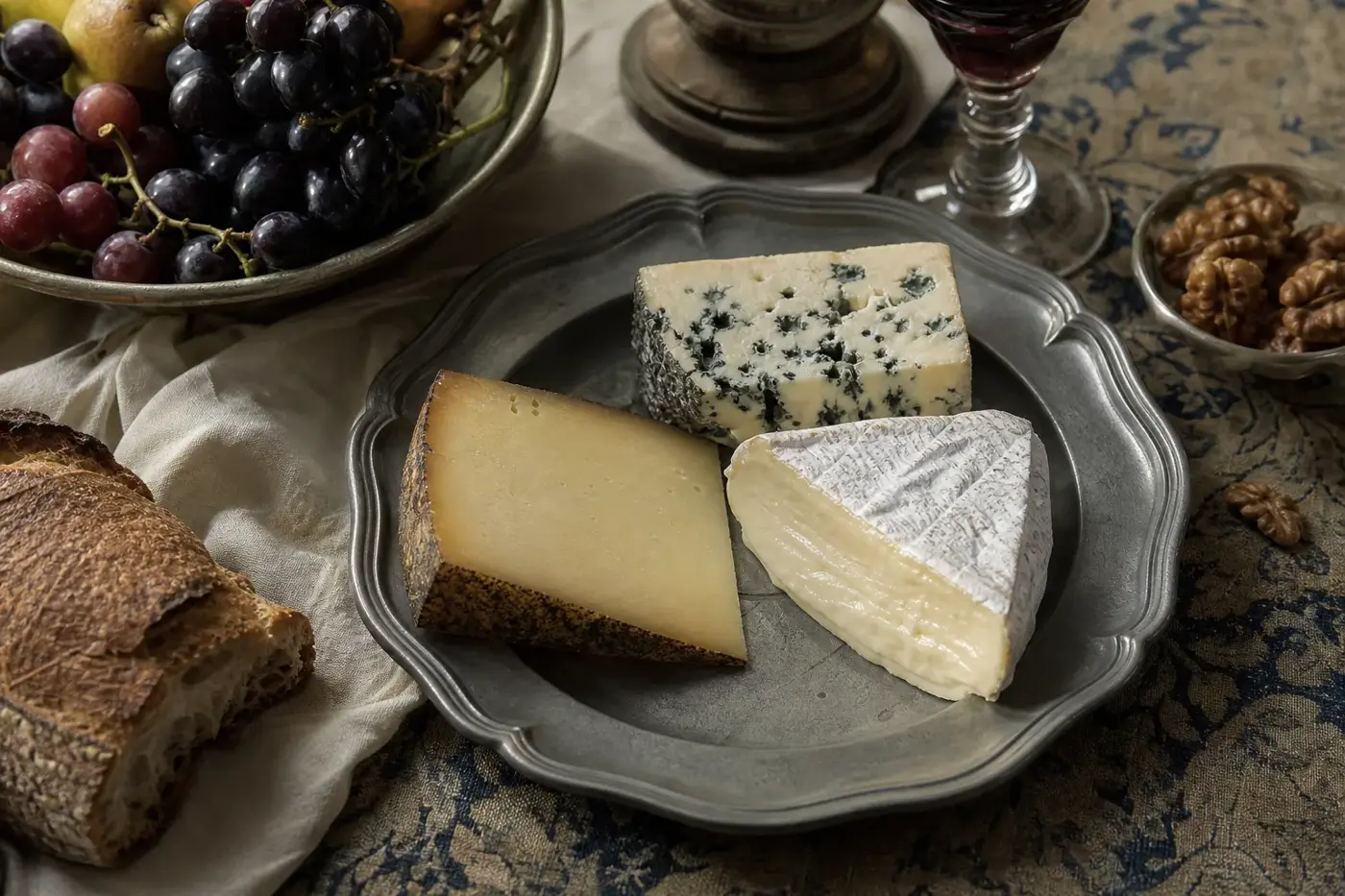
Macaroni and ravioli tumble down a mountain of grated Parmesan, ready for anyone below to gather. Welcome to the Decameron, where dinner comes downhill and nobody need be shy about seconds. Elsewhere, three cheeses rise from a pewter dish in Floris van Dijck’s Still Life with Cheeses, painted around 1615, with fruit, bread and tableware around them. One work feeds an impossible appetite; the other asks you to linger over everyday food.[1][4]
Follow the cheese and the company gets stranger. A frightened man recruits a crumb to explain away a ghost, while a marooned man dreams of having his cheese toasted. These small portions have a surprising amount of work to do.[5][6]
Come closer to Van Dijck’s table
The pewter plate seems to reach towards you, bringing Van Dijck’s spread almost within touching distance. The Rijksmuseum in Amsterdam records Still Life with Cheeses as an oil on panel by Floris Claesz van Dijck, dated about 1615. Its catalogue points to the high viewpoint and relatively little overlap between objects. Each thing has room to catch your eye.[1]
Let your gaze follow the soft light. The cheeses have weight, the vessels hold reflections, and the linen has a pattern worth pausing over. Start where a cheese’s outer surface meets its cut face, then follow that face towards the bright rim of the dish. Dense food meets reflective metal; rounded forms sit against folds of cloth.[1]
Give those differences a little time. Cutting, arranging and serving matter here as much as the vessels surrounding the food. Everything has been carefully placed, yet nothing needs to be extraordinary to hold your attention. The ordinary contents of this table are reason enough to stay.[1]
Follow the crumbs at Clara Peeters’s table
Small shreds of cheese bring you close to someone’s hands. In Clara Peeters’s Still Life with Cheeses, Almonds and Pretzels, also dated about 1615, a pyramid of cheeses supports a plate of butter curls. The Mauritshuis in The Hague, which owns the painting, highlights the dark green cheese’s crumbly texture and a sampling hole in the larger cheese. Someone has removed and replaced a plug, leaving shreds on the plate.[2]
Peeters worked in the Antwerp tradition, which the museum places among the beginnings of the meal still life. Her painting and Van Dijck’s belong to an exchange of pictorial ideas between Antwerp and the northern Netherlands. These tables were not a purely Dutch invention developing in isolation. Ideas travelled, and painted food went with them.[2][3]
To find your way into the texture, look for what is irregular. A broken edge, a cut surface or a displaced crumb helps your eye recognise substance. Beside the cheese, the museum draws attention to reflected light on the knife and the softness of the butter. Each offers a different pleasure: the knife catches light, while soft butter sits against crumbly cheese.[3]
A table dressed to impress
Look beyond the dairy food in Peeters’s painting and you will find a Chinese dish and a partly gilded glass made in the Venetian manner. The Mauritshuis identifies both objects. Set among such carefully arranged food, they suggest cultivated hospitality: a table intended to please and impress. You can see the objects for yourself; imagining their social purpose starts with their arrangement.[2]
Cheese and butter also belonged to the Netherlands’ export economy, as the museum’s catalogue explains. Its suggested meanings reach from prosperity to anxiety about excess and the passing of earthly things. You can admire a laden table and feel uneasy about it too. The abundance may impress you precisely because it prompts a question about what earthly plenty amounts to.[2]
Yet nobody sits at either painted table. You can imagine an arrival, some company or an offered portion, but the food remains beyond your reach. That distance makes the invitation more tantalising: the meal is permanently ready, and nobody can eat it. Hospitality becomes something to contemplate rather than accept.[1][2]
Visit Bengodi, where Parmesan forms the landscape
In the Decameron, Day Eight, story three, you leave the table and enter a country built for appetite. Maso del Saggio tells the credulous Calandrino about Bengodi, where a mountain consists entirely of grated Parmesan. People on it make macaroni and ravioli, cook them in capon broth and send them tumbling down for others to gather. Sausages serve as vine ties, and a stream of wine flows nearby.[4]
Take a moment to picture the scale. Cheese you might scatter over a dish becomes the very ground on which dinner is made. Familiar relationships between ingredients swell into absurdity. Unlike the still lifes, which hold everything in place, Bengodi sends dinner rolling downhill towards anyone ready to collect it.[4]
Calandrino has a practical question: what happens to the capons used for the broth? Then he imagines going to watch the pasta fall and eating his fill. Maso’s invented country succeeds because its pleasures feel solid enough to ask questions about. Satisfaction comes effortlessly in this fantasy of plenty, while the story reveals how readily a persuasive speaker can draw someone in through their desires.[4]
Set that mountain beside the painted stacks and notice what height does. Van Dijck and Peeters offer arrangements you can measure against dishes and vessels; Maso gives you a quantity beyond ordinary reckoning. The paintings reward your admiration for the convincing presence of objects, while the story delights in exaggeration. Both begin with recognisable food, then invite you to follow what happens to it.[1][2][4]
Watch Scrooge put a crumb between himself and a ghost
From a mountain to a mouthful, or rather what remains of one. In Stave One of A Christmas Carol, ‘Marley’s Ghost’, Scrooge tries to dismiss his dead business partner’s appearance by blaming disturbed digestion. His possible explanations include ‘a crumb of cheese’, alongside beef, mustard and an underdone potato. Dickens then shows you the fear beneath the cleverness: Scrooge is distracting himself and trying to suppress his terror.[5]
The cheese matters because it is so small and ordinary. Confronted with the dead, Scrooge reaches for the remnants of a meal, reducing the unknown to an inventory he can manage. Something once on a plate seems easier to explain than a visitor carrying a moral demand. A crumb is, admittedly, a modest defence against the supernatural.[5]
Listen for the scene’s two voices. Scrooge supplies the explanation; the narrator exposes the fear behind it. That separation keeps the humour and drama alive together. You watch a man trying to remain master of his surroundings as his familiar explanations fail, with cheese pressed into service as part of his defence.[5]
Hear what Ben Gunn really misses
‘Toasted, mostly’: Ben Gunn knows how he wants his cheese. In Chapter XV of Treasure Island, ‘The Man of the Island’, he tells Jim Hawkins that he has been marooned for three years, living on goats, berries and oysters. He asks for cheese, remembering ‘many’s the long night I’ve dreamed of cheese’. Then he gives that particular preference for its preparation.[6]
You can hear more than hunger in the request. Toasted cheese suggests the remembered comforts of a prepared meal, another rhythm of life and company beyond the island. Read as homesickness, it brings an enormous loss within reach through something modest enough for Jim to imagine supplying. Not any food will do: he misses this food, prepared this way.[6]
That wish changes the temperature of Stevenson’s scene. Jim has encountered a frightening stranger; now the request opens a route towards sympathy. You can recognise an appetite before you understand the whole person. Where Bengodi expands food into impossible plenty, Ben Gunn gathers his desire around one missing thing, and its precision helps you feel the loss.[6]
Look for the rind, listen for the longing
The paintings give appetite a surface; the prose gives it a situation and a voice. You see rind beside cut face, cheese beside metal, butter beside glass. Boccaccio makes food the material of an elaborate deception, Dickens turns it into a defensive explanation, and Stevenson uses its absence to help you understand a stranger. In every setting, the cheese has different work to do.[1][2][4][5][6]
Each work leaves space for your imagination. A painted cheese may suggest resistance under a knife, or the difference between a dry edge and a softer centre. Toasted cheese may bring back a remembered smell. These responses arise as you encounter the work: the artist or writer offers enough detail to get you imagining, without describing every sensation.
Familiarity and deliberate choice give ordinary food this extraordinary cultural range. Cheese can carry ideas about display, satisfaction, self-command or belonging because a particular work places it in a particular relationship. Rather than search for one meaning across centuries, ask why this cheese appears here. Scale, setting and speaker all change what it can do.[1][2][4][5][6]
Think about time, too. A painting lets you return to the same unchanged surface, while a story carries you through expectation, speech and response. Ben Gunn’s wish gains force from what comes before it; Scrooge’s explanation matters because you watch it fail. Read either scene aloud after looking at a painting, and you may find it easier to notice the difference between a held arrangement and an unfolding encounter.[1][2][5][6]
Give the small details your attention
The strongest readings begin with particulars, not a grand theory. Across these five examples, a collection record gives you an attribution and an approximate date, a painting offers an arrangement of objects, and a literary passage tells you what a character says within a story. Ideas about symbolism, homesickness or an invitation to hospitality grow from those details. Their persuasiveness depends on how closely you attend to the work.
Take Peeters’s elaborate knife. The Mauritshuis identifies it as a bridal knife and notes her signature on it; the catalogue suggests it may have been her own wedding present, while leaving that possibility open. Before imagining its history of ownership, spend time with the signature and decoration. Looking closely makes the object interesting in its own right and gives you firmer ground for asking what it might have meant.[2]
Begin with a picture, stay for the whole scene
Start with the museums’ own images, where you can linger over the details. For the literary works, give yourself a complete scene rather than stopping at the cheese remark. This short route keeps what you notice close to what you make of it:
- Open the Rijksmuseum collection record for Van Dijck. Take in the whole arrangement, then enlarge the cheese and the plate at the table’s edge. Before travelling, consult the current record and official visiting information for display, booking and accessibility details.[1]
- Compare the Mauritshuis collection record for Peeters. Find the sampling marks, butter curls and knife, then step back to see how the different materials share the table. Consult the museum’s current visiting arrangements before planning to see the original.[2]
- Read Day Eight, story three at Brown University’s Decameron Web, including Maso’s description and Calandrino’s questions. Pay attention to those practical questions. They make an impossible country seem briefly manageable.[4]
- Find Stave One in A Christmas Carol and Chapter XV in Treasure Island, both available through Project Gutenberg. Keep reading beyond each cheese remark. Scrooge’s fear and Jim’s developing response to Ben Gunn give those details their narrative force.[5][6]
If you would like a practical vocabulary to bring back to the pictures, how to tell cheese styles apart helps organise your attention around rind, texture and method. Poems, collected quotations and screen appearances belong in the separate hubs on cheese in poetry, quotations, film and television within Cheese in the Arts. Here, start with one painted table and one complete scene.
Put them beside each other and notice what each invites you to imagine. Perhaps it is the substance of a cut cheese, the scale of impossible plenty, or the comfort of something long missed. You have something familiar to begin with. See how far it takes you.
Questions people ask
Where can I find Floris van Dijck’s painting of cheeses?
The Rijksmuseum in Amsterdam records Still Life with Cheeses as an oil on panel by Floris Claesz van Dijck, dated about 1615. Its collection record includes an image of the painting.
What are the marks on the cheese in Clara Peeters’s painting?
The Mauritshuis identifies a sampling hole in the larger cheese. A plug has been removed and replaced, leaving shreds on the plate.
What happens on the cheese mountain in the Decameron?
In Day Eight, story three, Maso del Saggio describes people making macaroni and ravioli on a mountain of grated Parmesan. They cook the pasta in capon broth and send it tumbling down for others to gather.
Why does Scrooge mention cheese in A Christmas Carol?
Scrooge tries to explain away the appearance of his dead business partner by blaming disturbed digestion. He mentions a crumb of cheese among other foods, while the narrator reveals that he is trying to suppress his terror.
Why does Ben Gunn ask for cheese in Treasure Island?
Ben Gunn tells Jim Hawkins that he has spent three years marooned, living on goats, berries and oysters. He says he has dreamed of cheese and specifies that he likes it toasted.
Sources
- Rijksmuseum. Still Life with Cheese, Floris Claesz van Dijck, c. 1615, object SK-A-4821. Collection record and catalogue entry by J.P. Filedt Kok, 2007, in Dutch Paintings of the Seventeenth Century in the Rijksmuseum, current online version consulted November 2026. The record also gives Still Life with Cheeses as a title.
- Mauritshuis. Still Life with Cheeses, Almonds and Pretzels, Clara Peeters, c. 1615, inventory 1203. Collection record and catalogue text, adapted from Edwin Buijsen’s ‘Clara’s Cheeses’, Mauritshuis in focus 25(2), 2012, pp. 14 to 22; current online version consulted November 2026.
- Mauritshuis. Slow Food: Still Lifes of the Golden Age. Archived exhibition introduction, 2017. Used for the relationship between Antwerp and northern Netherlandish meal still lifes and the discussion of painted textures.
- Giovanni Boccaccio. Decameron, ‘Eighth Day, Novel III’. Brown University, Decameron Web, English online text, undated edition consulted November 2026, especially paragraphs 004 to 018.
- Charles Dickens. A Christmas Carol. 1843; Project Gutenberg ebook 46, updated 4 March 2018. Stave One, ‘Marley’s Ghost’, especially the exchange about trusting the senses and the narrator’s explanation immediately afterwards.
- Robert Louis Stevenson. Treasure Island. Project Gutenberg ebook 27780, released 12 January 2009, transcribing the 2002 Gramercy Books edition. Chapter XV, ‘The Man of the Island’.
This piece combines desk research in museum collection catalogues with close reading of the literary passages, distinguishing documented details from editorial interpretation.
Last checked: November 2026
Last checked November 2026.
The editors suggest you read next