Cheese in Songs, Poems and Nursery Rhymes
Picture the ceremonial welcome.
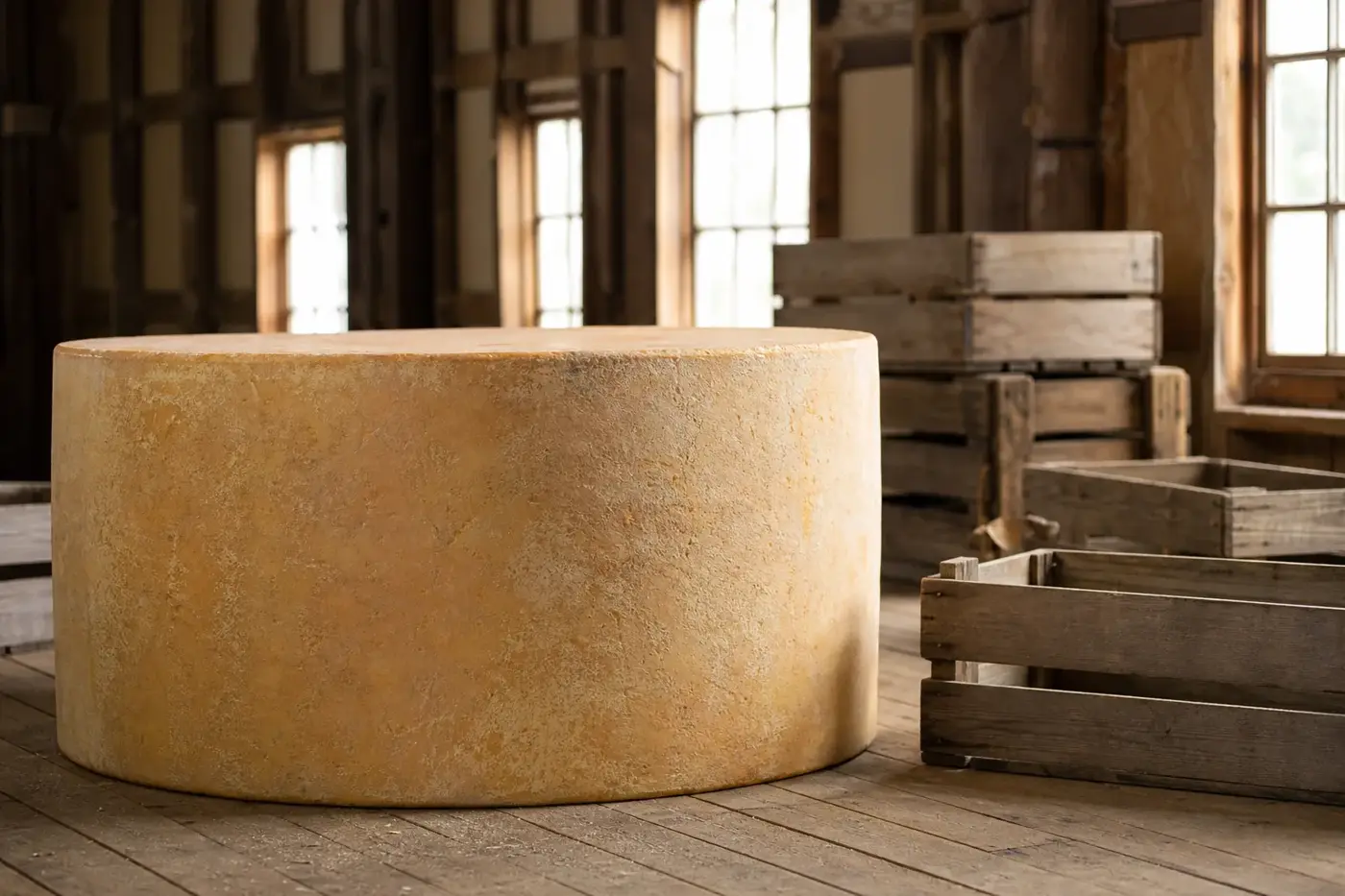
Picture the ceremonial welcome. Before you sits a cheese weighing more than approximately 3,175 kilograms (7,000 pounds), destined for public admiration and perhaps a trip beneath a balloon. In James McIntyre’s poem, this enormous visitor gets the reception its bulk demands. This is not a cheese you casually bring round for supper. [3]
Elsewhere, you will find cheese in a child’s bowl, inside a singing game and answering a solemn appeal to Milton. The Rutles bring the same collision of everyday food and elevated expression to pop pastiche. A meal, a body, a comic prop, an emblem of local pride: cheese gives each work something wonderfully concrete to play with. [1][2][3][4][6]
Settle beside Miss Muffet, before the spider arrives
Before the spider arrives, Little Miss Muffet offers you a peaceful meal. A girl sits absorbed in something domestic and familiar. Her “curds and whey” create a small enclosure of comfort, while “whey” prepares the sound that “away” will answer. There has to be some peace for the spider to spoil. [1]
Look into that bowl and you catch milk partway through a transformation. Curds form when milk proteins coagulate into a gel or solid mass; whey is the liquid associated with their separation. Cheesemakers may drain the curds, so curds and whey together are not necessarily finished, drained cheese. You can follow the process in how cheese is made.
Put cut wedges and mature wheels out of your mind for a moment. This meal belongs to the world of milk becoming something else. The rhyme names neither a cheese nor a production method, leaving its bowl less precisely defined than any one modern product. [1]
Listen to the rhyme’s modern transcription: Muffet answers tuffet, spider answers beside her, whey answers away. Each cluster prepares your ear, then nudges the action forward. Food sits quietly at the centre until the spider interrupts. The rhythm makes the miniature story and its sudden fright easy to remember; the early printed version and its publication details remain open questions. [1]
Such a neat little scene naturally makes you curious about the girl. Accounts connect Miss Muffet with the family of physician and naturalist Thomas Muffett, but the historical discussion treats this as speculation, not established authorship. The shared surname and interest in spiders make the story appealing. A dated manuscript or printed attribution would offer a different kind of connection. [1]
Follow the farmer and give the cheese room to run
In The Farmer in the Dell, cheese leaves the bowl and joins the cast. A farmer chooses a wife, the wife chooses a child, and successive characters bring others into the game. Eventually, a child becomes the cheese. In one recorded version, that is your cue for a chase. [2]
You can find that version in the John Quincy Wolf Folklore Collection at Lyon College. Mr and Mrs F. E. Ash were recorded at Evening Shade, Arkansas, on 30 June 1959. Their chain runs through farmer, wife, child, dog, cat, rat and cheese. Listen for “cherry-o” in the refrain, a small, audible reminder that familiar songs can change from household to household. [2]
The cheese runs, and whoever catches it becomes the next farmer. Mrs Ash explains that the outside circle drops its joined hands to let the cheese escape. First, the child stands alone in the centre. Then the circle opens, turning what might have been a motionless ending into a chase. [2]
The transcript lets you hear that ending return to focus. When the collector asks about the missing final verse, the performers supply it. A printed lyric can look settled and complete, but this conversation restores an extra action and explains what the words alone leave unstated. Performance and recollection keep the game alive together. [2]
Cheese makes a satisfying final character because the chain has travelled from human relationships to animals and their food. A rat taking cheese is easy enough to follow. A child playing the cheese brings a pleasing touch of absurdity. Repetition gives everyone a structure; the last selection decides who starts the next burst of action. [2]
Another record, William Wells Newell’s Games and Songs of American Children, has an 1884 title page and an 1883 copyright notice in its digitised edition. Those dates belong to the book, not necessarily to the creation of its games. For the detailed verses and movements described here, turn to the recorded Ash performance. Newell’s relevant verses and instructions are not the basis of this account. [7]
Make room for James McIntyre’s mammoth cheese
James McIntyre’s Ode on the Mammoth Cheese invites you to admire an agricultural exhibit on a truly enormous scale. It appears in Poems of James McIntyre, published at the office of the Chronicle in Ingersoll in 1889. Beneath the title, the printed text gives a weight exceeding approximately 3,175 kilograms (7,000 pounds). McIntyre gives his subject an entrance to match. [3]
He begins:
“We have seen thee, queen of cheese”
You are no longer looking at ordinary food. You are receiving a distinguished visitor, though admiration soon gives way to worries that it might be squeezed or bitten. At the poem’s most extravagant moment, suspending it from a balloon threatens a lunar catastrophe below. The very bulk that makes this cheese magnificent also makes it funny. [3]
There is more here than a joke about size. The many cows behind the cheese make abundance visible, while an anticipated journey to the Provincial show at Toronto promises a public audience. You can picture a dairying district’s achievement moving beyond its place of origin. Exhibitions and spectators give local production a larger stage. [3]
Keep your eye on the future tense. Toronto is an anticipated destination, and a possible journey to Paris is presented as Mr Harris’s intention. These are proposed exhibition journeys as McIntyre describes them, not a completed itinerary. To follow where the cheese actually travelled, you would need the exhibitions’ own records. [3]
Read the surrounding dairy poems and that ambition becomes clearer. McIntyre writes about cheesemaking pioneers, factories, agricultural land and the town of Ingersoll. In Fertile Lands and Mammoth Cheese, exceptional size expresses a district’s productivity. The giant cheese is both a spectacle and a concentrated image of collective agricultural effort. [3]
The Dictionary of Canadian Biography connects the ode with Oxford County’s great cheese of 1866. Keep those two dates separate: 1866 identifies the event, while 1889 dates the collection’s publication. The cheese’s maker, measured size and completed exhibition history are separate questions for contemporary records. Meanwhile, you can enjoy the poem’s clear achievement: making local dairying sound worthy of a public ceremony. [8]
Hear Chesterton call for Stilton, not Milton
G. K. Chesterton gives cheese a different sort of grandeur. In Sonnet to a Stilton Cheese, he borrows the language of national literary importance. The poem appears in “The Poet and the Cheese”, the opening essay of A Miscellany of Men, first published in 1912. The surrounding prose lets you in on the joke, teasing readers about supposedly mysterious poetic influences. [4]
His model is Wordsworth’s sonnet commonly called London, 1802. In the 1807 edition of Poems, in Two Volumes, Wordsworth calls upon Milton as a moral example England needs. Chesterton summons a cheese instead. Once you hear Milton become Stilton, the substitution feels almost inevitable. [4][5]
Chesterton opens:
“Stilton, thou shouldst be living at this hour.”
The next sentence confirms that it is. Suddenly, the grand address loses its solemn footing, though the form remains intact. Wordsworth calls for an absent historical figure; Chesterton finds his edible subject conveniently present. You get just enough solemnity to savour the difference. [4][5]
Both poems retain the fourteen-line shape of a sonnet. Wordsworth figures England as a stagnant fen; Chesterton turns that figurative language towards the actual flat country described in his essay. National institutions, domestic habits and his own digestion all fit into the same tightly organised performance. The scale keeps changing, but the verse holds its shape. [4][5]
The essay gives you the scene behind the sonnet. Chesterton arrives in Stilton expecting the place to honour its cheese, only to discover that an inn cannot supply any. His extravagant disappointment makes food a measure of cultural memory. In this literary framing, the town seems to have lost touch with the very thing its name brings to mind. [4]
Put his sonnet beside McIntyre’s ode and you can hear ceremonial language doing two different jobs. McIntyre builds up his agricultural subject through earnest public admiration. Chesterton keeps letting appetite intrude upon national grandeur. Both give cheese the dignity of verse, but one celebrates achievement while the other relishes the distance between elevated form and edible subject. [3][4]
Join the Rutles as cheese takes the pop stage
With Cheese and Onions, you leave literary parody for the world of a fictional pop group. Neil Innes’s estate identifies him as a co-creator of the Rutles and the performer of Ron Nasty, one of its invented members. The estate places the group within a deliberately recognisable imitation of another Liverpool band’s career and presentation. [6]
The title does its share of the musical make-believe. Where a pop song might announce love, revelation or emotional crisis, you get cheese and onions, stubbornly ordinary and all the more effective for it. The contrast resembles Chesterton’s. Familiar food enters a cultural form capable of sounding much more momentous than its subject. [4][6]
The fictional performers and the group’s presentation contribute to the pastiche too. [6] A fuller account of the credits, dates and relevant film sequence would require the original recording and film. Here, the title gives you a point of comparison with the other food subjects without reconstructing that sequence.
Think back to Miss Muffet’s bowl and the farmer’s escaping cheese. One creates a domestic scene; the other gives a player a role and a game its ending. In pop pastiche, an ordinary food title becomes the small, resistant detail around which a much larger cultural imitation takes shape. Its very familiarity makes the contrast work. [1][2][6]
Look what a little cheese can set in motion
You can eat cheese, carry it, exhibit it or impersonate it. Few cheeseboards ask quite so much of you. Its tangible familiarity makes it easy to picture, yet it is adaptable enough to become a character or symbol. Once you have it in mind, a writer or performer can build an interruption, a chain of choices, an exaggerated address or a district’s public celebration around it. [1][2][3][4]
Repetition gives that familiar object a form. In the farmer’s game, repeated lines guide each selection; in McIntyre’s ode, recurring rhymes sustain the ceremonial address. Chesterton asks you to hear an existing literary pattern beneath his substituted subject. Part of the pleasure is knowing what ought to happen next, then discovering what the cheese does to your expectations. [2][3][4][5]
Each form gives cheese a different job. A nursery rhyme folds it into a compact story, while a singing game turns it into action. An agricultural ode makes it stand for local achievement. Parody and pastiche draw energy from the distance between everyday food and an elevated manner, without needing cheese to carry one fixed symbolic meaning. [1][2][3][4][6]
Scale brings another pleasure. Miss Muffet’s meal is small and private; McIntyre’s cheese calls for an exhibition audience. Chesterton makes a personal appetite sound like a national requirement. As you move between them, the importance of the subject changes, but the concrete food stays firmly at the centre. [1][3][4]
Follow the cheese beyond the famous line
Read past the words you remember and you often find the action. A poem’s surrounding prose, a game’s instructions or an archived performance can show you how a work actually moves. Keep dates attached to what they establish: a collection records an attested version, while a recording date identifies a particular performance. Those distinctions bring the settings and actions into sharper focus. [2][3][4][7]
Start with the Wolf Collection’s transcript and linked recording for the farmer’s game. Open McIntyre’s scanned 1889 volume at the dairy poems rather than stopping at a quotation anthology. Then read Chesterton’s “The Poet and the Cheese” beside Wordsworth’s 1807 text. You will find what an isolated line conceals: a game in motion, a dairying district’s ambition and the precise machinery of a literary joke. [2][3][4][5]
Questions people ask
What are the curds and whey eaten by Little Miss Muffet?
Curds form when milk proteins coagulate into a gel or solid mass, while whey is the liquid associated with their separation. A bowl containing both is not necessarily finished, drained cheese, and the rhyme names neither a cheese nor a production method.
Was Little Miss Muffet based on a real person?
Accounts linking her to the family of the physician and naturalist Thomas Muffett circulate alongside the rhyme. The historical discussion consulted treats that connection as speculation, not established authorship.
What happens to the cheese in The Farmer in the Dell?
In a version recorded from Mr and Mrs F. E. Ash in Arkansas in 1959, a child plays the cheese. The outside circle drops its joined hands to let the cheese escape, and whoever catches it becomes the next farmer.
When was Ode on the Mammoth Cheese published?
James McIntyre’s poem appeared in Poems of James McIntyre, published in Ingersoll in 1889. The Dictionary of Canadian Biography associates the ode with Oxford County’s great cheese of 1866.
What inspired Chesterton’s Sonnet to a Stilton Cheese?
Its model is Wordsworth’s sonnet commonly called London, 1802, in which Wordsworth calls upon Milton. Chesterton substitutes Stilton for Milton while keeping the fourteen lines of a sonnet.
Sources
- Emma Barrett-Brown, writing as Grissea Fox, “Nursery Rhyme Origins: Little Miss Muffet”, 2021. Modern transcription and historical discussion. Read the discussion.
- Lyon College, John Quincy Wolf Folklore Collection, “The Farmer in the Dell”, performed by Mr and Mrs F. E. Ash, recorded at Evening Shade, Arkansas, 30 June 1959. Transcript, game explanation and recording link. Open the collection record.
- James McIntyre, Poems of James McIntyre, Ingersoll: Office of the Chronicle, 1889, particularly “Ode on the Mammoth Cheese” and the surrounding dairy poems. Oxford County’s digitised original edition and Project Gutenberg’s transcription. Open the scanned volume; read the transcription.
- G. K. Chesterton, A Miscellany of Men, London: Methuen, 1912, “The Poet and the Cheese”, including “Sonnet to a Stilton Cheese”. Original work transcribed at Wikisource. Read the essay and sonnet.
- William Wordsworth, Poems, in Two Volumes, volume 1, 1807, sonnet beginning “Milton! thou should’st be living at this hour”. Original edition transcribed at Wikisource. Read the sonnet.
- Estate of Neil Innes, official website, biographical introduction and Rutles overview, undated, retrieved November 2026. Open the estate’s website.
- William Wells Newell, Games and Songs of American Children, New York: Harper & Brothers, edition with 1884 title page and 1883 copyright notice. Project Gutenberg transcription. Open the collection.
- Dictionary of Canadian Biography, “McIntyre, James”, volume 13, 1994. Historical identification of the cheese celebrated by the ode. Read the biography.
- Intellectual Property Office, “How copyright protects your work: How long copyright lasts”, current online guidance, retrieved November 2026. Editorial rights reference. Read the guidance.
This desk-researched draft compares literary texts, a digitised historical volume, an archived performance transcript and the songwriter’s estate account; the outstanding primary-source and rights checks are recorded below.
Last checked: November 2026
Last checked November 2026.
The editors suggest you read next