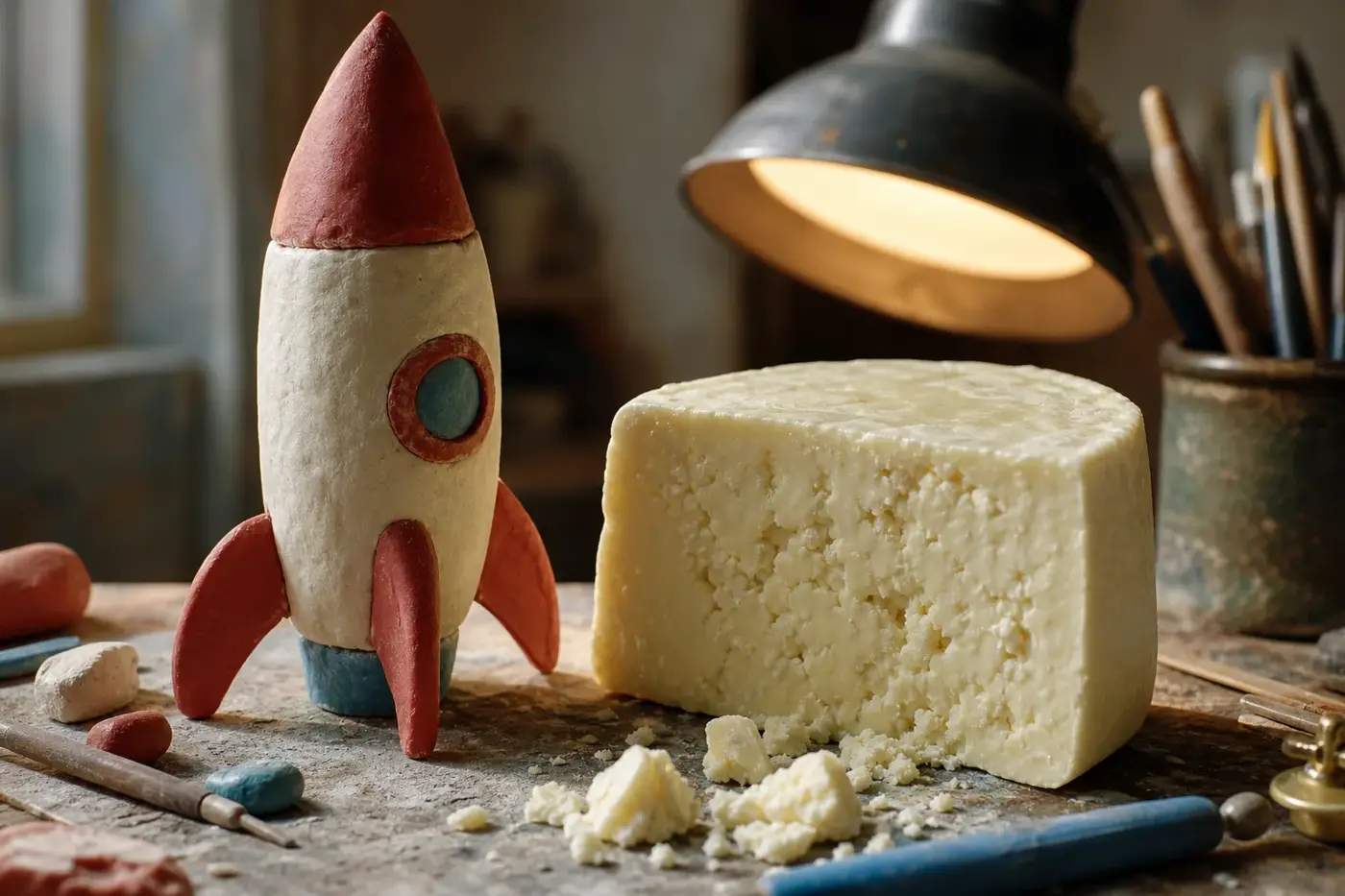
Crackers packed. Homemade rocket ready. Wallace is off to the moon because he needs cheese, and apparently the shopping trip has got out of hand. Elsewhere, Remy closes his eyes over a mouthful and flavour becomes colour and music. Step into Monty Python’s cheese shop, though, and all the names in the world will not get you a bite. [1][2][3][5]
In Ratatouille, Wallace and Gromit, Buffy the Vampire Slayer and Monty Python, this everyday food gets a surprisingly rich screen life. Characters crave it, recognise it, misunderstand it or conspicuously fail to obtain it. Follow their appetites and you find adventure, ambition and exquisitely frustrating conversation. What someone wants to eat can tell you rather a lot about them. [1][2][3][4][5]
Follow the appetite and meet the character
Remy wants to discover what flavours can do together. Wallace wants something for his crackers, even if that requires a lunar expedition. Both take cheese seriously, but their appetites lead in different directions: Remy towards experiment, Wallace towards the comforts of home. His cheese and crackers carry a small, recognisable piece of British domestic life into space. [1][3]
You cannot taste what is on screen, so the storytelling needs another route to your appetite. A closed eye, a sound, a repeated request or an extravagantly ambitious journey can make desire feel almost tangible. Give ordinary food enough attention and it begins telling a story. Sophistication and comfort emerge through what characters do, without anyone having to explain them. [1][3][5]
Remy’s concentration makes pleasure visible; Wallace’s lunar lunch takes familiar comforts somewhere extraordinary. In both, a modest mouthful gains importance from the effort spent pursuing it. Monty Python turns that attention into conversation, with an impressive succession of cheese names bringing the customer no closer to eating. You discover the character as the joke unfolds. [1][3][5]
Ratatouille: taste in glorious colour
Before Remy’s ambitions lead him into a professional kitchen, he makes a discovery over cheese and a strawberry. This early sequence in Pixar’s Ratatouille, released in 2007, gives his enthusiasm a visual language. Disney’s production retrospective singles it out as a scene where pictures and music evoke taste. You cannot share the mouthful, but his delight is there to follow. [2][6]
The screenplay places Remy in a farmhouse kitchen, where a plate of fruit and cheese catches his attention. He bites the cheese and closes his eyes; the kitchen disappears into blackness. A coloured shape appears, accompanied by music. Then he bites the strawberry, with cheese still in his mouth, and more shapes and musical elements enter the composition. [1]
His discovery goes beyond finding something delicious. One flavour changes his experience of another. Combination becomes creation, and this little act of eating holds the outline of his larger ambition. Remy wants to discover what food can become, rather than simply find enough to eat. [1]
Curiosity carries the scene, while its abstract imagery draws you into his private concentration. As Remy attends to taste, the farmhouse kitchen falls away. Cheese becomes part of a composition expressed through colour, movement and music. You are watching a cinematic version of paying close attention to a mouthful, consistent with the intention described in Disney’s retrospective. [1][6]
A Grand Day Out: remember the crackers
Wallace and Gromit approach a domestic problem on an extraordinary scale in A Grand Day Out. They need cheese, so they travel to the moon. Aardman’s official synopsis follows their homemade rocket through a successful landing to a lunar lunch. Then a mechanical inhabitant interrupts, unhappy about Wallace eating the moon. [3]
You know the familiar fantasy: the moon is made of cheese. Here, fantasy becomes practical geography. Once you accept the premise, the moon is simply somewhere to find lunch. The adventure follows the cheerful logic of taking an impossible idea entirely seriously in pursuit of an ordinary appetite. [3]
Wallace makes the expedition feel like an extension of home. Aardman’s character account specifically describes him putting moon cheese on crackers. Lunar exploration and a familiar snack fit comfortably into the same imaginative space. Whatever the surroundings, Wallace arrives knowing exactly what to do: his habits have travelled with him. [3]
The mechanical Cooker has an enthusiasm of its own. Aardman’s synopsis describes its fascination with a skiing brochure and eventual discovery of lunar skiing. Alongside Wallace’s expedition, this creates a lovely symmetry: each character encounters something unfamiliar and understands it through a personal passion. Cheese starts the journey; appetite, curiosity and resourcefulness shape what follows. [3]
Stinking Bishop: a rescue you can almost smell
Near the ending of the 2005 feature Wallace & Gromit: The Curse of the Were-Rabbit, Gromit reaches for Stinking Bishop. Wallace appears lifeless, and Gromit uses the cheese to revive him. This time, cheese is more than something Wallace wants to eat. Its forceful smell becomes the means of rescue. [7][8]
You understand the character joke without an explanation. Within the story, Wallace’s attachment to cheese is strong enough to call him back when other appeals fail. Gromit reaches for something that matters to his companion. Knowing that familiar appetite becomes a way of showing affection. [8]
An overpowering smell would usually send someone recoiling. Here, it draws Wallace towards life and appetite again. The reversal brings comic exaggeration and tenderness together, because Gromit knows his companion’s particular weakness. Cheese provides both the joke and a visible expression of their bond. [8]
Keep the fictional rescue distinct from the real food, though. Stinking Bishop’s extraordinary dramatic role belongs to the context of the ending. Why the filmmakers chose it, and any commercial consequences afterwards, are separate production or business stories. Those connections need evidence of their own.
Buffy’s Cheese Man: when the familiar turns strange
A slice of cheese is ordinary enough. Put slices into the dreams of “Restless”, the fourth-season finale of Buffy the Vampire Slayer, and that familiarity becomes deeply incongruous. Apple’s episode record identifies it as series four, episode 22, dated 23 May 2000. Its description has Buffy, Willow, Xander and Giles encountering the Cheese Man in their dreams. [4]
The script gives him several disconnected appearances. He draws attention to slices arranged on a table, offers a plate during a threatening encounter and later wears slices on his head. You can recognise hospitality, warning and self-presentation in those actions. Cheese makes each gesture peculiar. [9]
His return invites you to hunt for connections, then frustrates the search. Among recognisable people and anxieties, a recurring dream figure seems to promise significance. Yet every intervention involving cheese interrupts the possibility of a straightforward explanation. Repetition makes him memorable without making him any easier to resolve. [9]
The slices look ordinary; their placement and apparent importance do not. Remy’s tasting gives food a coherent expressive language, but the Cheese Man unsettles the relationship between an object and its meaning. The dream treats this strange association with complete confidence. You can feel how differently it would land in a waking conversation. [1][9]
Monty Python’s cheese shop: plenty of names, no lunch
Step into a specialist cheese shop and you expect abundance. Monty Python offers refusals instead. A customer requests cheese after cheese, meeting a succession of explanations for why each is unavailable. The sketch belongs to Monty Python’s Flying Circus, with the episode record identifying its original television setting as “Salad Days”. [5]
The gap between the shop’s purpose and its performance sustains the joke. Every failed request delays the customer’s acceptance that this establishment cannot supply the very thing it exists to sell. The growing catalogue promises variety while demonstrating absence. Each new name briefly restores the possibility of something to eat. [5]
The customer’s knowledge becomes his trap. Another cheese suggests another route to success, so vocabulary and persistence only prolong the exchange. Meanwhile, the shopkeeper maintains the outward forms of service as service itself disappears. You watch a conversation and an appetite held in suspension. [5]
Here, appetite is at the mercy of procedure. Vocabulary, determination and an apparently reasonable request cannot produce food. Where Ratatouille combines ingredients to create something new, this conversation steadily removes possibilities. You imagine an increasingly extensive selection precisely because the customer cannot obtain any of it: absence makes the cheese vivid. [1][5]
What each screen story brings to the cheese
Animation can turn taste into an invented visual world or make the moon a lunch destination. Live-action dream drama can make an ordinary object unsettling through its surroundings. Sketch comedy can build a whole encounter around food that remains unavailable. Each form invites you to take part differently. [1][3][5][9]
| What you are watching | What cheese gets up to | What you bring to the scene |
|---|---|---|
| Ratatouille, animation | Combines with strawberry in an abstract sensory sequence | Your imagination supplies the flavour. [1][6] |
| A Grand Day Out, animation | Makes the moon a lunch destination | You accept a familiar fantasy put into practice. [3] |
| The Curse of the Were-Rabbit, animation | Revives Wallace through smell | You recognise his attachment to cheese. [8] |
| “Restless”, live-action television | Returns in incongruous dream encounters | You search for connections and meaning. [4][9] |
| Cheese shop sketch, television comedy | Remains unavailable through repeated requests | You expect a cheese shop to supply cheese. [5] |
The distinction goes beyond realistic and impossible images. These scenes draw on different kinds of recognition: pleasure, habit, dreamlike dislocation or the frustration of an exchange going nowhere. Cheese gives each work something concrete around which to organise your response. You might see it, imagine tasting it or wait in vain for it to appear.
Love the scene? Explore the story behind it
A finished work, a screenplay and a production account each offer you something different. The work establishes what audiences see and hear. A screenplay records a written version, which may differ from the finished scene. A studio retrospective, interview or production record describes a creative decision from its source’s perspective.
That distinction matters when a food scene stays with you. Naming a cheese in dialogue does not necessarily identify the material used for a physical prop. A film appearance and a later rise in demand are separate events, too. Connecting them takes dated evidence from the people involved, rather than an assumption that one explains the other.
Disney’s retrospective makes a specific connection between Ratatouille’s cheese and strawberry scene and the ambition to evoke taste through pictures and music. Attributing that account gives the production story its proper place. You can still read comfort, affection or frustration in these scenes. Those readings explore how the storytelling works without claiming to describe the filmmakers’ stated intentions. [6]
Settle in with the whole work
Watch the complete work where possible, then return to its cheese sequence. Remy’s discovery belongs to a developing ambition; the Cheese Man’s appearances accumulate across several characters’ dreams. A compilation can preserve a memorable image while losing the relationships that give it force. Context changes what you feel. [1][4][9]
Disney’s US film page lists Ratatouille on Disney+ and in home-viewing formats in November 2026. Elsewhere, look in your local Disney catalogue. Apple’s US record identifies “Restless” as Buffy the Vampire Slayer, series four, episode 22, giving you a useful search reference. Local availability is separate from that US catalogue entry. [2][4]
For the Wallace and Gromit films, start with the titles on the official film pages, then consult a licensed local provider or library catalogue. With Python, distinguish the original television sketch from later recordings and performances. The official Monty Python website links to its YouTube channel. [3][5][7][10]
Availability and age classifications can change. In Britain, consult the BBFC’s current record and content advice for the particular release or collection; its website lets you search films, programmes and age ratings. Elsewhere, consult the relevant local classification authority alongside the provider’s listing. [11]
Still hungry? Choose your next viewing
The dedicated Wallace and Gromit hub explores cheese as a recurring character trait. For a closer look at expectation and repetition, head to the cheese shop sketch hub. Or choose a different viewing route with the cheese documentaries hub, exploring how nonfiction films use food to present people, places and claims about the world.
Questions people ask
What does Remy eat with cheese in Ratatouille?
Remy bites a strawberry while he still has cheese in his mouth. The screenplay describes coloured shapes and musical elements joining the composition as he tastes the combination.
Why do Wallace and Gromit go to the moon in A Grand Day Out?
They travel to the moon in a homemade rocket in search of cheese. Wallace puts moon cheese on crackers, but a mechanical inhabitant is unhappy about him eating the moon.
Which cheese revives Wallace in the 2005 Wallace and Gromit feature?
Gromit uses Stinking Bishop to revive an apparently lifeless Wallace near the end of the film. Its forceful smell brings Wallace back.
Which Buffy the Vampire Slayer episode features the Cheese Man?
The Cheese Man appears in “Restless”, the fourth series finale. Apple’s episode record lists it as series four, episode 22, dated 23 May 2000.
What happens in Monty Python’s cheese shop sketch?
A customer enters a specialist cheese shop and requests cheese after cheese. The shopkeeper gives a succession of explanations for why each is unavailable, and the customer cannot obtain any.
Sources
-
Pixar Animation Studios, Ratatouille, screenplay, undated awards-format copy, 2007 work, reproduced by The Script Savant. Printed pages 6 to 7, farmhouse kitchen tasting sequence.
Read at thescriptsavant.com -
Disney, Ratatouille, official US film and home-viewing record, 2007 film, live page checked November 2026.
Read at movies.disney.com -
Aardman, A Grand Day Out, official synopsis and character account, undated live page checked November 2026.
Read at wallaceandgromit.com -
Apple TV, Restless, US catalogue record for Buffy the Vampire Slayer, series four, episode 22, dated 23 May 2000, checked November 2026.
Read at tv.apple.com -
Wikipedia contributors, Cheese Shop sketch, secondary episode and sketch account, live revision checked November 2026. The original television episode, its version and the relevant scene remain to be verified before publication.
Read at en.wikipedia.org -
Disneyland Paris, Ratatouille: The Adventure celebrates its 10th anniversary, studio retrospective, 2024, checked November 2026.
Read at news.disneylandparis.com -
Aardman, Curse of the Were-Rabbit, official synopsis and film record, 2005 film, undated live page checked November 2026.
Read at wallaceandgromit.com -
Wikipedia contributors, Wallace & Gromit: The Curse of the Were-Rabbit, secondary film record, live page retrieved November 2026. The ending requires direct primary-source verification before publication.
Read at en.wikipedia.org -
Buffy the Vampire Slayer, “Restless”, script text reproduced by Buffy Angel Show, undated PDF copy of the 2000 work.
Read at buffyangelshow.com -
Monty Python, Monty Python Official Site, official channel navigation, live page checked November 2026.
Read at montypython.com -
British Board of Film Classification, official website and title-search facility, live page checked November 2026. Individual records were not retrieved.
Read at bbfc.co.uk
Researched through studio accounts, provider records and reproduced scripts, with critical interpretation separated from production claims; outstanding primary viewing checks are recorded below.
Last checked: November 2026
Last checked November 2026.
The editors suggest you read next