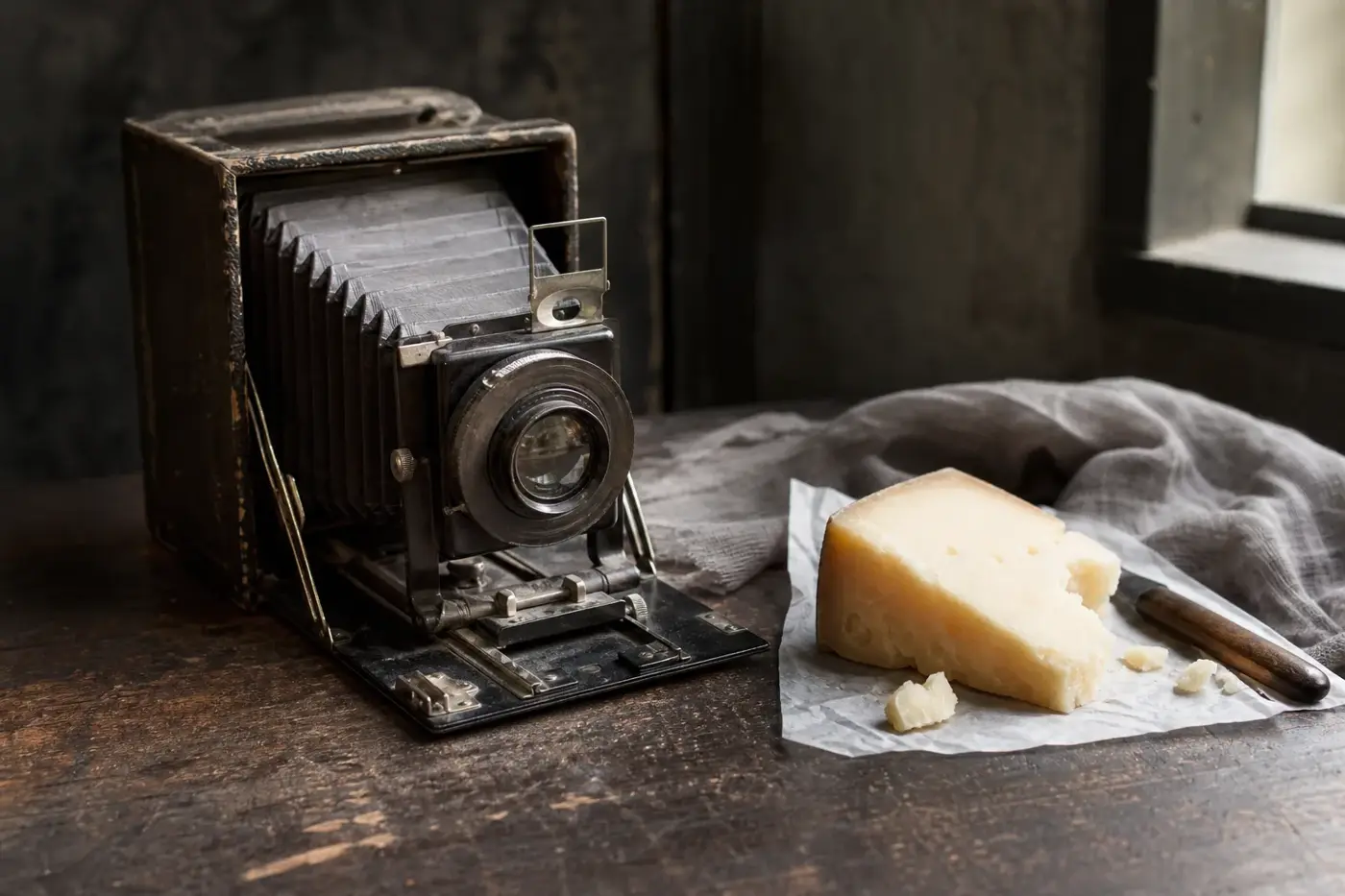
You are facing a camera. Someone tells you to say “cheese”. On 28 September 1942, the Los Angeles Times recorded a man giving that familiar instruction to a group, then explaining why it worked. Elsewhere in English, cheese could make you a boss or turn your disappointment into “hard cheese”. [1,4,8,12]
These expressions arrived by different routes. Some have well documented histories; others still keep linguists guessing. Cheese, it seems, has never been content to stay on the plate. [1,4,8,12]
Cheese: following the word back to Latin
Follow cheese far enough into the past and you reach Latin caseus. The American Heritage Dictionary traces the English word through Middle English chese and Old English cȳse to a reconstructed Germanic form, kasjus, ultimately borrowed from Latin. That asterisk marks a reconstructed form, not a surviving written quotation. [1]
You can hear the family resemblance in German Käse and Dutch kaas. Spanish queso and Italian cacio also descend from caseus, rather than lending their modern words to English. The Online Etymology Dictionary records two Old English forms: cyse in West Saxon and cese in Anglian. [2]
The food word has a reasonably secure family history. Later expressions need separate attention, particularly where dictionaries distinguish another cheese meaning an important person. The same spelling does not necessarily mean the same ancestry. [1]
Usage: General English, neutral. Example: “The recipe calls for cheese.”
Chalk and cheese: look beyond the colour
White milk and white snow; black pepper and black ink. A proverb collection first printed in 1546 puts these misleading likenesses beside things compared in taste as “chalke and cheese”. Matching colours, it reminds you, do not make things equivalent. The passage argues about comparison, rather than telling a tale about a dishonest cheesemonger. [3]
Today, you call two people chalk and cheese when they are strikingly different. “The sisters are chalk and cheese: one plans everything, the other improvises” neatly captures contrasting temperaments in British English. It need not mean they dislike each other: the expression describes their qualities, not their relationship. [3]
Usage: Chiefly British, conversational. History: The sixteenth-century comparison is securely documented; no particular shopkeeper or locality has been identified as its birthplace.
The big cheese: meet the boss, question the backstory
“Ask the big cheese to approve it” puts authority in a slightly irreverent light. You mean an important person, especially someone with power within a group. Sometimes there is another suggestion tucked inside: this person may rate themselves rather highly, too. [4]
The dates are less tidy than the meaning. Merriam-Webster records 1885 as its first use; the Online Etymology Dictionary gives 1914. Each date represents that dictionary’s record, rather than settling the expression’s definitive first appearance. [2,4]
The proposed origins take different paths as well. American Heritage tentatively traces its separate entry for an important person through Urdu chīz, meaning “thing”, from Persian. The Online Etymology Dictionary favours a connection with conspicuously large actual cheeses. [1,2]
Usage: Historically associated with American slang, now more widely understood; informal and often teasing. History: You can rely on the established meaning; the derivation remains disputed. [2,4]
Cheesed off: when you have had quite enough
If you are cheesed off, you are annoyed, disappointed or fed up. “I’m cheesed off with waiting for the repair” leaves little doubt about your mood. Cambridge labels the expression UK informal; American Heritage calls the verb cheese off chiefly British slang. [1,5]
The Online Etymology Dictionary dates cheesed, meaning disgruntled or exasperated, to 1941, while describing its origin as obscure. A later example reproduced by Merriam-Webster comes from a Leeds newspaper of 7 June 1974. There, business owners are irritated by circumstances along a stretch of road. [6,7]
That 1941 record places the expression in wartime. It does not establish that the military invented it. The date gives you firmer ground than the story of how the phrase began. [6]
Hard cheese: sympathy depends on how you say it
“You missed the last bus? Hard cheese.” In British English, that means bad luck or tough luck. Whether you receive sympathy with it depends on the delivery: gently spoken, it can sound rueful; briskly delivered, it brushes your complaint aside. [8]
Merriam-Webster dates this meaning to 1854, placing it in nineteenth-century English. Its entry supplies the date rather than displaying a historical passage. The definition remains “tough luck”, and you will often encounter the expression as an interjection. [8]
Usage: Chiefly British, informal and potentially dismissive. History: The dictionary supplies the nineteenth-century dating; no specific encounter with an unpleasant piece of cheese has been established as its origin. For the food meaning, see the separate guide to cheese styles.
Cheesy: from a compliment to a raised eyebrow
Cheesy has not always been an insult. The Online Etymology Dictionary records a literal sense from the late fourteenth century, then a favourable British slang sense meaning fine or showy from 1858. An inferior-quality sense appears in American student slang from 1896. The nineteenth-century slang dictionary reproduced by Project Gutenberg also records the favourable meaning. [10,11]
Today, you usually reach for figurative cheesy when something feels second-rate, artificial, tacky or embarrassingly sentimental. “The ending was cheesy, but I enjoyed it” admits an obvious emotional effect without denying its appeal. The literal food adjective survives too, so context tells you whether dinner or judgement is being served. [9,10]
An ironic reversal of the older praise is one proposed explanation for the shift. Usage: Informal in both British and American English; usually disapproving, sometimes affectionately so. History: The contrasting senses are documented more securely than the connection between them. [9,10]
Say cheese: how a word helps you smile
“Everyone look this way and say cheese.” You know the instruction, and the word gives your mouth a little assistance: its long vowel encourages a smile-like shape. A specialist word researcher discusses this explanation through historical dictionary evidence. [12]
That research reproduces the exchange in the Los Angeles Times of 28 September 1942. A man taking a group picture tells his subjects to say the word, then explains its purpose. Here is an identifiable printed example of the camera instruction you still hear today. [12]
The same account quotes an earlier reference, from 1930, to school slang in which cheese meant a smile or to smile. That is a related use, rather than an equally explicit photographic instruction. Usage: General English, conversational. History: Early printed examples survive; the inventor remains unidentified. [12]
Cheese it: time to stop talking or move along
With cheese it, the mood changes to concealment and danger. The 1811 Dictionary of the Vulgar Tongue records a warning to remain silent because other people understand what is being said. Depending on the circumstances, the urgent instruction can mean stop, keep quiet or get away. [13]
A later American example brings you a boy warning others about the police. The passage appeared in the New York Tribune on 27 January 1883 and is reproduced by Merriam-Webster. “Cheese it, the caretaker’s coming” follows the same warning pattern, though that is a teaching example, not a historical quotation. [14]
Usage: Historical British and American slang, now likely to sound deliberately old-fashioned. History: The 1811 record is firm. A connection with cease it has been proposed; American Heritage leaves the verb’s origin unknown. [1,11,13,14]
Cut the cheese: know your audience
“Who cut the cheese?” In American slang, you are asking who passed wind. This is familiar bodily humour rather than polite description: a dictionary of American slang published in 2000 records the meaning and marks it as usually objectionable. [15]
There is an earlier pungent association, although it does not settle this phrase’s history. The 1811 slang dictionary records a different cheese-related word for a strong-smelling fart. That parallel does not establish a chain of development between the expressions, and the modern phrase’s precise beginnings remain uncertain. [13,15]
Usage: American, informal and potentially offensive. History: The meaning is well documented. The 2000 dictionary dates this published record, not the expression’s origin. [15]
Cheeseparing: when thrift goes too far
“Removing every spare chair was cheeseparing, not sensible planning.” You can hear the disapproval: this is excessive, miserly saving, not sensible care. Merriam-Webster records both noun and adjectival uses, so the criticism can name the practice or describe it. [16]
The starting image is small pieces trimmed from a cheese. The dictionary traces a movement from those scraps to things of little significance, then dates the economy sense to the nineteenth century. It offers the desire to waste as little cheese as possible as a conjectural explanation for that connection. [16]
You are more likely to meet the word in critical commentary than casual banter. Merriam-Webster reproduces an example from a 1951 novel and another concerning public services from the Guardian, dated 15 May 2013. Usage: Established in British writing and also recorded in American dictionaries; formal or literary in flavour. History: The figurative development is recorded, while its precise motivation is less secure. [7,16]
Choose your phrase, and give its history room
A dated quotation tells you something valuable: an expression was in print by that point, carrying a particular meaning in that passage. A dictionary’s first known use is the earliest evidence its editors report, not a guarantee that nobody said it earlier. Fresh evidence may emerge, while remembered school slang may have circulated long before anyone wrote it down. The differing dates for big cheese show why that distinction matters. [2,4,12]
When you choose an expression, ask three questions: what does it mean, where does it sound at home, and how confidently can its history be traced? In everyday conversation, meaning and register usually matter most. Hard cheese can sound colder than you intend, cheeseparing more severe, and cut the cheese more coarse. In historical writing, keep the date attached to its source and preserve that source’s degree of certainty. [8,15,16]
Questions people ask
Where does the word cheese come from?
English cheese belongs to a Germanic word family whose ancestry reaches back to Latin caseus. It passed through Old English cȳse and Middle English chese.
Why do people say cheese for photographs?
The word’s long vowel encourages a smile like mouth shape. The Los Angeles Times recorded a man using and explaining the instruction for a group photograph on 28 September 1942, but its inventor remains unidentified.
Where did the phrase big cheese come from?
Its origin is disputed. American Heritage tentatively traces it through Urdu chīz, meaning “thing”, from Persian, while the Online Etymology Dictionary favours a connection with conspicuously large actual cheeses.
What does cheesed off mean, and did it start in the military?
It means annoyed, disappointed or fed up. The Online Etymology Dictionary dates “cheesed” in this sense to 1941, but that wartime record does not establish that it was invented in the military.
What does cut the cheese mean?
In American slang, it means to pass wind. It is informal and potentially offensive, and its precise beginnings remain uncertain.
Sources
- HarperCollins, The American Heritage Dictionary of the English Language, fifth edition, copyright 2022, entries “cheese¹”, “cheese²” and “cheese³”. Dictionary entries.
- Online Etymology Dictionary, “Cheese”, live edition retrieved November 2026. Entry and etymological discussion.
- Internet Archive digitisation, The proverbs of John Heywood. Being the “Proverbes” of that author printed 1546. Ed., with notes and introduction, edited historical edition, printed page 108. Edition publication year not verified. Digitised volume.
- Merriam-Webster, Merriam-Webster.com Dictionary, “Big cheese”, live edition retrieved November 2026. Definition and first-known-use record.
- Cambridge University Press, Cambridge Dictionary, “Cheesed off”, live edition retrieved November 2026. Definition and regional label.
- Online Etymology Dictionary, “Cheesed”, live edition retrieved November 2026. Historical dating and origin assessment.
- Merriam-Webster, “7 Words That Will Expand Your Understanding of Cheese”, live edition retrieved November 2026, sections “Cheesed Off” and “Cheeseparing”. Lexicographical discussion and reproduced citations.
- Merriam-Webster, Merriam-Webster.com Dictionary, “Hard cheese”, live edition retrieved November 2026. Definition, regional label and first-known-use record.
- Merriam-Webster, Merriam-Webster.com Dictionary, “Cheesy”, live edition retrieved November 2026. Literal and figurative definitions.
- Online Etymology Dictionary, “Cheesy”, live edition retrieved November 2026. Historical senses and proposed semantic development.
- Project Gutenberg, The Slang Dictionary: Etymological, Historical and Anecdotal, ebook 42108, released 2013, updated 2024, entries “Cheese”, “Cheese, or cheese it” and “Cheesy”. Original edition year not verified. Digitised text.
- Barry Popik, “Say ‘Cheese!’”, research entry published 2009, retrieved November 2026, reproducing historical dictionary citations and a Los Angeles Times passage dated 28 September 1942, page A1. Research entry and transcriptions.
- Project Gutenberg, 1811 Dictionary of the Vulgar Tongue, ebook 5402, released 2004, updated 2020, entries “Cheese it” and “Cheeser”. Digitised text of the 1811 edition.
- Merriam-Webster, “7 Deliciously Cheesy Cheese Words”, live edition retrieved November 2026, section “Cheese It!”, including a reproduced New York Tribune citation dated 27 January 1883. Historical discussion.
- NTC Publishing Group, NTC’s Dictionary of American Slang and Colloquial Expressions, third edition, 2000, printed page 99, entry “Cut the cheese”. Digitised dictionary.
- Merriam-Webster, Merriam-Webster.com Dictionary, “Cheeseparing”, live edition retrieved November 2026, definition and “Did you know?” discussion. Entry and semantic history.
This desk-researched article compares dictionary records, a digitised historical text and attributed historical transcriptions, keeping documented usage separate from proposed origins.
Last checked: November 2026
Last checked November 2026.
The editors suggest you read next

Cheese in Art and Literature
Macaroni and ravioli tumble down a mountain of grated Parmesan, ready for anyone below to gather.