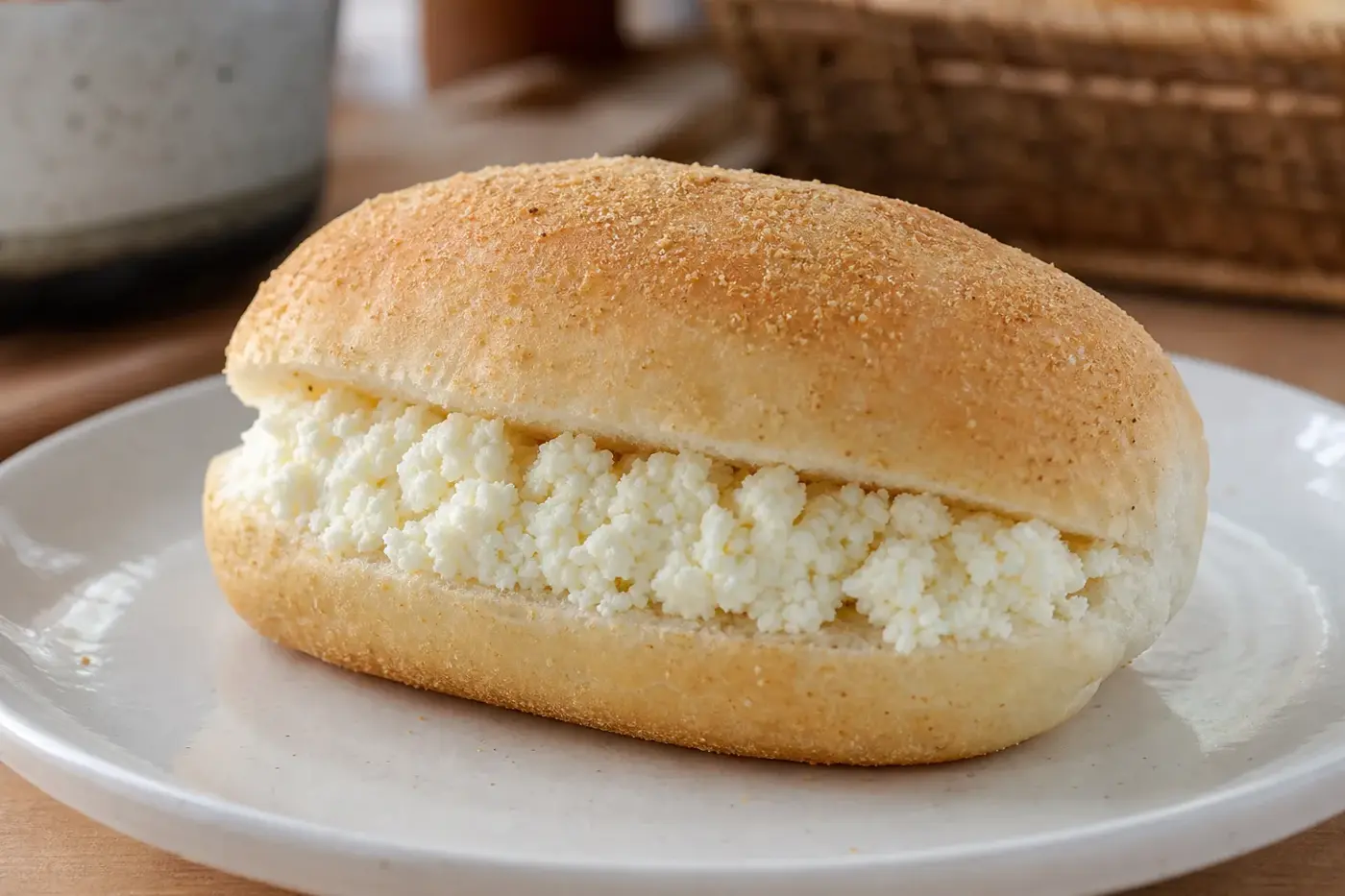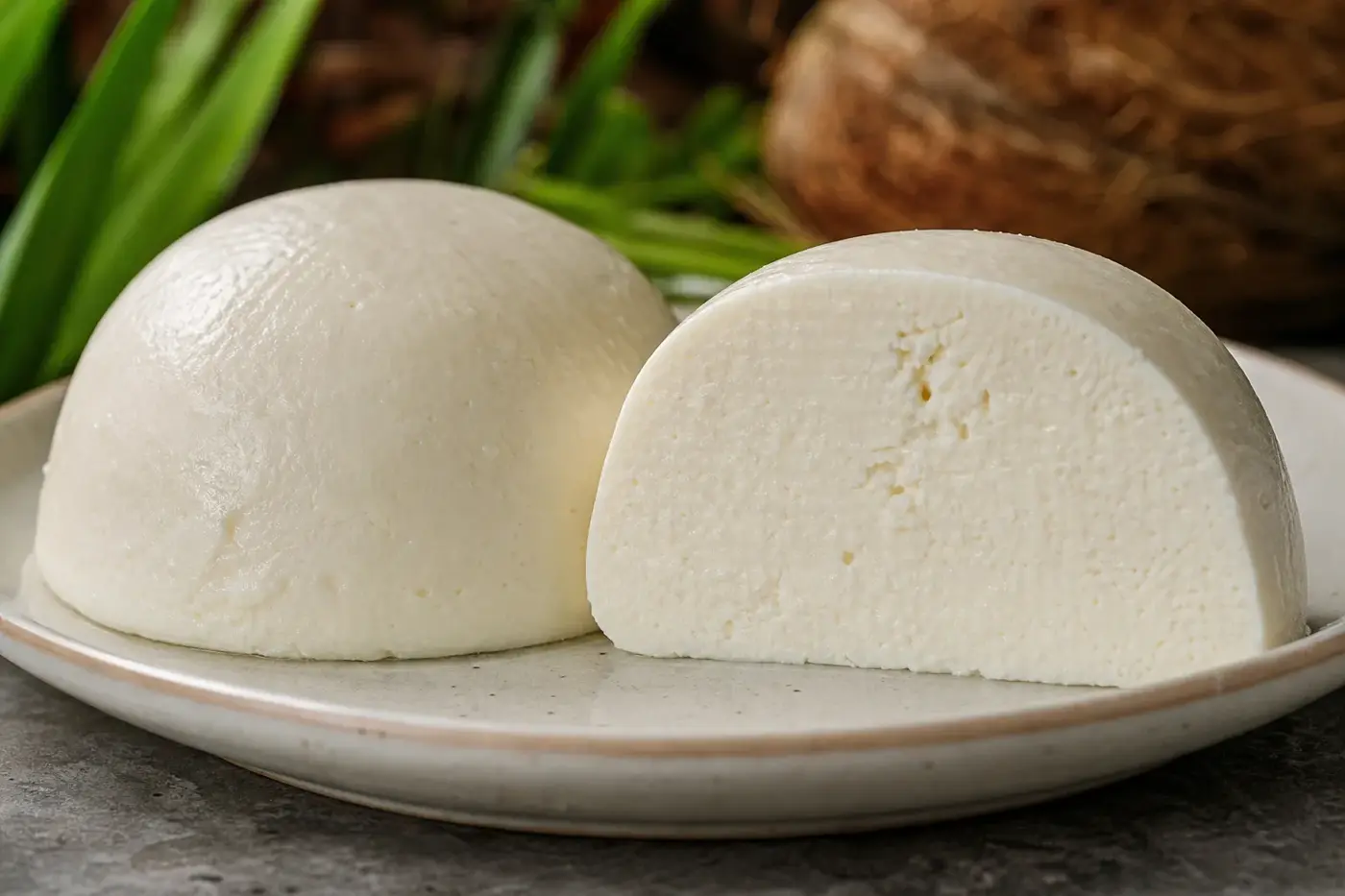
Watch the whey slip through a hole in a coconut shell. In Enrekang, South Sulawesi, cheesemakers use that shell to mould dangke, setting heated milk with papaya sap before pressing the curds into its rounded shape. Made with buffalo or cow’s milk, this fresh Indonesian cheese reaches your plate fresh, fried or grilled, often alongside rice and sambal. The coconut shell has a rather good second career.[1,3,11]
Your first taste of dangke
| What you might ask | The short answer |
|---|---|
| What is it called? | Dangke.[1] |
| Where is home? | Enrekang Regency, South Sulawesi, Indonesia.[1] |
| Which milk goes in? | Buffalo or cow’s milk.[1,8] |
| What sets the milk? | Heat and papaya latex.[3] |
| What sort of cheese is it? | Fresh and rindless.[4,11] |
| What shape should you expect? | Compact curd moulded in a coconut shell.[3] |
| How long does it mature? | It is customarily eaten fresh.[4] |
| Registered name, authority and register ID | Details not provided |
| Protection status in Indonesia | Details not provided |
| Applicable legal standard in Indonesia | Details not provided |
Pull up a chair in Enrekang
Dangke’s home is Enrekang Regency, on the Indonesian island of Sulawesi. The national tourism ministry’s entry for Langda tourism village introduces it as a traditional Enrekang food, made from buffalo or cow’s milk. To picture the texture, think tofu: moist and compact, only this time made from milk.[1]
Here, dairy farming and cheesemaking belong to the same household economy. Production research describes farmers making dangke as a side dish, then selling surplus cheese in traditional markets or sending it towards Makassar. Milk becomes food for the household, with cheese left over providing something to sell.[3]
A Dutch thank you, with a little history attached
“Dank je”, the Dutch words of thanks, lies at the heart of a local story about dangke’s name. The 2025 Journal of Ethnic Foods review records this colonial-period theory as part of the cheese’s storytelling tradition. It is an appealing connection, although establishing the linguistic origin would require earlier documentary evidence.[11]
A field study published in 2014 describes dangke as known since 1905, looking back in the paper’s introduction. Its research brings you closer to contemporary cheesemaking, too. Researchers interviewed and observed 60 cow’s milk dangke producers in Cendana, within Enrekang, recording the different ways they processed and stored their cheese.[2]
Buffalo or cow? Start with the maker
Buffalo milk is the traditional starting point for dangke in published accounts. Research from Curio, Enrekang, documents that use directly. For a microbiological investigation, researchers collected buffalo milk dangke from makers and sellers shortly after production.[8,11]
Cow’s milk has an established place at the table as well. The Cendana survey recorded local producers using it, and laboratory studies have also worked with cow’s milk dangke. When you choose a particular cheese, ask which milk went into it: the name dangke cannot tell you the species.[2,4,5]
Papaya sap, warm milk and a coconut shell
Papaya latex does the setting. This milky plant sap supplies protein-cutting enzymes, including papain, which help bring milk proteins together into curds. Heated milk separates into solid curd and liquid whey, which drains away before the curd is compacted.[3,4]
The coconut shell does two jobs: mould and draining vessel. Whey escapes through a hole as pressure brings the curds together, giving the cheese the shell’s rounded shape. Banana leaves are a documented wrapping, completing the recognisable appearance you see: a compact dome rather than a wheel shaped by months of ripening.[2,5]
Each producer may handle the heating, sap preparation and draining a little differently. The distinctive combination is still heated milk, papaya enzymes and shell moulding. For a closer look at what happens when milk separates, turn to how cheese is made.[2,3]
Why the papaya sap needs a careful hand
Enough sap gives you a useful curd; too much can bring bitterness. Published production research explains that too little papaya sap can leave fewer curd clumps and a lower yield. Add an excess and the cheese can become bitter, while heating conditions matter alongside the amount used.[3]
That makes the volume of crude sap only part of the story. How it was prepared matters, as does the treatment of the milk. An amount on its own is not a recipe.[3]
A 2017 laboratory study tested three papain concentrations against three heating temperatures, with three replicates, and selected a preferred temperature and enzyme concentration. A separate 2024 experiment tested different heating temperatures and latex levels, choosing a different combination. You need to read each result within its experimental system, not as a single formula for the home kitchen.[3,4]
A 2019 university thesis tackled bitterness by combining papaya latex with other coagulants. Its selected mixture of latex and glucono-delta-lactone, another coagulant, tasted less bitter than the Enrekang comparison sample. Changing how the milk sets can change what you taste, even when the resulting curd still looks like dangke.[6]
Meet its milky flavour and gentle texture
Look at dangke and you will see a white to ivory paste, the body of the cheese, without a developed ripening rind. It is moist and compact. Expect fresh milk rather than the sharpness of a long-aged cheese: assessors in the 2017 papain study described a moderately soft texture and relatively plain flavour, with possible bitterness associated with papain.[4,5]
Separate sensory work on experimentally coated dangke reported a white or yellowish-white colour, a milk-like smell and a smooth texture. Those descriptions give you a useful vocabulary, rather than a promise about every piece. Moisture, pressing and other production differences help explain why one maker’s curd might be softer and another’s more closely packed.[2,5]
Fresh cheese, and a few useful questions
Dangke is ordinarily eaten fresh. Some documented formulations contain salt, including the cheese mixture in the 2017 coating experiment. The local production survey recorded a process centred on heating and enzyme setting, classifying the dangke it sampled as a non-fermented product.[2,5]
Other researchers discuss spontaneous microbial activity, while experimental versions may deliberately change fermentation. One 2023 study fermented the papaya latex before using it and found an effect on taste, but not texture or colour. Fermenting the coagulant, deliberately culturing the milk and ageing the finished cheese are three different interventions, so you cannot use those descriptions interchangeably.[11,12]
For the dangke in front of you, ask whether the maker added salt or a starter culture. Find out, too, whether it is intended for immediate use. “Traditional” is a lovely word, but it is not much help with your shopping questions.[2,5,12]
Make room for rice, sambal and the grill
Rice and chilli accompaniments put dangke firmly in a meal, rather than leaving you to consider the cheese alone. Published culinary accounts describe it served fresh, fried and grilled. You can slice it, while frying and grilling give you other ways to appreciate its place at the Enrekang table.[6,11]
A lime chilli sauce brings a sour, hot contrast to that comparatively quiet milk flavour. In the 2019 thesis, researchers assessed both fresh and grilled samples, treating grilled dangke as a distinct eating form when examining texture and bitterness. Cooking is part of how the cheese tastes and feels, not simply a serving instruction.[6,11]
The fresh curd gives you one part of the story. How it is prepared, and what you eat alongside it, shapes the rest of the meal.[6]
Let paneer give you a starting point
If you know paneer, you have a useful starting point: a compact fresh cheese that you can portion for cooking. The setting method, though, is different. Experimental paneer research describes a heat-treated, acid-coagulated cheese, whereas dangke’s characteristic coagulant is papaya latex.[3,9]
The closest comparison lies in how you use them. Dangke has documented fried and grilled presentations, and paneer research shows how processing changes the firmness of a pressed fresh cheese. Do not expect the same texture or flavour, particularly when papaya sap gives dangke some bitterness.[6,9,11]
In the paneer experiment, researchers varied milk type, coagulation temperature and pressing pressure, using citric acid or vinegar. They measured hardness, cohesiveness and springiness alongside sensory assessments. Temperature, pressure and the choice of acid all played a part in that investigation into texture.[9]
That gives you something useful to draw on when comparing cheeses by feel. “Compact” describes a structure, but it cannot tell you exactly how much resistance a slice will offer when you bite. A useful comparison needs the actual cheeses, along with an account of how they were prepared.[9]
Give fresh dangke the care it needs
Treat dangke as a perishable fresh dairy food. Indonesian production studies identify short keeping quality and opportunities for contamination during handling. A 2014 hygiene survey of 60 Cendana producers found uneven cleaning and protection of moulds and wrapping materials, making careful handling after heating essential.[2,7]
A separate study tested buffalo milk dangke collected from makers and sellers in Curio just after production. Overall bacterial contamination exceeded the benchmark used, while tests for Escherichia coli and Salmonella were negative. These findings describe the sampled cheeses, rather than every dangke you might encounter.[8]
They also show why microbiological reports need careful reading. The organisms tested matter, as do the handling conditions.[8]
BPOM’s consumer guidance for Indonesia covers dairy storage, hygiene and separation of foods.[10] Check the current guidance and follow the product’s storage directions.
Keeping life depends on the product. Published experiments involving coatings or controlled storage apply to their particular samples and processes, so use the producer’s validated date and storage advice at home. For practical principles on refrigeration and keeping cheese separate from raw foods, see cheese storage at home and cheese food safety.[5,7,10]
General information only, not medical advice: follow the official guidance where you live.
Questions people ask
What is dangke and where does it come from?
Dangke is a fresh, rindless cheese from Enrekang Regency in South Sulawesi, Indonesia. It is made from buffalo or cow’s milk and has a texture reminiscent of tofu.
How is dangke made?
Cheesemakers heat milk and use papaya latex to help it form curds. They drain the whey and press the curds in a coconut shell.
What does dangke taste like?
Dangke has a relatively plain, milky flavour and a moist, compact texture. Papaya sap can bring bitterness, particularly if too much is used.
How is dangke eaten?
Dangke is served fresh, fried or grilled, often with rice and sambal. A lime chilli sauce can add a sour, hot contrast to its milky flavour.
How should dangke be stored?
Keeping life depends on the product. Indonesia’s BPOM provides consumer guidance on dairy storage, hygiene and separation of foods; check its current guidance and follow the producer’s storage directions.
Sources
-
Indonesian Ministry of Tourism. Produk Wisata Dangke, Jadesta, undated live entry. Official description of dangke associated with Langda, Enrekang.
-
Hasanuddin University and Bogor Agricultural University researchers. Survei Karakteristik Pengolahan dan Kualitas Produk Dangke Susu Sapi di Kabupaten Enrekang, Sulawesi Selatan, Jurnal Ilmu dan Teknologi Peternakan, volume 3, number 3, July 2014. Original producer survey and composition measurements.
-
Hasanuddin University, IPB University and Padjadjaran University researchers. Physicochemical Properties of Dangke-cheese by Different Temperature Processing and Papaya-latex as Coagulant, Indian Journal of Agricultural Research, 58(5), 911 to 916, 2024. Original processing experiment.
-
Bogor Agricultural University. Physical, Microbial, and Chemical Qualities of Dangke Produced by Different Temperatures and Papain Concentrations, Media Peternakan, 40(1), 63 to 70, April 2017. Original factorial experiment with physical, microbiological and sensory assessment.
-
Hasanuddin University. Evaluation of using edible coating and ripening on Dangke, a traditional cheese of Indonesia, Food Research, 1(2), 51 to 56, 2017. Original coating, texture and sensory experiment.
-
IPB University. Formulasi Kombinasi Getah Pepaya dan Koagulan Lain sebagai Koagulan dalam Pembuatan Dangke, undergraduate thesis, 2019. Repository abstract reporting comparisons of coagulant formulations, bitterness, and fresh and grilled dangke.
-
Jurnal Veteriner. Praktek Sanitasi Higiene pada Usaha Pengolahan Dangke Susu Sapi di Kabupaten Enrekang, Sulawesi Selatan, 15(1), 147 to 155, 2014. Original observation and questionnaire study of 60 processing businesses.
-
Hasanuddin University, proceedings indexed by Garuda. Microbial Contamination of Buffalo Milk Dangke from Curio Enrekang of South Sulawesi, Proceeding Buffalo International Conference, 2013; repository posting dated 2 July 2014. Original study abstract reproduced by the Indonesian government’s research index.
-
Journal of Food Quality. Influence of Machine Parameters and Coagulant on the Textural Properties of Paneer (Indian Cottage Cheese), volume 2022, article 6529064. Original paneer processing and texture experiment.
-
Badan Pengawas Obat dan Makanan, Indonesia. 101 Tips Keamanan Pangan, 2020 edition. Official consumer guidance, particularly dairy products, cross-contamination and refrigerated storage.
-
Journal of Ethnic Foods. Dangke: unveiling Indonesian traditional fermented cheese from Enrekang, South Sulawesi, volume 12, article 16, 10 April 2025. Secondary synthesis used for recorded folklore and culinary context; includes original documentary images of fresh, fried and grilled dangke.
-
BIOMA: Jurnal Biologi dan Pembelajarannya. The Effect of Fermentation of Papaya Sub on the Quality of Dangke (MILK PROCESSED PRODUCTS), 5(2), 73 to 81, 15 December 2023. Publisher’s abstract of an original fermented-latex experiment.
This piece was researched through Indonesian government material, original producer surveys and laboratory studies, with secondary literature used for attributed folklore and culinary context.
Last checked: November 2026
Last checked November 2026.
The editors suggest you read next