The Global Cheese Industry Explained
At the farm gate, a delivery of milk begins its journey with the clock already ticking.
At the farm gate, a delivery of milk begins its journey with the clock already ticking. Turn it into cheese, and its protein, fat and regional identity can travel far beyond that gate. Between there and your cheese counter stands a chain of farmers, cheesemakers, maturers, transporters and retailers, connecting local sales with international distribution.[1]
Four useful things to take to the cheese counter
- Comparing industry statistics? Check that the definitions, measures and years match.[4][6][7]
- A producer's size tells you one thing. Who owns it tells you another.[2][14]
- Codex is an international reference, not automatically binding law.[13]
- Environmental comparisons depend on where the assessment begins and ends, and how it handles shared products.[17]
Local craft can travel a long way
A large dairy can have skilled cheesemakers and cheeses maturing for months. A small dairy still needs dependable milk collection, hygiene and distribution. Size, ownership and method each tell you something different, so don't ask one to explain the others. FAO describes small processors alongside organised manufacturers, their products shaped by local tastes, culinary traditions and demand.[2]
Processing helps milk reach beyond its immediate neighbourhood, too. FAO identifies it as a way to manage seasonal supply, reach urban markets and create work in collection, transport and marketing. Local craft and international commerce need not be rivals. They can be successive stages of the same journey, as cheese made in one place finds customers in another.[1]
Big cheese numbers, with the small print
World milk production reached 1,005 million tonnes in 2025, according to the OECD and FAO's 2026 outlook. Before you picture all of that becoming cheese, pause. Even the most ambitious cheeseboard has its limits: that milk pool supplies every dairy use, not cheese alone.[3]
For cheese itself, Eurostat reports EU production of 10.8 million tonnes in 2024, measured as product weight. Its published country estimates put Germany at about 2.4 million tonnes, France at 1.9 million and Italy at 1.4 million. Poland and the Netherlands each produced about 1.0 million tonnes.[4][5]
Even the familiar word “cheese” needs a closer look here. Canada's official series separates natural cheese from processed cheese, recording 515,033 tonnes and 71,776 tonnes respectively in 2025. Count a processed product alongside the cheese used to make it, and you can count the same material twice. Useful comparisons match both categories and production stages.[6]
Consumption figures need careful reading, too. Canada reports 13.91 kilograms per person in 2025 across its cheese categories, using food availability data. That describes what reaches the national food supply, not what each person actually eats. USDA likewise distinguishes its consumption estimates from loss-adjusted availability.[6][7]
Before you compare, ask these four questions
Put two countries' figures beside each other and they can look ready for comparison. First, ask what each number actually describes. These four checks help you put like beside like.[4][6][7]
- Which product are you counting? Does the series cover natural cheese, processed cheese, cottage cheese or a combination? Match the product coverage on both sides.
- What does the figure measure? Is it production, imports, exports or food availability? Exports tell you what crosses a border, not everything made.
- Which unit is being used? Are those tonnes of cheese or tonnes of milk equivalent? Milk equivalent converts dairy products into an estimated quantity of milk.
- Are the periods the same? Compare the same year, and keep recorded results separate from forecasts. Note any revision date so you can recognise later updates.
Let each region tell its cheese story
Europe and North America account for the largest shares of cheese consumption in the OECD and FAO outlook. In India and Pakistan, fresh dairy products play a much larger part in dairy demand. Plenty of milk does not necessarily mean the cheese industry you might imagine from that total.[3]
Look inside national figures and regional traditions begin to emerge. FAO records ayib, gibna bayda and chhurpi alongside cheeses you may know from international supermarkets. Those totals hold different farming systems, household practices and markets. Industrial output tells you part of the story; cheeses made and used locally tell you another.[8]
Get to know the animals behind the milk
Cow's milk supplies much of the industry's raw material, but sheep, goats and buffaloes are essential to its diversity. The animals you find depend partly on the land around them. FAO explains how feed, water and climate shape that choice: sheep can support dairying in semi-arid Mediterranean environments, while goats can use areas with poor soils.[9]
Each milk gives the cheesemaker something different to work with. FAO describes sheep's milk as richer in fat and protein than cow's or goat's milk, making it particularly suitable for cheese production. Buffalo milk has a high fat content and a different balance of milk proteins. Goat's milk supports important regional cheesemaking traditions.[10]
Species is only the beginning. Breed, feed, season and stage of lactation also influence milk composition. For a cheese dairy, receiving a delivery is never simply a matter of counting litres. The character and composition of those litres help determine what the cheesemaker can make.[10]
Come along from collection point to counter
Before anyone makes cheese, perishable milk must reach the dairy. Farms may deliver to a collection point, or a processor may arrange transport from several holdings. FAO highlights the difficulty of connecting dispersed rural producers with urban markets, especially where roads and cooling facilities are limited. That connection makes everything that follows possible.[11][12]
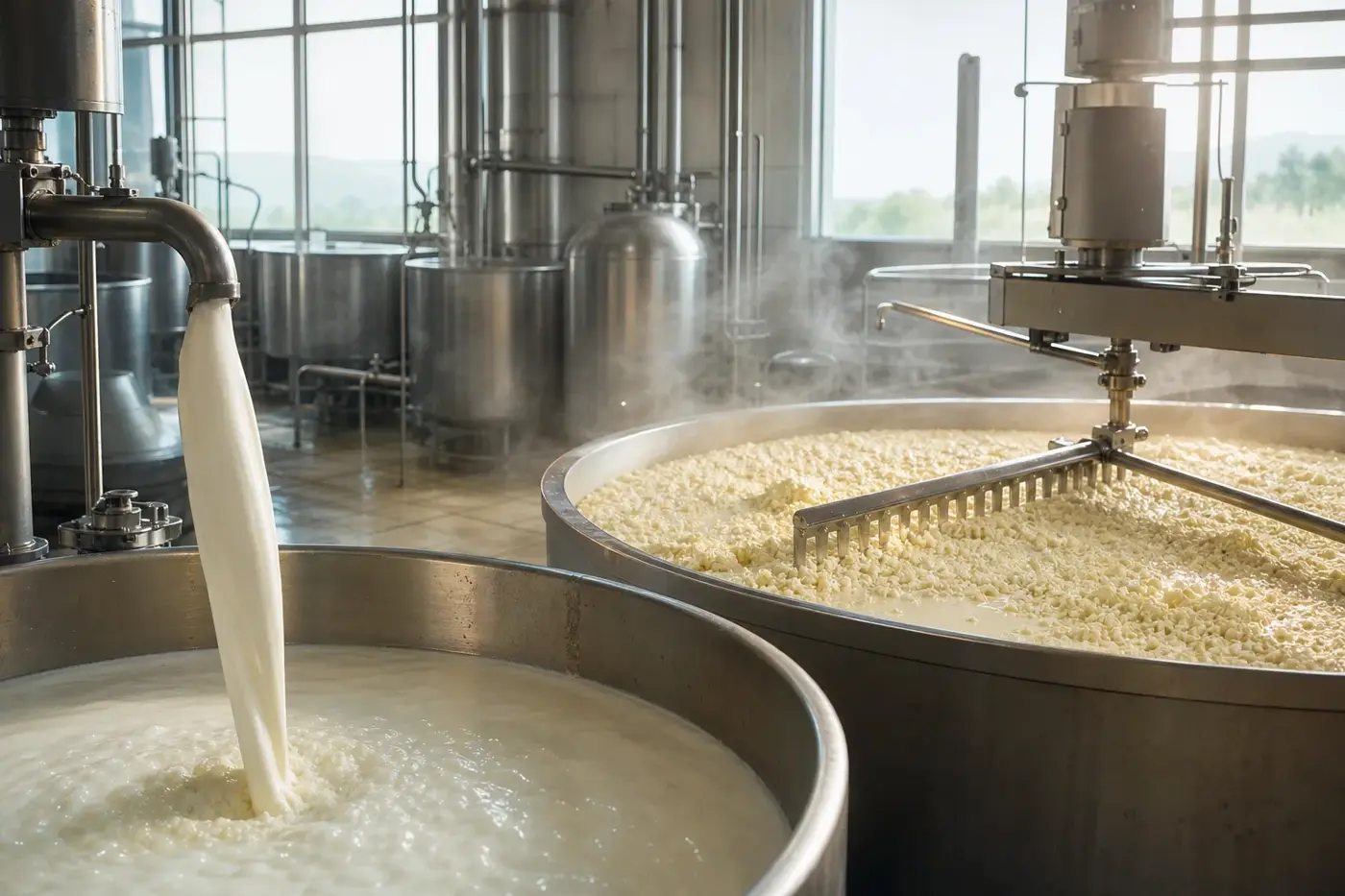
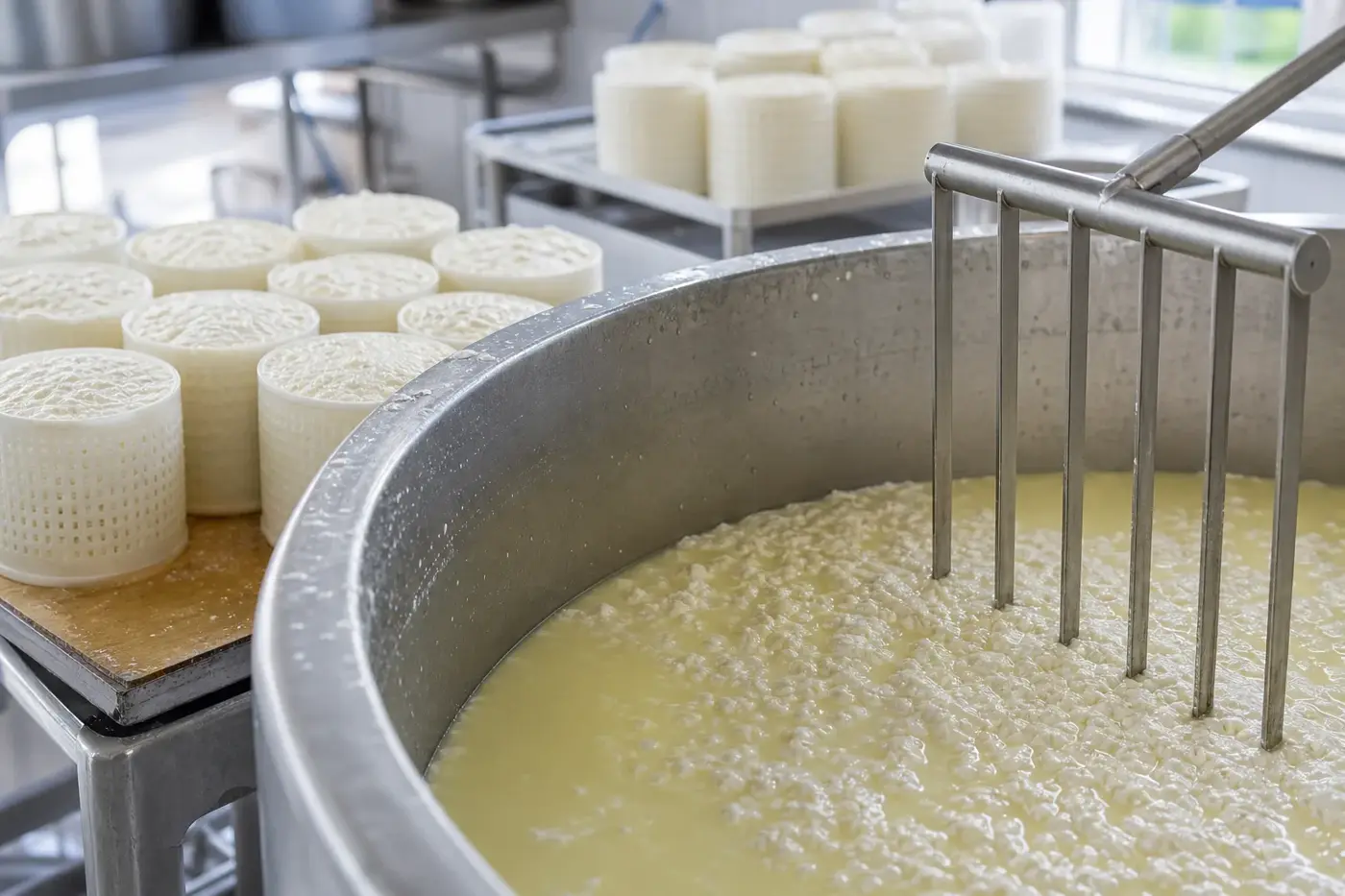
At the dairy, milk protein is concentrated into curd, the mass that becomes cheese, and separated from whey, the remaining liquid. Coagulation brings those proteins together, often using rennet, a milk-clotting enzyme preparation. Milk composition, microorganisms and processing choices all help shape what you eventually taste. Follow the technical stages in how cheese is made.[8][13]
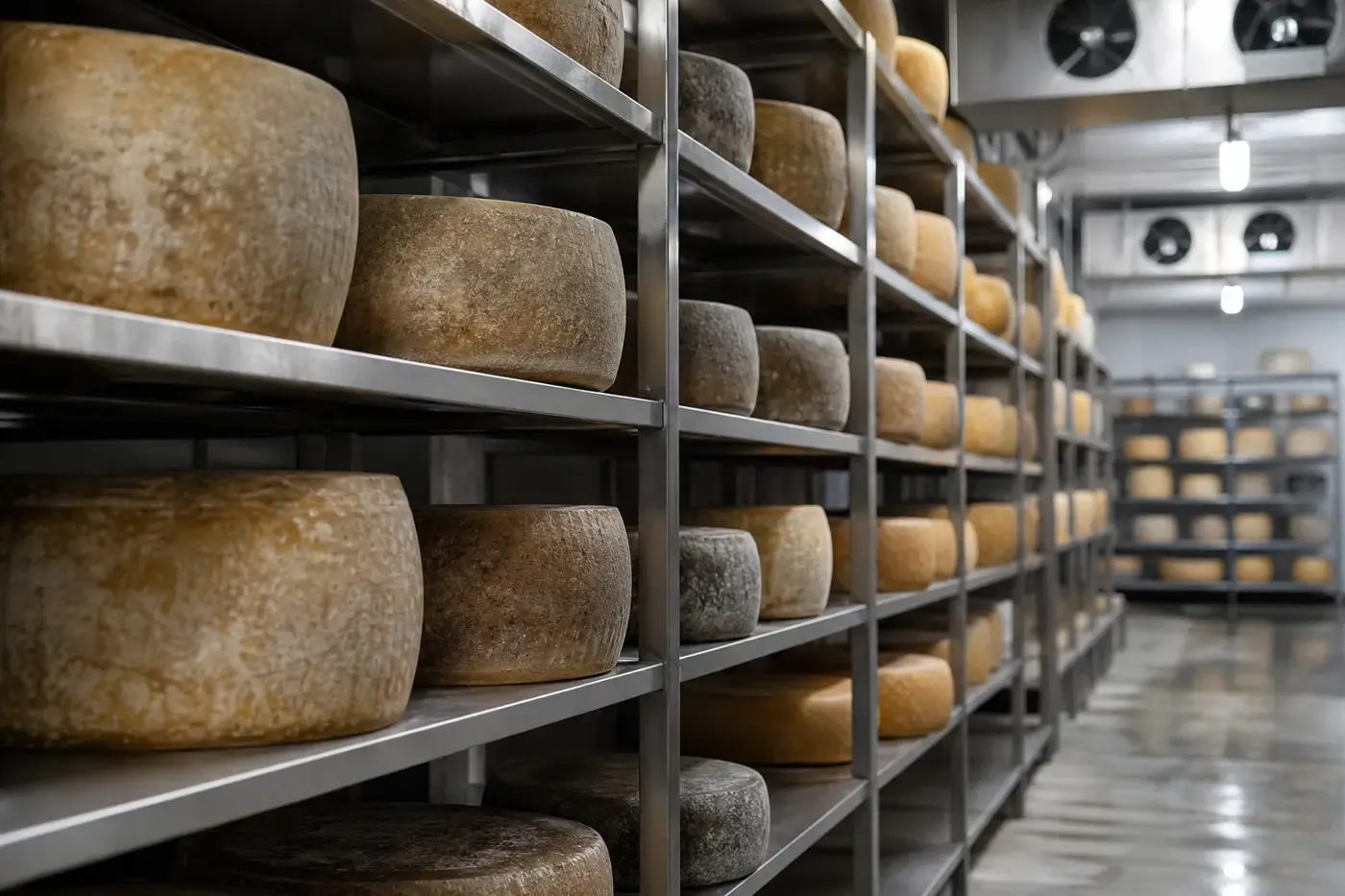
Fresh cheese can head towards sale without a ripening period. Other cheeses enter maturation, where controlled conditions allow texture and flavour to develop. Codex describes the rind formed during ripening as a layer of cheese, distinct from an applied coating. Maturing, portioning, packaging and transport can take place on different premises, with different businesses involved before your cheese reaches its final counter.[13]
And the whey? Its story doesn't end at separation. FAO lists whey drinks, whey cheese, lactose and dried whey among its uses. Finding a destination for that liquid is everyday dairy work, alongside making, storing and dispatching cheese.[8]
Who actually owns the dairy?
“Industrial” describes production organised at scale, not who owns the business. A cooperative can operate large processing plants, while an independent business can supply wholesalers as well as sell directly. To understand either, ask who owns it, who supplies the milk and who controls access to customers.[2][14]
Producer cooperatives bring farmers together for collection, processing, marketing and other activities. FAO identifies shared resources, better market access and stronger bargaining power among the advantages of producer organisations. Pooling milk and services lets farms participate in markets they would struggle to serve alone.[14]
An independent processor might build its business around a locality, a method or a relationship with customers. Independence gives it control over its choices, but dependable production still needs skills, infrastructure and a reliable market. FAO's account of small-scale processing identifies weaknesses too, including limited training and technical support.[2]
This page summarises published guidance from the official sources it cites. It is not medical advice. Guidance differs between countries and changes over time, so check the current source for where you live, and ask your doctor, midwife, pharmacist or dietitian about your own circumstances.
The care behind safe cheese and honest labels
Before cheese reaches you, its producer must control hazards and describe the product correctly. Codex's General Standard for Cheese provides an international reference for composition, hygiene and labelling. Its definition recognises ripened and unripened cheese, with more specific standards for some varieties. A Codex provision becomes legally binding only when incorporated into the relevant jurisdiction's rules.[13]
Those responsibilities extend well beyond the cheese vat. EU dairy hygiene legislation, Regulation (EC) No 853/2004, sets requirements for raw milk production, collection and dairy processing in Annex III, Section IX. Animal health, equipment, handling and records all form part of the practical workload.[15]
A protected geographical name brings another set of questions. Which name is registered, what production specification accompanies it, and in which market does protection apply? If you are designing a label or exporting cheese, these are practical checks. Start with the jurisdiction-specific explanation in protected names, then consult the relevant official register and specification.
Follow cheese across the border
Cheese allows a highly perishable raw material to travel further in processed form. The OECD and FAO estimate that less than 7% of world milk production is traded internationally, mainly as processed dairy products. That figure describes the whole milk economy. It is not the proportion of cheese exported.[3]
Canada gives you a concrete picture of domestic production sharing a market with imports. Official customs-based figures record cheese imports of 63,947 tonnes and exports of 9,847 tonnes in 2025, both measured as product weights. The United States, Italy and France were its leading import origins. This is traffic in both directions.[6]
Give the nutrition label a moment of your time
Cheese supplies protein and calcium and can form part of a balanced diet, according to UK NHS guidance. The NHS also advises considering how much and how often you eat it, because some cheeses are high in saturated fat and salt. It links excess saturated fat with raised blood cholesterol, and excess salt with high blood pressure.[16]
For a useful comparison, turn to the nutrition declaration rather than the cheese's reputation. The NHS recommends checking the label, including saturated fat and salt. Compare figures per 100 g, then consider how much cheese your meal actually uses and how it fits into your wider diet.[16] If the pack's terminology leaves you puzzled, see reading a cheese label.
Look beyond the dairy for the environmental picture
To understand a cheese's environmental impact, you need to look beyond the factory. Feed production and farming bring pressures including methane from ruminants, manure and fertiliser emissions, land occupied by grazing or feed crops, and water use. Processing needs energy. Packaging, transport and losses add further stages to the chain.[17]
A major life cycle assessment synthesis published in Science in 2018 assembled data covering about 38,700 farms in 119 countries. It examined five environmental indicators and followed supply chains through retail. Its evidence shows substantial variation between producers of the same food. A single average cannot tell you the full story of a particular farm or cheese.[17]
What you compare matters just as much as the figure itself. A kilogram of fresh cheese contains different amounts of water and milk solids from a kilogram of hard cheese. Water scarcity depends on location, while dividing shared production impacts between cheese and whey changes the accounting. Check what was measured, where the assessment's boundaries fall and how the calculation treated co-products.[17]
The daily work that keeps cheese coming
A dairy's milk supply depends on biology and logistics working together. Seasonal production, animal health and access to feed affect what arrives, while remote holdings need functioning collection routes. FAO identifies seasonality, transport distances and cooling infrastructure as persistent obstacles to an effective dairy chain.[12]
People matter every bit as much as equipment. According to FAO, smallholder dairying relies heavily on family work, while limited training, services and market access can restrict its development. Processing creates further jobs and calls for skills in cheesemaking, cleaning, maintenance and distribution. Keeping those capabilities in a rural area matters as much as installing machinery.[1][18]
Reliable power supports cooling, processing and distribution, making it part of the supply chain's resilience. A farm also needs negotiating power, and its access to alternative buyers depends on collection and market access. FAO's support for producer organisations reflects the practical value of acting collectively. You need not approach every buyer alone.[12][14]
Your pizza belongs in this story, too
Demand for pizza and burgers can shape what happens at the dairy. The OECD and FAO connect cheese consumption in emerging markets with these foods. For suppliers, that creates a place for cheeses chosen to do a particular kitchen job, alongside those selected for regional identity or a distinctive maturation method. Your pizza order has an industry behind it, not just an expectant cheese lover in front of it.[3]
Innovation need not mean an unfamiliar cheese on your plate. Changing cultures, milk composition or processing can alter a cheese's characteristics, while better collection or a useful destination for whey can change how a dairy operates. FAO's descriptions of cheesemaking and producer organisations show how broad that work is. Progress behind the counter matters alongside the new cheeses placed on it.[8][14]
Questions people ask
How is cheese made from milk?
Cheesemaking brings milk proteins together into curd and separates out the remaining liquid, called whey. Coagulation often uses rennet, a milk clotting enzyme preparation.
What happens to the whey left over from cheesemaking?
FAO lists whey drinks, whey cheese, lactose and dried whey among its uses. Finding an outlet for whey is part of running a dairy.
How much cheese does the EU produce?
Eurostat reports that the EU produced 10.8 million tonnes of cheese in 2024, measured as product weight. Germany accounted for about 2.4 million tonnes, France for 1.9 million and Italy for 1.4 million.
Can cheese be part of a balanced diet?
The NHS says cheese supplies protein and calcium and can form part of a balanced diet. It advises considering how much and how often cheese is eaten and checking labels for saturated fat and salt. See current NHS guidance and consult a health professional about your own circumstances.
Why does the environmental impact of cheese vary?
Environmental assessments can include feed production, farming, processing, packaging, transport and losses. Results also depend on the location, the boundaries of the assessment and how shared impacts are divided between cheese and whey.
Sources
- Food and Agriculture Organization of the United Nations, Milk processing, Gateway to Dairy Production and Products, undated web reference, accessed November 2026.
- Food and Agriculture Organization of the United Nations, Processing systems, Gateway to Dairy Production and Products, undated web reference, accessed November 2026.
- OECD and Food and Agriculture Organization of the United Nations, OECD-FAO Agricultural Outlook 2026-2035, Chapter 6, “Dairy and dairy products”, published 29 June 2026.
- Eurostat, Milk production reached 161.8 million tonnes in 2024, 20 November 2025, including methodological note and estimated EU aggregates.
- Eurostat, Key figures on the European food chain, 2025 edition, dairy production section.
- Agriculture and Agri-Food Canada, Cheese sector profile, tables covering production, consumption and trade through 2025, accessed November 2026. Underlying sources include Statistics Canada.
- United States Department of Agriculture, Economic Research Service, Dairy Data: Documentation, current web documentation accessed November 2026.
- Food and Agriculture Organization of the United Nations, Types and characteristics, Gateway to Dairy Production and Products, undated web reference, accessed November 2026.
- Food and Agriculture Organization of the United Nations, Dairy animals, Gateway to Dairy Production and Products, undated web reference, accessed November 2026.
- Food and Agriculture Organization of the United Nations, Milk composition, Gateway to Dairy Production and Products, undated web reference, accessed November 2026.
- Food and Agriculture Organization of the United Nations, Collection and transport, Gateway to Dairy Production and Products, undated web reference, accessed November 2026.
- Food and Agriculture Organization of the United Nations, The dairy chain, Gateway to Dairy Production and Products, undated web reference, accessed November 2026.
- FAO and WHO, Codex Alimentarius Commission, General Standard for Cheese, CXS 283-1978, revised 1999, amended through 2024.
- Food and Agriculture Organization of the United Nations, Institutions, Gateway to Dairy Production and Products, undated web reference, accessed November 2026.
- European Parliament and Council, Regulation (EC) No 853/2004 of 29 April 2004, Annex III, Section IX, original Official Journal text. Current consolidated text requires the verification recorded below.
- NHS, Dairy and alternatives in your diet, current published guidance accessed November 2026.
- Reducing food's environmental impacts through producers and consumers, Science, volume 360, issue 6392, pages 987 to 992, 2018. Author-hosted accepted manuscript and supplementary material, noting the 2019 erratum.
- Food and Agriculture Organization of the United Nations, Smallholders in the value chain, Gateway to Dairy Production and Products, undated web reference, accessed November 2026.
This desk-researched article combines official statistical definitions, FAO supply-chain references, published NHS guidance and environmental research.
Last checked: November 2026
Last checked November 2026.
The editors suggest you read next