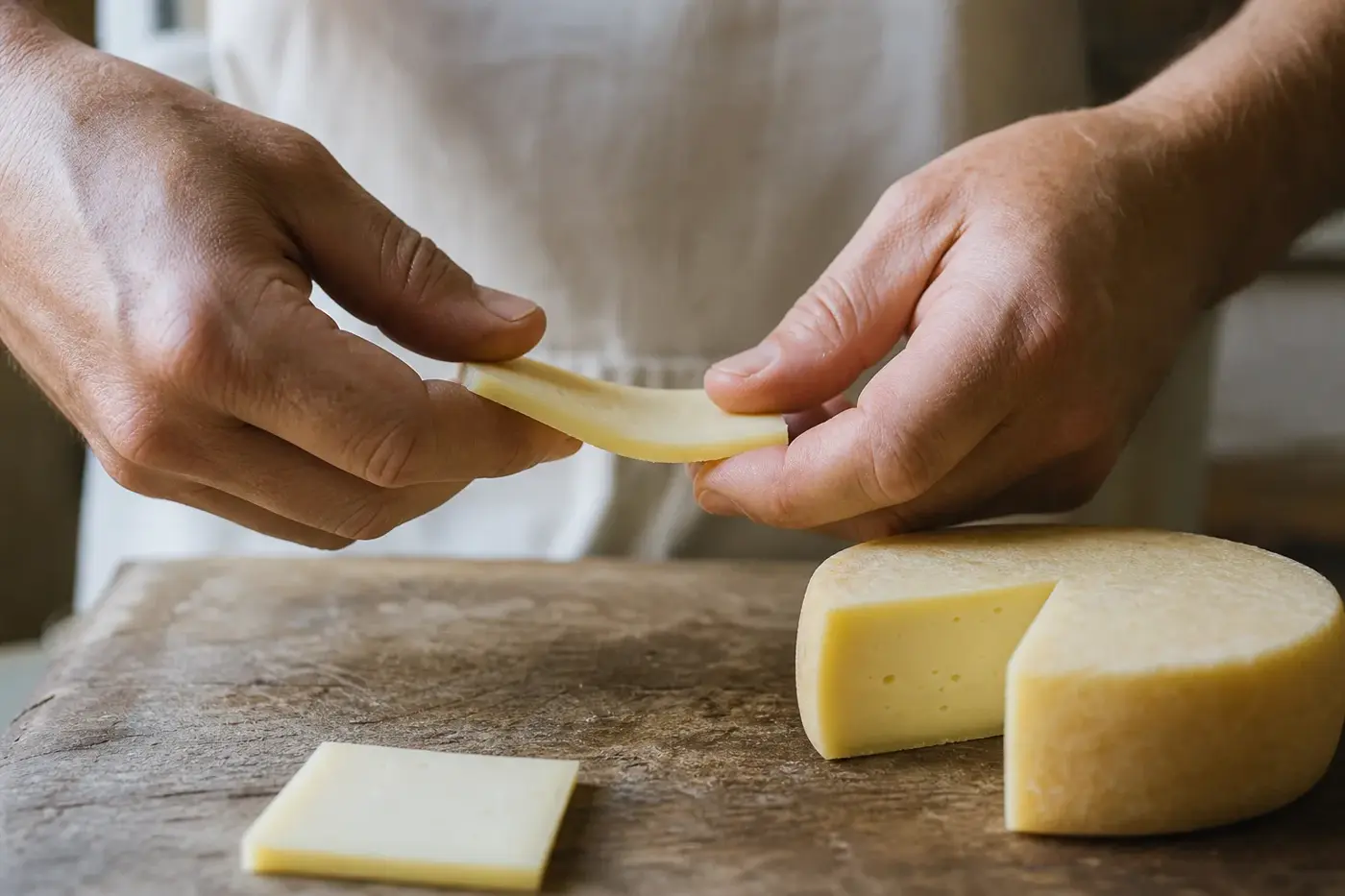
Bend a supple slice. Wait for the break, then taste that clean lactic tang. You might simply reach for another piece, but a cheesemaker could be looking for precisely this combination. For someone developing a small, pressed cheese from local cows’ milk, these are design goals. Getting it to your counter takes repeatable trials, controlled production and evidence that it can be sold safely. [1][5]
How much novelty does a new cheese need?
You do not have to invent a whole cheese family. An original combination of milk, cultures and ripening might give a cheese its identity. An established style might gain a distinctive texture, shape or maturation instead. The University of Guelph groups cheese families by coagulation, acidity, moisture control and curing, giving each new variation somewhere to belong. [4]
Start with what the dairy gives you
Sometimes the idea is already there: reliable local milk, an available ripening room or an ingredient rooted in the region’s food. A familiar way of draining, salting or serving cheese might provide the spark instead. In this example, local milk and that particular texture lead the way. Added flavourings stay out of the recipe.
Before you reach for equipment, put the intended eating experience, format and use on paper. Is this a cheese to slice at a counter rather than grate into cooking? Then measure that ambition against practical limits. A wheel needing extensive hand care may not fit a dairy whose staff and maturing space are already fully occupied.
Listen to what the milk tells you
Cows’, sheep’s or goats’ milk? That is only your first question. Fat, protein and mineral balance shape the raw material too, while published dairy science identifies lactation stage, diet and animal health as influences on milk composition. Those differences matter for coagulation, cheese yield and ripening. [3]
You need to know the actual milk supply and how it changes through the year. Switching species means a fresh development assessment, not simply swapping a word in the recipe. The milk deserves rather more attention than that. [3]
The example here uses pasteurised cows’ milk, with the heat treatment written into the specification. Treatment changes the microbial starting point and can affect cheesemaking behaviour, so it must suit the intended coagulation process. Pasteurisation does not finish the hygiene work: handling and equipment must protect the milk from subsequent contamination. [2][5]
You can explore the distinctions in raw, thermised and pasteurised milk. For every trial, the development record must state which treatment actually went into the vat.
Meet the cultures and coagulants
Cultures and coagulants have different jobs, and you need to distinguish them. Starter cultures are microorganisms selected to drive fermentation. Their acid production helps shape the cheese, while the wider microbial community contributes to ripening. [1][2][4]
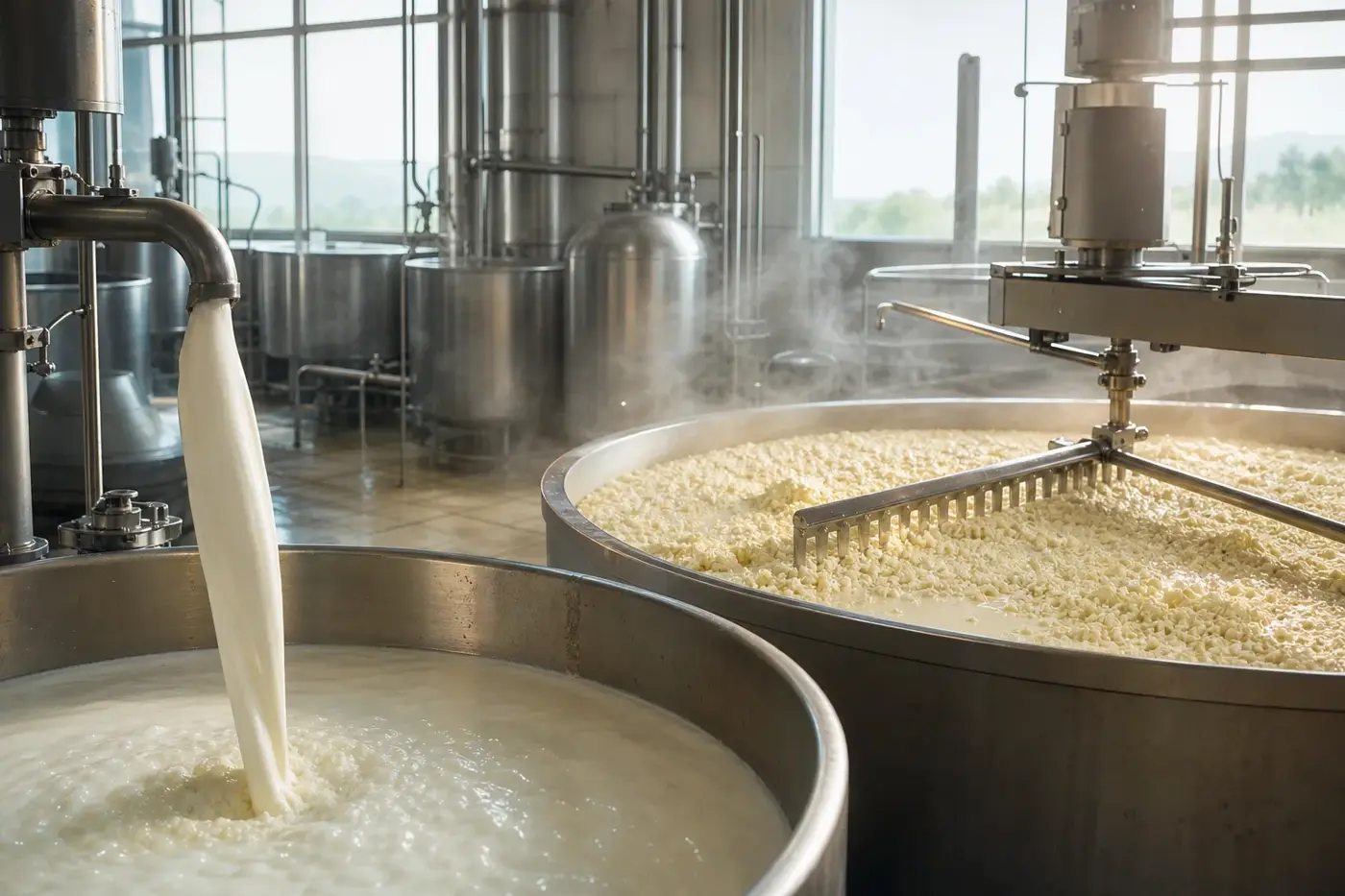
A coagulant turns milk into a gel. Rennet is an enzyme preparation used for that purpose; acid coagulation takes another route. The solids destined to become cheese are curd, and the liquid separated from them is whey. [1][2][4]
For this pressed cheese, the maker would choose a starter and rennet system suited to the intended style. Acidity, measured through indicators including pH, affects mineral retention and protein structure. Temperature, time and acid development influence how much whey the curd releases. Moisture retains fermentable milk sugar, which can support further acid development: each decision affects the next. [1]
That is why you need a coherent make plan, not merely a collection of attractive ingredients. They all have to get along, however impressive they look individually. For the underlying sequence, take a look at how cheese is made.
Shape the texture, then let it develop
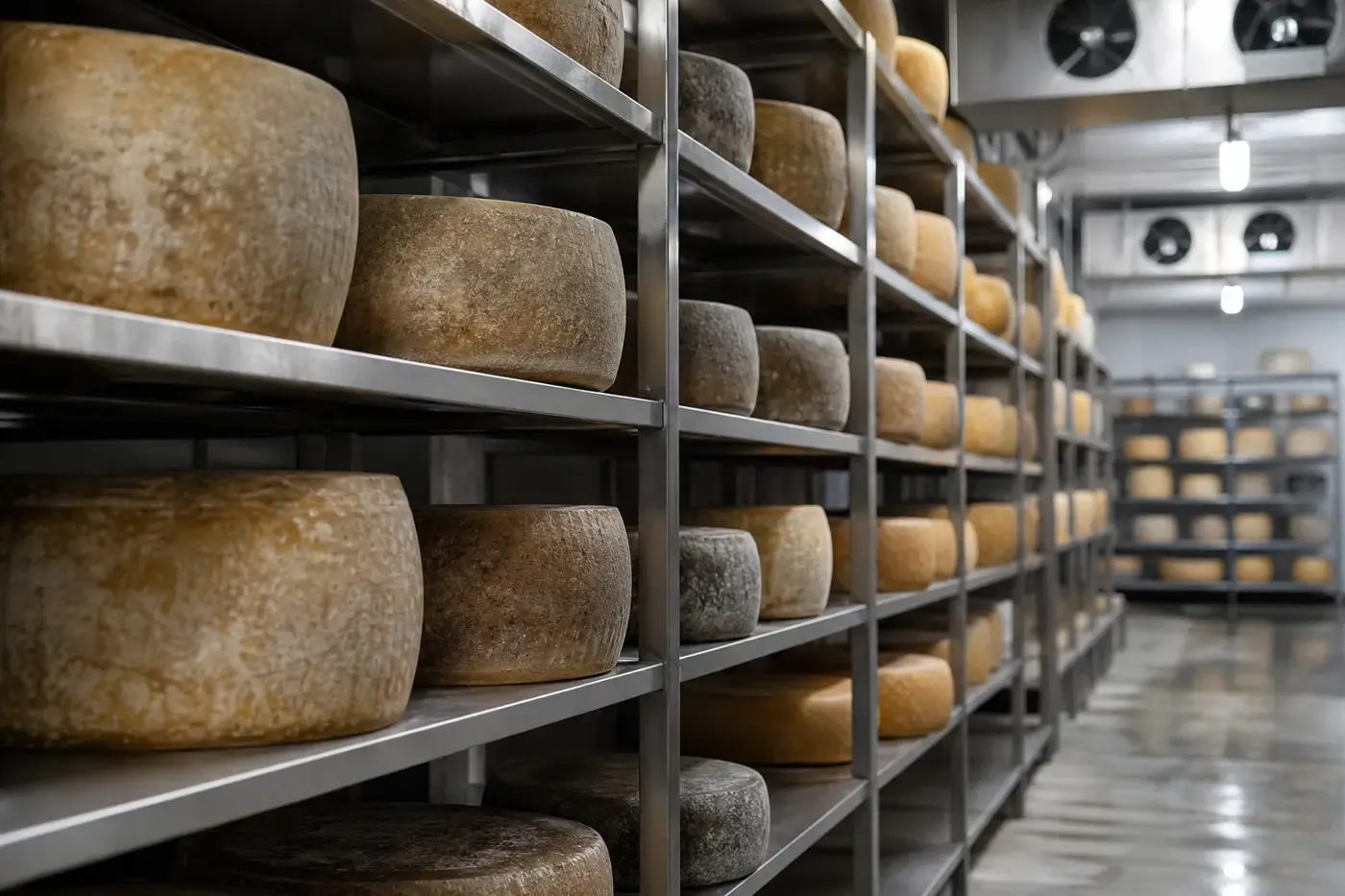
Cutting, washing, moulding, pressing and salting can lead the same broad ingredients towards different cheese families. Each changes acidity, moisture or structure. Ripening then develops the cheese under conditions chosen for that particular design. [1][4]
For the hypothetical pressed cheese, you can turn those stages into practical trial questions. Each needs a record, not just an impression.
| Stage | What are you trying to find out? | What should you record? |
|---|---|---|
| Cutting | Does this cut give you the drainage you want? | Cut description and curd condition |
| Washing | Would removing residual milk sugar help reach the intended acidity? | Washing procedure and acid development |
| Moulding and pressing | Does the curd knit into the intended shape? | Filling, handling and finished structure |
| Salting | Is the salt distributed consistently? | Method and measured composition |
| Ripening | Does this environment give the intended development? | Conditions, rind changes and tasting observations |
Cutting exposes more of the gel to whey drainage. Washing can remove residual lactose, the milk sugar available for fermentation. Moulding gives the cheese its format, while pressing helps the curd pieces join and release whey. [1][2]
Salt influences further acid development as well as eating character. During ripening, microbial activity and enzymes modify the curd, building flavour and changing texture. The slice you eventually taste carries the consequences of every stage. [1][2]
These questions belong to a proposed professional trial. Guelph’s dairy science account identifies microbial content, curd composition, temperature and humidity as influences on the finished cheese. The ripening room belongs in your design, not simply at the end of the corridor. [2]
When the slice snaps, stay curious
The first slice fractures when you bend it. That gives you an observation, but not yet an explanation. Excessive acid development or unsuitable moisture might account for it; those possibilities belong in a separate column. Keep what happened apart from why it might have happened, or a persuasive explanation can quietly become an assumed cause.
For the next comparison, the maker could change one planned variable and hold the others as steady as practicable. Keep the original as a control, compare cheeses at the same stage of development and repeat a promising result. Changing the culture, curd handling and ripening environment together might improve the cheese. It would also make the reason harder to identify.
A useful trial record links milk and ingredient batches with processing observations, acidity measurements, maturation conditions, cheese weights and tasting notes. Give failures the same care as successes. You want a repeatable relationship between a decision and an outcome, not one glorious wheel with no explanation.
Invite the right people to the tasting table
Different specialists answer different questions. For this project, the cheesemaker would turn the target into a make plan. An affineur, a specialist in maturing cheese, would assess how that plan develops during ripening. A dairy microbiologist would examine the organisms and controls relevant to the product.
Trusted tasters have another job: describing exactly what eating the cheese is like. Ask them to assess firmness, elasticity, acidity, salt perception and aroma separately before discussing preference. Coded samples and a shared vocabulary tell you more than a round of “Do you like it?” Customer preference and technical conformity need separate entries in the record.
This page summarises published guidance from the official sources it cites. It is not medical advice. Guidance differs between countries and changes over time, so check the current source for where you live, and ask your doctor, midwife, pharmacist or dietitian about your own circumstances.
Give safety a place from the start
If you are producing in Great Britain, food safety must develop alongside flavour. The applicable hygiene law requires food businesses to establish procedures based on HACCP, hazard analysis and critical control points. Those procedures need review when a product or process changes. The new cheese therefore needs assessment within the dairy’s food safety system. [6]
Shelf life needs evidence for the finished product under its intended distribution and storage conditions. In guidance on ready to eat foods, the FSA supports documented validation to manage Listeria monocytogenes. That means demonstrating control throughout shelf life, not assuming it from the type of cheese. [5]
The maker should agree the assessment with a competent specialist and the relevant authority, including the product measurements and microbiological studies needed. Tasting establishes eating quality. An appealing aroma and a successful flavour panel cannot supply the documented safety validation the FSA describes. [5]
Applicable microbiological rules differ between Great Britain and Northern Ireland, where the EU version applies. For this example, validation must follow the requirements for its production and market; the regulatory reference point is November 2026. You can explore the separate safety subject in Listeria and cheese safety. [5]
Let the larger vat earn your confidence
A larger vat is a fresh trial, not just a multiplied recipe. For this maker, scaling up would mean examining heating and cooling behaviour, mixing, cutting, draining and the time needed to fill moulds. Time, temperature and acidity influence moisture removal. Any change in sequence deserves your attention. [1]
The production specification should set acceptable variation as well as the target. The team could compare repeated batches for structure, composition and eating quality, then test performance with milk from different points in the supply cycle. Changes to the product or process also trigger a review of HACCP procedures. [3][6]
Before the counter, get premises and labels ready
Before first sale, the maker must establish whether the premises need registration or approval with the competent authority. Under the applicable animal product hygiene rules, establishments handling products covered by the specific requirements generally need approval. Exceptions include certain retail operations. Discuss the proposed activities with the competent authority before production for sale begins. [7]
The main requirements sit across different legal frameworks. This table shows how they line up for Great Britain and Northern Ireland.
| What needs your attention? | Great Britain | Northern Ireland | Source, November 2026 |
|---|---|---|---|
| HACCP procedures | Assimilated Regulation 852/2004, Article 5 | EU food hygiene framework | [5][6] |
| Establishment approval | Assimilated Regulation 853/2004, Article 4, where applicable | EU animal product hygiene framework, where applicable | [7] |
| Food information | Assimilated Regulation 1169/2011 | EU Regulation 1169/2011 | [8][9] |
Milk allergen information needs particular attention. The FSA explains that qualifying cheeses can omit an ingredients list and that the name “cheese” clearly refers to milk. Where an ingredients list is required, allergenic ingredients must be emphasised. Added ingredients can change the position, so the finished recipe and its processing aids need individual assessment. [8][9]
The label review must also cover the food’s name, net quantity, appropriate date marking and necessary storage instructions. Presentation and exemptions affect the rules: loose, prepacked and prepacked for direct sale products each need the appropriate assessment. For the view from your side of the counter, read how to read a cheese label. [9][10]
Is your new cheese a novel food?
Your cheese can be new to customers without being a novel food in law. In Great Britain, the definition combines a lack of significant consumption in the EU or UK before 15 May 1997 with specified categories. An unfamiliar name is not the deciding factor. [11]
Those categories include certain foods produced from microorganisms. They also include foods made using particular processes that significantly change composition or structure, affecting nutritional value, metabolism or levels of undesirable substances. The maker therefore needs to examine the ingredients and process, rather than the novelty of the name. [11]
If the status is uncertain, the FSA provides an Article 4 route to clarify it. Authorisation routes differ between Great Britain and Northern Ireland. That distinction needs a place in the development plan too. [12]
Find a name the cheese can carry
A new recipe cannot simply borrow a protected cheese name. Defra distinguishes the UK schemes, which protect registered names in Great Britain, from the EU schemes applying in Northern Ireland and the EU. Its guidance requires producers using a registered name to follow its specification and be verified to do so. [13]
For the maker in this example, an independent name and an accurate description would give the cheese a clear identity. Any proposed protected name needs comparison with the relevant register and specification before it reaches packaging. You can explore the distinction in PDO, PGI and TSG protection.
Is it ready for your cheese counter?
A distinctive cheese still has to fit a workable production system. The final decision takes in milk availability, equipment capacity, labour, packaging, maturation space and the proportion of production meeting specification. For this maker, that includes wheels occupying shelves before they are ready, routine turning and cleaning, and the work of preparing orders.
Customer feedback becomes useful when you ask precise questions. Does the cheese slice as intended, arrive in good condition and suit the way people want to use it? Keep comments about packaging or format separate from comments about flavour. That helps the maker decide which changes deserve another trial.
The outcome could be a launch, a revised brief or a decision to stop. In this example, first sale would follow repeatable production, supported shelf life, the necessary establishment arrangements and a label review. The useful invention is not simply a memorable slice. It is a cheese the dairy can keep making to its intended character, backed by the records and controls that support it. [5][6][7][10]
Questions people ask
What makes a cheese new?
A new cheese does not need to belong to a new family. Its identity might come from an original combination of milk, cultures and ripening, or a distinctive texture, shape or maturation within an established style.
What do cultures and rennet do in cheese?
Starter cultures are microorganisms selected to drive fermentation, and their acid production helps shape the cheese. Rennet is an enzyme preparation that turns milk into a gel.
How do cheesemakers test a new recipe?
A maker can change one planned variable while keeping the others as steady as practicable, with the original as a control. Promising results should be repeated, and cheeses compared at the same stage of development.
How is the shelf life of a new cheese established?
Shelf life requires evidence for the finished cheese under its intended distribution and storage conditions. The FSA supports documented validation to manage Listeria monocytogenes in its guidance on ready to eat foods.
Can a new cheese use a protected cheese name?
A new recipe cannot simply borrow a protected name. Defra says producers using a registered name must follow its specification and be verified to do so.
Sources
- University of Guelph, Cheese Making Technology e-Book: Process Control, undated online edition. Sections on moisture, acidity and mineral control. Source.
- University of Guelph, Dairy Science and Technology eBook: Cultured Dairy Products and Cheese, undated online edition. Retrieved indexed extract; full chapter verification outstanding. Source.
- Elsevier, Selection and Treatment of Milk for Cheesemaking, chapter 2, publication edition not verified. Retrieved indexed extract on milk variability; full chapter verification outstanding. Source.
- University of Guelph, Cheese Making Technology e-Book: Cheese Families, undated online edition. Retrieved indexed extract; full chapter verification outstanding. Source.
- Food Standards Agency, Managing food safety, updated 21 August 2026. Food safety procedures, traceability and shelf-life guidance for managing Listeria monocytogenes. Source.
- The National Archives, Regulation (EC) No 852/2004, assimilated version, Article 5, revised text retrieved November 2026. Source.
- The National Archives, Regulation (EC) No 853/2004, assimilated version, Article 4, revised text retrieved November 2026. Source.
- The National Archives, Regulation (EU) No 1169/2011, assimilated version, Article 19, revised text retrieved November 2026. Source.
- Food Standards Agency, Food allergen labelling and information requirements technical guidance, online revision retrieved November 2026. Source.
- Department for Environment, Food & Rural Affairs, Food labelling: giving food information to consumers, online revision retrieved November 2026. Source.
- The National Archives, Regulation (EU) 2015/2283, assimilated version, Article 3, revised text retrieved November 2026. Source.
- Food Standards Agency, Novel foods authorisation guidance, originally published 30 May 2018, online revision retrieved November 2026. Source.
- Department for Environment, Food & Rural Affairs, Protected geographical food and drink names: UK GI schemes, updated 8 March 2024. Source.
Researched through official guidance, legislation and university dairy-science material, using a hypothetical development project to connect the stages.
Last checked: November 2026
Last checked November 2026.
The editors suggest you read next
The Global Cheese Industry Explained
At the farm gate, a delivery of milk begins its journey with the clock already ticking.