The Moon Is Made of Green Cheese: Folklore and Fact
A wife has heard quite enough of her husband’s arguments.
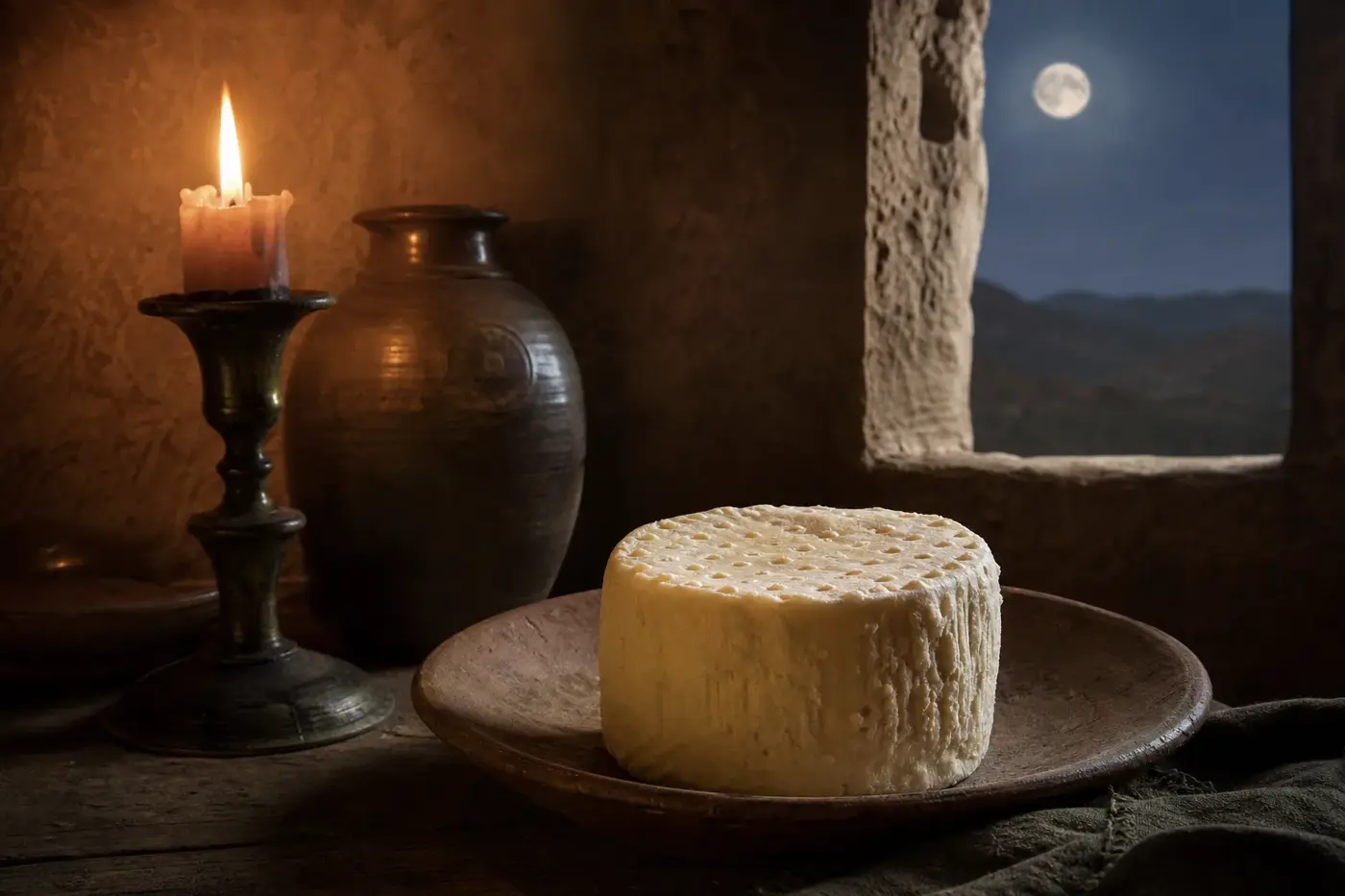
A wife has heard quite enough of her husband’s arguments. Does he really think he can persuade her that “the moone is made of a greene cheese”? In John Heywood’s proverb collection, she knows exactly how ridiculous that sounds. The joke is her refusal to be fooled, not her belief.[3][4]
There is another surprise tucked inside the phrase, though. In the older language of cheese, green could mean new or immature, rather than a colour.[1][2] The real Moon is rocky, as observations and returned samples establish, but follow this familiar absurdity and you find a much richer history.[5][6]
When green cheese was simply young
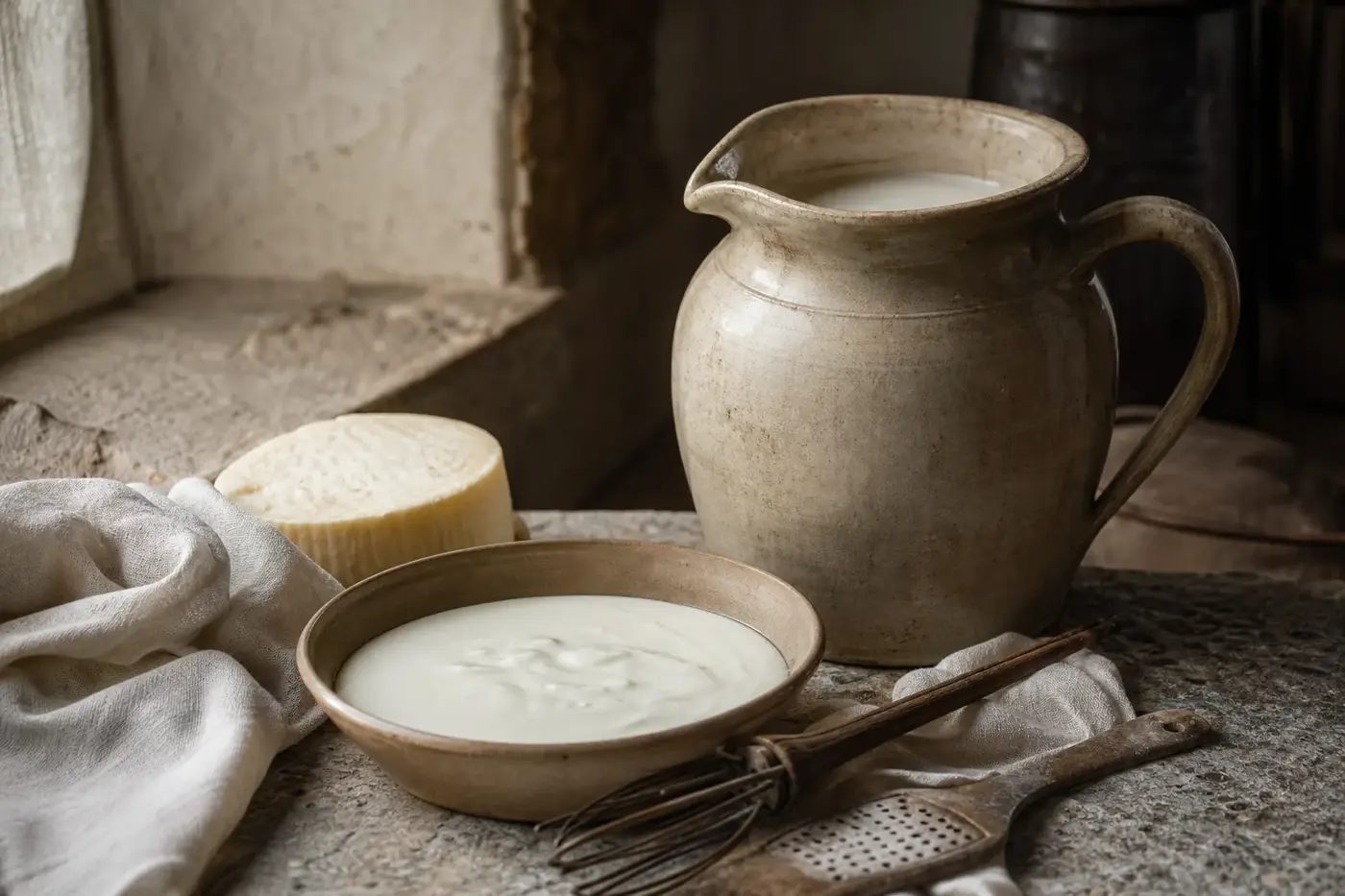
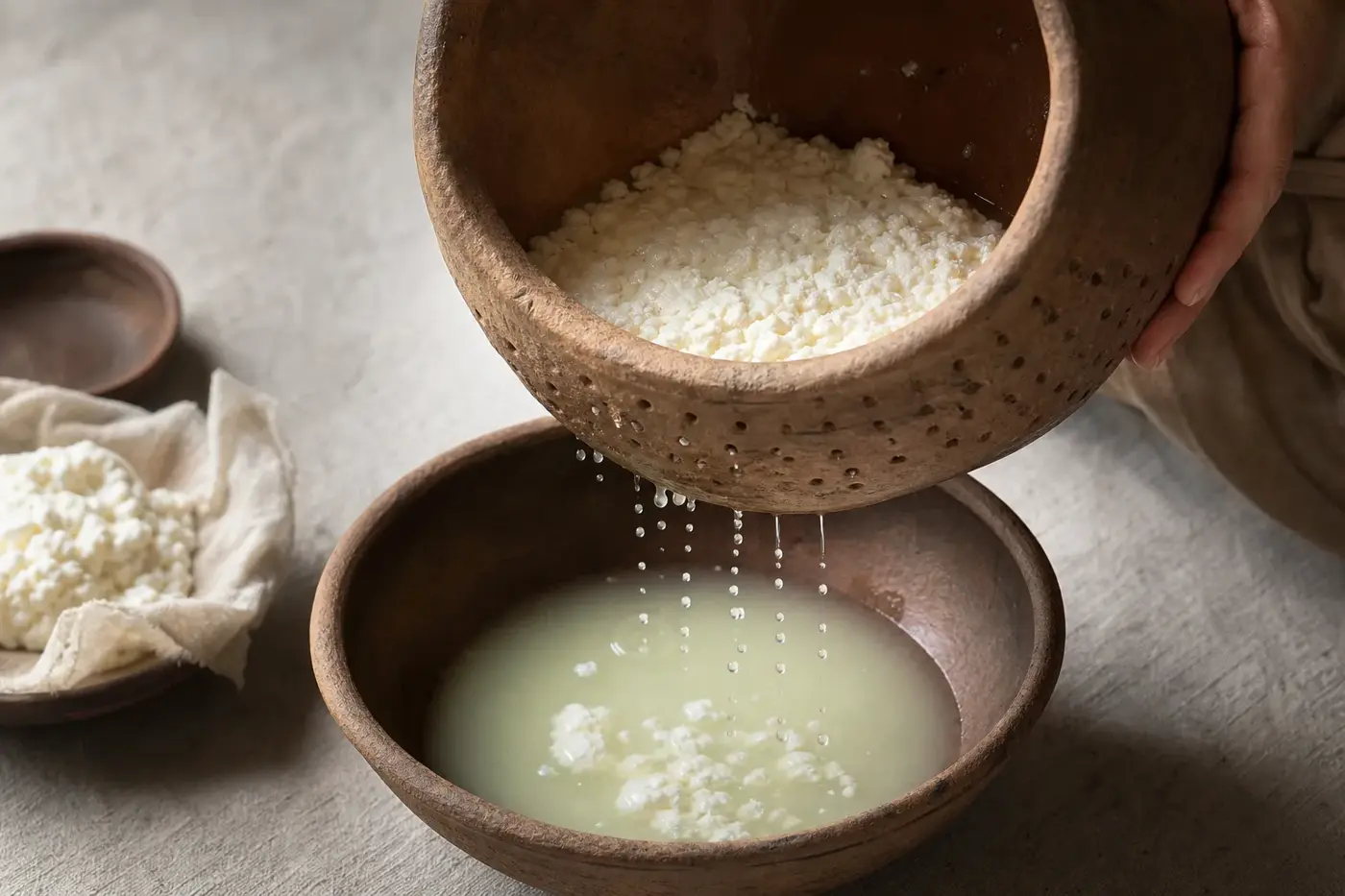
Picture a newly made cheese, still holding whey or waiting to mature. You could call that a green cheese. Oxford University Press’s account traces this meaning to the late fourteenth century, part of a broader use of green for freshness and incomplete development.[2]
Andrew Boorde brings the idea within touching distance. In his Dyetary, dated 1542 in the historical dictionary entry for cheese, he explicitly separates newness from colour. He describes cheese with much of its whey still waiting to be pressed out. Whey is the liquid separated from the curd during cheesemaking.[1]
Think moist and newly formed, then, rather than the bright green object you might find in a modern illustration. Nor should you picture a dry cheese matured over a long period. Depending on its making and draining, such a cheese might plausibly have had a tender body, though Boorde does not prescribe one shape, colour or texture for every historical example.[1]
His categories distinguish green, soft and hard cheese. Those words were not simply interchangeable, and historical cheese came in varied forms. What you have here is an explanation of what green cheese could mean, not a recipe for one standard product.[1]
Keep that distinction handy when you meet the Moon proverb. Fresh or immature is a documented historical meaning of green cheese. The expression alone cannot tell you exactly which cheese any particular speaker had in mind.[1][2]
The wife who was having none of it
Heywood’s wife recognises an absurd proposition when she hears one. In the text reproduced by Julian Sharman’s 1874 edition, she accuses her husband of using roundabout arguments to make a fool of her. The cheese Moon belongs to that complaint about manipulation, not to an explanation of the heavens.[4]
The collection first appeared in 1546 as A dialogue conteinyng the nomber in effect of all the prouerbes in the englishe tongue. The Oxford Text Archive records its publication and identifies its subject as a dialogue concerning two kinds of marriage. That is the setting you need around this famous scrap of lunar nonsense.[3]
Sharman’s text includes these words:
“Or thinke, that the moone is made of a greene cheese”[4]
The speaker understands the proposition perfectly well and refuses to be persuaded. You can see the joke taking shape: one person behaves as though another could be talked into almost anything. The intended victim is not obliging.[4]
Read the passage in its setting and you find a story about scepticism and persuasion. Treating it as evidence that sixteenth-century people generally believed in a cheese Moon turns its meaning upside down. The character who introduces the idea knows how absurd it is.[4]
There is a small but important wrinkle if you quote it. Sharman’s title prominently mentions the work printed in 1546, but his introduction says he used the 1598 edition for his text. The collection’s first publication and the particular textual witness quoted here therefore have different dates.[3][4]
Follow the saying without inventing its birthplace
Heywood gives you an early publication record, not an inventor. His title presents a collection of proverbs: expressions gathered together rather than necessarily coined for the book. A dated appearance tells you a saying had been recorded by then. Its inventor and its earlier life in speech are separate questions.[3]
Historical dictionaries preserve other witnesses, too. But if you encounter a quotation through a later edition, you cannot automatically assign its wording and context to an earlier printing.[1]
Following a phrase through folklore means keeping several kinds of evidence in view. A proverb records an expression, while a storyteller’s imagined incident gives it a setting. A later explanation of the proverb’s origins offers an account of its beginnings. These things may connect, but each does a different job.
A story can show you how an unlikely idea entertains an audience. It does not necessarily reveal the historical circumstances in which that idea first arose. That still leaves plenty to enjoy, and plenty to investigate.
Here, you have a substantial record to explore. Heywood’s collection supplies an early publication, the surviving text gives you a conversational setting, and later adaptations show what subsequent storytellers made of the idea.[3][4][11] Taken together, those layers offer a fuller history than a single supposed birthplace.
Look up and picture a round cheese
A bright circular face, marked with darker patches: you can see why the full Moon invites comparison with a round cheese. A storyteller need only bring that distant, unfamiliar object down to the table. This explains the comparison’s visual appeal, rather than documenting how somebody invented it.[5][7]
Those broad light and dark areas are real features of the lunar surface. NASA distinguishes darker lowland plains from brighter highlands. Different rocks account for much of the contrast you see.[5]
The resemblance needs very little help from you. A pale disc with patches is enough to spark recognition. There is no need to identify one particular historical cheese, or match every feature of the lunar landscape to something edible.
Resemblance, of course, is not the same as shared material. You can recognise the shape of one thing in another without believing they consist of the same substance. That imaginative leap is part of the pleasure.
Heywood’s scene depends on precisely this gap. You can easily picture a cheese in the Moon’s place; accepting that the Moon actually consists of cheese is quite another matter. The comparison is imaginable, while the claim is unacceptable to the speaker.[4]
Read the rocks in the Moon’s mottled face
The Moon’s dark plains are called maria, the plural of mare, meaning sea. They are largely basaltic: rock formed when lava cooled and solidified. NASA’s lunar sample teaching collection identifies basalt with these dark lowland “seas”.[5]
Much of the brighter highland terrain is rich in anorthosite, a rock dominated by feldspar crystals. NASA describes anorthosite as the predominant highland rock. It distinguishes this from basalt and from breccia, which consists of fragments broken and joined during impacts.[5]
Across the surface lies regolith, loose material created by the breaking and alteration of rock. NASA lists rock chips, mineral fragments and glasses among its ingredients. This dusty covering belongs to the Moon’s geological history, as repeated impacts help break down the material beneath it.[6]
So the view you get from Earth has more to tell you than “grey rock” suggests. Different terrains record different processes, including volcanic activity and impact damage. The contrast between dark plains and brighter highlands carries some of that history across the distance.[5][6]
If you enjoy the cheese comparison, geology gives you another way to look. The dark patches have a material explanation, while their fanciful resemblance remains yours to enjoy. Knowing what makes that familiar face need not make it any less engaging.
Why the crescent has no missing piece
Watch the Moon change shape and you are watching a change in how much of its sunlit side you can see. As it travels around Earth, the viewing angle shifts. That produces the familiar sequence from new Moon through crescent and quarter phases to full Moon, then back again.[7]
At first quarter, the visible disc looks half illuminated. The name describes the Moon’s progress through its cycle, not a quarter of the disc being bright. NASA’s explanation separates the illuminated half of the spherical Moon from the portion of that half you can see from Earth.[7]
A lunar eclipse is a different affair. It happens at full Moon when the alignment allows Earth’s shadow to fall across the lunar surface. Ordinary phases come from viewing geometry; an eclipse involves the Moon passing through that shadow.[7][8]
Why do you not get a lunar eclipse at every full Moon? The Moon’s orbit is tilted relative to Earth’s orbit around the Sun. The bodies therefore do not line up each time.[8]
A crescent needs neither a missing piece nor a passing terrestrial shadow. The Moon stays whole as its illuminated portion comes into and moves out of view.[7] Nobody has been helping themselves to a slice: the apparent transformation concerns how much sunlit surface you can see, not a change in the Moon’s material.
Meet the rocks that came home
Apollo astronauts brought approximately 382 kilograms of lunar rocks and soil back to Earth, according to NASA.[9] These are physical specimens that researchers can examine alongside observations from Earth and spacecraft. You are no longer dealing only with a distant face in the sky.
Apollo 15 sample 15415, commonly called the Genesis Rock, offers an especially instructive example. The Lunar Sample Compendium records its collection at Spur Crater and describes its crystalline texture. Laboratory examination identified it as an anorthosite composed almost entirely of plagioclase feldspar.[10]
Its record gives you much more than a photograph of a pale object. There are microscope observations, mineral proportions and chemical analyses. Thin sections show how crystals meet inside the rock, while analytical tables report its composition. Together, they provide detailed measurements of geological material.[10]
Collected samples also connect with observations across wider areas. NASA describes spectroscopy, the study of light signatures, alongside gravity, rotation and moonquake measurements as ways to investigate lunar composition and structure. Each lets researchers explore a different aspect of the Moon.[6]
The picture builds across scales, from individual mineral grains and collected rocks to broad surface terrains and the behaviour of the Moon as a whole. Each contributes its own kind of detail. The cheese Moon belongs in storytelling; the specimens examined in laboratories belong to a rocky world.[5][6][10]
Leave room for a lunar cheese adventure
In A Grand Day Out, wanting cheese becomes a reason to leave Earth. The official Wallace & Gromit synopsis describes a journey to the Moon, where Wallace eats slices of lunar cheese. A homemade rocket turns an impossible lunch destination into somewhere the characters can actually visit.[11]
The story neatly reverses Heywood’s use of the expression. In the proverb dialogue, accepting the cheese Moon would mean being fooled. In the animated adventure, accepting it is your invitation into the fiction.[4][11]
Both depend on the distance between ordinary experience and an extraordinary proposition. Cheese is familiar enough to eat; the Moon is remote enough to make the substitution startling. Put them together and the everyday becomes wonderfully improbable.
Humour and children’s storytelling can cross that distance without settling an astronomical question. You can enjoy the impossible premise on its own terms. Heywood’s speaker can recognise that same impossibility and refuse to be taken in.
Basalt, feldspar and changing illumination leave the imaginative pleasure intact. A child can learn why the Moon changes shape and still enjoy a story in which somebody takes crackers there. For the length of a joke or a story, you can delight in the thought that lunch might be waiting overhead.
Questions people ask
Why was the Moon said to be made of green cheese?
The full Moon’s bright circular face and darker patches invite a comparison with a round cheese. The resemblance explains the comparison’s visual appeal, but does not establish how the saying was invented.
Did green cheese mean cheese that was green in colour?
Not necessarily. Green could mean a cheese that was new or immature, a sense recorded from the late fourteenth century.
Did people once believe the Moon was made of cheese?
In John Heywood’s proverb collection, the wife who mentions a cheese Moon recognises the idea as absurd and refuses to be fooled. The passage is a joke about scepticism and persuasion, not evidence that people generally believed it.
Who invented the saying that the Moon is made of green cheese?
Heywood’s collection recorded the saying when it first appeared in 1546, but it does not establish who invented it. The collection gathered proverbs rather than necessarily coining them.
Why does the Moon change shape, and why is there not an eclipse every full Moon?
The Moon’s apparent shape changes as the visible portion of its sunlit side changes. A lunar eclipse happens when Earth’s shadow falls across the Moon at full Moon, but the Moon’s orbit is tilted, so the bodies do not line up every time.
Sources
- World English Historical Dictionary, “Cheese sb.1”, historical dictionary entry, undated online transcription. Includes quotations attributed to Boorde’s Dyetary (1542), Frith and later writers. Historical entry and dated quotations.
- Oxford University Press, “How green became green”, 2017. Historical development of green, including its application to immature cheese. Publisher’s account.
- Oxford Text Archive, Bodleian Libraries, John Heywood, A dialogue conteinyng the nomber in effect of all the prouerbes in the englishe tongue, 1546, catalogue record ota:A03168. Publication record.
- John Heywood, edited by Julian Sharman, The proverbs of John Heywood, George Bell and Sons, 1874. Introduction, page xlviii; dialogue, page 145. The introduction identifies the underlying edition as 1598. Digitised volume. (upload.wikimedia.org)
- NASA Johnson Space Center, ARES, “Lunar Sample Disk Information”, undated educational resource. Definitions of basalt, breccia, anorthosite and lunar soils. Lunar sample descriptions.
- NASA Science, “Moon Composition”, undated online edition retrieved November 2026. Sections “The Lunar Crust” and “How Do We Know What the Moon Is Made Of?” Composition and observational evidence.
- NASA Science, “Moon Phases”, undated online edition retrieved November 2026. Illumination, viewing geometry and individual phases. Explanation of lunar phases.
- NASA Science, “Eclipses and the Moon”, undated online edition retrieved November 2026. Lunar eclipse geometry and orbital inclination. Explanation of lunar eclipses.
- NASA Science, “Moon Facts”, undated online edition retrieved November 2026. Returned Apollo sample mass. Apollo sample summary.
- NASA, C. Meyer, Lunar Sample Compendium: 15415, Ferroan Anorthosite, 2011. Collection context, petrography, mineralogy and analytical tables; copy hosted by the Lunar and Planetary Institute. Sample 15415 laboratory record.
- Wallace & Gromit official website, “A Grand Day Out”, undated film synopsis. Primary source for the production’s published plot description. Official story synopsis.
Researched through historical dictionary evidence, a bibliographic record and digitised Heywood edition, NASA educational and sample records, and an official film synopsis; the comparisons and literary interpretation are desk-research synthesis.
Last checked: November 2026
Last checked November 2026.
The editors suggest you read next
Cheese Legends: Origin Stories and What the Record Shows
Peer into a broken pot and a cheese story begins to stir.