Do Mice Really Like Cheese? Myth and Evidence
Six laboratory mice, mascarpone and chocolate spread.
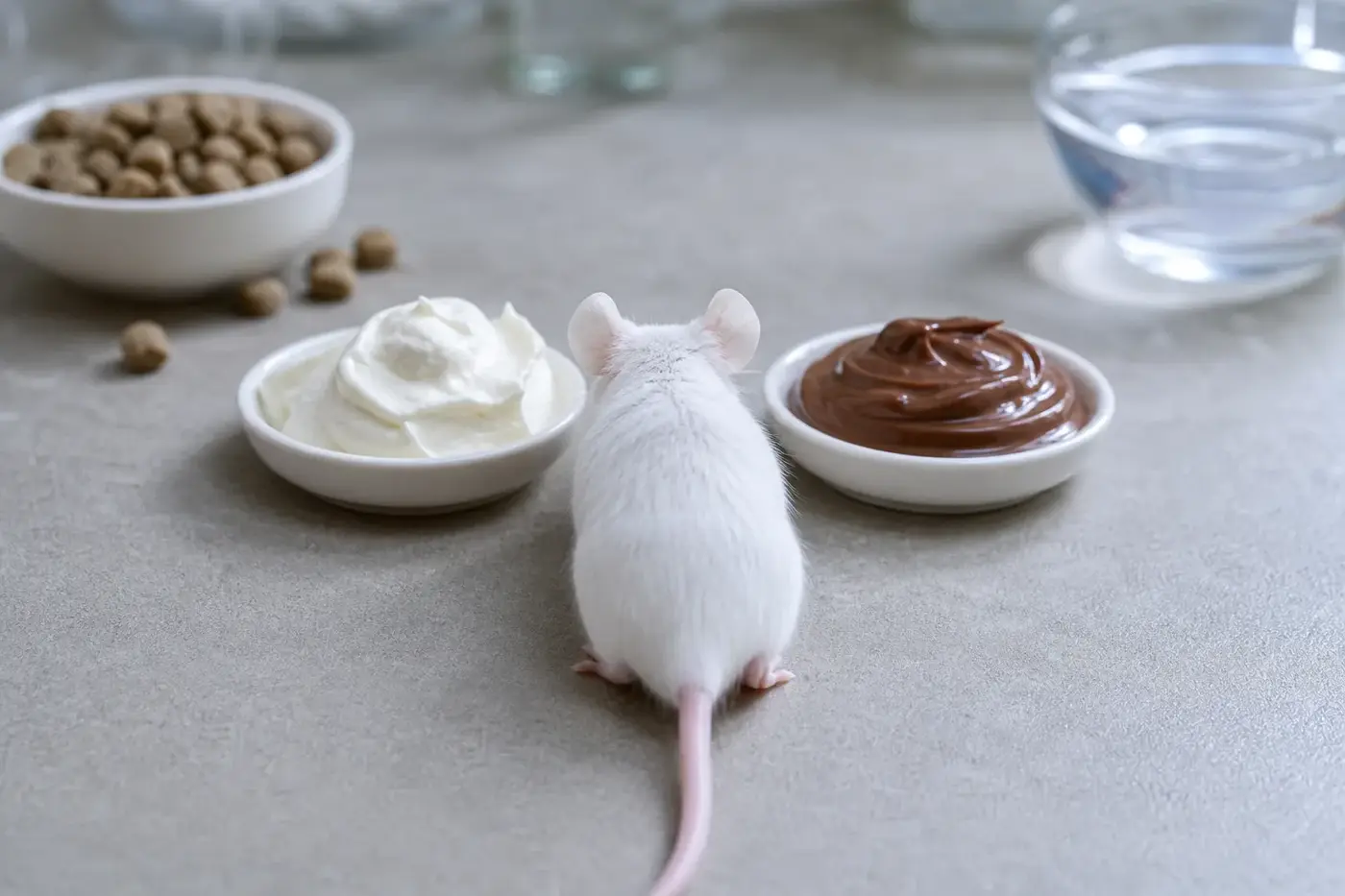
Six laboratory mice, mascarpone and chocolate spread. If you expect the chocolate to disappear first, here comes a small surprise. In a 2010 study, every mouse tasted the cheese, while only three tried the spread. They approached the cheese sooner and returned to feed more often.[1]
One small victory for the cheeseboard, then. But the familiar mouse racing towards a wedge of cheese tells a simpler story than the evidence does. Mice can eat cheese; whether they prefer it depends on what else is on offer.
A nibble does not make a favourite
Yes, some mice readily eat cheese, and experiments can show a preference for it over another food.[1] But watch a mouse approach a morsel, eat it or choose it over something else, and you are watching three different behaviours.
Attraction means approaching something, perhaps to investigate its smell. Acceptance means eating it. Preference needs a comparison: choosing one food more readily than another when both are offered.
Those distinctions matter beside a trap, in your kitchen and in a laboratory.[1] A mouse eating cheese tells you that this animal accepted this cheese in those circumstances. To call it a favourite, you need to know what else was accessible, whether the foods were familiar and what was measured. The first food approached need not be the one eaten in the greatest quantity.
This page summarises published guidance from the official sources it cites. It is not medical advice. Guidance differs between countries and changes over time, so check the current source for where you live, and ask your doctor, midwife, pharmacist or dietitian about your own circumstances.
Follow the mouse to the grain store
To understand a house mouse's everyday menu, start with cereals and seeds. University of California pest biologists describe the house mouse, Mus musculus, as an omnivore eating cereals, grasses, roots, seeds and insect larvae. They connect its close association with people to the storage of cereals and grains.[2]
The RSPCA describes a similarly varied menu for wild mice: seeds, grains and other plant material alongside animal food. These opportunistic omnivores have room in their diet for foods encountered around people. A broad diet does not stop an animal favouring particular foods within it.[3]
You also need to know which mouse you are looking at. In its British household and garden guidance, the RSPCA distinguishes house mice from wood mice and yellow-necked mice.[4] A finding about a particular laboratory strain needs that identification attached. Calling every small rodent a mouse can hide important differences.
Sometimes cheese is simply within reach
House mice are adaptable nibblers. The university account describes them eating wherever they find food, or carrying it somewhere more secluded.[2] Cheese within reach becomes part of a practical household menu: available food for an animal equipped to use it.
Finding cheese alone, though, is not the same as choosing between cheese and grain. Only the second arrangement directly compares their appeal. Even then, your answer depends on the cheese, its competitor and the observation period. Cheese is a broad category, as anyone with an overcrowded cheese drawer can confirm; one comparison cannot speak for every choice.
Mascarpone meets chocolate in the laboratory
Mascarpone won the 2010 pilot study. Six male C57BL/6J laboratory mice, all four months old, were offered mascarpone and chocolate spread for 15 minutes, with standard pellets and water still available. All six tasted the cheese; only three tasted the spread. Cheese prompted an earlier approach and more feeding visits.[1]
That gives you a preference under those measured conditions: six males, one strain, one cheese and one comparator. The researchers measured how quickly and how often the mice fed. They were not building a comprehensive food ranking based on total consumption.[1]
A 2024 experiment asked a different question: how does experience change a food's value? It involved 52 male C57BL/6N mice, aged three to six months, randomly assigned to four groups of 13. After familiarisation, they received their regular diet for 30 minutes, then another food period lasting 30 minutes. Test foods included cheese, sweet chocolate and bitter chocolate.[5]
The mice ate less regular food when cheese or sweet chocolate followed it, and more when bitter chocolate followed. That supports changes in food value shaped by experience. Keep the sequence in mind: anticipating a later food is different from choosing between a cheeseboard and a bowl of seeds offered together.[5]
What another mouse's meal can tell you
A food's smell can carry information from another mouse. A 2022 study explored this social transmission of food preference using ordinary laboratory mice and genetically modified mice lacking olfactory marker protein. Behavioural comparisons involved six to 16 animals per condition and genotype, with sample sizes differing between tests.[6]
Observer mice met companions that had eaten scented powdered food, then chose between two scented foods. Ordinary mice acquired the preference their companions demonstrated; loss of the protein disrupted that process. The experiment shows how smell and social experience can shape choices involving flavoured chow, rather than comparing cheese aromas.[6]
Hunger could influence a response too, although these experiments do not establish how it changes a mouse's response to cheese. Remember that the 2010 mice still had their ordinary pellets: cheese was not their only food. When you interpret a choice, look at access to other foods and the animals' familiarisation with the offerings.[1,5]
Pull up a chair for cheese parings in 1692
Picture the country mouse's table in 1692: crusts, oatmeal, bacon and cheese parings. In Fables of Æsop and Other Eminent Mythologists, these are among the offerings when a city mouse visits a country mouse. Cheese has a place at this mixed household meal, but it is not the entire attraction.[7]
A later fable turns cheese into the dwelling itself. In the 1882 English edition of La Fontaine's fables, Book VII, fable III, The Rat Retired from the World, a rat retreats into a Holland cheese and eats his home from within. A bold approach to the property ladder, although the animal is explicitly a rat. Keep that distinction when you trace the supposed history of a mouse myth.[8]
The stories put their food to different uses. The first contrasts country hospitality with city abundance; the second makes an edible refuge the setting for satire. Both show how readily rodents and stored food could meet in a story.[7,8]
The country mouse gets an animated outing
Disney's production reference dates The Country Cousin to 31 October 1936. Its description follows a rural mouse visiting his city cousin, carrying the mouse story into animation.[9] You get the familiar visit from that description, but no detail about whether cheese appears.
Following the story back to its first crumb
The 1692 collection gives you a firm dated example of a mouse associated with cheese in print.[7] The earlier history remains open. Fables travel through translations and retellings, so keep three things separate: the age of a story, the date of an edition and the wording of that particular version.
Old kitchens and cheese exposed in storerooms may sound like tempting explanations, but they need the same care. Historical evidence would need to establish both the storage practice and its connection to the belief. The surviving examples show a long association between rodents and cheese. Its first appearance and the relative influence of different media remain unresolved.
Choosing bait for a mouse trap
The feeding study tested food choice, not traps.[1] For mouse traps, East Hampshire District Council recommends peanut butter, with traps placed indoors where mouse activity has been seen. It also advises removing other accessible food.[10]
Bait is only part of the response. The council combines trapping with housekeeping and pest-proofing, tells you to follow the manufacturer's directions, and says traps must be kept away from children and pets. Identify the activity and prevent access to your household's existing food supply before concentrating on bait.[10]
Protect the cupboard and consider welfare
Start with the whole cupboard, not just your cheese. For homes in England, the council advises cleaning crumbs from beneath appliances, checking cupboards for spills and damaged packets, and keeping food waste bins firmly closed. The RSPCA recommends sealed, rodent-proof food containers and attention to entry points.[4,10]
The Food Standards Agency's pest control guidance is written for caterers rather than households.[11] If you have a household infestation, consult the current guidance from your local authority.
Prevention and humane deterrence come first in the RSPCA's animal welfare guidance. It opposes glue traps and warns that live capture followed by release can leave animals facing unfamiliar food sources, shortages of shelter and predation. If activity persists, seek competent pest-control advice and explicitly include welfare in the discussion.[4]
Once your food is protected, how to store cheese at home covers everyday handling. For wider contamination questions, see cheese food safety.
What should you make of the mouse and the cheese?
Three conclusions stand out. House mice eat a varied diet in which seeds and cereals matter. They can accept cheese and prefer it to a particular alternative in an experiment. Printed stories linked rodents with cheese before animation continued the broader tradition of stories about mice and food.[1,2,7,8,9]
The animal, its experience, the food and the alternatives all shape your answer. Neither a universal ranking of cheese against other foods nor a single origin for the popular belief has been established. The useful question is more precise than the cartoon: which mouse, offered which cheese, alongside what else?
Questions people ask
Do mice prefer cheese to other foods?
Mice can eat cheese and may prefer it to a particular alternative. In one small study, six mice approached mascarpone sooner and made more feeding visits to it than to chocolate spread, but the study did not establish a universal food ranking.
What do mice normally eat?
University of California pest biologists describe house mice as omnivores that eat cereals, grasses, roots, seeds and insect larvae. They link the mouse's close association with people to the storage of cereals and grains.
Why are mice associated with cheese?
A 1692 collection of fables includes a mouse serving cheese parings as part of a mixed meal. The first appearance of the association, and the relative influence of different media, remain unresolved.
Is cheese good bait for a mouse trap?
The mascarpone study tested food choice, not traps. East Hampshire District Council recommends peanut butter for mouse traps, placed indoors where mouse activity has been seen, and advises removing other accessible food.
How can I protect food and respond humanely to mice?
The RSPCA recommends sealed, rodent-proof food containers and attention to entry points. It opposes glue traps and warns that animals released after live capture can face unfamiliar food sources, shortages of shelter and predation.
Sources
-
Berry and Alleva. Preference for novel food in a familiar versus unfamiliar context: a pilot study on C57BL/6J mice. Rendiconti Lincei. Scienze Fisiche e Naturali, volume 21, pages 233 to 237, 2010. Author-uploaded full text, published online 24 April 2010.
-
University of California Statewide Integrated Pest Management Program. House Mouse. Pest Notes, revision July 2025.
-
RSPCA. What to feed pet mice. Undated online guidance, retrieved November 2026.
-
RSPCA. Living with... Rats & Mice. 2022 update, four-page guidance document.
-
Cheng and colleagues. Changes in food valence of regular diet depending on the experience of high and low preference food. Neuropsychopharmacology Reports, volume 44, issue 4, pages 842 to 846, 2024. First published 28 October 2024.
-
de Vallière and colleagues. Food preference acquired by social transmission is altered by the absence of the olfactory marker protein in mice. Frontiers in Nutrition, volume 9, article 1026373, published 9 November 2022.
-
Fables of Æsop and Other Eminent Mythologists, with Morals and Reflexions. 1692 edition, fable XI, A City Mouse and a Country Mouse. Historical text transcribed in the David M. Hart collection; relevant passage retrieved through the indexed transcription.
-
The Fables of La Fontaine. English translation, new edition with notes, 1882. Book VII, fable III, The Rat Retired from the World. Project Gutenberg transcription, ebook 7241, updated 13 March 2020.
-
Disney, D23. Country Cousin, The (film). Undated Disney A to Z production reference, retrieved November 2026.
-
East Hampshire District Council. Pest advice. Sections on prevention, trapping and mice; undated current online guidance, retrieved November 2026.
-
Food Standards Agency. Safe method: Pest control. Safer food, better business guidance for caterers; undated retrieved PDF, November 2026.
This desk-researched article compares original experimental reports, historical texts, a studio production reference and current public-body and animal-welfare guidance.
Last checked: November 2026
Last checked November 2026.
The editors suggest you read next

Cheese Legends: Origin Stories and What the Record Shows
Peer into a broken pot and a cheese story begins to stir.