Cheese Legends: Origin Stories and What the Record Shows
Peer into a broken pot and a cheese story begins to stir.
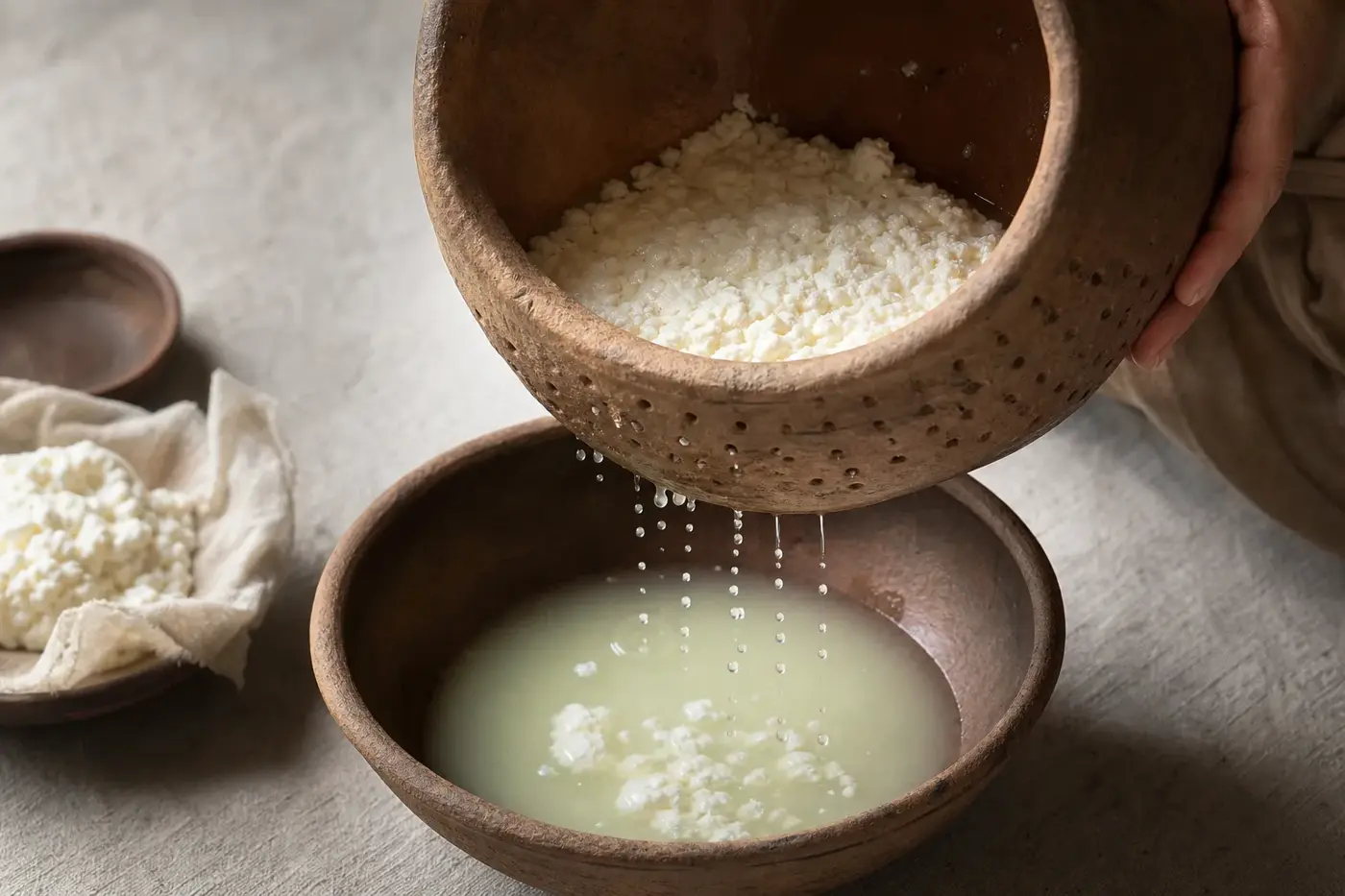
Peer into a broken pot and a cheese story begins to stir. Small holes pierce the clay; milk fat lingers inside. Recovered at early farming sites in Kuyavia, in what is now north-central Poland, these vessels carry traces of cheesemaking from the sixth millennium BC. Their shape and residues point to people separating curds from whey.[7]
Other beginnings come with someone you can picture. A traveller opens his pouch after a hot desert journey and finds his milk transformed; Aristaeus learns useful crafts from nymphs and passes them to humanity. Texts, milk chemistry and prehistoric pottery bring you closer to different parts of the story: discovery, teaching and the work itself.[1][5][7]
Why a good cheese story stays with you
You can see why both legends have lasted. The traveller finds something unexpected and recognises its usefulness; Aristaeus receives knowledge and shares it. These are stories about observation, ingenuity and skills passed onwards, rather than a timetable for the invention of cheese.[1][5]
Each kind of evidence has its own job, though. A published legend records a story in circulation, while an ancient myth preserves an association within a surviving literary tradition. An archaeological investigation identifies materials and activities at particular sites. Let each tell you what it can, and the whole account becomes more rewarding.[1][5][7]
There is drama in that unexpected supper, and generosity in the teaching attributed to Aristaeus. The pottery offers a quieter fascination: holes that once let liquid escape, and fat that researchers can investigate thousands of years later. The stories give you characters to remember. The objects bring the practical work within reach.[1][5][7]
A desert journey with an unexpected supper
An Arabian merchant sets off across the desert carrying milk in a pouch made from a sheep’s stomach. You will find this version in the United States Department of Agriculture’s Cheese Varieties and Descriptions, issued in December 1953. During the long journey, the story says, rennet in the stomach lining and the sun’s warmth cause the milk to separate.[1]
By nightfall, his drink has become two things. There is curd, the coagulated portion, and whey, the liquid. He drinks the whey and eats the curd: an accidental discovery that the handbook explicitly introduces as a legend. Not the refreshment he packed, but supper nonetheless.[1]
The container is the lovely twist. The merchant expects it simply to carry his milk, yet it helps turn a familiar drink into an unfamiliar food. He notices the change and makes use of it. What might have been an interruption to his journey becomes an unexpected meal.[1]
Where you can meet the traveller in print
December 1953 gives you a firm publication date for this telling. The handbook’s introduction calls the account ancient, but names no specific ancient text, manuscript or collected oral testimony for the journey. Its pages place the story in circulation by that date. They do not establish when the tale began.[1]
That distinction matters when you follow a legend backwards. A dated appearance is an attestation: evidence that someone had recorded a version by then. To reach an original source, you need an earlier chain of evidence, ideally showing where an author found the account. A tale can arrive in print labelled traditional without bringing that trail along.
The pouch story also packs several claims into one neat adventure. There is an animal-derived container, active milk-clotting enzymes, suitable conditions, a journey and a discovery. Each needs its own evidence. The pouch itself belongs to the handbook’s retelling: a literary detail, distinct from archaeological evidence for such a vessel.[1][2]
Inside the pouch: where the chemistry begins
An animal stomach gives the legend a persuasive setting because the biological connection is real. Animal rennet contains milk-clotting enzymes and is traditionally obtained from the abomasum, the glandular stomach compartment of a young ruminant such as a calf. Chymosin is a principal active enzyme, alongside pepsin.[2]
To picture what happens, start with milk proteins called caseins, gathered into small assemblies known as micelles. Chymosin cuts a particular bond in κ-casein, one of the proteins helping to keep those assemblies stable. The altered assemblies can then gather together into a gel. That is coagulation: liquid milk setting into a protein network.[2][3]
An original laboratory study published in 1996 examined purified bovine κ-casein using chromatography and electrophoresis, techniques for separating and investigating molecules. It identified the principal fragments released by chymosin. The experiment established the enzyme’s action on milk protein under the conditions studied. That finding stands independently of any proposed prehistoric discovery.[3]
You can follow the mechanism further in the explanation of rennet. For the traveller, the distinction is straightforward: chemistry explains how milk can coagulate, while his identity, route and moment of discovery belong to historical enquiry. A workable mechanism makes the story biologically plausible. It supplies neither a date nor a documented protagonist.
Curds need not take the same route
Milk does not need an added milk-clotting enzyme to set. As it becomes more acidic, changes in the casein assemblies and their electrical charges allow a network to form. Acidification and enzyme action take different routes, but both can produce a set milk gel.[2]
They can work together, too. A 2021 experimental study followed milk gels during slow fermentation, comparing preparations containing different added enzymes with controls without added proteases, the enzymes that cut proteins. Researchers recorded differences in firmness and liquid release. These included firmer gels with chymosins than in their controls.[4]
That leaves you with more than one possible explanation for the traveller’s curds. Curds alone cannot identify an animal enzyme as the cause: acidification offers another route, and the processes can interact. For the wider sequence of setting, draining and subsequent processing, turn to how cheese is made.[2][4]
Nor can warmth explain everything. Milk composition, acidity, calcium and temperature all influence coagulation, so applying that knowledge to a particular ancient pouch would require details of its material and circumstances. The science supports the possibility of an enzyme-assisted accident. The merchant’s journey remains part of the recorded legend.[1][2]
Aristaeus brings the gift of knowing how
With Aristaeus, you move from finding something to knowing how to do it. In Library of History, Book 4, sections 81.1 and 81.2, Diodorus Siculus describes him as the son of Apollo and Cyrene. Apollo entrusts the infant to nymphs, who nurture him and give him several names.[5]
His education brings three practical activities together. In the English translation reproduced by Theoi, he learns “how to curdle milk”, make beehives and cultivate olive trees, then becomes the first to instruct people in these matters. That phrase about curdling milk is the passage’s precise connection with cheesemaking.[5]
Divine parentage, nymphs for teachers and useful knowledge delivered to humanity: you are firmly in the world of myth. Diodorus preserves the literary association between Aristaeus and these crafts. Instruction by a historical individual would require a different supporting record.[5]
Set him beside the traveller and you can feel the change in emphasis. Aristaeus matters because he passes knowledge onwards, not because he happens upon a changed drink. Bringing milk processing, beekeeping and olive cultivation together honours practical skills through which people work with animals, plants and their surroundings. That reading follows the crafts grouped in the passage.[5]
The two stories leave you with different questions. The merchant’s pouch invites you to ask what might happen inside a container; Aristaeus invites you to ask why a culture linked useful knowledge to a particular mythic figure. Neither needs to explain every aspect of cheese’s beginnings. Each becomes more interesting when you let it keep its own concern.
Back to Poland, and the pots that did the work
Now leave the characters behind and look again at those holes in the clay. At early farming sites in Kuyavia, in what is now north-central Poland, archaeologists recovered pottery fragments pierced with small openings. Their form suggested a practical possibility. Liquid could pass through while larger material stayed behind.[6][7]
In 1984, an archaeological paper proposed that ceramic sieves of the Linear Pottery culture had separated curds from whey. Its argument drew on comparisons with later vessels and ethnographic examples, alongside animal-remains evidence relevant to dairying. Several observations supported that interpretation of the pots’ function. Chemical identification of their contents had yet to become part of the case.[6]
The later investigation brought that chemical evidence into view. Published online on 12 December 2012 and appearing in the January 2013 issue of Nature, the original sieve study used molecular and isotopic evidence to identify milk fat in residues from the region’s perforated pottery. The vessels belonged to the sixth millennium BC.[7]
Here, the holes and the fat tell you more together. Researchers interpreted abundant milk fat in vessels resembling cheese strainers as compelling evidence for separating fat-rich curds from whey. The holes suggest a task; the residues connect the vessels’ use with milk processing. Neither offers such a specific account on its own.[7]
A contemporary Princeton account follows the earlier hypothesis and later investigation through interviews with members of the research team. You can trace an interpretation gaining a new line of support. Comparisons based on pottery were joined by molecular traces preserved within the ceramic material.[8]
These are traces of people getting on with a job. Someone made perforated vessels, and dairy material entered the pottery during use. Together, those observations let the study reconstruct a processing activity from material evidence. The interpretation grows from what survives, rather than fastening an invention story to an unexplained object.[6][7]
What the pots reveal, and what they keep to themselves
A pot can hold on to a meal long after the food has gone. Lipids, meaning fats and related substances, sometimes survive within its pores. Researchers extract and examine them using methods including chromatography, mass spectrometry and measurements of carbon isotopes. These isotopes are forms of an element whose relative proportions can help distinguish different sources of ancient fats.[9]
Where you find those traces matters. Dairy residues in an ordinary pot indicate milk use or processing, but leave the exact operation uncertain. Put dairy residues in a perforated vessel, and contents connect more closely with a possible function. That is why the Polish sieve evidence takes you beyond simply finding milk traces in pottery.[7][9]
The study supports cheesemaking in the broad sense of separating curd from whey. It does not give you an inventor, a complete recipe, a particular coagulant, a precise texture or a named modern cheese. Those details lie beyond what vessel form and milk fat can establish. They need additional evidence.[7][9]
When you encounter a claim about cheese’s origins, this gives you a useful way to untangle it. Start with what the evidence supports. Then ask which parts need a separate case.
| What you have to go on | What it tells you | What needs its own evidence |
|---|---|---|
| Merchant story in the 1953 handbook | A legend was in print by that date | The journey as an event [1] |
| Diodorus, Library of History 4.81.1 and 4.81.2 | Aristaeus has a literary association with curdling milk | Historical instruction by Aristaeus [5] |
| Dairy fats in perforated prehistoric pottery | The study’s interpretation of curd and whey separation | A complete recipe or individual inventor [7] |
Place matters just as much as process. The Kuyavia evidence establishes activity there during the period represented by the vessels. To claim cheese was invented there would take a much wider argument. The earliest surviving record available to an investigation is not the same thing as the first occurrence of a practice.[7]
Room for more than one beginning
A legend can gather a discovery into one journey, or the teaching of a craft into one figure. Archaeology takes another route, bringing together a vessel fragment, a residue and a dated context. Researchers use those pieces to develop and test an interpretation. You are looking at two different ways of giving shape to the past.[1][5][6][7]
Several beginnings remain possible: different encounters with coagulated milk, repeated experiments, and skills developed or shared across communities. The Polish sieves leave that larger question open. Their evidence is local and specific. People in that region processed milk in ways the researchers interpret as cheesemaking.[7]
So keep the stories, but enjoy what each brings. The traveller’s tale rewards attention to an unexpected change; Aristaeus honours useful knowledge passed to others. Beside them, those perforated pots preserve something quieter: traces of people doing the work. Together, they give you a richer beginning for cheese than a single confidently named inventor.[1][5][7]
Questions people ask
Who invented cheese?
The page does not identify an inventor. The Polish pottery supports an interpretation of cheesemaking in Kuyavia, but it cannot establish who invented cheese or where it first occurred.
Is the story of the Arabian merchant true?
A United States Department of Agriculture handbook published the story in December 1953 and described it as a legend. The handbook named no specific ancient text, manuscript or collected oral testimony for the journey, so its publication does not establish when the tale began or whether the journey happened.
What is the archaeological evidence for early cheesemaking?
Researchers found milk fat in perforated pottery from sixth millennium BC farming sites in Kuyavia, now in north central Poland. They interpreted the combination of holes and milk fat as compelling evidence that the vessels were used to separate curds from whey.
Who was Aristaeus in the cheese origin story?
In Diodorus Siculus’s Library of History, Aristaeus is the son of Apollo and Cyrene. Nymphs teach him how to curdle milk, make beehives and cultivate olive trees, and he becomes the first to instruct people in those skills.
How can milk separate into curds and whey?
Animal rennet contains enzymes, including chymosin, that can cause milk proteins to form a gel. Milk can also set as it becomes more acidic, without an added milk clotting enzyme. The presence of curds alone cannot establish which process caused them.
Sources
[1] United States Department of Agriculture, Cheese Varieties and Descriptions, Agriculture Handbook No. 54, issued December 1953. Introduction, page 1. Digitised handbook.
[2] Swedish University of Agricultural Sciences, Coagulation Properties of Milk: Association with Milk Protein Composition and Genetic Polymorphism, doctoral thesis, 2008:75. Sections 1.3.1 to 1.3.3. University repository copy.
[3] Journal of Dairy Research, “Comparative study of methods for the isolation and purification of bovine kappa-casein and its hydrolysis by chymosin”, 1996. Original comparative research, abstract indexed by the US National Library of Medicine. PubMed record.
[4] International Journal of Dairy Technology, “The impact of chymosin and plant-derived proteases on the acid-induced gelation of milk”, volume 74, pages 297 to 306, 2021. Original experimental research. Publisher’s abstract.
[5] Diodorus Siculus, Library of History, Book 4, sections 81.1 and 81.2, English translation reproduced in Theoi Classical Texts Library. Ancient text in translation.
[6] Oxford Journal of Archaeology, “Ceramic sieves of the Linear Pottery culture and their economic implications”, 1984. Original archaeological interpretation, publisher’s abstract. Publication record.
[7] Nature, “Earliest evidence for cheese making in the sixth millennium bc in northern Europe”, volume 493, pages 522 to 525, 2013. Published online 12 December 2012; issue dated 24 January 2013. Original archaeological residue study, publisher’s abstract and figure descriptions. Publication record.
[8] Princeton University, “Clay pot fragments reveal early start to cheese-making, a marker for civilization”, 9 January 2013. Contemporary interviews with members of the research team. University account.
[9] University of Bristol repository, Milk, 2018, author manuscript. Sections on archaeological lipid analysis and prehistoric milk processing. Repository manuscript.
This piece was researched through published legend, an ancient literary passage, original scientific and archaeological research, and supporting university records; the cultural readings are editorial interpretation.
Last checked: November 2026
Last checked November 2026.
The editors suggest you read next
Marie Harel and Camembert: Legend and Record
It is Monday in Vimoutiers, and cheese has come to market from the Camembert area.