Marie Harel and Camembert: Legend and Record
It is Monday in Vimoutiers, and cheese has come to market from the Camembert area.
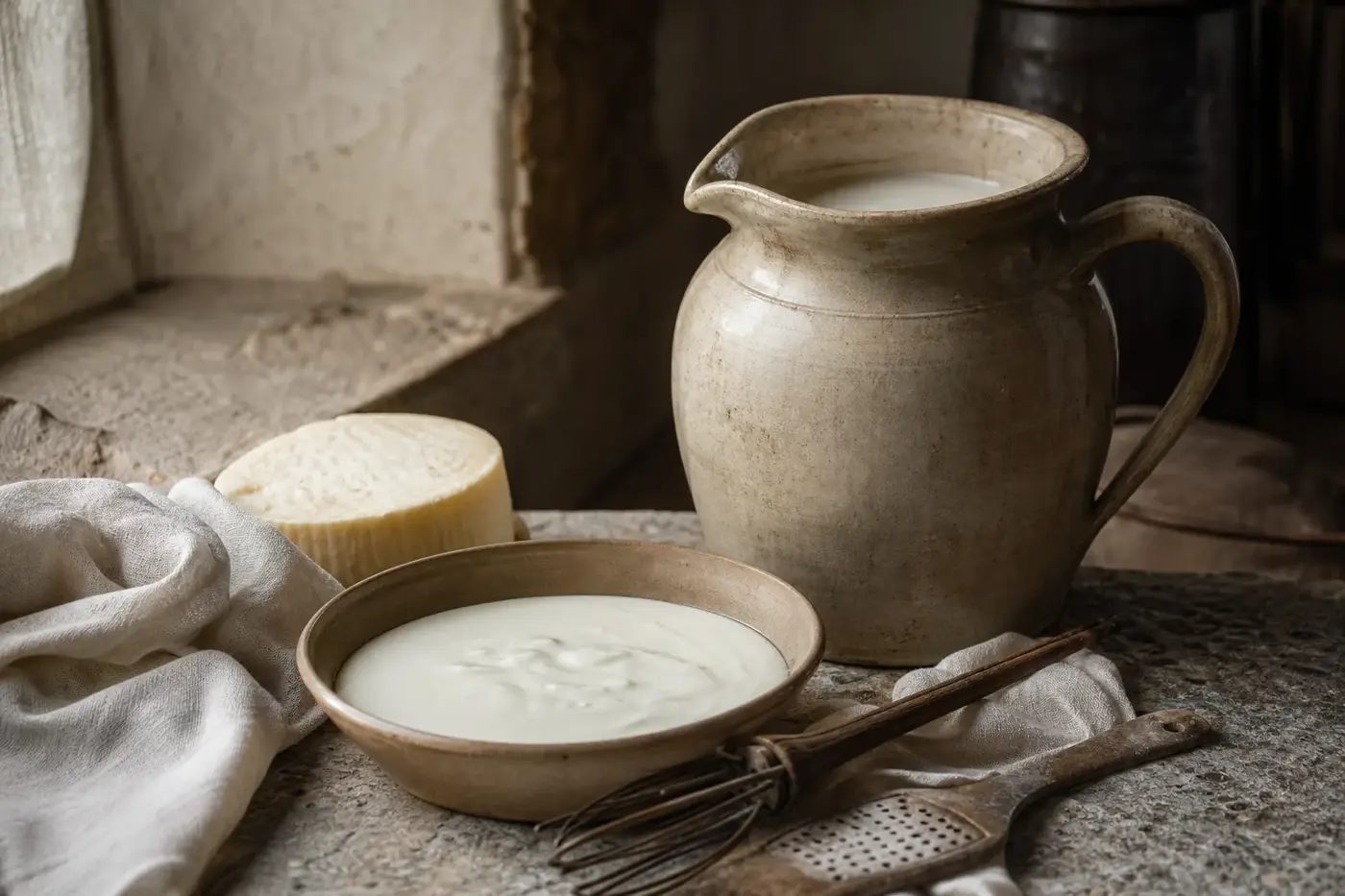
It is Monday in Vimoutiers, and cheese has come to market from the Camembert area. You might expect Marie Harel to be somewhere in this picture. But the official Camembert de Normandie specification traces this trade to a reference published in 1708, decades before the celebrated encounter said to have made her its inventor. [1, 2, 3]
Follow the trail into Normandy's Pays d'Auge and you find dairy farms, a market and generations of makers. Harel remains the enduring founding figure. The history around her, though, has rather more going on than one splendid moment of inspiration. [1, 2, 3]
A fugitive priest comes to the door
The familiar story begins in 1791, with someone in danger and a door opened to him. A Normandy cheesemaker shelters a priest who has refused the revolutionary oath. In gratitude, he shares a cheesemaking secret. [1, 2, 3]
Some versions connect the priest with Brie. In those tellings, you follow his knowledge west until, in Harel's hands, it becomes Camembert. As origin stories go, it packs a great deal into one doorstep. [1, 2, 3]
The official Camembert de Normandie specification calls this episode involving Harel and the abbé Bonvoust unconfirmed. The document explaining the cheese's geographical heritage therefore draws a line between the memorable encounter and established history. [1]
You can understand the story's staying power. Danger, shelter, gratitude and useful knowledge meet in an exchange between two people. The patient business of cheesemaking acquires the drama of the Revolution.
When the priest's tale found its readers
A recognisable printed version appears in the Norman writer Xavier Rousseau's work in 1927, discussed by Pierre Boisard in Le Camembert, mythe français. A priest who has refused the oath is pursued and takes shelter with peasants. He repays a woman named Harel with cheesemaking knowledge unfamiliar to her. [2]
Boisard makes a distinction worth carrying with you: this is transmission, not invention. One person passes a secret to another. Calling Harel the inventor changes what this particular account describes. [2]
The 1927 appearance dates the telling, not the events it contains. When did the story begin circulating, and can its priest be connected with a documented revolutionary household? To follow those questions, you need earlier evidence: an event and its eventual narration are not the same thing.
Getting to know Marie Harel
A later biographical account gives the famous name a fuller identity: Marie Catherine Fontaine, born at Crouttes on 28 April 1761. It names her husband as Jacques Harel and places her death at Vimoutiers on 9 November 1844. The original registers are the essential sources for establishing those particulars. [3]
Later biographical accounts also connect her daughter with the Paynel cheesemaking family. They suggest that reports of a death at Champosoult confuse mother and daughter. Here, too, the family relationships and death records take you back to the original documents. [3]
Parish and civil registers offer the clearest path through this family history. A baptism identifies a child; a marriage connects families. Names, ages and relationships gradually bring the people into focus.
Even a register has its limits, though. Establishing who belonged to a household is one task. Establishing who devised a cheesemaking method is quite another.
Monday market, long before 1791
Return to Vimoutiers on a Monday and the timeline opens out. The official specification's historical section cites Thomas Corneille's Dictionnaire universel géographique et historique, published in 1708. Its reference concerns cheese brought to market from the Camembert area. [1, 3]
As reported in the specification, this puts Camembert, cheese and trade together before the traditional date of 1791. The original entry is the place to establish the precise wording and what it allows you to conclude. [1, 3]
A market reference can tell you where cheese came from without revealing exactly what buyers took home. How was the milk treated? How did the curd drain, and what rind and shape did those buyers see?
A name can stay put while the food changes substantially. The relationship between that early cheese and today's Camembert de Normandie therefore remains a question to explore. You cannot assume that the recipe stayed the same.
Pasture, butter and the working dairy
Permanent pasture was expanding in the region from the seventeenth century, according to the specification's historical account. Cattle farming supplied milk for butter and soft cheeses. By Harel's time, you are looking at an established dairy economy, not an enterprise waiting for a single revelation. [1]
That gives you a setting for her work, rather than her farm's precise method. Milk going into butter and soft cheese tells you about the surrounding agriculture. It does not recover one maker's daily sequence of tasks. [1]
Even the familiar white rind has a history of change. INAO describes modern Camembert de Normandie as a soft cheese with a bloomy rind, a surface covering of ripening mould. That offers you a useful present-day comparison, but not a portrait of the cheese made on Harel's farm. [9]
The Paynels bring the paperwork
With the Paynels, you move from family tradition towards working papers. The Archives du Calvados catalogue identifies Cyrille Paynel, 1817 to 1886, as Harel's grandson, a cattle breeder and a cheesemaker. It records a published edition of his notebook, with an inventory of private papers entrusted by his descendants. [4]
Published in 1997, that edition offers a way into the family's agricultural and manufacturing activities. Its interest goes beyond adding another branch to a famous founder's family tree. Here is the prospect of following a working life through its records. [4]
The catalogue documents a cheesemaker in the family, but leaves you with questions. What did he produce, how did he make it, and what did he sell? Did he follow an inherited recipe? [4]
For those answers, the trail leads into the notebook and dated papers themselves. They take you beyond identifying a cheesemaking family towards understanding what happened during its working day. [4]
Camembert meets an emperor at Surdon
At Surdon railway station in 1863, Victor Paynel offers Camembert to Napoleon III. That is the version discussed by Boisard, who describes Paynel as Harel's grandson. A rural cheese, a family maker and an emperor share a railway platform. [2]
You can feel the appeal of the scene. Imperial approval arrives beside the transport that could carry the cheese to a wider public. Like the priest episode, it gathers a complicated development into one memorable meeting.
The documentary trail calls for an imperial itinerary alongside a dated report identifying the presentation. Did the emperor pass through the station? Did he meet the cheesemaker, and did a continuing supply arrangement follow?
Those are three separate questions, rather than one. The later narrative brings them together in a single tradition. Each event needs evidence of its own.
How Camembert reached a wider table
Railways and a growing milk supply offer another account of expansion, with fewer emperors and rather more organisation. The specification connects the railway's arrival in the Pays d'Auge in 1855 with increasing trade. It also describes farms buying additional milk as demand grew. [1]
Faster journeys were only part of the job. Makers needed enough milk, organised production and deliveries that brought cheese to buyers in usable condition. Farms, cheesemakers, carriers and customers had to work together as a larger commercial system.
Methods changed alongside markets. Boisard follows Camembert as both a developing product and a national story, placing modern production within a longer history of adaptation. For the manufacturing principles, how cheese is made takes you from milk to finished cheese. [2]
The historical question is who changed that work, and when. The specification connects the later selection of white surface cultures with Camembert's familiar appearance. The timing of that change and its commercial effects remain questions for further source research. [1]
Later manufacturing accounts reveal how wide the differences became. The 2015 Fromages & Chefs publication describes hand ladling and automated moulding. It also describes production with pasteurised milk outside the raw milk designation. [7]
This is a commercially interested account, presenting the methods its publisher chose to include. Even so, the contrasting systems help you see how one familiar cheese name can cover different manufacturing histories. The finished cheeses may share a recognisable format and practical purpose without taking the same route to your table. [7]
Two statues and a town's long memory
In Vimoutiers, you can encounter Harel's story in physical form. The municipality records two statues: an original that lost its head during the bombing of 14 June 1944, and another facing the town hall. The second was given by the Borden Cheese Company in Ohio. [5]
Normandy's tourism authority places the American gift within the town's postwar reconstruction and describes a contribution by dairy workers. Harel's commemoration becomes part of a relationship stretching across the Atlantic. Cheese history joins the history of a town rebuilding itself. [6]
The monuments have histories of their own. They show you whom a community chose to honour and how that choice took shape. Bomb damage and replacement bring war and reconstruction into the cheese's public memory.
An inscription naming an inventor establishes a public attribution. Evidence for the invention itself must come from the period concerned. A statue can tell you a great deal about remembrance, but it cannot take you inside Harel's dairy.
From a statue unveiling to a Google Doodle
The 2015 Livre blanc du camembert, published by Fromages & Chefs, dates the inauguration of Harel's statue to 11 April 1928. This later industry publication records the heritage story circulating within the cheese trade. For the ceremony's precise circumstances, you need its original programme and contemporary reporting. [7]
Google brought Harel to another audience with a birthday Doodle on 28 April 2017. Its accompanying page presents her through the familiar association with Camembert. For that anniversary, the digital commemoration is itself primary evidence: you have the date, the subject and the story chosen to represent her. [8]
A statue, an industry history and an online anniversary can all reinforce the same association. None adds testimony from Harel's lifetime simply by repeating it. Together, they help explain why the account feels so familiar.
Follow each retelling towards its source and a useful distinction emerges. Several appearances of one inherited story are not the same as several independent witnesses. Familiarity is powerful, but it answers a different question.
The Camembert de Normandie on your board
Picture a flat cylinder with a bloomy rind on your cheese board. Its flavour begins milky and mild, becoming more pronounced and fruity as it ripens. That is INAO's published description of present-day Camembert de Normandie. [9]
INAO identifies it as a raw milk cheese and distinguishes the designation from the broader name Camembert. Regulation (EU) No 1209/2013 approved an amendment to its specification. The current registration and applicable specification are separate documentary questions. [9, 10]
Production rules define which cheese is entitled to bear the designation. They establish a legal connection with place. They do not settle a revolutionary origin story or identify a single inventor.
For the cheese itself, read Camembert. For the difference between a registered designation and a familiar style name, turn to protected names explained. It is a useful distinction to take with you to the cheese counter.
What the evidence lets you take home
The most useful answer comes from separating the claims, rather than asking one story to do every job. Harel remains a significant figure in Camembert's remembered history. Different parts of that history have different degrees of support in the evidence.
A regional trade, a family's working records and a town's monuments each have something valuable to tell you. They simply answer different questions. Keep those questions apart and the history becomes more revealing, not less.
| The claim | What the evidence tells you | Where you can follow the trail |
|---|---|---|
| Cheese associated with Camembert began in 1791 | An earlier reference in the specification challenges this; the original entry remains the key source | Corneille reference reported in the official historical account. [1, 3] |
| An exchange of practical knowledge helped develop the cheese | Plausible, but unproven | Priest narrative discussed by Boisard. [2] |
| Paynel family members worked in cheesemaking | Documented at catalogue level | Archives du Calvados description of Cyrille Paynel's papers. [4] |
| Contemporary corroboration of the imperial encounter | A question still requiring contemporary evidence | Contemporary press and imperial records. |
| The statues establish Harel's invention | They document commemoration, not invention | Vimoutiers' account of its monuments. [5] |
Questions people ask
Did Marie Harel invent Camembert?
Harel is an enduring founding figure in Camembert's history, but the evidence does not establish her as its inventor. The official specification cites a reference to cheese from the Camembert area being traded before 1791.
What is the story about Marie Harel and the priest?
The familiar story says that in 1791 Harel sheltered a priest who had refused the revolutionary oath, and he repaid her with a cheesemaking secret. The official specification describes the episode involving Harel and the abbé Bonvoust as unconfirmed.
Who was Marie Harel?
A later biographical account identifies her as Marie Catherine Fontaine, born at Crouttes on 28 April 1761, and names Jacques Harel as her husband. It places her death at Vimoutiers on 9 November 1844, but these details await checking against the original registers.
Was Marie Harel's family involved in cheesemaking?
The Archives du Calvados catalogue identifies Cyrille Paynel as Harel's grandson, a cattle breeder and a cheesemaker. It records a published edition of his notebook and an inventory of private papers entrusted by his descendants.
What is the difference between Camembert and Camembert de Normandie?
INAO distinguishes the designation Camembert de Normandie from the broader name Camembert. It describes Camembert de Normandie as a raw milk cheese with a bloomy rind.
Sources
- Ministère de l'Agriculture, Cahier des charges de l'appellation d'origine « Camembert de Normandie », homologated by Décret n° 2013-1059 of 22 November 2013, published in the ministry's official bulletin on 29 November 2013. Sections 5 and 6, particularly the historical discussion on pages 10 to 12. Official specification.
- Pierre Boisard, Le Camembert, mythe français, Odile Jacob, 2007. Retrieved Perlego excerpt discussing Rousseau's 1927 narrative and the imperial encounter. Access was limited to the retrieved excerpt, rather than the complete book. Retrieved edition page.
- Wikipédia contributors, Marie Harel, undated changing reference article, consulted November 2026. Used as a secondary biographical account and archival finding aid; the underlying registers require direct inspection before publication. Retrieved article.
- Archives du Calvados, Publications gratuites des Archives du Calvados, undated catalogue. Entry for Carnet de Cyrille Paynel (1817-1886), un éleveur fromager du Pays d'Auge, 1997, 60 pages. Official publications catalogue.
- Ville de Vimoutiers, Marie Harel, undated municipal heritage entry, consulted November 2026. Municipal account.
- Normandie Tourisme, Les statues de Marie Harel, undated heritage entry, consulted November 2026. Tourism authority account.
- Fromages & Chefs, Laurent Seminel, Le Livre blanc du camembert, May 2015. Industry publication, hosted by the Académie de Versailles. Manufacturing descriptions and historical retelling are treated as the publisher's account. Retrieved publication.
- Google, Marie Harel's 256th Birthday, Doodle and accompanying account, 28 April 2017. Original digital commemoration.
- Institut national de l'origine et de la qualité, Camembert de Normandie, undated official product record, consulted November 2026. Product description, raw milk requirement and distinction from the broader name Camembert. Official product record.
- European Commission, Commission Implementing Regulation (EU) No 1209/2013 of 25 November 2013, approving a non-minor amendment to the specification for Camembert de Normandie (PDO), Official Journal L 317, 28 November 2013, pages 17 to 18. Official legal text.
This desk-researched draft distinguishes official product documentation, archival catalogue descriptions and records of commemoration from later historical narratives; outstanding original-document checks are recorded below.
Last checked: November 2026
Last checked November 2026.
The editors suggest you read next
Cheese Legends: Origin Stories and What the Record Shows
Peer into a broken pot and a cheese story begins to stir.