Can Plant Based Products Be Called Cheese?
You slide a slice onto a burger and watch it soften, or stir it into a sauce until it melts.
You slide a slice onto a burger and watch it soften, or stir it into a sauce until it melts. It looks the part. Your dinner is not asking for paperwork, but can a purely plant based food call itself cheese? On 14 June 2017, that question reached the Court of Justice in the TofuTown judgment.[1]
The ruling confirmed the EU’s general reservation of dairy names for milk products. Great Britain and Northern Ireland also generally reserve those designations. Across the Atlantic, US federal rules take a different approach to clearly identified alternatives.[1,3,4]
Behind the cheese name, milk matters
That slice on your burger might resemble cheese beautifully. Legally, though, resemblance is not the deciding ingredient. Under Regulation (EU) No 1308/2013, Annex VII, Part III, milk products are derived exclusively from milk, and cheese is among the designations reserved for them.[1]
Necessary manufacturing ingredients may be added, provided they do not replace a milk constituent. That gives the name a meaning rooted in composition. A familiar shape, pale colour or shared kitchen use cannot turn a plant based substitute into a milk product. What it contains matters, not appearance or consumer expectation alone.[1]
The US also sets ingredient-based standards for named cheeses. Its Cheddar standard, for example, specifies dairy ingredients and manufacturing requirements. Part of the difference lies in how an alternative may refer to that standardised food while clearly identifying itself as something else.[4,5]
Great Britain: why “vegan” does not settle the name
Put “vegan” on a label in Great Britain and you have not automatically gained permission to use a reserved dairy name. The assimilated version of Regulation (EU) No 1308/2013 distinguishes milk products entitled to those names from substitutes in which plant ingredients replace dairy constituents. The wording must reflect what is inside the pack.[1,2]
If you are developing a label, separate two questions: what is the food, and what wording may identify it? A prominent vegan claim can tell shoppers who it is intended for, but does not independently permit a reserved dairy name. Brand names and imaginative spellings also need assessment alongside the actual description and overall presentation.[1,8]
Great Britain means England, Scotland and Wales. For Northern Ireland, you need a separate legal assessment. Relevant EU food rules operate there through the Windsor Framework, rather than simply following every change to assimilated legislation in Great Britain.[12]
Northern Ireland: start with the product’s journey
Where was your product made? Where will you sell it, and how will it get there? In Northern Ireland, all three questions matter because EU agricultural marketing rules continue to have a role under the Windsor Framework.[12]
Official evidence to the Northern Ireland Assembly distinguishes Northern Irish production and ordinary trade requirements from arrangements for eligible retail goods moving from Great Britain under the Northern Ireland Retail Movement Scheme. For dairy naming, the starting point remains the reservation of dairy designations.[1,12]
A commercial assessment must then establish the product’s origin, destination and movement route. Before you use a Great Britain label in Northern Ireland, have it assessed against the requirements that apply there.[1,12]
TofuTown: what the Court decided
Adding a reference to plants did not solve the naming problem in Case C-422/16, TofuTown, decided on 14 June 2017. The dispute concerned purely plant based products marketed with dairy designations. Some names combined references to plants and dairy foods.[1]
The Court held that reserved designations could not generally identify purely plant based products in marketing or advertising. That remained true even when extra wording explained their plant origin, although listed traditional exceptions remained available. The judgment interpreted an existing reservation; it did not create a new category-wide prohibition.[1]
The distinction matters when you read about the ruling: restricting a name is not the same as restricting a food’s sale. Producers can develop and sell alternatives under appropriate descriptions, subject to other applicable food rules. The dairy naming reservation governs how those products are represented.[1,9]
Does “plant based” change the answer where you shop?
The answer depends on the market. Under the EU approach, explaining that a food comes from plants does not automatically overcome the dairy reservation. In the US, naming the plant source can be an important part of an accurate statement of identity.[1,4]
| Market, November 2026 | How naming works | What extra wording can do | Main reference |
|---|---|---|---|
| Great Britain | Dairy designations generally reserved for milk products | “Vegan” does not itself authorise a reserved name | Assimilated dairy framework; traditional exceptions.[1,2] |
| Northern Ireland | Relevant EU marketing rules apply through the Windsor Framework | Plant wording does not generally displace the reservation; movement arrangements matter | EU dairy framework; official Northern Ireland evidence.[1,12] |
| EU | Dairy designations reserved, with listed exceptions | Plant wording does not generally overcome the reservation | Regulation 1308/2013, interpreted in TofuTown.[1] |
| US federal | Standards of identity sit alongside naming and misbranding rules | A qualified alternative name may be acceptable; the whole presentation matters | 21 CFR 101.3; FDA draft guidance.[3,4,6] |
Traditional exceptions: read the exact expression
Some established expressions have meanings people already understand. Traditional exceptions recognise those expressions, with the relevant products and designations listed in Commission Decision 2010/791/EU. Its recitals explain that the list reflects traditional use in the languages concerned.[2]
Each exception belongs to the listed expression and its conditions. It does not give you permission to invent fresh combinations containing a dairy word. The decision also explains that listed names were intended to be usable across EU Member States, subject to food information requirements.[2]
For Great Britain, consult the applicable assimilated instrument separately from the EU version. Before you carry an exception across a border, or extend it through translation, read the wording that applies. The precise expression matters as much as the principle.[2]
The US: room for a descriptive name
US federal law distinguishes standardised foods from foods without a prescribed standard. Under 21 CFR 101.3, packaged food must carry a statement of identity. As applicable, that means the legally prescribed name, the common or usual name, or an appropriately descriptive term.[6]
FDA’s January 2025 draft guidance addresses plant based alternatives to animal-derived foods, including dairy alternatives other than milk alternatives. It explains that a standardised food name can appear within another food’s name. The resulting name must not be misleading.[4]
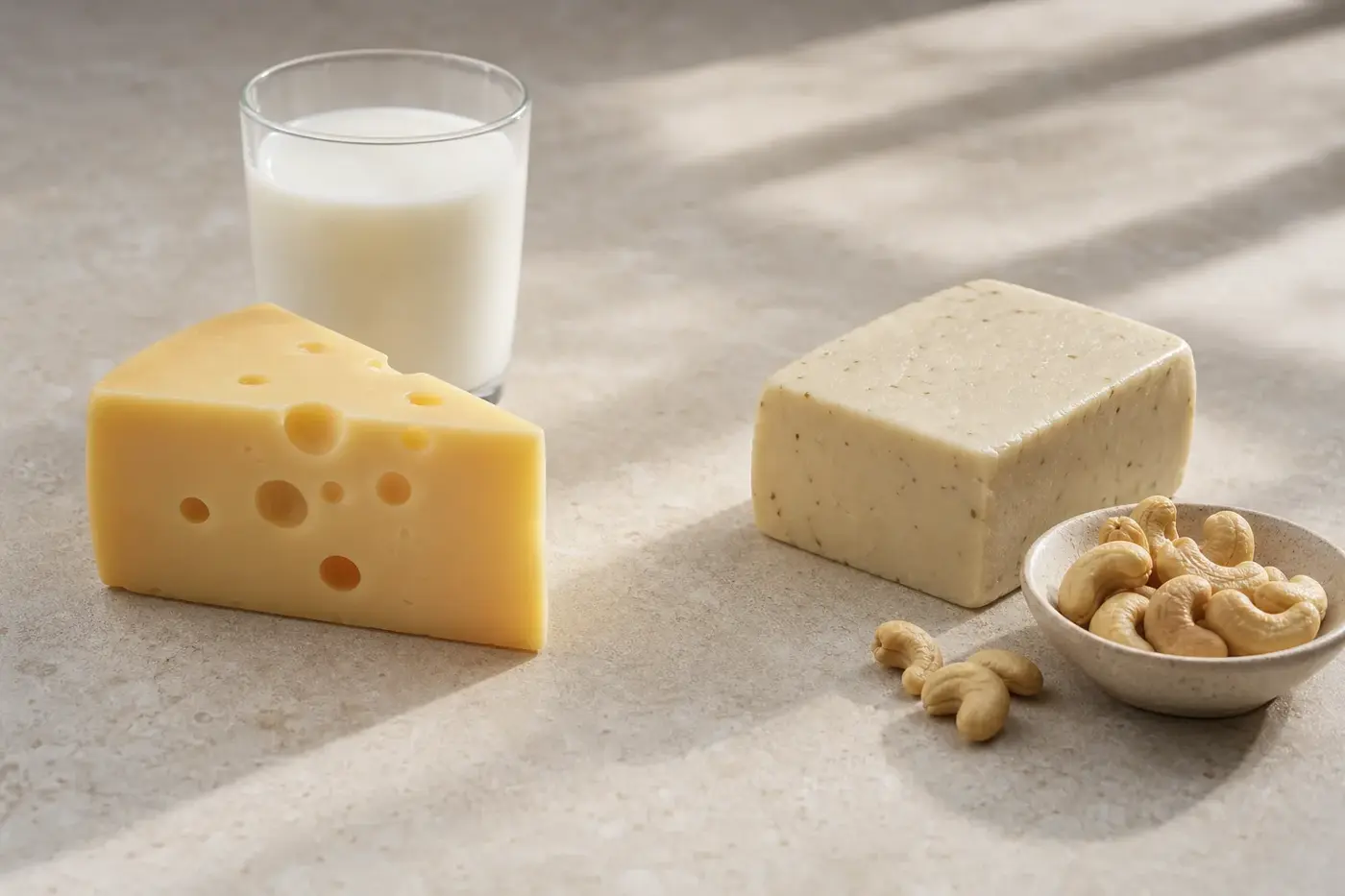
The draft recommends naming the particular plant source. Its example, “cashew cheese spread”, shows how the wording helps explain composition. For November 2026, the document’s FDA status remained draft, not for implementation, and its recommendations, including those examples, were non-binding.[3,4]
Imitation foods have a separate federal rule under 21 CFR 101.3(e). A substitute that resembles another food and is nutritionally inferior to it can require an imitation designation. “Nutritional inferiority” has a regulatory meaning, so appearance alone does not decide whether that requirement applies.[6]
Before you print, give state rules a place
Massachusetts General Laws, Chapter 94, Section 50 contains specific imitation-cheese labelling provisions. These cover substitutes meeting its stated conditions, including products containing fats not produced from cows’, goats’ or sheep’s milk.[7]
Before approving your label, assess relevant state provisions alongside federal requirements. Even a naming example from federal guidance needs a market-specific assessment wherever you plan to distribute the product.[3,6,7]
Give shoppers a clear picture of what is inside
“Fermented cashew spread”, “coconut oil and starch slices” and “almond-based savoury topping” give you a useful starting point. Tell shoppers what the food contains and how it is presented. Each description must accurately reflect the product it names.[4,8,9]
These are descriptive approaches, not ready-made answers for every pack. Compliance depends on the actual formulation, ingredients list, prominence of the description and surrounding claims. If several plant ingredients characterise the food, your wording may need to convey that mixture rather than spotlighting one attractive ingredient.[4,8,9]
Comparing packs? Start with the descriptive name, then read the ingredients. It is perfectly reasonable to give the small print more attention than the front of the pack. Reading a cheese label explains how the name, ingredient declarations and other information work together.
Your whole pack has something to say
The words on the front do not speak alone. Pictures, packaging and display can matter just as much. Article 7 of the EU food information regulation, and its assimilated counterpart in Great Britain, prohibit misleading information about matters including identity and composition. Their provisions also cover advertising and presentation.[8,9]
The rules expressly address presentations suggesting that a food or ingredient is present when another component has replaced it. Packaging, appearance and the setting in which the food is displayed also form part of that assessment.[8,9]
For a plant based alternative, make the identity clear throughout. Your descriptive name, imagery, ingredient emphasis and promotional language should tell a consistent story. FDA likewise says it assesses compliance case by case, considering the totality of the information.[3]
This page summarises published guidance from the official sources it cites. It is not medical advice. Guidance differs between countries and changes over time, so check the current source for where you live, and ask your doctor, midwife, pharmacist or dietitian about your own circumstances.
Ingredients, nutrition and allergens: give each a look
Dairy cheese is made from milk; plant based alternatives can contain legumes, nuts, seeds, grains and starches.[1,4] Ingredients and nutritional composition vary between products. Neither category is automatically healthier or nutritionally equivalent to the other.
When you compare nutrition declarations, use the same quantity basis and look at protein, saturated fat, salt or sodium, and any declared vitamins and minerals. Sharing a place in your sandwich or recipe does not establish nutritional equivalence. Read both the ingredients list and nutrition panel: they answer different questions.[4,8,9]
For allergens, EU and Great Britain rules require specified allergenic ingredients to be identified and emphasised in the ingredients list. Relevant plant ingredients can include soya and listed nuts. US rules require declaration of the sources of major food allergens, and FDA explains the permitted declaration formats.[8,9,11]
“Vegan” does not guarantee the absence of animal-origin allergens, UK government guidance warns, because cross-contamination can occur. Consult current official guidance and the product’s allergen information. Cheese allergy and lactose intolerance explains the distinction between those two conditions.[10]
Cheese names and place names: two separate questions
Being allowed to use cheese as a food description does not settle whether you may use a particular protected geographical name. That needs a separate assessment of the name, jurisdiction and conditions attached to it.
Keep those questions distinct when you develop a label or compare products. Protected names explained covers PDO, PGI and TSG schemes and their differences. The Cheese Law hub leads you to related legal guidance.
For commercial decisions, obtain current guidance for your destination market and, where necessary, specialist legal advice before approving packaging, menus or advertising. This article’s research timeframe is November 2026. When you launch a product, consult the legislation, guidance and status of draft documents afresh.
Questions people ask
Can a plant based product be called vegan cheese in Great Britain?
Adding ‘vegan’ does not by itself authorise a reserved dairy designation in Great Britain. Cheese is among the names generally reserved for milk products.
Did the EU ban the sale of plant based cheese alternatives?
No. The dairy naming reservation governs how products are represented, not whether the foods can be sold. Producers can sell alternatives under appropriate descriptions, subject to other applicable food rules.
Can plant based alternatives use the word cheese in the US?
A qualified alternative name may be acceptable under US federal rules if the resulting name is not misleading. FDA draft guidance gives ‘cashew cheese spread’ as an example and recommends naming the particular plant source. At the November 2026 check, the guidance was still draft and its recommendations were not binding.
Can a Great Britain label be used in Northern Ireland?
Northern Ireland requires a separate legal check because relevant EU food rules operate through the Windsor Framework. The product’s origin, destination and movement route all matter, so a Great Britain label should be checked against the requirements that apply there.
Are there exceptions to the EU reservation of dairy names?
Yes. Commission Decision 2010/791/EU lists traditional exceptions reflecting established use in the languages concerned. An exception applies to the listed expression and its conditions, not to newly invented combinations containing a dairy word.
Sources
- Court of Justice of the European Union, Judgment in Case C-422/16, Verband Sozialer Wettbewerb eV v TofuTown.com GmbH, 14 June 2017. Paragraphs 20 to 40 and the operative ruling. Official judgment.
- European Commission, Commission Decision 2010/791/EU, 20 December 2010, traditional dairy designation exceptions. UK legislation publisher’s retrieved text, including recitals and Article 1. Official text.
- US Food and Drug Administration, Draft Guidance for Industry: Labeling of Plant-Based Alternatives to Animal-Derived Foods, January 2025, status and scope page. FDA guidance page.
- US Food and Drug Administration, Draft Guidance for Industry: Labeling of Plant-Based Alternatives to Animal-Derived Foods, January 2025, sections II and III. Draft document.
- US Food and Drug Administration, 21 CFR 133.113: Cheddar cheese, eCFR text displaying currency to 5 November 2026. Federal standard.
- US Food and Drug Administration, 21 CFR 101.3: Identity labeling of food in packaged form, eCFR text displaying currency to 5 November 2026. Federal regulation.
- Commonwealth of Massachusetts, General Laws, Part I, Title XV, Chapter 94, Section 50, current legislature webpage retrieved November 2026. State text.
- UK legislation publisher, Regulation (EU) No 1169/2011 on the provision of food information to consumers, assimilated text, particularly Articles 7, 17, 21 and 30, and Annex II. Retrieved legislation.
- European Union, Regulation (EU) No 1169/2011 on the provision of food information to consumers, consolidated text dated 1 April 2025. Retrieved EU text.
- UK Government, Understanding food labelling: Vegan food labelling, retrieved November 2026. Official guidance.
- US Food and Drug Administration, Have Food Allergies? Read the Label, retrieved November 2026. Official guidance.
- Northern Ireland Assembly, Minutes of evidence concerning proposed agricultural marketing-standard amendments, official committee record retrieved November 2026, departmental evidence on the Windsor Framework and retail movement arrangements. Official record.
This desk-researched draft compares retrieved court, legislative and official guidance sources; outstanding current-law checks are recorded for the editor below.
Last checked: November 2026
Last checked November 2026.
The editors suggest you read next
Cheese Law Around the World: The Complete Guide
GRUYERE reached an American legal border and lost its exclusivity.