Cheddar
Cheddar is a ripened hard cheese with roots around the village of Cheddar in Somerset, England, and a name now used for cheese made in many countries.
Cheddar is a ripened hard cheese with roots around the village of Cheddar in Somerset, England, and a name now used for cheese made in many countries. Two regional names, West Country farmhouse Cheddar cheese and Orkney Scottish Island Cheddar, have specific protection under the EU and Great Britain geographical indication schemes.[1,3,5,6,8]
Cheddar at a glance
| Field | Detail |
|---|---|
| Familiar name | Cheddar.[1] |
| Category | Ripened hard cheese; a family or style rather than one regional product.[1,3,4] |
| Milk under Codex | Cows' milk, buffaloes' milk or their mixtures.[1] |
| Milk treatment | Varies by applicable standard and product.[2,3,4] |
| Rind | Under Codex, rindless or with a rind, which may be coated.[1] |
| US composition | Minimum 50% fat in dry matter; maximum 39% moisture in the whole cheese.[2] |
| Protected regional names | West Country farmhouse Cheddar cheese, PDO; Orkney Scottish Island Cheddar, PGI, in the EU and Great Britain, checked November 2026.[5,6,8] |
What the name Cheddar tells you
Cheddar carries two kinds of information that are easy to confuse: a cheese identity and, when accompanied by a registered regional name, a particular origin and specification. In the EU, Article 1 of Regulation (EU) No 1186/2013 explicitly preserves continued use of “Cheddar” alone, subject to the Union's applicable rules.[7]
Codex CXS 263-1966 supplies an international reference standard, rather than a worldwide law. Its labelling section separates the country where the cheese was manufactured from the country where its name originated. That distinction is useful when comparing Cheddars from different countries: the familiar name identifies the cheese, while the origin declaration identifies its manufacture.[1]
National standards then set their own requirements. In the United States, 21 CFR 133.113 defines Cheddar cheese and permits alternative manufacturing procedures that deliver the specified physical and chemical properties. In Canada, item 12 of Canadian Standards of Identity, Volume 1: Dairy Products directs Cheddar to the separate compositional standard in Volume 7, section 7.4.3.[2,9]
How cheddaring works
The distinctive operation begins after the milk has set and the curd, its solid portion, has been separated from the liquid whey. The US standard describes letting the curd mat together, cutting it into slabs, then piling and handling those slabs to encourage further drainage and the development of acidity.[2]
The slabs are subsequently cut into smaller pieces, salted and pressed into forms. This sequence helps explain why cheddaring means more than simply cutting milk curd: it names the handling of the drained mass before the final cheese is shaped.[2]
Yet the family also includes stirred-curd methods. Codex describes both stirring and cheddaring, while the Orkney PGI specification requires continuous dry stirring before salting. A Cheddar can therefore belong to an established regional tradition without being made by stacking slabs.[1,4]
Block, clothbound and farmhouse
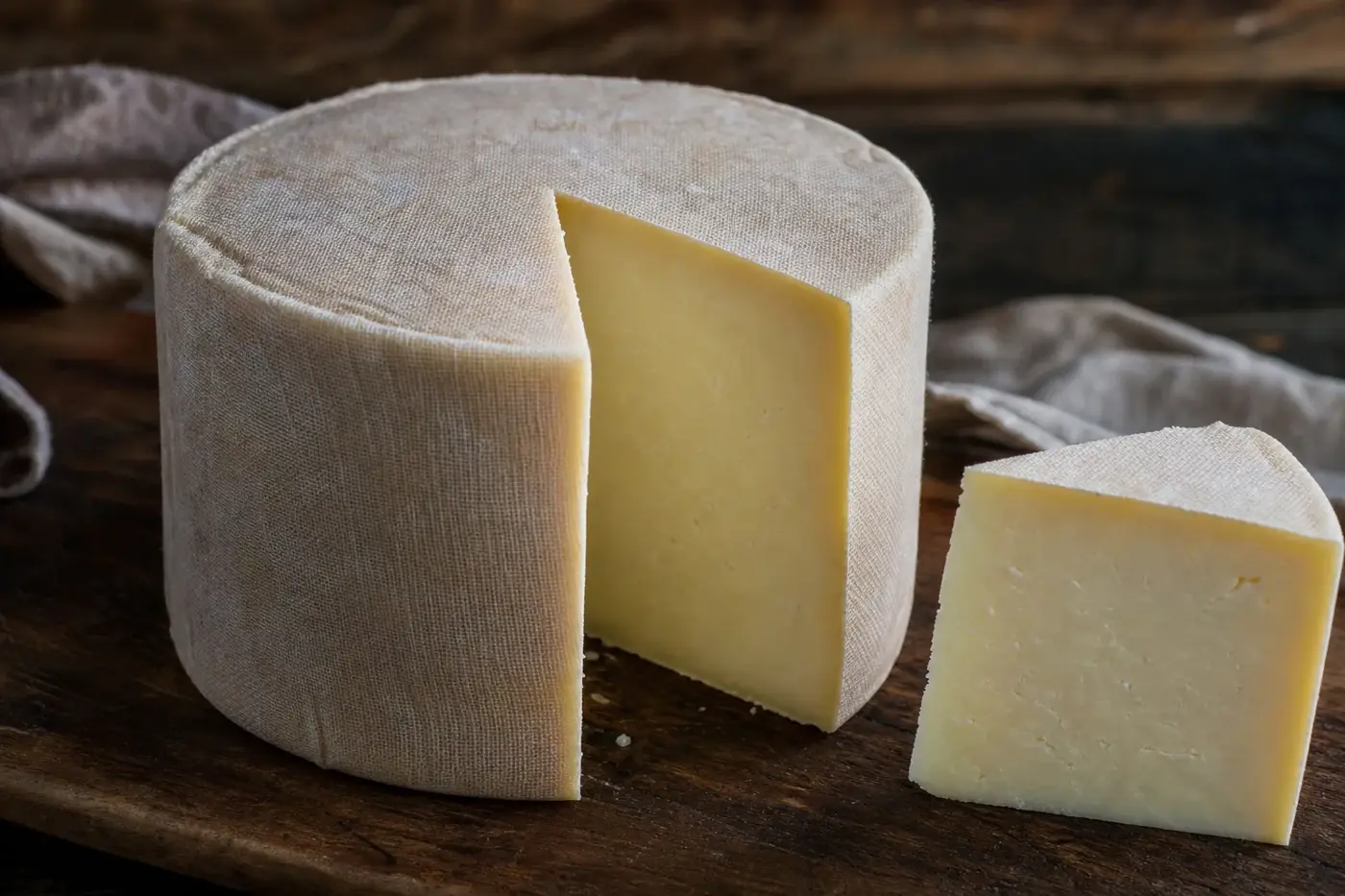
These descriptions answer different questions. Block describes a format; clothbound describes a covering used during maturation; farmhouse connects production to a farm in the West Country PDO specification. They can overlap: that specification permits both blocks and cylinders, with hand cheddaring in either case.[3]
For sensory expectations, Codex describes a firm, smooth, waxy body. The Orkney specification gives a more particular account: a smooth, closed texture, becoming slightly brittle in its oldest stated profile, with increasingly sharp savoury notes.[1,4]
The Orkney PGI specification sets the ages plainly: medium is 6 to 12 months, mature 12 to 15 months and extra mature 15 to 18 months. Other Cheddars use their own terms. They offer a concrete comparison within one specification when deciding which texture and flavour description interests you.[4]
For a side-by-side tasting, choose cheeses with a documented age and keep the maker's descriptions beside your notes; record differences in texture, acidity and finish in your own words.
The two registered regional names
West Country farmhouse Cheddar cheese is the exact EU registered form; Great Britain's register capitalises it as West Country Farmhouse Cheddar Cheese. The PDO, or Protected Designation of Origin, covers farm production in Dorset, Somerset, Devon and Cornwall, using their 1955 county boundaries. The specification permits milk from Gloucestershire and Wiltshire during shortages. It allows pasteurised or unpasteurised cows' milk and requires at least nine months' maturation.[3,5]
Orkney Scottish Island Cheddar is a PGI, or Protected Geographical Indication. Its specification requires pasteurised milk from the Orkney Islands, dry-stirred curd and production in 20 kg blocks, with maturation for 6 to 18 months. White and annatto-coloured versions are permitted.[4,6]
Both names are shared geographical indications: Defra explains that any producer meeting the specification and verification requirements can use a registered name. The registration belongs to the geographical name rather than an individual business.[8]
Cheddar name protection by jurisdiction
These are the positions checked in November 2026. Great Britain's scheme covers England, Scotland and Wales; Northern Ireland uses the EU schemes. “Not verified” records an unresolved protection check, including any relevant agreement or trade mark rights.[8]
| Jurisdiction | Cheddar alone | West Country farmhouse Cheddar cheese | Orkney Scottish Island Cheddar |
|---|---|---|---|
| EU | Generic name may continue to be used.[7] | Registered PDO.[5,8] | Registered PGI.[6,7,8] |
| Great Britain | Cheddar is used as a general cheese name; the registered regional names have separate protection. | Registered PDO.[5] | Registered PGI.[6] |
| Northern Ireland | EU position.[8] | EU PDO protection.[5,8] | EU PGI protection.[6,8] |
The full regional name is the useful identifier when choosing one of these registered cheeses. “Cheddar” answers a broader question about the cheese's identity; a geographical indication adds a defined regional connection and production requirements.[7,8]
Somerset origins and a dated history
The West Country specification places Cheddar's roots around Cheddar village in Somerset, citing evidence suggesting production as far back as the fifteenth century. It presents maturation in caves beneath the Mendip Hills as tradition.[3]
- 1928 to 1932: farmhouse cheesemakers' federations formed, according to the PDO specification.[3]
- 1955: the specification records registration of the Milk Marketing Board's “Farmhouse Cheddar Cheese” certification trade mark.[3]
- 21 June 1996: original EU registration date recorded for the West Country PDO.[5]
- 21 November 2013: the Commission adopted the regulation registering the Orkney PGI; it was published on 22 November 2013.[7]
- 31 December 2020, 23:00: both regional names entered the UK scheme.[5,6]
Reading a Cheddar label
For a practical comparison, look for four details: country of manufacture, the complete cheese name, milk treatment and a stated age. Record them separately. This avoids asking a single word such as clothbound or farmhouse to explain the whole cheese.
Canada's identity document also lists processed cheese, processed cheese food and cold-pack cheese separately. That makes the legal food name worth reading before comparing products whose front labels all mention Cheddar. Start with the identity of the food itself, then look at the descriptive words around it. This is a useful order for reading a label wherever the local rules distinguish cheese from products made with cheese.[9]
In the United States, Cheddar made with unpasteurised dairy ingredients must be cured for at least 60 days at a minimum of about 1.7 °C (35 °F). This is a legal manufacturing condition; recalled products must still be discarded or returned in accordance with the recall notice.[2,11]
One forthcoming US change also deserves its date: the FDA's salt-substitute amendment was published on 13 October 2026 and is scheduled to take effect on 14 December 2026, subject to provisions that may be stayed following proper objections.[10]
Cheese recall notices from 2026
Official notices issued in 2026 concerned particular Cheddar products. In the United States, Sierra Nevada Graziers recalled raw-milk cheeses including Medium and Sharp Cheddar. In Canada, a notice covered specified organic Cheddar products. In Australia, La Vera Cheddar Pepper was recalled with a stated best-before date of 14 May 2027. These notices concern identified products and batches, not Cheddar as a whole.[11,12,13]
Check the linked official notices against the exact product and identifying details, and follow the instructions in the relevant notice.[11,12,13]
Sources
- Codex Alimentarius Commission, FAO and WHO. Standard for Cheddar, CXS 263-1966. Retrieved PDF: revision 2007; amendments 2008, 2010 and 2013. Sections 2, 3 and 7; manufacturing appendix.
- US Food and Drug Administration. 21 CFR 133.113: Cheddar cheese. eCFR displayed as current to 4 November 2026; paragraphs (a) to (c).
- Defra. Product specification: West Country Farmhouse Cheddar. Version date not shown; sections 2 and 4.
- Defra. Specification: Orkney Scottish Island Cheddar. Version date not shown; sections 4.2, 4.3 and 4.5.
- Defra. [West Country Farmhouse Cheddar Cheese](../west-country-farmhouse-cheddar-cheese/). Great Britain GI register entry, published 4 January 2021; retrieved November 2026.
- Defra. [Orkney Scottish Island Cheddar](../orkney-scottish-island-cheddar/). Great Britain GI register entry, published 4 January 2021; retrieved November 2026.
- European Commission. Commission Implementing Regulation (EU) No 1186/2013. Adopted 21 November 2013; published in Official Journal L 313, 22 November 2013. Recital 7, Articles 1 and 2, and Annex.
- Defra. Protected geographical food and drink names: UK GI schemes. Updated 8 March 2024; retrieved November 2026.
- Canadian Food Inspection Agency. Canadian Standards of Identity: Volume 1: Dairy Products. Current page retrieved November 2026; cheese section, items 11 and 12.
- US Food and Drug Administration. Use of Salt Substitutes To Reduce the Sodium Content in Standardized Foods. Final rule, 91 FR 65040, 13 October 2026; DATES, effective-date qualifications and amendment 28.
- US Food and Drug Administration and CDC. Sierra Nevada Cheese Company Recalls Graziers Raw Milk Cheese Because of Possible Health Risk, company announcement dated 28 September 2026, published by FDA on 29 September 2026; and E. coli Outbreak Linked to Raw Milk Cheese, CDC, 25 September 2026.
- Canadian Food Inspection Agency. Various brands of organic cheeses recalled due to Listeria monocytogenes. Updated 14 October 2026; affected-products table and consumer instructions.
- Food Standards Australia New Zealand. La Vera Group Pty Ltd- La Vera Cheddar Pepper R/W approx 300g. Recall published 9 July 2026.
Researched through desk comparison of official standards, product specifications, register entries, legislation and recall notices.
Last checked: November 2026
Last checked November 2026.
The editors suggest you read next
West Country Farmhouse Cheddar Cheese
Large pieces of curd turn and stack under the cheesemaker’s hands.