Red Leicester
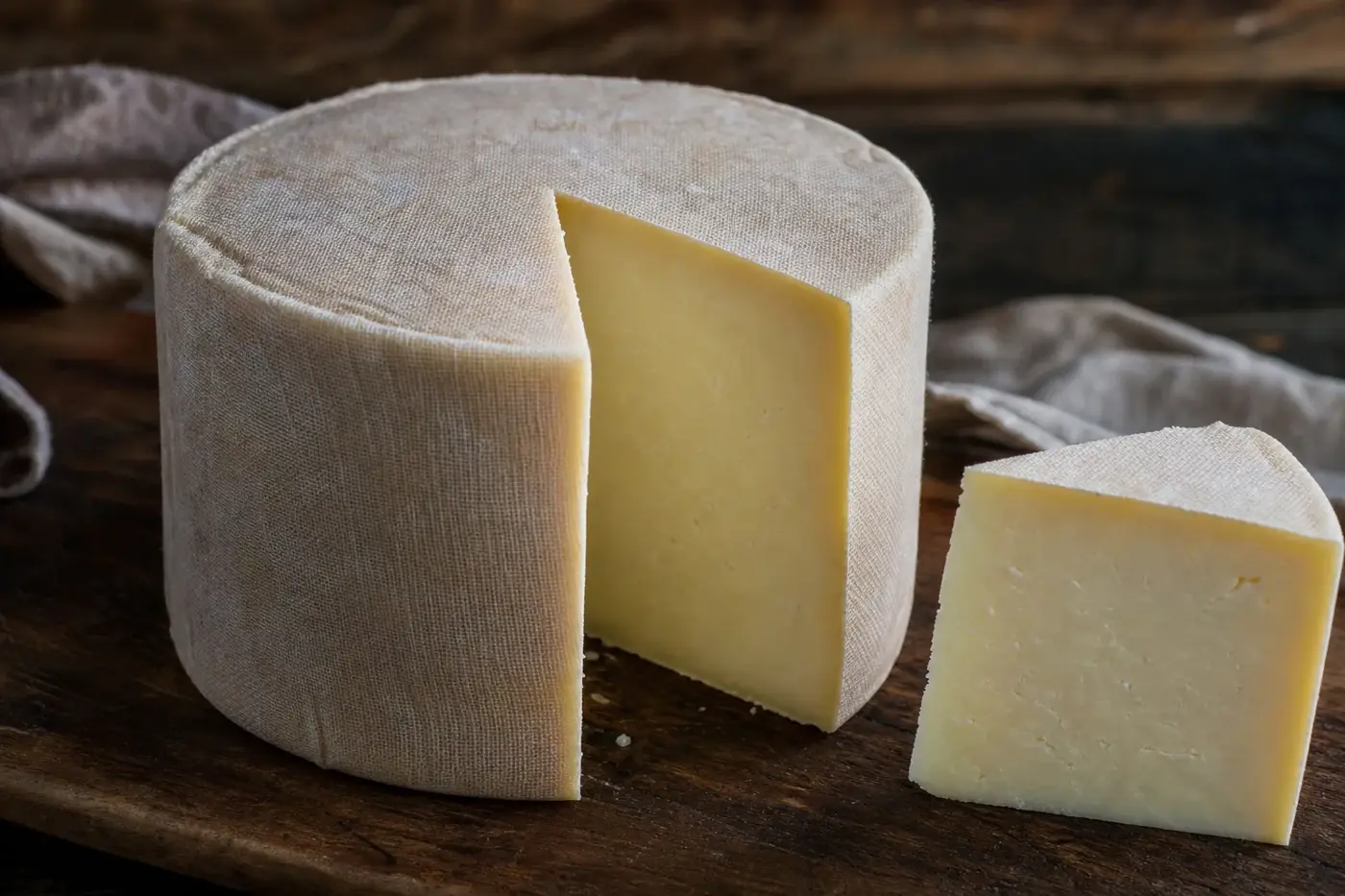
Beneath the muslin at Sparkenhoe, six months of waiting leads to an orange interior.
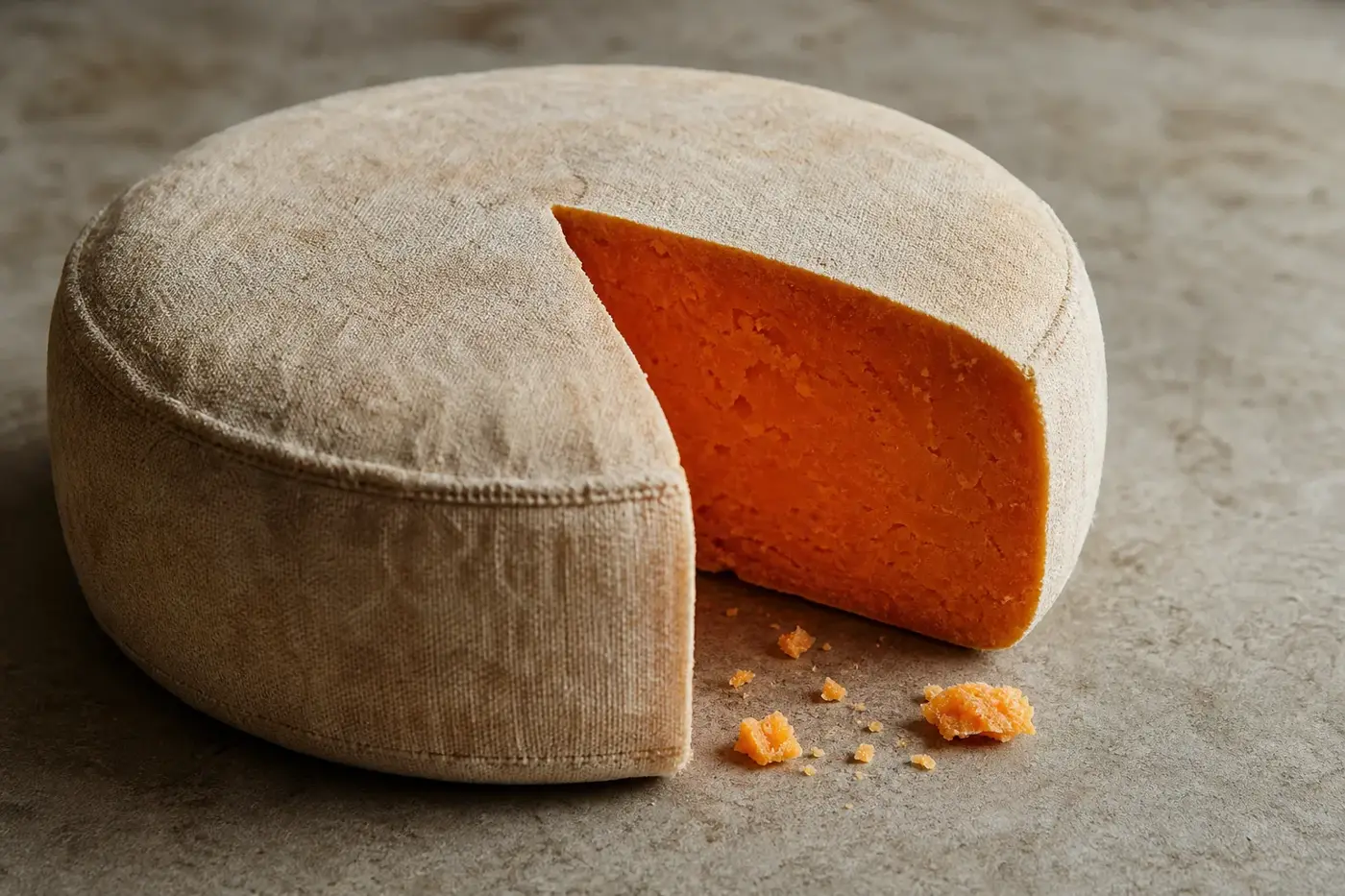
Beneath the muslin at Sparkenhoe, six months of waiting leads to an orange interior. Then comes the sweetness, nuttiness and citrus finish its maker describes.[1] The colour gets your attention. The cheese knows how to keep it.
If you know Red Leicester chiefly from a sandwich, there is more to meet. This firm cow’s milk cheese, associated with Leicestershire, can be flaky, chewy or smooth enough for everyday slicing. Look past the orange and you find the real clues: how the curd is handled, what surrounds the cheese as it ripens and how long it matures.[1][3][4]
Your guide at a glance
| What you want to know | The essentials |
|---|---|
| Name to look for | Red Leicester.[1] |
| Milk | Cow’s milk; both raw and pasteurised examples.[1][3] |
| That orange colour | Annatto added during making.[1] |
| Rind and wrapping | Clothbound examples; check the coverings.[1][3][4] |
| Time to mature | Sparkenhoe: six months and 14 months; Rutland Red: six months.[1][2][4] |
Follow the cheese back to Leicestershire
Follow Red Leicester’s story back and you reach references to Leicestershire cheese in the seventeenth century. A history published by the Society of Dairy Technology in 2018 traces its development. Farmhouse production continued alongside the first local cheese dairies in the nineteenth century.[5]
The names changed along the way. The history records both “Leicestershire cheese” and the later “Leicester cheese”. A pronounced red colour was already characteristic before the familiar modern name emerged.[5]
The farmhouse revival has a precise starting point: 2005. Leicestershire Handmade Cheese Company says that was when it began making Red Leicester with an old recipe, traditional methods and raw milk from its own herd. It connects the project with cheese previously made at Sparkenhoe Farm; the earlier dates in that history come from the maker’s account.[10]
There is more to that glorious orange
Annatto gives Red Leicester its orange to reddish-orange colour. Sparkenhoe’s maker identifies it as the colouring added to its cheese, while Neal’s Yard Dairy, which selects and matures the cheese, calls it a plant dye.[1][3] If you want clues to maturity and flavour, the maker’s description and stated age tell you more.
The colour began with an appetite for the appearance of rich milk. The Society of Dairy Technology’s history records annatto being used to achieve that look. Over time, colour became a signature of Leicester cheese rather than a dependable measure of the milk’s richness.[5]
For the ingredients in your particular piece, turn to its product information. Orange is a splendid calling card, but a rather poor CV.
From the milk to your next slice
For Neal’s Yard Dairy’s Sparkenhoe selection, the ingredient list is cow’s milk, starter cultures, rennet, salt and annatto. The rennet is animal rennet.[3] It is a short list, with a distinct job for each ingredient.
Starter cultures are microorganisms that develop acidity. Rennet is the enzyme preparation that sets milk into a gel, beginning the formation of solid curd. The curd is then cut and worked to release whey, the liquid portion of the milk.
Draining, further curd handling, salting and pressing build the cheese’s structure before maturation. The recipe shapes those steps. One dairy’s way with its curd is not a compulsory method for every Red Leicester you buy.
After shaping, the paths diverge. Sparkenhoe’s standard cheese is bound in muslin and matured for six months.[1] Clawson describes filling Rutland Red into moulds, clothbinding it, coating the outside with clarified butter and maturing it for six months.[4] You can follow the wider sequence in how cheese is made.
Find your texture, from clothbound to sandwich slice
Clothbound does not promise one particular texture. Neal’s Yard Dairy describes its Sparkenhoe as moist and chewy, bound in cloth with lard; Clawson describes Rutland Red as firm and flaky.[3][4] The cloth gives you a clue about maturation, but the producer’s account fills in the texture and milk treatment.
If you want a smoother, rindless piece for sandwiches, ask how it feels and slices. A rectangular shape tells you less about age than the product information does. A wheel’s weathered exterior is no substitute for a clear account of its maturation, either.
Remove cloth before serving. Ask the seller which surrounding materials are rind and which are coverings, and follow the maker’s instructions for any coated exterior.
Six months or 14 months? Taste your way
Sparkenhoe’s maker describes its six-month cheese as mellow, with sweetness, nuttiness and a citrus finish. Its 14-month vintage version is stronger, with a pronounced nutty character and a light lemony tang.[1][2] Those descriptions give you something specific to look for beyond the buttery, nutty and savoury words often used around Red Leicester.
Rutland Red offers another combination: Clawson describes sweetness, caramel notes and a savoury bite.[4] Together, these accounts help you choose without asking age to tell the whole story.
Do you fancy a mellow slice, a flaky mouthful or a more forceful finish? Find the producer’s description that fits your occasion. Longer maturation offers a different choice, not an automatic promotion.
Set a place for Cheddar and Double Gloucester
When you discuss Cheddar, cheddaring is a useful term to know. It means working drained curd in slabs before milling it into smaller pieces. For Red Leicester, ask how that particular cheese is made rather than treating the presence or absence of the word as a defining test.
At the table, give both cheeses a fair hearing. Compare samples of similar ages, rather than measuring a young Leicester against a much older Cheddar.
Double Gloucester brings its own whole-milk tradition. The Society of Dairy Technology history describes the historical use of cream-enriched milk and its naturally deeper colour, an appearance other regional cheesemakers sought to imitate.[5] Today, orange alone will not distinguish the cheeses: read the name, find out who made it and consider the texture.
Choose a piece for the way you eat
For neat sandwich slices, look for a supple, close-textured Red Leicester. For pieces to scatter over a salad, go firmer and flakier. On a cheese plate, a mellow example beside a longer-aged one can reveal more than several cheeses chosen for matching colour.
Four questions will help you choose: who made it, how old is it, was the milk pasteurised, and how was it matured? Keep a note of the answers when you find a favourite. Your next good piece need not rely on remembering “the orange one”.
The product name may not settle every detail. Neal’s Yard Dairy says it sells both raw-milk and pasteurised versions of Sparkenhoe, each labelled with the appropriate treatment.[3] For ingredient wording and milk-treatment terms, use how to read a cheese label alongside the individual producer’s information.
Give your cheese a little room to shine
Start simply: bread, a crisp apple and a little chutney. Leave some cheese plain so you can pay attention to its texture. Pear is a gentler alternative to apple, while oatcakes keep the accompaniment in the background.
Adjust the sweetness and acidity of those serving suggestions to the cheese in front of you. Sparkling water or an unsweetened apple drink keeps the drinks choice simple, particularly when you taste two ages together.
Use the same accompaniments for both cheeses and notice how each finish develops: sweet, tangy or savoury. You do not need an elaborate board to make the comparison interesting.
In the kitchen, try Red Leicester in a toastie, over a baked potato or in a cheese sauce. Grate it for even distribution and use gentle heat when incorporating it into a sauce; its colour will carry into the dish. Judge the melted texture separately, because a cheese that flakes on the board need not behave like a younger, smoother piece in the pan.
This page summarises published guidance from the official sources it cites. It is not medical advice. Guidance differs between countries and changes over time, so check the current source for where you live, and ask your doctor, midwife, pharmacist or dietitian about your own circumstances.
Bring it home and store it well
Start with the pack’s storage instructions or the advice supplied with a cut piece. For England, Wales and Northern Ireland, the Food Standards Agency recommends a home fridge between 0 and 5 °C (32 to 41 °F), including for dairy products. It also advises following the label’s storage instructions and date marks.[8]
Protect the cut face with the wrapping recommended by the seller. Replace dirty wrapping and keep your cheese separate from raw foods. For more detailed wrapping choices, see how to store cheese at home.
When serving in England, Wales and Northern Ireland, follow the FSA guidance on chilling and serving food alongside the product’s storage instructions.[8] Keep those instructions handy rather than guessing from the cheese’s appearance.
Let the label guide you on milk, rennet and pregnancy
The label is your starting point for milk treatment and vegetarian suitability. Clothbound does not necessarily mean raw milk, and Red Leicester is not always vegetarian. Neal’s Yard Dairy lists animal rennet and a lard-treated cloth covering for its Sparkenhoe selection.[3]
If microbial rennet is used, look for the producer’s vegetarian declaration and check the rind treatment too. Both the ingredient and the finished cheese need consideration.
For pregnancy in the UK, the NHS guidance as of November 2026 lists pasteurised or unpasteurised hard cheeses among foods that can be eaten, while giving different advice for certain soft and blue cheeses.[9] Follow the current NHS guidance for the product category and ask your midwife or doctor about your circumstances. For more on milk treatment, see raw milk, thermised and pasteurised cheese.
Questions people ask
Why is Red Leicester orange?
Annatto, a plant dye, gives Red Leicester its orange to reddish orange colour. It was used to create the appearance of rich milk, but the depth of colour is not a dependable measure of the milk’s richness.
What does Red Leicester taste like as it ages?
Sparkenhoe’s maker describes its six month cheese as mellow, sweet and nutty, with a citrus finish. Its 14 month vintage is described as stronger and distinctly nutty, with a light lemony tang.
Is Red Leicester made with raw or pasteurised milk?
Both raw and pasteurised examples are documented. Neal’s Yard Dairy says it sells both versions of Sparkenhoe, with each labelled according to its milk treatment.
Is Red Leicester vegetarian?
Red Leicester is not always vegetarian. Neal’s Yard Dairy lists animal rennet and a lard treated cloth covering for its Sparkenhoe selection, so check the producer’s vegetarian declaration and rind treatment.
Can you eat Red Leicester during pregnancy?
The NHS lists pasteurised and unpasteurised hard cheeses among the foods that can be eaten during pregnancy. Consult the current NHS guidance on foods to avoid in pregnancy and ask your midwife or doctor about your circumstances.
Sources
- Leicestershire Handmade Cheese Company, Sparkenhoe Red Leicester, undated product information, retrieved November 2026. Producer source.
- Leicestershire Handmade Cheese Company, Vintage Red Leicester, undated product information, retrieved November 2026. Producer source.
- Neal’s Yard Dairy, Sparkenhoe Red Leicester, undated product and maturation information, retrieved November 2026. Selecting and maturing cheesemonger’s source.
- Clawson Farms, Our cheese, Rutland Red section, undated, retrieved November 2026. Producer source.
- Society of Dairy Technology, History of cheesemaking A4, document title displayed by the retrieved file, 2018. Historical synthesis.
- Department for Environment, Food and Rural Affairs, Protected geographical food and drink names, live register collection, retrieved November 2026.
- European Parliament and Council, Regulation (EC) No 1333/2008 on food additives, consolidated text dated 28 October 2020, Annex II, Part E, category 01.7.2.
- Food Standards Agency, How to chill, freeze and defrost food safely, published 18 December 2017, live guidance retrieved November 2026. Applies to England, Northern Ireland and Wales.
- NHS, Foods to avoid in pregnancy, live guidance retrieved November 2026, cheese, milk and other dairy section.
- Leicestershire Handmade Cheese Company, Sparkenhoe Cheese Dairy, undated producer account, retrieved November 2026.
- Food Standards Agency, Alerts, live notices index, inspected November 2026. Editorial recall-check source.
- Leicestershire Handmade Cheese Company, Sparkenhoe Cheese, undated serving recommendation, retrieved November 2026. Producer source.
This piece combines desk research from producer and cheesemonger records, a specialist historical survey, legislation and official guidance; serving combinations are editorial suggestions.
Last checked: November 2026
Last checked November 2026.
The editors suggest you read next
West Country Farmhouse Cheddar Cheese
Large pieces of curd turn and stack under the cheesemaker’s hands.