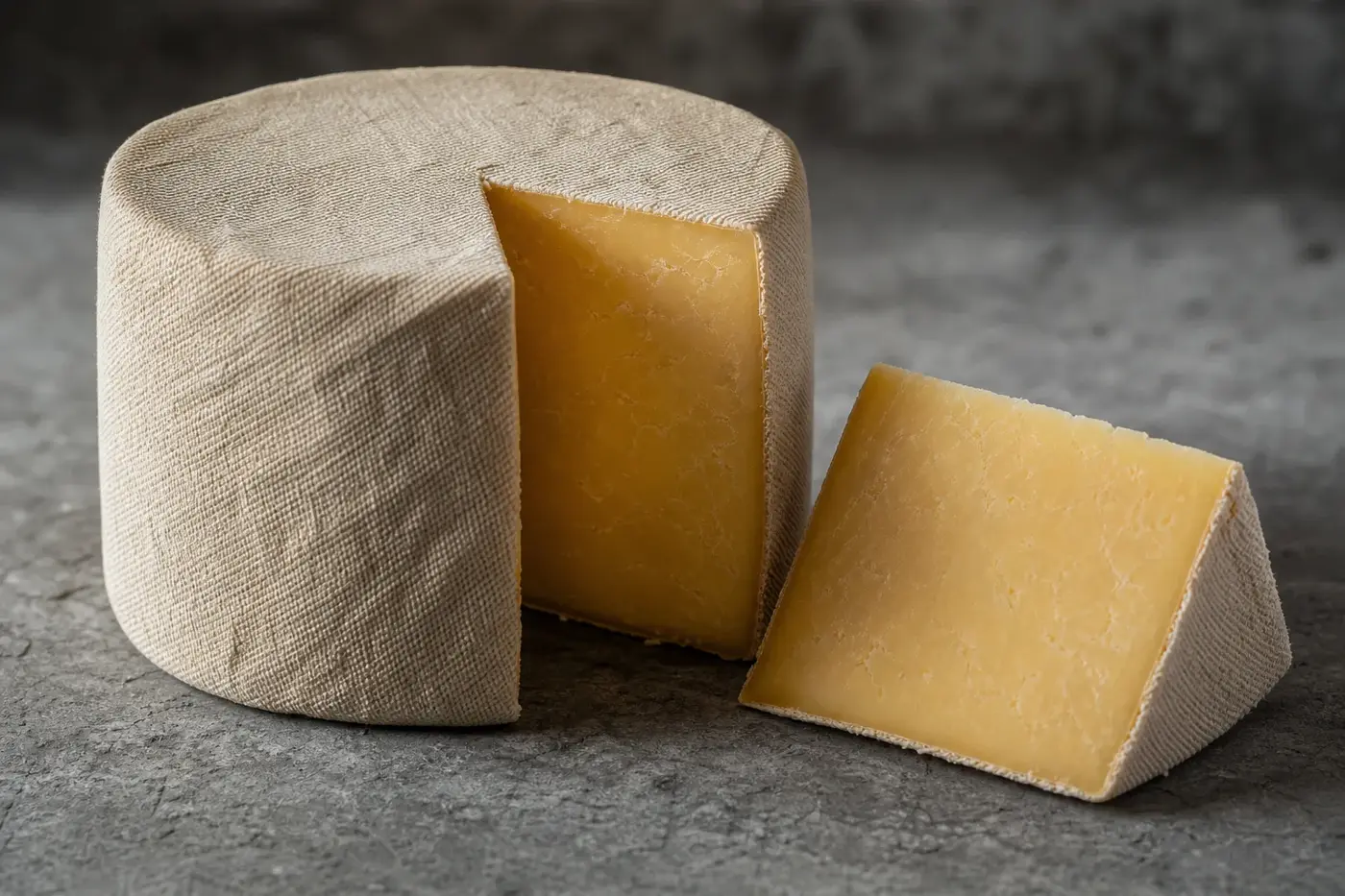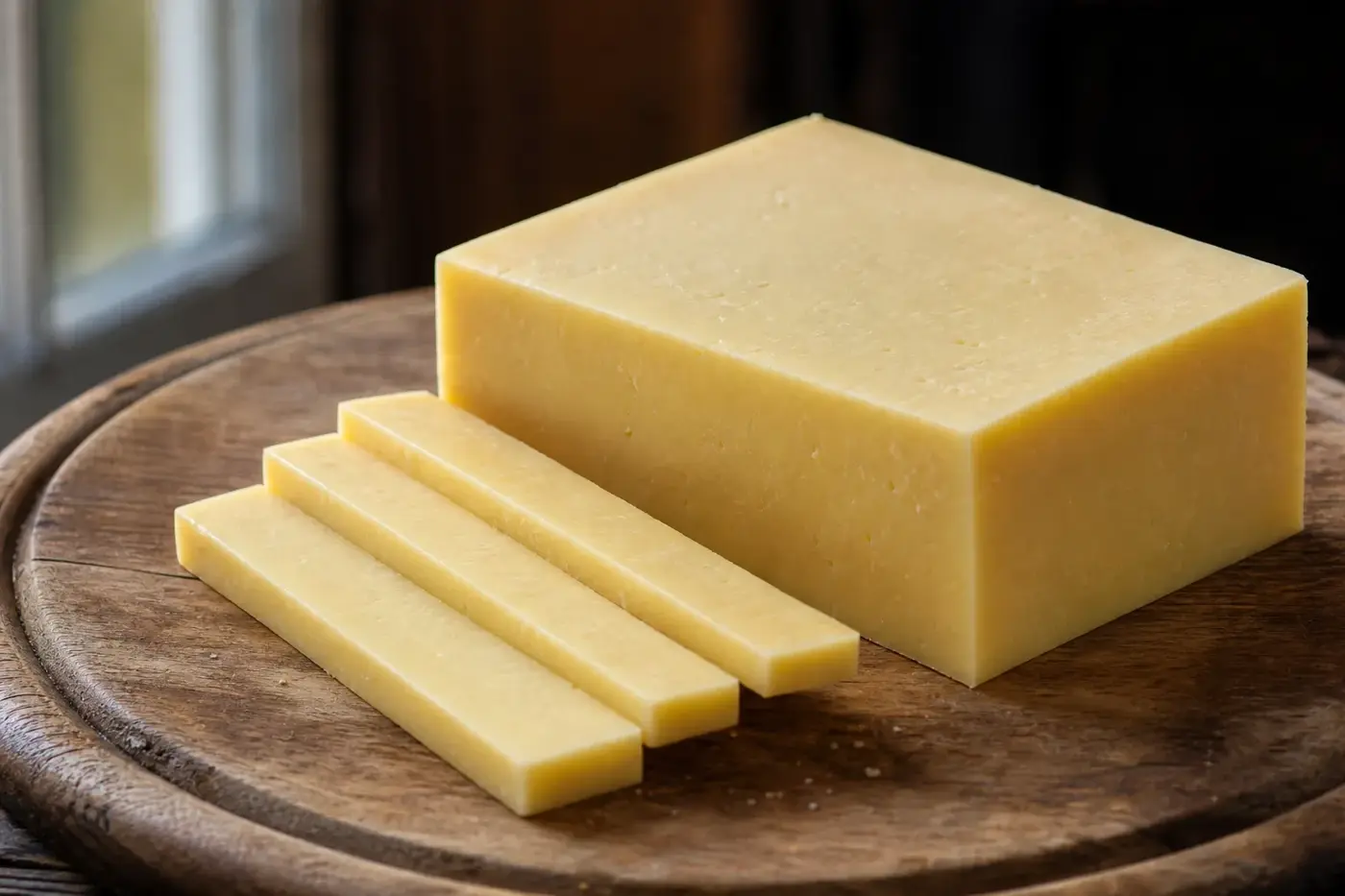
Inside the dairy, the curd keeps moving. No settling into slabs, no quiet moment to itself. This dry-stir method gives Orkney Scottish Island Cheddar its close body, continuing a creamery story that began in a converted Nissen hut near Kirkwall in 1946.[1][2][6]
Then time takes its turn. Made with milk from the islands’ dairy farms, the cheese moves from smooth and gently savoury towards sharper flavours and a more brittle texture. The version you want on your plate depends on how long it has matured.[1][2][3]
| What you want to know | The detail |
|---|---|
| Familiar and registered name | Orkney Scottish Island Cheddar.[1] |
| Registration authority and identifier | Great Britain: Defra; register identifier unspecified here. EU file number: PGI-GB-0908.[1][4] |
| Protection | Great Britain: registered PGI. EU and Northern Ireland: registered under the EU scheme, subject to outstanding legal review. Switzerland and the United States: status unspecified here.[1][4][5] |
| Where it is made | Orkney Islands, north of Scotland, centred on Kirkwall.[2] |
| Milk and treatment | Local cows’ milk, pasteurised.[2] |
| What sets the milk | Rennet; origin unspecified.[2] |
| Time to mature | Minimum six months; specified range six to 18 months.[2] |
| Size before cutting | 20 kg blocks, cut into smaller portions.[3] |
| What is on the outside | Matured in vacuum bags; remove packaging before eating.[2] |
Step into Orkney’s crofting kitchens
Before the creamery came a household question: what do you do with surplus milk? Long before factory production, crofting households north of mainland Scotland turned it into cheese to keep or sell. That is where the creamery’s published history begins.[6]
Wartime demand expanded the islands’ milk supply and prepared the ground for a modern creamery. The converted Nissen hut near Kirkwall opened in 1946, making hard cheeses in several formats. A Cheddar recipe joined the line-up in 1958.[6]
The dry-stir technique arrived in 1984, according to the specification.[2] It defines the cheese you find today. By then, though, island households and cheesemakers already had a substantial story behind them.
Today’s producer, Orkney Cheese Company Limited, gives its address as Crowness Road, Kirkwall. It describes its Cheddar as made entirely from locally sourced milk. Companies House separately records the legal entity as active as of November 2026.[7][8]
Follow the milk through an island year
Island milk is not a decorative detail on the label. The specification requires it, and the producer describes a year shaped by outdoor grazing and winter housing. In winter, cattle receive conserved forage and supplementary feeds, including barley and distillery grains.[2][9]
Picture a working dairy landscape, rather than cows permanently at pasture. “Island milk” tells you about a particular farming and supply system. It does not let you trace every mouthful to sea air or an individual field.
The producer attributes the milk’s character to fertile farmland and the maritime climate.[9] That supplies the sense of place. When you are choosing a cheese, the manufacturing method and maturation time offer more concrete clues, with their effects described in the published product profiles.[3]
The protected specification sets the shared production framework, but your pack handles the particulars. Look there for ingredients, declared suitability and age, rather than asking the geographical name to explain everything. For milk treatment, turn to raw, thermised and pasteurised milk.
Meet the curd that keeps moving
The telling moment comes at the draining table. Curd particles stay separate and keep stirring until salting, instead of settling into slabs.[2] This is the dry-stir stage, and it is worth remembering when you compare Cheddars.
Before that, rennet coagulates the milk into a gel. Cutting produces curd particles and liquid whey. Heating then firms the curd, ready for draining and stirring.[2]
Conventional hand cheddaring takes another route. The West Country Farmhouse Cheddar specification describes slabs being turned and stacked, then milled into smaller pieces before salting. Milling belongs to that slab-based sequence, not to Orkney’s dry-stir account.[10]
For Orkney, the salted particles go into a vacuum block-forming tower and bind into blocks. The tower forms and consolidates the cheese. That differs from the separate mould-and-press sequence described for West Country production.[2][10]
You now have something more useful to compare than a shared family name. Cheddars do not necessarily share equipment or curd handling, however often “traditional” appears in their descriptions. The broader guide to Cheddar introduces the family; Orkney’s signature is that moving curd.
Find your age: smooth, sharp or brittle
At six to 12 months, the medium cheese is described as smooth and slightly savoury. Mature, at 12 to 15 months, becomes firmer while keeping its smoothness and gaining sharpness. At 15 to 18 months, extra mature is slightly brittle, with sharp savoury notes and lactate crystals.[3]
These profiles come from the Japanese designation notice. They describe this cheese, not universal rules for “medium”, “mature” and “extra mature” Cheddar.[3] Ask how many months old it is: a birthday tells you more than a boast.
Both white and coloured versions are described, with even colour through the paste, or interior. Colour tells you little about maturity, so give it no deciding vote. The specification’s overall sensory description brings together moderate acidity and rounded savoury and nutty notes.[3]
Let texture help you choose, too. If you want neat slices, start with the smoother profile; if you prefer a firmer cheese that breaks more readily, look towards the older one. These suggestions follow the published profiles, rather than a site tasting.[3]
Get to know the protected name
PGI means protected geographical indication. Defra’s register records Orkney Scottish Island Cheddar as registered in the Great Britain scheme from 31 December 2020 at 23:00. The original EU registration date is 22 November 2013.[1]
Where you buy matters to the legal position. The UK scheme protects registered names in Great Britain, while the EU scheme applies in the EU and Northern Ireland. That is the jurisdiction-specific position recorded here for November 2026.[5]
The name is available to qualifying producers, not exclusively to one company. Defra requires producers to follow the specification and undergo verification before using a registered name. Orkney Cheese Company is the producer identified in the application and on its current website.[2][5][7]
At the counter, look for the complete registered name rather than simply “Scottish Cheddar”. The registered wording and clear product information tell you more than a general reference to Scotland. For the wider distinctions, turn to the explanation of PDO, PGI and TSG.
Make room for West Country and Mull
Put these cheeses alongside one another and the differences go beyond the map. Orkney requires pasteurised milk; West Country Farmhouse Cheddar permits raw or pasteurised milk. The West Country specification also requires at least nine months’ maturation and describes hand cheddaring followed by milling.[2][10]
| What to compare | Orkney Scottish Island Cheddar | West Country Farmhouse Cheddar Cheese | Isle of Mull cheese |
|---|---|---|---|
| Where the milk comes from | Orkney farms.[2] | Predominantly the defined area, with specified provision for outside supplies.[10] | Producer’s own cows, according to the maker.[11] |
| Where it is made | Kirkwall creamery identified by producer.[7] | Farms in Dorset, Somerset, Devon and Cornwall.[10] | Sgriob-ruadh Farm, Mull.[11] |
| A detail worth knowing | Dry-stir curd handling.[2] | Hand-stacked curd, then milling.[10] | Farm production from one herd.[11] |
The Mull producer calls its product “Isle of Mull Traditional Farmhouse Cheese”. Keep that wording in mind when you ask for it. It distinguishes the maker’s named cheese from the two registered Cheddar names.[11]
If you are planning a comparison, ask the seller for each piece’s actual age and milk treatment. “Island” and “farmhouse” offer useful context. Neither, on its own, tells you the whole story of the cheese in front of you.
Choose your piece and set the table
Begin with three questions: is this the registered product, how old is it, and is it white or coloured? Ask separately about any additional treatment. Those answers make comparisons clearer than a strength number, whose meaning may depend on the seller.
Give the pack a read as well as listening at the counter. The guide to reading a cheese label explains how the food’s name, ingredients and producer information each answer a different question.
Cut only what you expect to eat. Follow the pack’s instructions and current Food Standards Agency guidance for England, Wales and Northern Ireland.[12]
Taste the cheese plain first. Then try oatcakes or plain bread, apple slices and a little onion pickle, served separately. Add them gradually to find the sweetness or acidity that suits that maturity: the pickle need not chair the meeting.
For a drink, try water or unsweetened black tea. Treat these as suggestions to explore, not a fixed pairing. Take a bite, try the drink, then return to the cheese and ask whether the combination preserves what you liked in that first mouthful.
From the fridge to cheese on toast
Keep your fridge at 5 °C or below. Follow the packaging instructions, including any directions after opening. This is the household advice in the cited FSA guidance for England, Wales and Northern Ireland.[12]
If you move the cheese into another container, keep its label with it. Dates and instructions need to travel too: there is no single opened life for every pack, so follow that product’s directions. The fuller guide to storing cheese at home covers organising and protecting cut cheese.
When you are ready to cook, start with cheese on toast, a baked potato, a cauliflower sauce or a leek tart. Choose the maturity to suit the result, whether you want a quieter cheese component or a more pronounced savoury presence. Taste a little before adjusting the seasoning of the whole dish.
If you need a substitute, begin with another plain Cheddar of comparable age. West Country Farmhouse Cheddar or the Mull product can offer an interesting alternative, but compare the actual cheese before deciding quantities. Keep the substitute’s own name when describing the finished dish.
For cooked leftovers, follow current Food Standards Agency guidance for England, Wales and Northern Ireland. Follow any more specific directions in the recipe too.[12]
General information only, not medical advice: follow the official guidance where you live.
Questions people ask
What makes Orkney Scottish Island Cheddar different from other Cheddars?
Its curd particles are kept moving and separate until salting, rather than being formed into slabs. The salted particles then enter a vacuum block forming tower, where they bind into blocks.
How long is Orkney Scottish Island Cheddar matured?
It is matured for at least six months, with a specified range of six to 18 months. At 15 to 18 months, extra mature cheese is slightly brittle, with sharp savoury notes and lactate crystals.
Is Orkney Scottish Island Cheddar vegetarian?
The specification states that rennet is used, but does not specify its origin. Check the pack for the individual cheese’s declared suitability.
Is the name Orkney Scottish Island Cheddar protected?
Yes. It is registered as a protected geographical indication in Great Britain and under the EU scheme, which applies in the EU and Northern Ireland. Qualifying producers must follow the specification and be verified before using the registered name.
How should I store Orkney Scottish Island Cheddar?
The Food Standards Agency advises keeping the fridge at 5 °C or below and following the packaging instructions, including any directions after opening. See its current guidance for England, Wales and Northern Ireland.
Sources
- Defra. Orkney Scottish Island Cheddar. Great Britain register entry, published 2021, retrieved November 2026.
- Defra. Specification: Orkney Scottish Island Cheddar. Specification linked from the current Great Britain register; document undated, retrieved November 2026.
- Japan Ministry of Agriculture, Forestry and Fisheries. Notice of designation, designation number 138: Orkney Scottish Island Cheddar. Updated 29 February 2024. Product characteristics and manufacturing description, retrieved November 2026.
- EUIPO, GIview. Orkney Scottish Island Cheddar. File PGI-GB-0908, registered-status record, retrieved November 2026.
- Defra. Protected geographical food and drink names: UK GI schemes. Updated 8 March 2024, retrieved November 2026.
- Orkney Cheese Company. Our story. Undated producer history, search-retrieved November 2026; direct page subsequently returned an error.
- Orkney Cheese Company Limited. Current website holding page, retrieved November 2026.
- Companies House. Orkney Cheese Company Limited, company SC196090. Company overview, retrieved November 2026.
- Orkney Cheese Company. Our farmers. Undated producer account, search-retrieved November 2026; direct page subsequently returned an error.
- Defra. Product specification: West Country Farmhouse Cheddar. Specification linked from the current Great Britain register; document undated, retrieved November 2026.
- Isle of Mull Cheese. Sgriob-ruadh Dairy Farm and Distillery and Isle of Mull Traditional Farmhouse Cheese. Undated producer pages, retrieved November 2026.
- Food Standards Agency. How to chill, freeze and defrost food safely. Published 18 December 2017, retrieved November 2026. Applies to England, Northern Ireland and Wales.
Researched through official registration records, published specifications, producer accounts and household food-handling guidance; pairing and cooking suggestions are editorial desk research.
Last checked: November 2026
Last checked November 2026.
The editors suggest you read next
Shropshire Blue
Cut into Shropshire Blue and you get quite a colour scheme: orange crossed by blue-green veins.