Cheese Analogues and Imitation Cheese
You lift a pizza slice and the topping stretches, apparently reluctant to let you go.
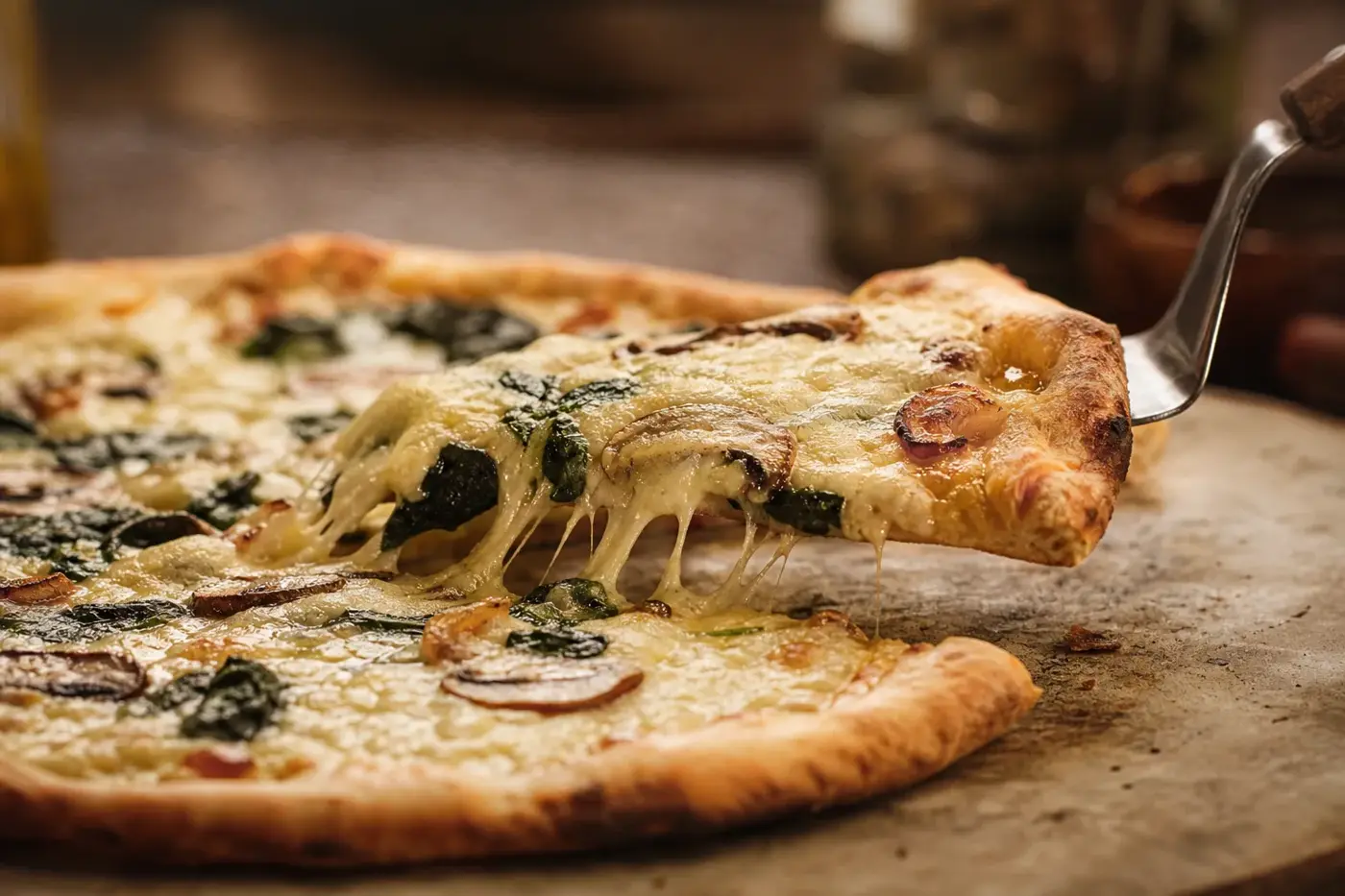
You lift a pizza slice and the topping stretches, apparently reluctant to let you go. That stretch might come from milk protein and vegetable fat, so it still contains milk. A coconut oil and starch alternative may contain almost no protein. Both can do a job associated with cheese, but their ingredients, kitchen behaviour and permitted names tell different stories. [1,2,3,10]
There is more to a slice than its looks
A cheese analogue is made to deliver some of cheese's appearance, texture, flavour or cooking performance. Think of a recipe assembled for a particular result: a formulation category. Scientific papers use analogue, substitute and imitation with overlapping meanings. On a label, though, imitation can have a precise legal meaning, particularly in the United States. [1,2,4]
Three broad formulations help you get your bearings. Fully dairy analogues use dairy protein and dairy fat, such as casein and cream. Partly dairy recipes combine milk ingredients with replacements such as vegetable fat or starch. Entirely plant based alternatives replace the dairy ingredients, although their protein content depends on the recipe. [1,2,3]
Here is the detail to keep in mind: casein is milk protein, not a plant ingredient. Sodium caseinate comes from casein; whey is a milk derived ingredient containing proteins. Combine vegetable oil with casein and you still have milk protein. Vegetable fat alone tells you little about whether a product suits your diet. [5]
Meet the ingredients holding it together
Behind your slice or topping are fat, water and a network that holds them together. In a casein formulation, hydrated protein helps keep fat in an emulsion, with fat droplets dispersed through water. Emulsifying salts help casein hydrate and perform that task. Starch can replace some or all of the protein structure. [2]
Vegetable fat supplies the fat component, while starch gives many alternatives their body. Plant proteins can help build the structure too. In a University of Guelph experiment, researchers combined waxy starch, plant protein and coconut oil. Changing the interactions between them produced different firmness, melt and stretch characteristics. [6]
Flavour belongs in this picture too. The dairy analogue experiment used added cheese flavouring and lactic acid alongside casein, cream and water. Violife's published UK ingredients list coconut oil, modified starch, flavourings, citric acid and colour. These are different routes to a sliceable product, each with its own ingredient profile. [1,3]
Softening is not the same as a glorious melt
You see a topping soften and expect the full pizza performance. Softening, however, does not guarantee the spreading, stretching or browning you want. Researchers studying casein and modified potato starch explored those differences through microscopy, texture measurements and melting tests. More starch increased hardness and rigidity; fat droplet size and emulsification influenced how far the product melted. [2]
The method matters as much as the shopping list, which is not, sadly, a crystal ball. In the dairy analogue study, changing processing conditions altered the topping's stretch and pizza browning. The Guelph study measured texture and melting properties in plant based formulations and compared them with commercial alternatives. Together, these experiments explain why an ingredient category alone cannot tell you how a product will perform. [1,6]
Why makers like a recipe they can steer
For makers and caterers, the attraction is control. Formulators can choose ingredients and processing conditions for a firm slice or a topping that flows when heated. Published experiments show that both texture and baking performance can be adjusted through formulation and processing. [1,2,6]
If you run a food business, those possibilities become practical questions. Will it portion consistently, slice cleanly, cover a pizza as intended and deliver the expected flavour? Dietary requirements need a separate check. A plant based ingredient list and a milk protein formulation serve different customers, even when both products are called analogues. [1,2,3,5]
Give the nutrition panel a proper look
Compare equal quantities, usually 100 g, rather than slices of different sizes. Violife's UK Original Slices page describes the product as a food preparation with coconut oil and publishes the figures below. The 30 g column is calculated from those declarations, not offered as a recommended portion. [3]
| Nutrient | Per 100 g | Per 30 g, calculated |
|---|---|---|
| Protein | 0.1 g | 0.03 g |
| Saturated fat | 21 g | 6.3 g |
| Salt | 2.3 g | 0.69 g |
This example has very little protein, with 21 g saturated fat and 2.3 g salt per 100 g. Its ingredients include added vitamin B12, but that neither adds protein nor reduces saturated fat. Read protein, saturated fat, salt and any declared micronutrients separately. Each answers a different nutritional question. [3]
The same brand's Original flavour Slices page for Trinidad and Tobago declares 0 g protein per 100 g, with the same saturated fat and salt figures. Look at the exact product and the market where it is sold. Neither the analogue category nor the word plant gives you the whole nutritional picture. [3,7]
This page summarises published guidance from the official sources it cites. It is not medical advice. Guidance differs between countries and changes over time, so check the current source for where you live, and ask your doctor, midwife, pharmacist or dietitian about your own circumstances.
Start with ingredients, then check allergens
Start with the ingredient list, not the front of the pack. Casein, caseinate and whey point to milk protein; soy ingredients and named nuts raise different allergen considerations. For the distinction between milk protein and milk sugar, see cheese allergy and lactose intolerance. The FDA specifically identifies casein, sodium caseinate and whey as milk proteins. [5]
In Great Britain, the Food Standards Agency's technical guidance explains how regulated allergens used as ingredients must be identified and emphasised on prepacked foods with an ingredient list. These include milk, soybeans and specified nuts. In the EU, Regulation 1169/2011, Article 21 and Annex II, provides the corresponding framework, subject to its specified exemptions. [8,9]
In the United States, FDA guidance requires the food source of major allergens to be identified through the ingredient wording or an adjacent Contains statement. Milk, soybeans and tree nuts are included. A separate Contains statement is not compulsory if the ingredient information already gives the required identification. You need to check both. [5]
Vegan labelling does not mean allergens are absent. The UK's published allergen guidance explains that a vegan claim can appear alongside precautionary allergen labelling. If you have a milk allergy, start with the FSA's and FDA's current label guidance rather than the word analogue. Consult the official source for your country and your clinician. [5,8]
Why cheese is a protected word in Great Britain and the EU
Cheese is a reserved dairy designation in both systems, not simply a description of how something looks or melts. The EU rule defines milk products as products derived exclusively from milk. Substances necessary for manufacture are allowed only where they do not replace milk constituents. Replace milk fat with vegetable fat and a naming issue arises, even if milk protein stays in the recipe. [8,10]
In Great Britain, your starting point is the assimilated version of Regulation 1308/2013, Annex VII, Part III, and the domestic enforcement rules. Defra's England guidance describes reserved names and composition requirements for milk products, and points to the separate national authorities. EU amendments need to be checked separately from GB legislation. [8,11]
Exceptions to reserved terminology need their own legal basis. A familiar expression on one product does not give another product permission to use it. As a shopper, distinguish the descriptive name from the ingredient list. Declaring a milk ingredient does not make the finished formulation eligible for a reserved dairy name. [10]
EU food information rules require the legal name, or a customary or descriptive name where appropriate. They also prohibit misleading information about composition and substitution. Naming the food and explaining its ingredients are connected obligations. Reading a cheese label covers the wider label; protected names involve an additional, separate question. [9]
What imitation means on a US label
On a US label, imitation can be a technical term rather than a casual description. Under 21 CFR 101.3(e), a food is an imitation if it substitutes for and resembles another food but is nutritionally inferior to it. The label must place imitation immediately before the imitated food's name, with uniform size and prominence. A substitute that is not nutritionally inferior can use an appropriate, nonmisleading name instead. [4]
Nutritional inferiority concerns reductions in essential nutrients present in measurable amounts, including protein and specified vitamins and minerals. Reducing fat or energy alone does not establish inferiority under this provision, subject to its labelling conditions. Here, imitation is a regulatory test, not a general verdict on processing or quality. [4]
Standards of identity ask a different question: what composition and characteristics must a named food have? US Cheddar's standard, 21 CFR 133.113, specifies at least 50% milk fat in the dry matter and at most 39% moisture in the whole cheese. Resemblance or nutritional equivalence does not establish compliance with that standard. [12]
A substitute should never be a secret
An openly described substitute is different from an undeclared replacement. EU food information law prohibits misleading a purchaser about a food's nature or composition, including suggesting that a particular ingredient is present when it has been replaced. The US imitation rule likewise forms part of the framework for preventing misbranding. Accurate disclosure matters more than resemblance to cheese. [4,9]
If you are concerned about misleading food labelling, UK government consumer guidance directs reports to Trading Standards. That includes concerns about product descriptions, ingredients and allergens. [13]
When you meet an unfamiliar product, read its descriptive name, then its ingredients, allergen information and nutrition panel. Match the formulation to the job you want it to do. A sandwich slice and a pizza topping pose different performance questions. The experimental evidence shows why success in one cannot simply be assumed in the other. [1,2,6]
Questions people ask
What is a cheese analogue?
A cheese analogue is formulated to resemble cheese or perform like it. It can be fully dairy, partly dairy or entirely plant based.
Can a cheese analogue contain milk?
Yes. A product made with vegetable oil and casein still contains milk protein. The FDA identifies casein, sodium caseinate and whey as milk proteins.
Are vegan cheese alternatives safe for someone with a milk allergy?
The UK's published allergen guidance says a vegan claim can appear alongside precautionary allergen labelling. The page points readers to the current FSA and FDA label guidance and advises consulting the official source for their country and their clinician.
Why do some cheese alternatives melt or stretch differently?
Ingredients and processing both affect how a product behaves. In one study, more starch increased hardness and rigidity, while fat droplet size and emulsification influenced melting.
What does imitation cheese mean in the United States?
Under US rules, a food is an imitation if it substitutes for and resembles another food but is nutritionally inferior to it. The label must place the word imitation immediately before the imitated food's name, with uniform size and prominence.
Sources
-
Association of Food Scientists and Technologists, India. “Process standardization for rennet casein based Mozzarella cheese analogue”. Journal of Food Science and Technology, volume 47, 2010, pages 574 to 578. Experimental dairy formulation and pizza performance, rather than a current legal standard. Full text.
-
Aarhus University and KMC. “Imitation cheese, New insights to relations between microstructure and functionality”. Food Structure, volume 29, article 100206, 2021. Experimental microscopy, texture, rheology and melting study. University repository text.
-
Violife. “Original Slices”, UK product page, undated, retrieved November 2026. Manufacturer's published ingredients and nutrition declaration; a commercial primary source for its own product information. Product declaration.
-
US Food and Drug Administration. 21 CFR 101.3: Identity labeling of food in packaged form, particularly paragraph (e). Current eCFR text retrieved November 2026. Regulation.
-
US Food and Drug Administration. “Have Food Allergies? Read the Label”. Consumer guidance, version retrieved November 2026. Official guidance.
-
University of Guelph. “Methodology and development of a high-protein plant-based cheese alternative”. Current Research in Food Science, volume 7, article 100632, 2023. Experimental formulation and instrumental comparison with commercial products. Research record and abstract.
-
Violife. “Original flavour Slices”, Trinidad and Tobago product page, undated, retrieved November 2026. Manufacturer's published ingredients and nutrition declaration. Product declaration.
-
Food Standards Agency. “Food allergen labelling and information requirements technical guidance”. Version retrieved November 2026, including dairy designations and voluntary vegan information. Official technical guidance.
-
European Parliament and Council. Regulation (EU) No 1169/2011 on the provision of food information to consumers, 2011, particularly Articles 7, 17 and 21 and Annex II. Original official text retrieved; current consolidation requires the editorial check recorded below. Official text.
-
European Parliament and Council. Regulation (EU) No 1308/2013, Annex VII, Part III. Original official text and consolidated document landing page retrieved November 2026. Official text.
-
Department for Environment, Food and Rural Affairs. “Food standards: labelling and composition”. Updated 20 September 2022, retrieved November 2026; guidance applies to England and identifies other national authorities. Official guidance.
-
US Food and Drug Administration. 21 CFR 133.113: Cheddar cheese, paragraph (a)(1). Current eCFR text retrieved November 2026. Standard of identity.
-
UK Government. “Understanding food labelling: Overview”. Version retrieved November 2026, section on misleading labels. Official consumer guidance.
Researched through official legislation and regulator guidance, primary experimental studies and manufacturers' published product declarations, with outstanding verification recorded for the editor below.
Last checked: November 2026
Last checked November 2026.
The editors suggest you read next
Cheese Law Around the World: The Complete Guide
GRUYERE reached an American legal border and lost its exclusivity.