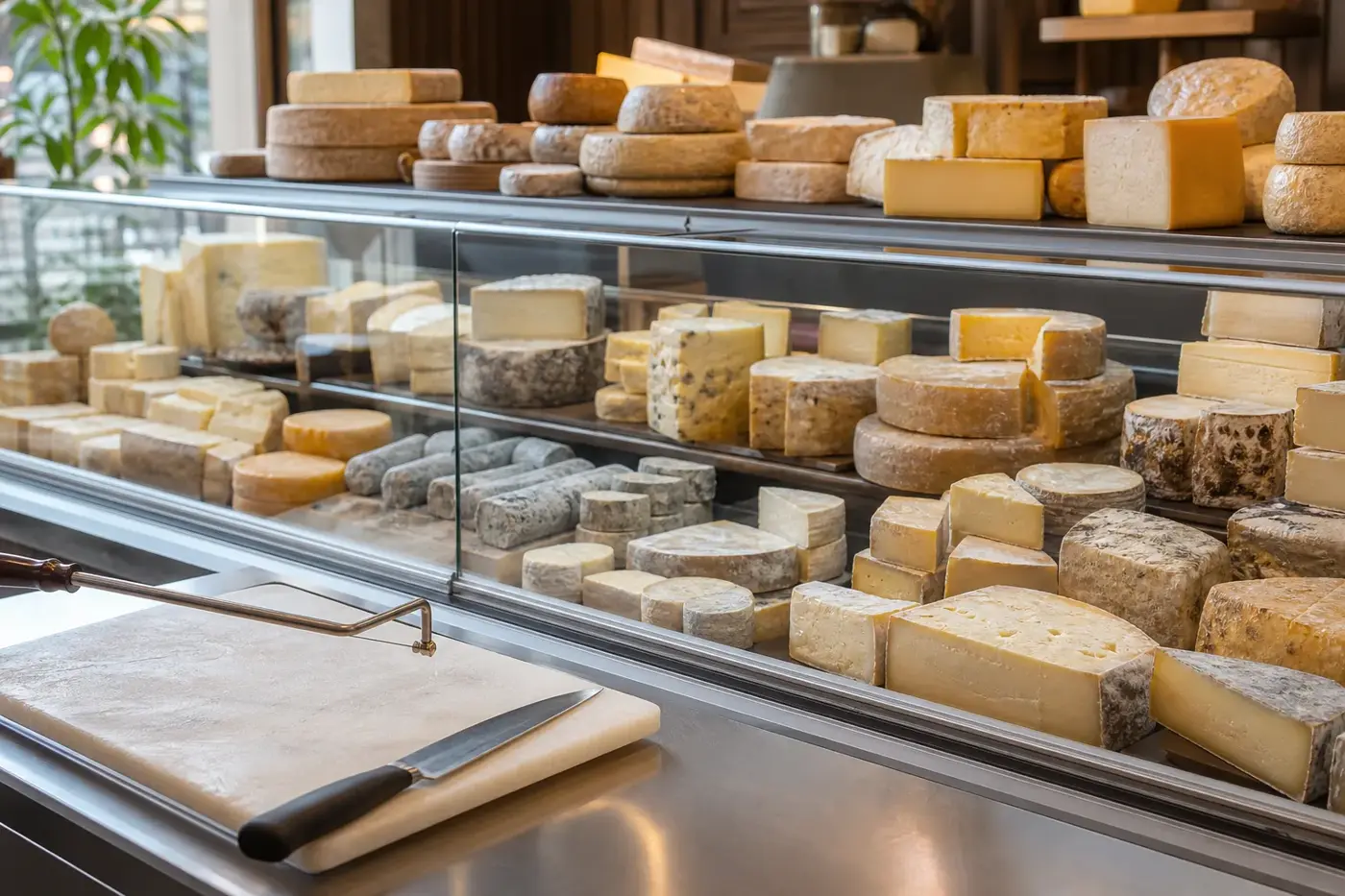
Your knife meets the cheese. A portion comes away, ready for the customer. But what travels with the blade into the next cut? A knife, cutting wire or board can carry harmful microorganisms straight into ready to eat cheese.[5]
The work starts before that first slice: clean equipment, controlled temperatures and people who know when something is wrong. In the UK, you need those daily habits within a food safety management system. Good records keep stock traceable and help you act quickly.[2,15]
Before the shutters go up, get the foundations right
Register your business with its local authority and keep its details current. The Food Standards Agency (FSA) lists registration, staff training, managing food safety and traceability among your responsibilities. Local authority officers inspect compliance, looking at what happens at your counter as well as what appears in your paperwork.[1,15]
Build documented procedures around HACCP, meaning hazard analysis and critical control points. Identify hazards, establish controls, monitor them and decide what to do if a control fails. Cover the everyday work: deliveries, cutting, wrapping, display and accompaniments. Ask your authority whether additional activities, particularly supplying other businesses, bring approval requirements.[2]
Follow the journey from surface to cheese
Ready to eat cheese may get no further cooking before someone eats it. That makes every hand and food contact surface important. A contaminated hand, knife, wire or board can transfer harmful microorganisms straight to a portion. Shared cloths and frequently touched handles can link a clean surface back to a dirty area.[5]
Listeria needs particular attention because, as the US FDA explains, it can grow at refrigeration temperatures. Chilling limits growth; hygienic handling prevents transfer. You need both, alongside the same separation discipline against other foodborne pathogens, including contamination from raw foods and ill staff.[6,7,9]
For a closer look at the organism, see listeria and cheese safety. For the wider picture, turn to cheese food safety.
Give your team a clean start
Good handwashing needs a properly equipped basin: hot and cold running water, soap and hygienic drying facilities. Staff should wash and dry their hands before handling food, after toilet visits and after contamination. Set clear personal hygiene rules, including clean protective clothing and waterproof dressings over cuts.[4,7]
In England, Wales and Northern Ireland, FSA guidance normally excludes staff from working with or around open food for 48 hours after vomiting or diarrhoea stops naturally. Food Standards Scotland (FSS) also recommends 48 hours without symptoms, with additional conditions after medication and for certain infections. Require prompt illness reporting, and make sure staff are fit before they return.[4,7]
Take a proper look before you uncover the cheese
Check that yesterday's cleaning is complete, food contact equipment is clean and undamaged, and handwashing supplies are ready. Look for droppings, gnawed packaging and other signs of pests. Isolate affected stock and deal with contamination before service. Removing the visible evidence does not resolve the problem.[5]
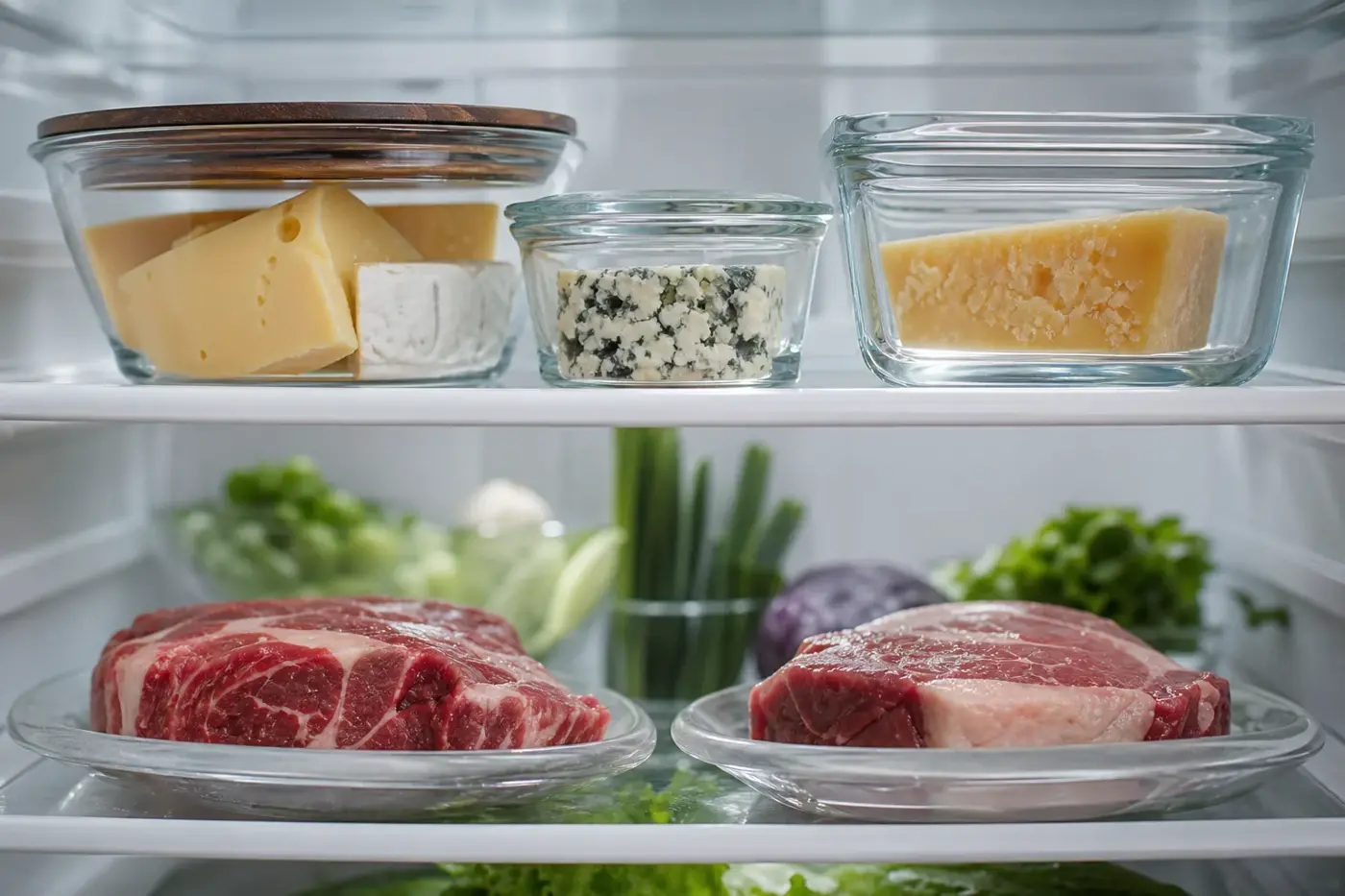
Check fridge and display performance against your written limits. Inspect stock for damaged packaging, expired use by dates, missing identification and storage instructions. Record both the problem and your corrective action, whether you reject a delivery, move stock or repair equipment. A temperature record only helps if a failure leads to action.[2,8]
Clean first, then let the disinfectant work
Cleaning removes food residues; disinfection reduces microorganisms after cleaning. Give your team a clear method for knives, cutting wires, boards, scale pans and display surfaces. It must work during busy service, not just in the cleaning folder. Choose chemicals suitable for the surface and for food contact use.[4,9]
- Remove cheese fragments and other loose debris.
- Wash with detergent, including joints and removable components, following equipment instructions.
- Apply disinfectant to the cleaned surface at the manufacturer's specified dilution and contact time.
- Rinse if the product instructions require it, then let equipment dry hygienically before reuse.[4,9]
Contact time is how long the chemical must stay on the surface to work. Put your chosen product's actual dilution and contact time in the cleaning schedule. GOV.UK advises looking on disinfectant labels for BS EN 1276 or BS EN 13697. Store chemicals away from food, and replace equipment you can no longer clean effectively.[4,9]
Make room for clean work
A designated ready to eat workspace is easier to protect than a board moved repeatedly around the counter. Keep raw foods, dirty delivery packaging, waste handling and cleaning activities away from exposed cheese and clean wrapping materials. For incompatible tasks, use separate equipment or effective cleaning and disinfection between them.[5]
Carry that care beyond the cutting board. Cloths, taps, fridge handles and payment equipment need attention too. After handling money or touching a screen, staff must use appropriate hand hygiene before returning to exposed food.[7,9]
This page summarises published guidance from the official sources it cites. It is not medical advice. Guidance differs between countries and changes over time, so check the current source for where you live, and ask your doctor, midwife, pharmacist or dietitian about your own circumstances.
Have the allergen answer at your fingertips
Accurate allergen information starts with your supplier. Check for milk and every other regulated allergen used, including egg where lysozyme is present. Review crackers, chutneys, nuts and other accompaniments individually. Update your written allergen record whenever a product or supplier changes, and keep accompaniments' utensils and crumbs away from other foods.[10,11]
Across the UK, loose cheese requires accurate information about regulated allergenic ingredients. If your team gives that information orally, provide clear signposting and a reliable written reference. Cheese packed on the premises before the customer selects or orders it can be prepacked for direct sale (PPDS). That requires the food's name and an ingredients list with allergens emphasised.[10,11]
A wedge wrapped after an order follows the loose food rules. Keep allergy and lactose intolerance distinct when answering customers.[10] For the label distinctions, see how to read a cheese label.
Keep the cold steady and the clock in sight
Set temperature limits for the nation, food and operation involved. This table brings together official guidance, with November 2026 as its reference date. Follow any lower product storage temperature.[3,8,12]
| Where your counter is | Temperature rule to follow | Legal source, November 2026 |
|---|---|---|
| England | Generally 8 °C or below for food capable of supporting pathogen growth or toxin formation, subject to exemptions. | SI 2013/2996, Schedule 4.[3,16] |
| Wales | Generally 8 °C or below for food capable of supporting pathogen growth or toxin formation, subject to exemptions. | SI 2006/31, Schedule 4.[3] |
| Northern Ireland | Generally 8 °C or below for food capable of supporting pathogen growth or toxin formation, subject to exemptions. | SR 2006/3, Schedule 4.[3,16] |
| Scotland | No equivalent general fixed 8 °C limit; storage conditions must prevent a health risk. | SSI 2006/3, Schedule 4; Regulation 852/2004, Annex II.[3,16] |
In England, Wales and Northern Ireland, the general 8 °C requirement excludes operations governed by Regulation (EC) No 853/2004. Other exemptions and tolerances apply, including for some foods still maturing at ambient temperature. Scotland has separate temperature control duties without an equivalent general fixed 8 °C limit. FSA and FSS recommend running fridges at 5 °C or below.[3,4,8]
For England, Wales and Northern Ireland, the display tolerance allows only one period outside temperature control, legally less than four hours. Record when that period starts. A conservative counter procedure is to discard remaining affected food at four hours, following current GOV.UK guidance.[3,8,12]
Rechilling does not reset the allowance. In Scotland, establish display controls through your food safety system and local enforcement advice.[3,8,12]
Check units during trading, not just when you open. Use a suitable thermometer and document what your team must do if a unit fails.[12]
Give every sample and wrapper the same care
Protect fresh wrapping from splashes and dirty hands, and keep its food contact side off unclean surfaces. Use clean utensils or suitable wrapping paper to minimise direct handling. Give sample portions and their serving utensils the same care as the cheese you sell from the counter.[5]
Disposable gloves can help with particular tasks, but they do not replace handwashing. Change them when contaminated or damaged, and between incompatible tasks, including handling waste or payment equipment. Wearing one pair through several jobs can carry contamination between those tasks.[4,7]
Rotate the stock, respect its shelf life
Use stock with the earliest appropriate deadline first. Check dates during service as well as at opening, record opening and cutting dates where your procedures require them, and retain the original identification. Follow your supplier's instructions for opened products.[2,4]
Cutting or rewrapping does not create a new safe shelf life. Any revised life needs evidence appropriate to the product and process; appearance or smell alone cannot establish safety. Remove food past its use by date from sale. A best before date concerns quality, but the food must still be safe.[2,4]
Keep every portion traceable if a recall comes
Your traceability records must identify suppliers and, where applicable, business customers. Include product descriptions, quantities and transaction or delivery dates. Check whether additional rules for food of animal origin apply to your supplies.[2,13]
Preserve batch information and keep cut portions linked to their source stock. General traceability does not require you to identify every individual retail customer.[2,13]
When a supplier issues an alert, stop selling affected stock. Find every matching batch, including portions already cut or repacked, and isolate it clearly. Follow the notice's return or disposal instructions, recording the quantities involved and the actions you take.[13,14]
If food that has left your immediate control may be unsafe, start withdrawal action. If it may be injurious to health, inform the competent authority immediately. If it may have reached consumers, tell them effectively and accurately why it is being withdrawn.[13,14]
Recall it where other measures cannot achieve a high level of health protection. Keep the distinction clear: withdrawal removes stock from the supply chain; recall also reaches consumers.[13,14]
Close with tomorrow's team in mind
Return suitable stock to its required storage, preserving identification and date controls. Remove waste, clean and disinfect food contact equipment and surfaces, and clean touch points. Leave reusable equipment hygienically dry. Record unresolved faults so the next shift can act before opening.[4,9]
Give management a regular rhythm, too. Adapt this suggested schedule to your hazards and workload:[2,15]
- Every shift: complete opening, temperature and closing records; report illness, contamination and equipment failures.
- At induction and task changes: demonstrate handwashing, cleaning, allergen enquiries and recall procedures, then check staff can perform them.
- Weekly: review recurring problems, overdue repairs and missing records.
- Whenever products, equipment or processes change: review the relevant hazards, instructions and staff training.[2,15]
Questions people ask
What temperature should a cheese counter be kept at?
In England, Wales and Northern Ireland, food capable of supporting pathogen growth or toxin formation must generally be kept at 8 °C or below, subject to exemptions. Scotland has no equivalent general fixed 8 °C limit, but storage conditions must prevent a health risk. The Food Standards Agency and Food Standards Scotland recommend running fridges at 5 °C or below, and any lower product storage temperature should be followed.
How long can cheese be displayed outside temperature control?
In England, Wales and Northern Ireland, the display tolerance allows one period outside temperature control, legally less than four hours. Record when it starts, and note that rechilling does not reset the allowance. In Scotland, establish display controls through the food safety system and local enforcement advice.
When can a cheesemonger return to work after vomiting or diarrhoea?
In England, Wales and Northern Ireland, Food Standards Agency guidance normally excludes staff from working with or around open food for 48 hours after symptoms stop naturally. Food Standards Scotland also recommends 48 hours without symptoms, with additional conditions after medication and for certain infections. Check the current guidance from the relevant agency.
How should cheese counter equipment be cleaned and disinfected?
Remove loose debris and wash equipment with detergent, including joints and removable components. Apply disinfectant to the cleaned surface at the manufacturer's specified dilution and contact time, then rinse if instructed and dry hygienically before reuse.
What allergen information does cheese sold at a counter need?
Loose cheese requires accurate information about regulated allergenic ingredients. If staff give it orally, there must be clear signposting and a reliable written reference. Cheese packed on the premises before the customer selects or orders it can be prepacked for direct sale, requiring the food's name and an ingredients list with allergens emphasised.
Sources
- Food Standards Agency. Food business registration. Updated 25 June 2026.
- Food Standards Agency. Managing food safety. Web guidance, version retrieved November 2026.
- Food Standards Agency and Food Standards Scotland. Guidance on Temperature Control. Official PDF, edition date not established from the retrieved text.
- Food Standards Scotland. CookSafe, web version, section 3. House rules covering personal hygiene, cleaning, temperature control and stock control; web version retrieved November 2026.
- Food Standards Scotland. RetailSafe Food Safety Assurance System. September 2021 file, retaining sections marked Issue 1, July 2006. Used for operational hygiene principles.
- US Food and Drug Administration. Food Safety Tips for Consumers & Retailers During an Outbreak of Foodborne Illness. Official search extract retrieved November 2026. Used solely for the statement that Listeria can grow at refrigeration temperatures.
- Food Standards Agency. Food handlers: fitness to work. Official PDF, version retrieved November 2026.
- UK Government. Food hygiene for businesses: Chilling and freezing. Web guidance retrieved November 2026.
- UK Government. Food hygiene for businesses: Cleaning. Web guidance retrieved November 2026.
- Food Standards Agency. Food allergen labelling and information requirements technical guidance. Web version retrieved November 2026, particularly paragraphs 74 to 104.
- Food Standards Scotland. Allergen labelling. Web guidance retrieved November 2026.
- Food Standards Agency. Safer food, better business: Chilled storage and display. Official PDF retrieved November 2026.
- Food Standards Agency and Food Standards Scotland. Guidance on Food Traceability, Withdrawals and Recalls within the UK Food Industry. Official PDF linked from current FSA guidance, retrieved November 2026.
- Food Standards Agency. Food incidents, product withdrawals and recalls. Updated 20 August 2026.
- UK Government. Running a food business: Your responsibilities. Web guidance retrieved November 2026.
- UK legislation, original published instruments: The Food Safety and Hygiene (England) Regulations 2013, SI 2013/2996; The Food Hygiene Regulations (Northern Ireland) 2006, SR 2006/3; and The Food Hygiene (Scotland) Regulations 2006, SSI 2006/3. Originals retrieved; consolidation verification remains an editorial hold below.
Researched through official food agency guidance, operational manuals and published legislation, with a working-day structure synthesised for cheese counters.
Last checked: November 2026
Last checked November 2026.
The editors suggest you read next