Cheese: The Complete Guide
Picture milk draining through perforated pottery in sixth-millennium-BC Kuyavia, Poland.
Picture milk draining through perforated pottery in sixth-millennium-BC Kuyavia, Poland. Thousands of years later, traces of its fat still clung to the clay. Researchers interpreted those vessels as sieves for separating curds from whey: a small, stubborn trace of cheesemaking.[12,17]
That separation still starts the story. Milk becomes curd, some liquid drains away and, for many cheeses, ripening takes over. From fresh curds to hard grating cheeses, all that variety grows from milk, coagulation, moisture, microorganisms and time. Quite a range from such a short cast list.[2]
Follow the curd: where cheese begins
Watch milk's proteins come together into a gel and you're watching coagulation. The solid portion becomes curd; the liquid released is whey. Cheese selectively concentrates milk, retaining casein, its principal protein in most cheeses, to help build the structure.[1]
Codex CXS 283-1978 covers ripened and unripened cheeses, soft to extra-hard, coated or uncoated, ready to eat or intended for further processing. Its definition includes coagulation followed by partial whey drainage, plus equivalent processing that produces similar physical, chemical and sensory characteristics. Protein must be concentrated, and the whey-protein-to-casein ratio must be no higher than in the starting milk. Particular varieties can have separate, more specific standards.[3]
Fresh cheese is ready soon after manufacture. Ripened cheese needs time in suitable conditions to develop its character. For mould-ripened cheese, characteristic mould growth works on the surface, inside, or both.[3]
Five questions to help you choose
You can make sense of almost any cheese with five questions. Take them in order, but leave room for overlap: a blue cheese can also be soft, made from sheep's milk and sold under a protected name. Cheese rarely confines itself to one box, however neatly you arrange the fridge.[4]
| Ask about | What to look for | Explore next |
|---|---|---|
| Milk | The animal species and how the milk was treated. | How to Read a Cheese Label |
| Method | Acid, enzymes, heat and how the curd was handled. | How Cheese Is Made: From Milk to Cheese |
| Rind | No rind, mould-ripened, washed or otherwise treated. | How to Tell Cheese Styles Apart: Milk, Rind, Texture and Method |
| Texture | Moisture and structure, from soft to hard. | How to Tell Cheese Styles Apart: Milk, Rind, Texture and Method |
| Name | A style, brand or registered designation. | Protected Names Explained: PDO, PGI and TSG |
Meet the milk, microbes and salt
Milk brings proteins, fat, water, milk sugar and minerals to the dairy. Cow's milk is widely used, but sheep, goats and buffalo supply cheesemaking milk too. The animal gives you only part of the picture: the balance of fat and protein, and the maker's handling, also shape what you taste.[1]
Starter cultures are selected microorganisms, commonly bacteria that turn lactose, milk's sugar, into lactic acid. That acidity influences curd formation, moisture loss and texture. Rennet, an enzyme preparation, coagulates milk in many cheeses; others set mainly through acid, or heat combined with acid.[1]
Salt adds flavour while helping to control moisture and microbial activity. Additional cultures, including moulds and yeasts, can guide ripening, while other ingredients depend on the variety and its rules. Milk, cultures, rennet and salt give you a useful starting list, not a recipe for every cheese.[2,3]
Step inside the dairy
First, the maker prepares the milk, develops acidity where the method calls for it, then coagulates its proteins. The curd may be cut, stirred or heated to release whey before draining and shaping. Some varieties are pressed; others drain more gently.[2]
Salt goes into the curd, onto the surface or into a brine. Fresh cheeses can be ready shortly afterwards. Others enter controlled ripening, where microorganisms and enzymes change their structure and flavour.[2]
Each decision shapes what happens next. Cutting and cooking influence moisture release; acidity affects the curd's structure; salting changes the conditions for ripening. You can follow the whole sequence in How Cheese Is Made: From Milk to Cheese.[2]
Find your family, from fresh to blue
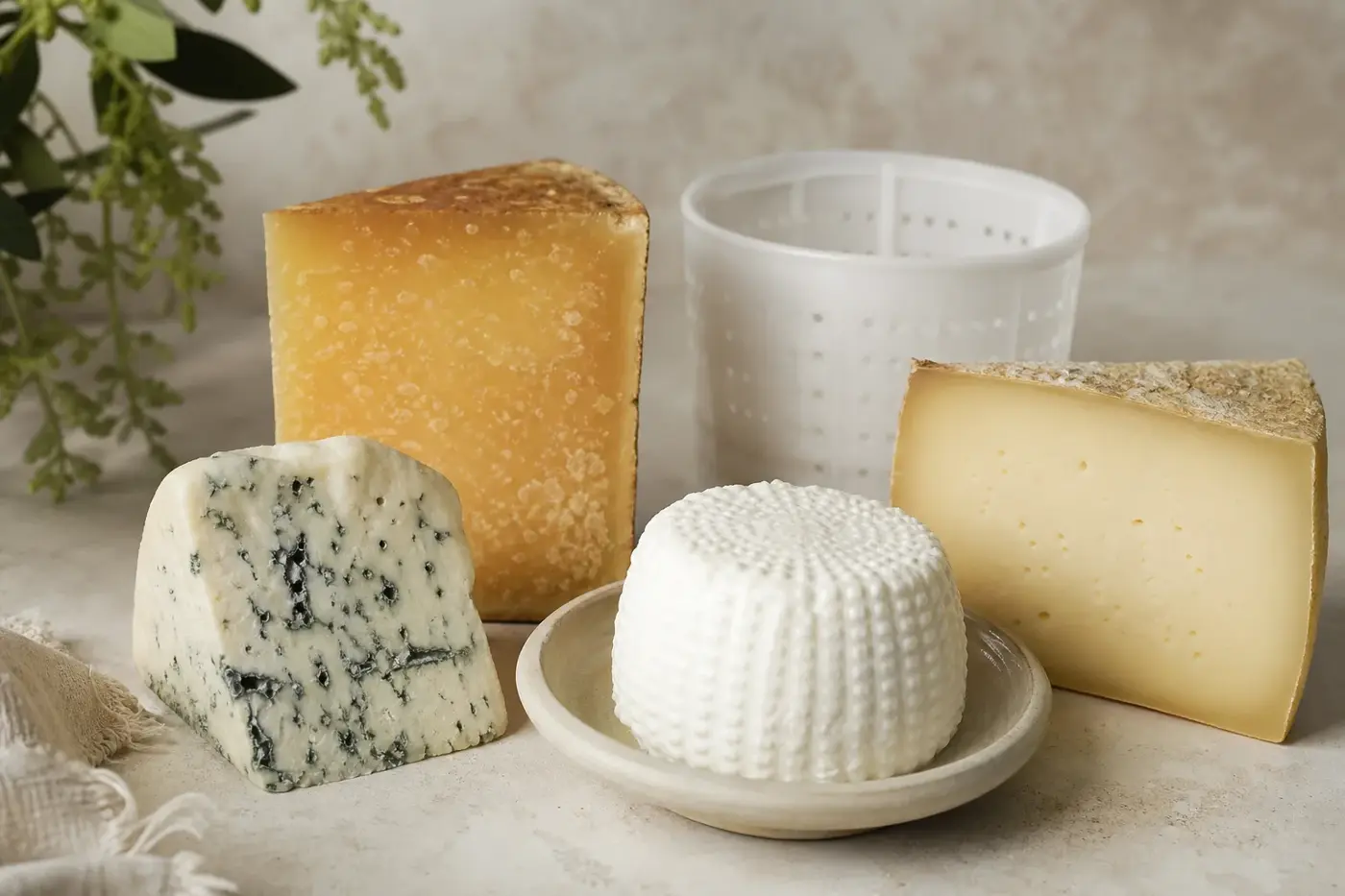
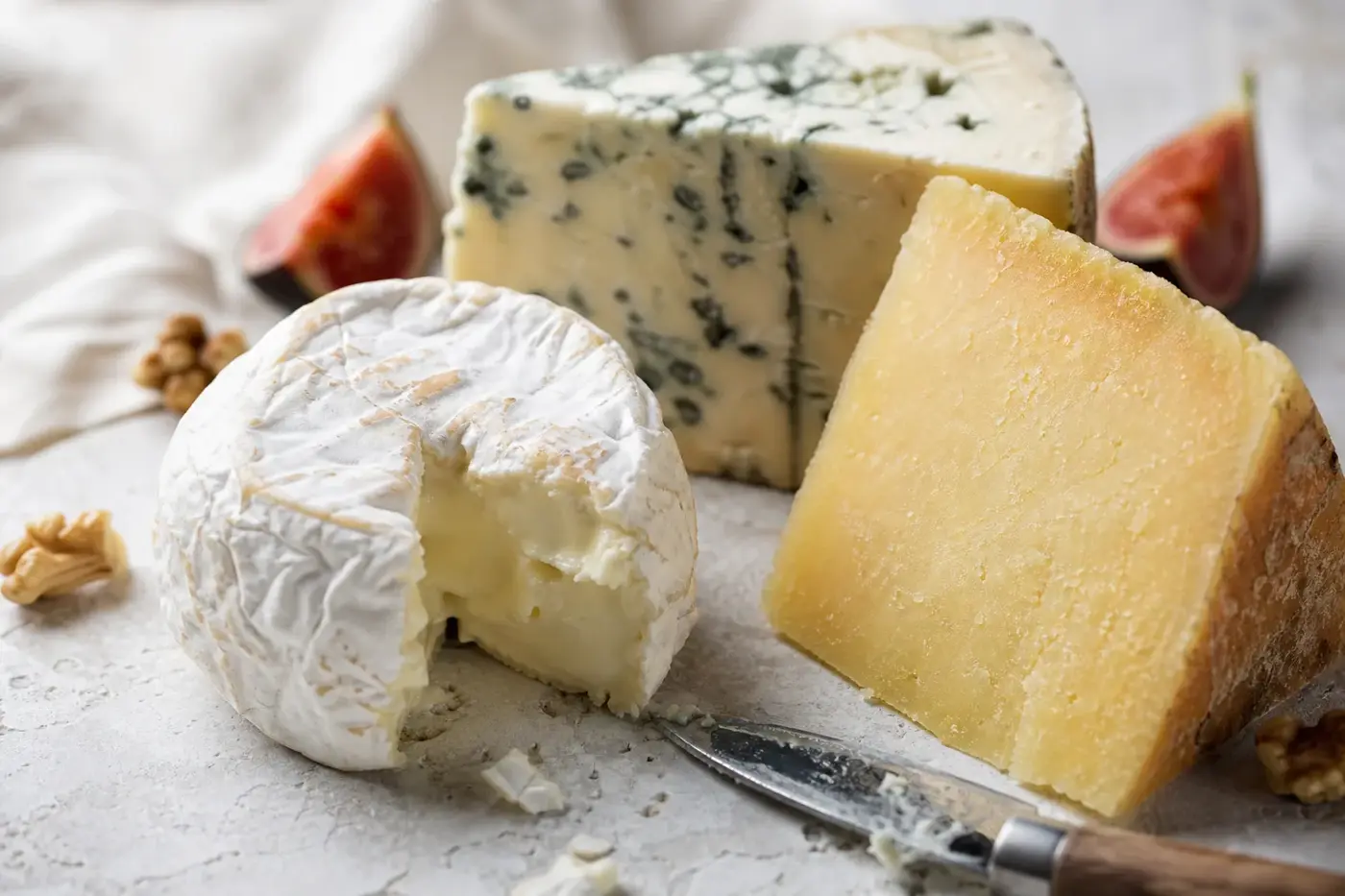
Fresh cheeses reach your table without a ripening stage. For the other families, look at how they develop: surface growth ripens some soft cheeses, changing the paste, the interior beneath the rind. Washed rind cheeses receive surface treatments during ripening, while blue cheeses develop characteristic mould inside.[3,4]
Firmer cheeses generally have more moisture removed. Cooking, handling and maturation create further groups within them. Texture gives you a useful clue, but never quite the whole story.[3,4]
Method offers another way to find your bearings. Acid-set fresh cheeses, heat-and-acid cheeses and stretched-curd cheeses are grouped by how their structure is made, overlapping with texture and ripening categories. How to Tell Cheese Styles Apart: Milk, Rind, Texture and Method helps you untangle those distinctions.[1,4]
Give it time, then look at the place
Ripening is no quiet wait on a shelf. Also called maturation or affinage, it involves enzymes breaking down proteins and fats while microorganisms contribute to the developing cheese. Temperature, humidity and the starting curd help determine the result. The same number of months means different things for different styles.[1]
Place matters through the milk available and the methods developed around it. Regional traditions bring particular raw materials together with ways of draining, salting and ripening them. When you compare cheeses, look at milk and process rather than treating age alone as a badge of quality.[4]
Read the name, know the rules
What may be sold under a particular name? The answer comes from food law, rather than a maker's description of cheese. Codex provides international reference texts, while binding requirements come from the law applying in the market concerned. Its General Standard for the Use of Dairy Terms, CXS 206-1999, supplies the accompanying vocabulary for milk and milk products.[3,5,6]
Definitions and standards: November 2026.
| Place or reference | What it means for you | Legal or reference source |
|---|---|---|
| Codex | Covers fresh and ripened products made by coagulation and whey separation, or equivalent processing. It is an international reference, not legislation. | CXS 283-1978, sections 1 and 2.[3,5] |
| EU | Cheese is a reserved milk-product designation. Necessary manufacturing ingredients must not replace milk constituents. | Regulation (EU) No 1308/2013, Annex VII, Part III.[7] |
| Great Britain | The assimilated regulation reserves the designation cheese for milk products. | Assimilated Regulation (EU) No 1308/2013, Annex VII, Part III.[18] |
| United States | Named cheeses and related products have individual standards. Part 133 has no single general cheese definition. | 21 CFR Part 133.[9] |
| Canada | The named variety standard describes bacterial curd formation and whey drainage. Specified exceptions have separate standards. | Food Compositional Standards, Volume 7, section 7.4.2.[10] |
| Australia and New Zealand | Both countries share a joint cheese standard. | Food Standards Code, Standard 2.5.4.[16] |
In the US, an FDA rule published in October 2026 allows salt substitutes in specified standardised foods from 14 December 2026. Objections may delay the dairy provisions. If those provisions take effect, safe and suitable salt substitutes may replace some or all added salt in standardised foods. This is separate from the proposal to revoke certain dairy standards.[11]
Protected names: get to know the place behind the label
A protected name brings its own requirements, so start with the jurisdiction whose register and specification apply. Look up the exact registered wording and requirements, including any production area, permitted method or minimum ageing. Protected Names Explained: PDO, PGI and TSG takes you further into these terms.
Back to the pottery, and cheese's long history
The earliest evidence of making cheese is not the same thing as the oldest surviving cheese. Salque and colleagues analysed milk-fat residues in perforated pottery from Kuyavia, Poland, including Ludwinowo 7, dated to the sixth millennium BC. Their 2013 Nature paper, published online on 12 December 2012, interpreted those sieves as evidence of separating curds from whey.[12,17]
For surviving material, you need to move much further forward. Yang and colleagues' 2014 study identified kefir dairy remains associated with mummies at Xiaohe cemetery in Xinjiang, China, dated to 1980 to 1450 BC. A 2024 Cell study recovered ancient DNA from Xiaohe cheese described as about 3,500 years old.[13,14]
Yang and colleagues described the Xiaohe material as an earliest known cheese. Later, Greco and colleagues described cheese residue from the tomb of Ptahmes at Saqqara, Egypt, as probably the most ancient solid cheese residue found to date. Those claims rest on different evidence, an important distinction as you follow the history.[13,19]
This page summarises published guidance from the official sources it cites. It is not medical advice. Guidance differs between countries and changes over time, so check the current source for where you live, and ask your doctor, midwife, pharmacist or dietitian about your own circumstances.
Enjoy cheese with the safety essentials to hand
Pasteurisation kills Listeria, but cheese can become contaminated afterwards. The US Centers for Disease Control and Prevention explains this in guidance updated on 26 August 2026.[15] If you're at higher risk, consult your national authority's specific advice.
Follow guidance for your country and circumstances, along with the product's handling instructions and any recall notice. Cheese Food Safety: The Complete Guide is your next reference for guidance by country.
Where will your curiosity take you next?
Start with the task in front of you. These pieces are in preparation:
- How to Read a Cheese Label: find the information that matters on a pack.
- How to Tell Cheese Styles Apart: Milk, Rind, Texture and Method: find a more precise way to describe your cheese.
- How Cheese Is Made: From Milk to Cheese: follow each stage of production.
- Protected Names Explained: PDO, PGI and TSG: get to know the name and its rules.
Questions people ask
How is cheese made?
Milk proteins are coagulated to form curd, and some of the liquid whey is drained away. The curd is shaped and salted, and some cheeses are left to ripen.
What is the difference between fresh and ripened cheese?
Fresh cheese is ready soon after manufacture, without a ripening stage. Ripened cheese needs time under suitable conditions to develop its character.
What does rennet do in cheese?
Rennet is an enzyme preparation that coagulates milk in many cheeses. Other cheeses set mainly through acid, or through heat combined with acid.
What does a protected cheese name mean?
A protected name comes with requirements of its own. Check the relevant register and specification for the exact wording and any production area, permitted method or minimum ageing.
Can cheese become contaminated after pasteurisation?
The US Centers for Disease Control and Prevention explains that pasteurisation kills Listeria, but cheese can become contaminated afterwards. See the agency's guidance, updated on 26 August 2026, and check the guidance for your country and circumstances.
Sources
- University of Guelph. Dairy Science and Technology eBook, chapter 29, Cultured Dairy Products and Cheese. Online edition, publication date not stated.
- Arthur Hill and Mary Ann Ferrer, University of Guelph. Cheese Making Technology e-Book, chapter 1, The Basic Process. Online edition, publication date not stated on the retrieved chapter.
- Codex Alimentarius Commission, FAO/WHO. General Standard for Cheese, CXS 283-1978, English edition, amended through 2013; and Norma General para el Queso, Spanish edition, amended through 2024.
- Arthur Hill and Mary Ann Ferrer, University of Guelph. Cheese Making Technology e-Book, chapter 2, Cheese Families. Online edition, publication date not stated on the retrieved chapter.
- Codex Alimentarius Commission, FAO/WHO. About Codex, General Principles of the Codex Alimentarius. Online edition, undated, particularly “Nature of Codex texts”.
- Codex Alimentarius Commission, FAO/WHO. General Standard for the Use of Dairy Terms, CODEX STAN 206-1999. Retrieved legacy edition; section 2.
- European Parliament and Council. Regulation (EU) No 1308/2013, Annex VII, Part III. Official Journal edition, 2013.
- Department of Agriculture, Environment and Rural Affairs, Northern Ireland. Marketing standards. Online guidance, retrieved November 2026.
- US Food and Drug Administration, via the Office of the Federal Register. 21 CFR Part 133, Cheeses and Related Cheese Products. eCFR display stated current to 3 November 2026.
- Canadian Food Inspection Agency. Canadian Food Compositional Standards, Volume 7, section 7.4. Online incorporated document, retrieved November 2026.
- US Food and Drug Administration. Use of Salt Substitutes To Reduce the Sodium Content in Standardized Foods. Final rule, 91 FR 65040, published 13 October 2026.
- Salque M. and colleagues. Earliest evidence for cheese making in the sixth millennium BC in northern Europe. Nature 493, 522 to 525, 2013; published online 12 December 2012. DOI: 10.1038/nature11698.
- Yang Y. and colleagues. Proteomics evidence for kefir dairy in Early Bronze Age China. Journal of Archaeological Science 45, 178 to 186, 2014; author abstract indexed by FAO AGRIS. DOI: 10.1016/j.jas.2014.02.005.
- Liu Y. and colleagues. Bronze Age cheese reveals human-Lactobacillus interactions over evolutionary history. Cell 187, 5891 to 5900, 2024; abstract indexed by PubMed. DOI: 10.1016/j.cell.2024.08.008.
- US Centers for Disease Control and Prevention. Listeria Outbreak Linked to Soft Cheese. Updated 26 August 2026.
-
Food Standards Australia New Zealand. Australia New Zealand Food Standards Code, Standard 2.5.4. Compilation, August 2026.
-
The National Archives. Regulation (EU) No 1308/2013, Annex VII, Part III, assimilated GB text. Revised text, up to date for changes in force on or before 11 October 2026.
-
Greco E. and colleagues. Proteomic Analyses on an Ancient Egyptian Cheese and Biomolecular Evidence of Brucellosis. Analytical Chemistry 90, 9673 to 9676, 2018. DOI: 10.1021/acs.analchem.8b02535.
- Frontiers in Environmental Archaeology. Integrated approaches to understanding animal exploitation and dairying in the Central European Early Neolithic: a case study from Ludwinowo 7 (Kuyavia, Poland; c. 5250 to 5000 cal BC). Original research, 2023. DOI: 10.3389/fearc.2023.1187087.
This desk-research synthesis draws on academic cheesemaking references, official standards and legislation, national guidance and archaeological research.
Last checked: November 2026
Last checked November 2026.
The editors suggest you read next
Why Is Some Cheese So Prized? Milk, Time and Craft
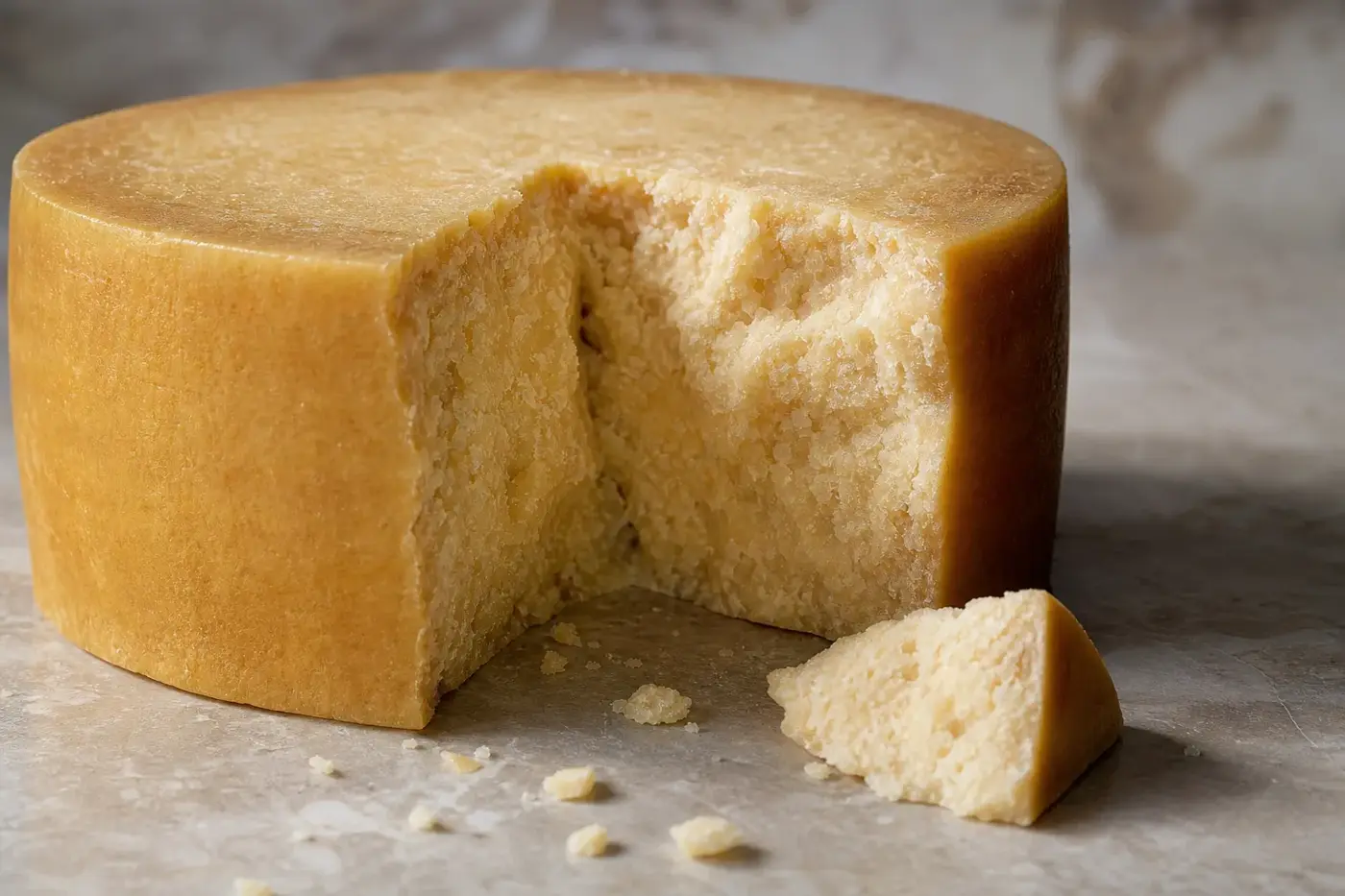
Picture a wheel of Parmigiano Reggiano waiting its turn, while you contemplate another mouthful.