Cheese vs Other Cultured Dairy Foods
In West Sumatra, buffalo milk ferments inside bamboo tubes covered with banana leaves.
In West Sumatra, buffalo milk ferments inside bamboo tubes covered with banana leaves. In Serbia, makers collect the rich skin that forms as heated milk cools. A cloth bag of draining yoghurt takes another path again. Dadih, kajmak and labneh reveal how much depends on what makers ferment, collect, drain or mature, and what their communities call the result. Cheese commonly involves separating curd from whey. Fermentation and thickness alone cannot draw the boundary. [1,2,3,4,7]
Cheese and cultured dairy: follow what stays behind
The revealing question is simple: which part of the milk does the maker retain, and how? In much cheesemaking, milk proteins form a network that traps water and fat. This setting process is coagulation; the resulting solid or gel is curd, and the liquid released from it is whey. Cutting, stirring, draining and pressing control how much whey remains. The Codex General Standard for Cheese describes both coagulation followed by partial whey drainage and alternative techniques that achieve comparable characteristics. [1]
That broader definition makes room for more than cut curds, draining baskets and wheels. It includes products made by other concentration methods and recognises a wide range of consistencies, including soft cheeses. Codex provides an international reference; individual countries have their own legal frameworks. [1]
Labneh concentrates a fermented gel. Kajmak collects a surface layer. Jameed combines fermentation with substantial drying. Following those operations makes their differences clearer than starting with a category name. [3,4,5] For the wider production sequence, see how cheese is made.
Fermentation, setting and ageing do different jobs
Fermentation is microbial activity; coagulation is the physical setting of milk proteins. In cultured dairy foods, lactic acid bacteria commonly turn milk sugar into lactic acid, making the milk more acidic. The processes often work together, but added acid or enzymes, including those supplied by rennet, can also coagulate milk. Codex lists suitable bacterial cultures, rennet and other coagulating agents among permitted cheesemaking ingredients. [1,10]
Maturation is the further development that follows manufacture, rather than the milk's initial setting. Codex distinguishes ripened cheese from unripened cheese, including fresh cheese ready to eat shortly after manufacture. Cheese therefore need not undergo either fermentation or a subsequent ageing period. [1]
Nor does a cultured food necessarily contain living starter organisms when eaten. The Codex fermented-milk standard requires viable, active and abundant starter microorganisms through the date of minimum durability, with an exception for products heat-treated after fermentation. Fermented history and present culture status describe different things. [2]
For the finished food, distinguish what organisms did during manufacture from what remains when it reaches the table. Read the producer's description rather than treating “cultured”, “fermented” and “live” as interchangeable terms.
Labneh: yoghurt becomes a substantial spread
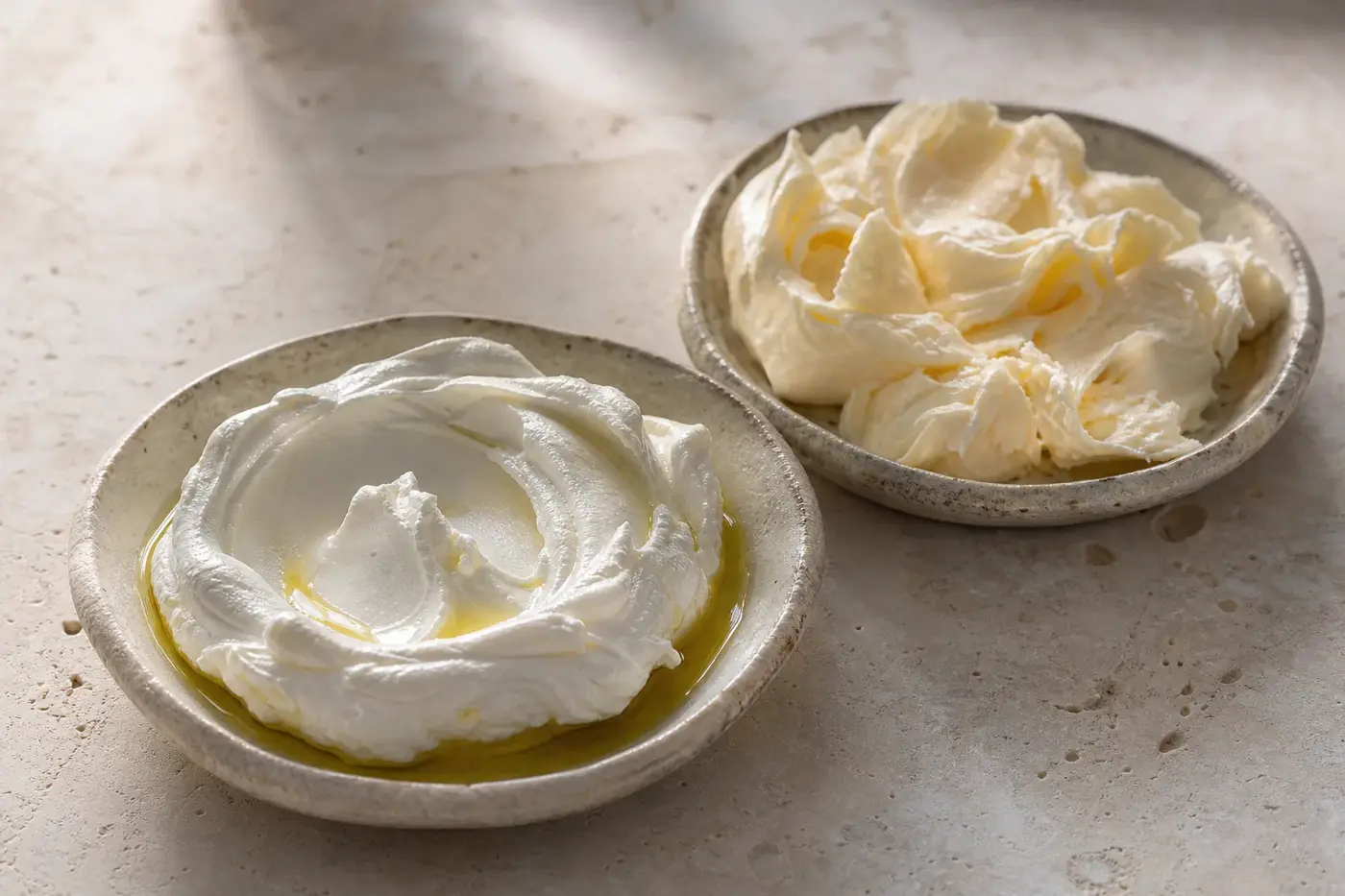
A cloth bag and time are the traditional means of turning yoghurt into labneh: liquid drains away, leaving a thicker, concentrated food. The resemblance to cheese is easy to see. Liquid leaves a coagulated milk product, and what remains becomes a substantial spread. “Yoghurt cheese” captures that resemblance; Codex places labneh among concentrated fermented milks. [2,3]
Research published in Food Structure shows how the order of production shapes the result. The study compared traditionally strained labneh with versions made by filtering fermented yoghurt or fermenting milk that had already been concentrated. Traditional labneh and the filtered-yoghurt products had similar consistency. Concentrating the milk before fermentation produced something firmer and more crumbly. Foods bearing the same name acquired different structures through different sequences of work. [3]
Thickness tells only part of that story. Labneh takes its character from yoghurt fermentation combined with concentration, and makers can achieve that concentration with different equipment and methods. A spoonable product and a firmer spread can belong to the same broad tradition while having distinct manufacturing histories. [3]
To place those textures alongside cheese, see the guide to telling cheese styles apart.
Kajmak: the richness at the surface
Kajmak begins at the surface of heated milk. In the traditional Serbian process documented by dairy researchers, a skin develops as the milk cools. Rising fat joins that layer, which makers collect, salt and assemble in successive portions. Some serum drains away, but collecting the surface layer defines the process, rather than separating an ordinary cheesemaking curd. [4]
The resulting structure brings together concentrated milk fat and proteins. Research describes production in Serbia, Montenegro and Bosnia and Herzegovina, encompassing both fresh and ripened forms. Kajmak is therefore a family of products at different stages of development, with texture and maturity worth asking about when choosing it. [4,8]
Maturation changes the material itself. In one Serbian study, researchers obtained kajmak from the same producer on three occasions and compared its development under two storage conditions. Protein breakdown differed between the treatments. These were experimental conditions, rather than instructions for storing kajmak at home. [8]
Place matters too. A study of Romanija mountain kajmak in Bosnia and Herzegovina examined products at different maturation stages and recorded changes in appearance and structure. The name opens a conversation about place, production and age; those details give a fuller picture of the food's sensory character. [9]
Dadih: buffalo milk, bamboo and fermentation
Dadih, also written dadiah, belongs to Minangkabau food traditions in West Sumatra. Indonesian researchers describe buffalo milk fermented in bamboo tubes covered with banana leaves, yielding a soft, yoghurt-like food with a whitish appearance and sour flavour. The milk develops within its vessel; drainage is not the central operation in this traditional process. [7]
The bamboo is part of the production environment, not merely a container for serving. The researchers identify milk, bamboo and leaves as possible sources of microorganisms involved in spontaneous fermentation. They also studied producers who used a little of the previous product to start another batch, a practice called back-slopping. [7]
The samples made through those approaches had different bacterial profiles. Even within a relatively focused geographical area, the traditional name accommodates more than one fermentation practice. The account of a particular maker's dadih is most useful when it keeps that local setting and method in view. [7]
Its kinship with cheese lies in the set milk, rather than a wheel, rind or draining stage. To understand dadih, start with the buffalo milk, the vessel and the fermentation practice. Those details describe the food more precisely than using “cheese” as a convenient translation. [7]
Jameed: drying gives fermented dairy a cooking role
Jameed's firm character comes from extensive drying after fermentation and fat separation. Strongly associated with Jordan and mansaf, it follows a traditional route documented by research involving Jordan's agricultural research service and the International Center for Agricultural Research in the Dry Areas: yoghurt is churned to recover butter, then the remaining fermented dairy material is dried into jameed. [5]
Calling it simply hard cheese obscures that sequence. Fermentation, butter recovery and drying each help explain the finished ingredient. The research also tested an alternative method in which milk fat was separated before yoghurt manufacture, showing how producers could alter the process while retaining the intended product. [5]
A later Jordan-wide study of market samples found substantial variation in composition, including solids and salt. The researchers linked those differences to processing and standardisation. Salted, dried fermented dairy is the useful broad description, with composition varying between producers. [6]
Jameed supplies the fermented dairy component of mansaf. Its place in the kitchen is consequently closer to a concentrated cooking ingredient than a cheese chosen for slicing. The sheep-farming context documented in Jordanian research also connects it to the milk available to its makers. Production, local milk and culinary use together explain its distinctive place among dairy foods. [5,6]
Kashk: ask where it comes from
Kashk and related spellings can describe preparations with different ingredients. Iranian research covers dairy kashk as well as versions incorporating wheat. A study of kashk zard, or “yellow curd”, examined a fermented preparation of yoghurt, wheat flour, herbs, spices and salt. Here, the name belongs to a cereal-and-dairy food, and the ingredient description is essential to understanding it. [11,12]
Lebanese kishk offers a related but distinct preparation. A producer survey and laboratory study across four Lebanese regions examined foods made from cereals and fermented milk. Milk species, cereal choice and manufacturing practice differed. The documented process included drying and grinding, yielding a powder that could be prepared as soup. [13]
The practical distinction is between dairy preparations and those in which cereal is a substantial ingredient. Closely related names can cover different textures, compositions and culinary functions. Before choosing one for a dish, ask where it comes from and read the ingredient description. [11,12,13]
These differences belong to the tradition itself. In the Lebanese study, local livestock and culinary traditions helped explain regional variation. “Traditional” describes that inheritance without requiring every region or producer to make an identical food. [13]
Yoghurt and kefir: different cultures, different handling
Yoghurt and kefir share fermentation, but their microbial partnerships differ. Codex describes yoghurt through its characteristic combination of Streptococcus thermophilus and Lactobacillus delbrueckii subspecies bulgaricus. Its kefir description includes bacteria and yeasts associated with kefir grains. Behind their shared sourness are different microbial systems. [2]
What happens to the whey offers another distinction. Under the Codex fermented milk standard, whey removal after fermentation is reserved for concentrated fermented milks, including labneh. In cheesemaking, whey separation is commonly a deliberate manufacturing step. As international reference descriptions, these sit alongside the legal classifications used in individual countries. [1,2]
“Solid versus liquid” is a less useful guide. A fermented gel can be stirred, concentrated or otherwise processed, while cheeses span markedly different consistencies. Looking at culture, coagulation and separation explains more than testing whether the food stays on a spoon. [1,2,3]
Skyr and quark: fresh cheese in context
A food eaten like thick yoghurt may be classified as cheese. Skyr and quark sit close to this boundary because acid setting and whey separation can produce spoonable foods. Iceland's former milk-products regulation described skyr as cultured skimmed milk with whey removed and allowed rennet in its production. It described quark through acidification and/or rennet coagulation followed by whey separation. Neither rennet nor spoonable texture alone settles the comparison. [14]
For quark, current German official standards give a clear answer: Speisequark belongs within fresh cheese. The German dairy industry body's production account describes lactic acid bacteria, a small amount of rennet and centrifugal separation of curd from whey. Cream may then be used to adjust fat content. [10,15]
The German standard describes a soft, supple to paste-like consistency and a lightly lactic-acid flavour. Those qualities make quark at home on the breakfast table, while its local classification remains fresh cheese. How a food is eaten and how it is legally categorised answer different questions. [10]
Texture, flavour and a place at the table
Start with these documented forms, then check the individual product. Manufacturing method and culinary role make useful comparisons while leaving room for regional differences.
| Food or preparation | Defining treatment | Source-described texture or flavour | Eating context |
|---|---|---|---|
| Labneh | Concentrating yoghurt | Substantial spread; texture varies with concentration method [3] | Choose a consistency for spreading or spooning |
| Kajmak | Collecting heated milk's surface layer | Fat-rich structure; fresh and matured forms [4,8] | Ask the maker about maturity |
| Dadih | Fermenting buffalo milk in bamboo | Soft, yoghurt-like and sour [7] | Eaten as part of the local diet |
| Jameed | Fermentation, fat separation and drying | Dry, concentrated and salted [5,6] | Preparing mansaf |
| Lebanese kishk | Combining fermented milk and cereal, then drying | Powdered preparation [13] | Soup |
| Quark | Acid setting and whey separation | Soft to paste-like, lightly sour [10,15] | Spoonable fresh cheese |
Store the food you have
For household storage in the UK, the Food Standards Agency advises keeping a home fridge at 5 °C or below. Follow the storage instructions on the packaging. Advice checked November 2026. [16]
A dried ingredient, a fresh spread and a matured dairy food need different consideration. Check the supplied directions for storage before opening, after opening and after any reconstitution. For more detail, see how to store cheese at home and how to read a cheese label.
At the counter, ask concrete questions: which milk was used, what was fermented, what was separated, and was the result dried or matured? The answers reveal how the food was made and what to expect from it, well beyond whether it counts as cheese.
General information only, not medical advice: follow the official guidance where you live.
Questions people ask
Does cheese have to be fermented or aged?
No. Milk can be coagulated with added acid or enzymes, including those supplied by rennet. Codex also recognises unripened cheese, including fresh cheese ready to eat shortly after manufacture.
Is labneh a cheese?
Labneh is sometimes called yoghurt cheese because liquid drains from yoghurt, leaving a thick spread. Codex places labneh among concentrated fermented milks.
What is jameed and how is it used?
Jameed is a salted, dried fermented dairy food strongly associated with Jordan. It supplies the fermented dairy component of mansaf.
Does kashk always contain dairy?
The page describes Iranian dairy kashk as well as versions incorporating wheat. Kashk zard contains yoghurt, wheat flour, herbs, spices and salt.
Are skyr and quark cheeses?
Current German official standards place Speisequark within fresh cheese. Iceland’s former milk products regulation described skyr as cultured skimmed milk with whey removed and allowed rennet in its production.
Sources
-
FAO/WHO Codex Alimentarius Commission. General Standard for Cheese, CXS 283-1978, retrieved official PDF incorporating amendments through 2013. Sections 2 and 3. This edition supports the production principles cited here. Official PDF.
-
FAO/WHO Codex Alimentarius Commission. Standard for Fermented Milks, CXS 243-2003, amended 2024. Sections 2.1, 2.2 and 3.4. Official PDF.
-
Food Structure, hosted by Utah State University. Rheology and Microstructure of Strained Yoghurt (Labneh) Made From Cow's Milk by Three Different Methods, volume 8, issue 1, article 15, 1989. Research record and abstract.
-
Dairy Science & Technology. Research article on traditional and industrial kajmak production, volume 88, pages 163 to 172, 2008. Sections 2 and 3 and production diagrams. Published article.
-
Jordanian National Centre for Agricultural Research and Extension and International Center for Agricultural Research in the Dry Areas. Enhancing Jameed quality by improved processing methods for small scale dairy sheep farms in Jordan, undated research abstract. Institutional document.
-
Applied Sciences, through the CGIAR institutional repository. Nutritional and Food Safety Characteristics of Jameed, A Traditional Dairy Product of Drylands, volume 14, issue 2, 2024. Repository abstract describing the Jordanian market-sample study. Institutional record.
-
Veterinary World, through PubMed Central. Diversity of lactic acid bacteria in dadih produced by either back-slopping or spontaneous fermentation from two different regions of West Sumatra, Indonesia, 2019. Introduction, methods and conclusions. Research article.
-
Food Science and Technology, through SciELO. Protein and fatty acid profiles of Kajmak ripened at two different temperatures, 2022. Abstract, section 2.1 and protein-profile results. Research article.
-
Journal of Agricultural, Food and Environmental Sciences. The quality of mature Romanija’s kajmak, volume 76, issue 7, 2022. Published abstract. Journal record.
-
German Federal Ministry of Justice official legislation service. Verordnung über Qualitätsanforderungen an Milchprodukte, MilchPQV, 2025 instrument, online consolidated text retrieved November 2026. Standard cheese-varieties table, Frischkäse, Speisequark row. Official text.
-
International Dairy Journal. Geographical differentiation of traditional Iranian dried kashk based on gross composition, fatty acids, elements, free amino acids and vitamins, 2023. Retrieved publisher abstract and introductory extract. Publisher record.
-
Microorganisms. Microbial Diversity and Nutritional Properties of Persian “Yellow Curd” (Kashk zard), a Promising Functional Fermented Food, volume 8, issue 11, article 1658, 2020. Production description. Research article.
-
CIHEAM, Options Méditerranéennes, series A, number 115, 2016. Research paper on Lebanese kishk production, composition and sensory properties, pages 169 onwards. Producer survey, methods and regional production results. Published paper.
-
Icelandic official regulation archive. Reglugerð um mjólk og mjólkurvörur, archived regulation, 2003, marked repealed. Section F, “Skyr og kvarg”. Used only for its historical production descriptions. Archived official text.
-
Milchindustrie-Verband, German dairy industry body. Speisequark, Milkipedia, undated, retrieved November 2026. Production account. Industry reference.
-
Food Standards Agency, GOV.UK. How to chill, freeze and defrost food safely, online guidance retrieved November 2026. “Chilling food” and packaging-instruction passages. Official guidance.
This piece was researched from official standards, original dairy research, institutional research records and attributed industry information, comparing production methods rather than reporting a site tasting.
Last checked: November 2026
Last checked November 2026.
The editors suggest you read next
Cheese: The Complete Guide
Picture milk draining through perforated pottery in sixth-millennium-BC Kuyavia, Poland.