Cheese in Different Languages: Fromage, Formaggio, Queso, Käse
Picture cheese taking shape inside a mould.
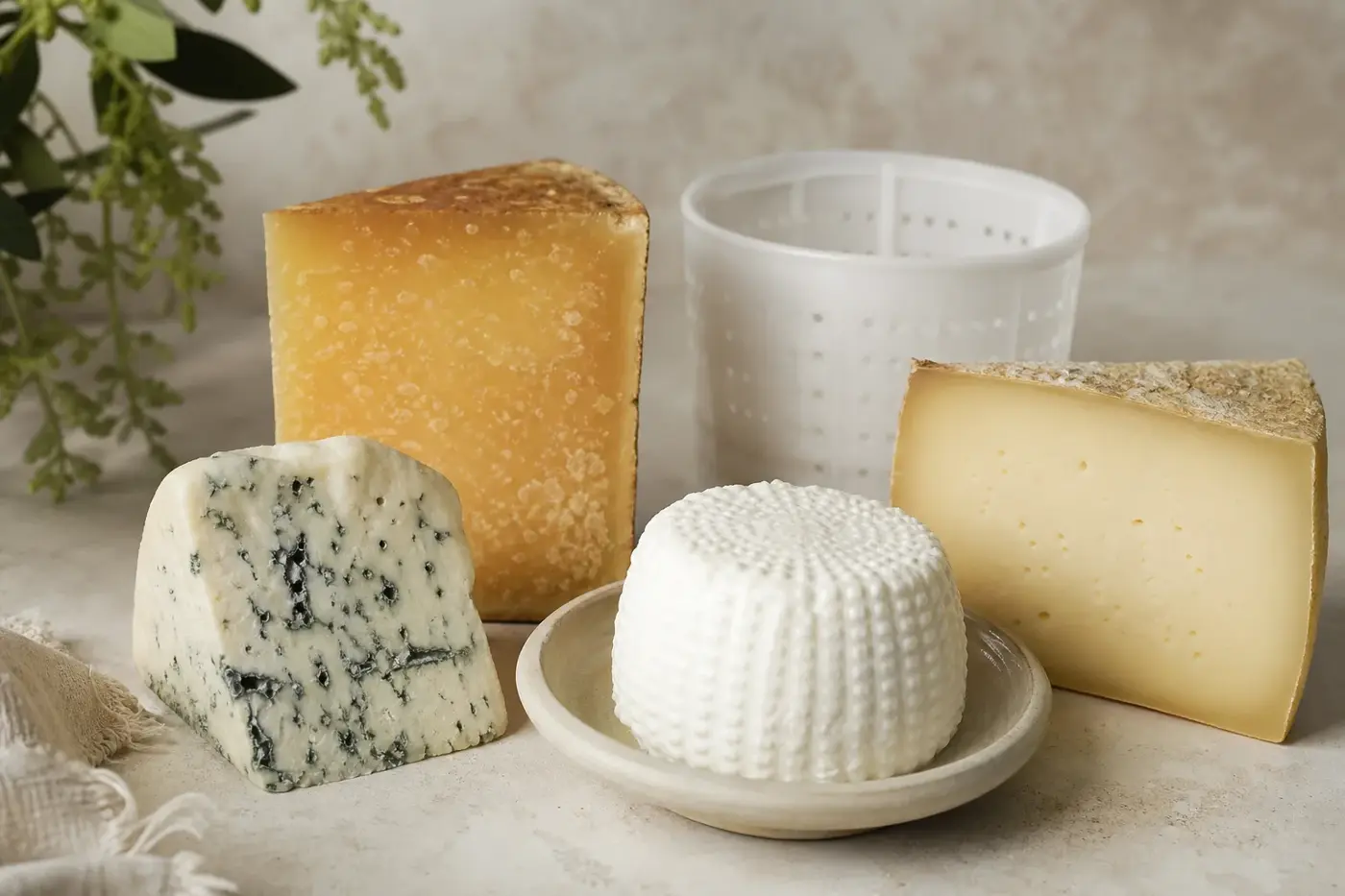
Picture cheese taking shape inside a mould. The container is doing more than shaping your lunch: it has left its mark on French fromage and Italian formaggio. Spanish queso, German Käse and English cheese follow another Latin trail, back to caseus. Follow these two families into European cheese vocabulary, then let Greek τυρί, Arabic جبن and Japanese チーズ take you further. [1][2][3][4][7]
Your first cheese words, ready for a first attempt
Start with the everyday word for cheese, then meet its companions. Below, you have the original writing alongside a reading aid. Spot the word on a menu or packet, then try saying it aloud.
| Language | The cheese word, with a reading aid where useful | Have a go |
|---|---|---|
| French | fromage | froh-MAHZH [5] |
| Italian | formaggio | for-MAHD-joh [8] |
| Spanish | queso | KEH-soh [12] |
| German | Käse | KEH-zuh [4] |
| Portuguese | queijo | KAY-zhoo (European Portuguese) [6] |
| Dutch | kaas | kahss [7][13] |
| Greek | τυρί (tyrí) | tee-REE [7][13] |
| Polish | ser | sehr [7][13] |
| Arabic | جبن (jubn) | jubn (short u, as in put) [7][13] |
| Japanese | チーズ (chīzu) | chee-zoo (light final vowel) [7][13] |
Treat these English respellings as a helping hand, not an exact match. Capitals show the stronger syllable in words with stress; the Japanese guide instead signals a long first vowel. For froh-MAHZH and KAY-zhoo, use the middle sound in English measure for zh, not the j in jam. [5][6][13]
Want to get a little closer? Duden gives Käse as /ˈkɛːzə/: hold that first vowel, then finish with a quiet uh. Collins gives formaggio as /forˈmaddʒo/, stressing mag and strengthening the j sound. Porto Editora gives European Portuguese queijo as /ˈkɐjʒu/. [4][6][8]
The Arabic word gives you a Standard Arabic starting point; spoken varieties have their own forms and sounds. In Greek τυρί, the accent marks the final stressed syllable. In Japanese chīzu, the bar over ī means a long vowel, and the final sound is lighter than a full English zoo. [13]
Queso, Käse, cheese: listen for the family resemblance
Latin caseus is the thread connecting these words. The Real Academia Española traces queso to caseus; Duden takes Käse through Middle High German kæse and Old High German chāsi or kāsi to the same Latin word. Portuguese queijo belongs here too: Porto Editora gives its origin as Latin caseu-. [3][4][6]
English cheese shares that history, however different its opening sound might seem to you. Collins records Old English cēse and a Latin origin. The historical Bosworth-Toller dictionary records cýse and cése, translates the word with Latin caseus, and sets Dutch kaas and German Käse alongside it. [7][9]
Say the sequence aloud: queso, queijo, kaas, Käse, cheese. You have a family resemblance to remember, rather than five translations sitting in separate corners of your notebook. The connection runs through earlier dictionary forms and different language histories, not from modern Spanish handing its word to modern German or English. [3][4][6][7][9]
Italian has a seat at this table too. Cacio, another Italian word for cheese, comes from Latin caseus, and Treccani records it as a synonym of formaggio. Its formaggio entry identifies that as the more widespread everyday word, so Italian keeps words from both Latin families you meet here. [2][10]
Fromage and formaggio: the mould that made a name
Return to that shaping container. Latin forma, a form or mould, starts the second family: the Académie française traces fromage to caseus formaticus, meaning cheese made in a form. The earlier French spelling, formage, lets you see the resemblance to Italian formaggio more easily. [1][5]
The Italian word travelled through French. Treccani traces formaggio through Old French formage, with Medieval Latin formaticum behind it. You are looking at a history of borrowing, not two independent words surviving unchanged from Latin. [2]
Picture the mould holding the cheese and giving it shape. The food takes its name from that form; mould here means the container doing the shaping. The historical French dictionary hosted by CNRTL explicitly connects forma with a cheese mould, giving you a real object behind the explanation, not just a resemblance to modern English form. [5]
The word has long since outgrown that starting point. The Académie's modern definition includes cheese eaten fresh, while Treccani's formaggio entry covers different milks, textures and stages of maturation. A name rooted in a mould now covers a much broader everyday category. [1][2]
A word's history tells you where its name came from. Cheesemaking tells you how that particular food was made. For that second story, head to how cheese is made, where the production process takes centre stage.
Small details that make the words feel familiar
Learn the article alongside the noun: le fromage in French, il formaggio in Italian, el queso in Spanish and der Käse in German. All four nouns are masculine in these dictionary entries, as is Portuguese queijo. Keep those little pairs together and you have something easier to recognise in a sentence. [1][2][3][4][6][8][11]
Keep the capital K and umlaut in Käse, both part of the German spelling shown by Duden. Greek τυρί needs its accent too. The ordinary French, Italian, Spanish and Portuguese words in the table have no written accent: adding one does not make them more foreign, just differently spelt. [1][2][3][4][6][13]
If an ending changes, you may simply be meeting grammar. Collins gives formaggi as the Italian plural of formaggio; the Académie uses fromages when discussing several French cheeses. On a menu, recognising the stem can serve you better than hunting for the dictionary form every time. [1][8]
On packaging, keep an eye out for formaggino. Treccani records this diminutive as a word used especially for processed cheese supplied in small shapes. You can see formaggio inside it, but the ending adds information: look up the whole word rather than treating it as another spelling. [2]
A few useful words at the cheese counter
You do not need a long speech to name what you want. A short phrase helps while you point to a display or choose a dish, and these examples come from dictionary entries and their recorded combinations. Add your usual greeting and polite wording; let the phrase name the food. [1][3][4][5][8]
| Phrase | What it means | When it comes in handy |
|---|---|---|
| Un morceau de fromage | A piece of cheese | Asking for a piece at a counter. [5] |
| Du fromage de chèvre | Some goat's cheese | Specifying the milk in French. [1] |
| Un panino con il formaggio | A cheese roll | Ordering an Italian sandwich. [8] |
| Queso rallado | Grated cheese | Recognising grated cheese in Spanish. [3] |
| Mit Käse | With cheese | Reading a German dish description. [4] |
Give the small connecting words their due. In the Italian example, con il formaggio means with cheese; Duden's German example etwas mit Käse überbacken describes something baked or gratinated with cheese. The cheese word names the ingredient, but its neighbours tell you what it is doing in your dish. [4][8]
When the cheese word takes an unexpected turn
French fromage de tête deserves a second look. The Académie defines it as a preparation of pork head in jelly, moulded in a terrine. Translate fromage alone and you will be looking for the wrong food: a longer food name can have a meaning all its own. [1]
Local usage can surprise you too. Duden records weißer Käse, literally white cheese, as a regional expression for Quark. Translate the whole expression and ask what it means locally, because a colour followed by cheese will not necessarily tell you the precise texture or method. [4]
When you save a word, keep its original script. Greek τυρί and the reading aid tyrí represent the same word, just as Japanese チーズ and chīzu do. The original gives someone the spelling they actually read when you show them a note or question; the transcription helps you say it. [7][13]
Think of the table as language entries, not one word assigned to each country. Collins lists queso for both European and Latin American Spanish, and queijo for both European and Brazilian Portuguese. The shared spelling helps you recognise the word even when pronunciation and local food vocabulary differ. [6][7][13]
Read the label and let your curiosity wander
Read menus and packaging in layers. Find the broad cheese word first, then the named variety, then the description and ingredients. That gives you three distinct kinds of information: the general category, the particular food name and what went into the product, each worth keeping separate in your notes.
Fromage alone tells you less than fromage de chèvre, the goat's milk expression recorded by the Académie. Treccani likewise distinguishes formaggio vaccino, pecorino, caprino and di bufala according to the milk used. The broad noun opens the door; its companions tell you more about what is inside. [1][2]
Keep a variety's own spelling when you look it up. Make that named entry your next reference point rather than translating it word by word. The guide to reading a cheese label takes you further, while how to tell cheese styles apart helps you organise your discoveries by milk, rind, texture and method.
For a useful shop note, write three lines: the local word, the exact name on the counter card or packet, and the question you still want answered. Perhaps you want to know about the milk, texture or stage of maturation. Those details tell you more than squeezing everything back into the single English word cheese, however fond of it you are.
Where your next cheese discovery begins
- Cheese: The Complete Guide: get the broader foundations behind the vocabulary.
- How to Read a Cheese Label: look closer at the information beside the name.
Questions people ask
How do you say cheese in French, Italian, Spanish and German?
Cheese is fromage in French, formaggio in Italian, queso in Spanish and Käse in German. The articles are le fromage, il formaggio, el queso and der Käse.
Do cheese, queso and Käse come from the same word?
Yes. All three share a history connected to Latin caseus, as does Portuguese queijo.
Is there another Italian word for cheese besides formaggio?
Yes, cacio is another Italian word for cheese and comes from Latin caseus. Treccani identifies formaggio as the more widespread word in ordinary use.
How do you write cheese in Greek and Japanese?
In Greek, it is τυρί, written tyrí in a reading aid. In Japanese, it is チーズ, written chīzu.
What do fromage de chèvre and weißer Käse mean?
Fromage de chèvre is the French expression for goat's cheese. Weißer Käse literally means white cheese and is a regional German expression for Quark.
Sources
- Académie française, “Fromage”, Dictionnaire de l’Académie française, ninth edition, 2024. Meaning, masculine gender, historical form, milk expressions and fromage de tête.
- Istituto della Enciclopedia Italiana, “Formaggio”, Vocabolario Treccani, undated online entry, accessed November 2026. Etymology, grammatical gender, usage, milk terminology and formaggino.
- Real Academia Española and Asociación de Academias de la Lengua Española, “Queso”, Diccionario de la lengua española, online edition displayed as the 24th edition, accessed November 2026. Meaning, masculine gender, Latin origin and queso rallado.
- Duden, “Käse”, undated online entry, accessed November 2026. Spelling, pronunciation, masculine gender, historical forms and regional usage.
- ATILF, CNRS and Université de Lorraine, “Fromage”, Trésor de la langue française informatisé, through CNRTL, dictionary material identified by the portal as 1960 to 1990, accessed November 2026. Historical derivation, pronunciation and recorded combinations.
- Porto Editora, “Queijo”, Dicionário Infopédia da Língua Portuguesa, undated online entry, accessed November 2026. European Portuguese pronunciation, masculine gender and Latin derivation.
- HarperCollins, “Cheese”, Collins English Dictionary, online entry, accessed November 2026. English word history and multilingual equivalents.
- HarperCollins, “Formaggio”, Collins Italian-English Dictionary, undated online entry, accessed November 2026. Pronunciation, plural, gender and sandwich phrase.
- Charles University, “Cýse”, Bosworth-Toller Anglo-Saxon Dictionary Online, digital edition, 2014. Old English forms, Latin gloss and related vocabulary.
- Istituto della Enciclopedia Italiana, “Cacio”, Vocabolario Treccani, undated online entry, accessed November 2026. Italian synonym and Latin derivation.
- HarperCollins, “Fromage”, Collins French-English Dictionary, undated online entry, accessed November 2026. Le fromage and masculine gender.
- HarperCollins, “Queso”, Collins Spanish-English Dictionary, undated online entry, accessed November 2026. Spanish translation reference.
- Wiktionary contributors, pronunciation and transliteration entries for kaas, Polish ser, τυρί, جبن and チーズ, continuously edited online dictionary, accessed November 2026. Supplementary language references alongside the Collins translations.
This desk-researched article brings together dictionary histories, multilingual equivalents and practical reading examples; pronunciation respellings are editorial approximations.
Last checked: November 2026
Last checked November 2026.
The editors suggest you read next
Cheese: The Complete Guide
Picture milk draining through perforated pottery in sixth-millennium-BC Kuyavia, Poland.