Cheese Myths Debunked
A little cheese before bed, then you settle in and wait for the dreams.
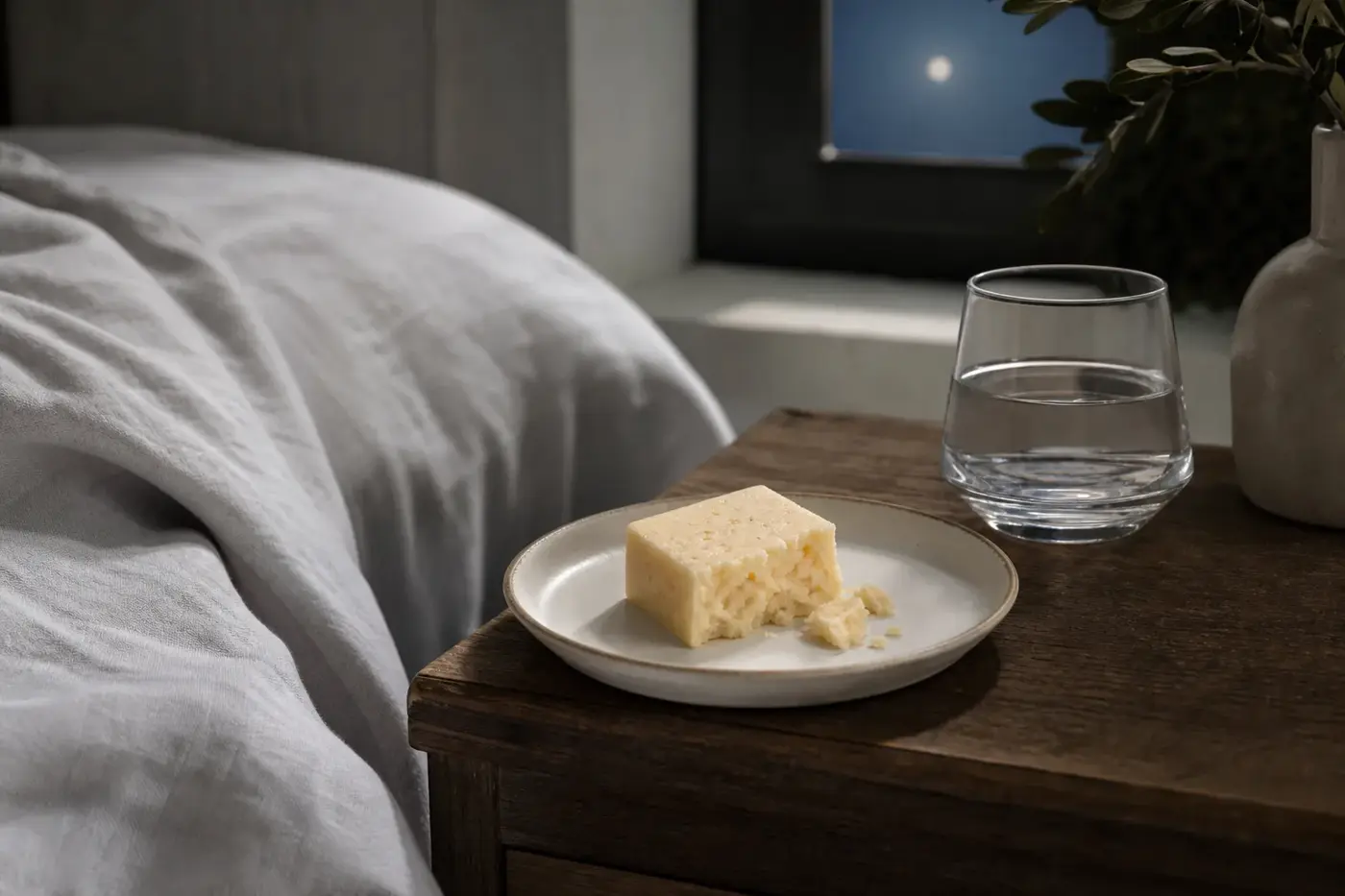
A little cheese before bed, then you settle in and wait for the dreams. In 2005, 200 volunteers took part in a British Cheese Board exercise that became a widely reported story. A contemporary BBC account said they had no nightmares.[2]
It is an intriguing bedtime story, but what can it actually tell you? Research links food sensitivities, disturbed sleep and nightmares, yet evidence that cheese itself causes frightening dreams remains weak.[1][3] Other cheese myths deserve equally careful attention, especially when allergy, pregnancy or unwanted mould enters the picture.
Cheese before bed: what is really disturbing your dreams?
Verdict: a direct cause has not been established. A nightmare after a late cheeseboard makes a memorable story. But cheese did not necessarily act alone: the meal, the drinks, digestive discomfort and an unsettled night may all matter. Dream researchers suggest explanations including physical discomfort and blaming a dream on the wrong cause.[1]
Return to those 200 volunteers in 2005. According to the contemporary BBC account, they ate 20 g of cheese half an hour before bed. Alongside reporting no nightmares, the account repeated claims linking different cheeses with different dream themes.[2]
What was missing? A comparison with people who ate no cheese. The contemporary account describes no such control group, so pleasant, strange or absent dreams cannot establish what cheese changed. A 2015 research paper described the exercise as industry sponsored, unpublished in a peer reviewed journal and supported by extremely sparse methodological information.[1][2]
A 2025 study gives you a more useful direction to explore. It surveyed 1,082 university students about eating, food sensitivities, sleep and dreams. Nightmare severity was associated with reported lactose intolerance, with gastrointestinal symptoms helping explain the relationship. This was a questionnaire study, not an experiment assigning cheese before sleep, so it establishes associations rather than a direct cheese effect.[3]
Consider what surrounds your cheeseboard, too. A rich meal may be large, late and accompanied by alcohol. For November 2026, the UK NHS advice for insomnia is to avoid big meals late at night and alcohol before bed, and keep regular sleeping hours.[4] That makes cheese alone a difficult culprit to identify.
This page summarises published guidance from the official sources it cites. It is not medical advice. Guidance differs between countries and changes over time, so check the current source for where you live, and ask your doctor, midwife, pharmacist or dietitian about your own circumstances.
Lactose intolerance: does every cheese need to go?
Verdict: lactose content and individual tolerance both matter. If dairy leaves you bloated or uncomfortable, this distinction is worth understanding. Lactose is milk sugar, and the NHS describes lactose intolerance as difficulty digesting it because your body makes too little lactase, the enzyme that breaks it down. Symptoms can include bloating, discomfort and diarrhoea.[5]
Some cheeses contain substantially less lactose than milk. The US National Institute of Diabetes and Digestive and Kidney Diseases names hard cheeses, including cheddar and Swiss cheese, as lower-lactose choices. It also explains that the amount people can tolerate varies.[7]
Neither “all cheese is fine” nor “all cheese must go” gives you useful guidance. The UK NHS advises against removing dairy from your or your child’s diet without discussing it with a GP or dietitian. Its guidance allows for reducing lactose according to individual circumstances, rather than giving everyone the same restriction.[5][6]
Milk allergy needs a separate approach. It is an immune reaction to milk protein, and food allergy can be life threatening. Lactose free dairy still contains milk protein, making it unsuitable for someone with milk allergy.[5][6][8]
Nor should you treat goat, sheep or buffalo milk cheese as a safe substitute without specialist advice.[5][6][8] The guide to cheese allergy and lactose intolerance helps you untangle the distinction.
Fat, salt and calcium: read the whole picture
Verdict: compare each nutrient separately. Put different cheeses beside one another and their fat content can vary considerably. The comparisons below come from the NHS’s UK dietary guidance.[6]
| Cheese choices in NHS guidance | Fat per 100 g | Fat in a 30 g comparison portion |
|---|---|---|
| Many familiar cheeses, including brie and cheddar | 20 to 40 g | 6 to 12 g |
| Reduced-fat hard cheeses, usually | 16 to 22 g | 4.8 to 6.6 g |
| Some reduced-fat cottage cheeses and quark | 3 g or less | 0.9 g or less |
The portion figures are calculated from the NHS ranges. Treat 30 g here as a way to compare cheeses, not a prescribed serving.[6]
Fat is only one part of the nutritional picture. A cheese’s fat content cannot tell you its salt or calcium content, so compare the relevant product information using the same weight each time. Each nutrient needs its own comparison.[6]
Cheese can contribute useful nutrients, but more is not automatically better. The NHS places it within a balanced diet and advises watching how much and how often you eat it, because it can be high in saturated fat and salt.[6] For a broader look at differences between styles, explore the complete cheese guide.
Crystals or mould? Get to know that little white speck
Verdict: crystals, intended ripening and unwanted growth are different things. That noticeable crunch in your cheese might come from crystals. The Wisconsin Center for Dairy Research describes calcium lactate and tyrosine crystals, which affect appearance and texture and are sometimes mistaken for yeast or mould.[9]
Crystals are solid deposits, not colonies spreading across your cheese. Whether they belong there depends on the intended product: something prized in one aged cheese may be a quality defect in another. The research centre separates those appearance and texture questions from the assumption that the deposits are harmful.[9]
With mould, you need a different distinction. The UK Food Standards Agency separates mould integral to cheese production from unwanted contamination. Intended mould belongs to an established ripening process; an unfamiliar patch appearing during storage calls for another decision.[10]
The FSA’s cheese recovery guidance concerns controlled business procedures, including handling mould contamination. It distinguishes soft cheese from large hard blocks and from small pieces, gratings and shavings.[10] Advice for one situation does not automatically apply to another.
At home, take particular care with soft cheese. Do not taste a suspect patch to identify it. Follow the product instructions, and turn to the mould guidance for the separate question of whether trimming is appropriate.
Your nose cannot settle every safety question, either. For England, Wales and Northern Ireland, the FSA says the sniff test cannot establish whether food carrying a use-by date is safe. You cannot necessarily smell food-poisoning organisms.[11]
Vegetarian cheese: let the maker tell you
Verdict: check the particular cheese, not just its style name. A wedge cannot tell you everything by its looks, however closely you inspect it. Rennet means enzymes used to coagulate milk, turning it into curd, and some rennet comes from animals. Cheese made with animal rennet is not vegetarian; cheesemaking can also use other coagulants, acid, or acid combined with heat.[12]
A clear vegetarian statement from the maker beats a guess based on appearance or texture. Wyke, for example, says in its own FAQ that its products are suitable for vegetarians. That tells you about its products, not every cheddar.[13]
Look for an explicit suitability statement, and ask the maker if it is missing. For a closer look at enzyme sources, read the companion guide to animal, microbial and fermentation-produced rennet.
Orange or pale: let flavour, not colour, do the talking
Verdict: colour offers clues to ingredients and milk, not a flavour scale. A deeper colour can catch your eye, but it cannot tell you how strong a cheese will taste. Cheese Science Toolkit explains that yellow in cows’ milk cheese can come from carotenoid pigments in the milk fat. Orange can come from added annatto, a colouring derived from seeds.[14]
Those colours tell you something about how a cheese acquired its appearance. They cannot establish its maturity, balance, quality or suitability for your dish. An orange cheese has not necessarily turned the flavour volume up.
Read the description, ingredients and any stated ageing information instead of treating colour as a strength rating. Pale and orange cheeses both deserve that closer look. The guide to reading a cheese label helps you separate useful product information from assumptions.
Pregnancy and cheese: start with the right category
Verdict: UK NHS guidance distinguishes cheese types and milk treatment. You need more than a glance at “pasteurised” on the label. For November 2026, NHS pregnancy guidance lists pasteurised or unpasteurised hard cheeses among foods that can be eaten. It also includes pasteurised semi-hard cheeses and specified pasteurised soft cheeses, including cottage cheese, mozzarella, feta and ricotta.[15]
Mould ripened soft cheeses with a white outer coating, including brie and camembert, receive different advice. So do soft blue cheeses. The UK NHS advises avoiding these unless cooked until steaming hot all the way through, whether their milk is pasteurised or unpasteurised.[15]
“Pasteurised” alone therefore cannot settle every pregnancy question. Equally, “soft” does not describe every restricted cheese. Match the cheese category to the current official guidance.[15]
Follow the NHS wording: steaming hot throughout. A melted surface is not the same instruction. If you live elsewhere, consult your own national authority, and ask a midwife or doctor about your individual circumstances.
Fridge or freezer: plan for your next slice
Verdict: refrigeration helps, but storage instructions and dates still matter. Before you tuck that cheese away, take a moment to read its instructions. For England, Wales and Northern Ireland, the FSA advises keeping your home fridge at 5 °C or below. Follow the cheese’s storage directions, including any instructions for use after opening.[16]
A use-by date concerns safety; a best-before date concerns quality. UK government guidance says not to eat food after its use-by date, even if it looks and smells acceptable.[17] Familiar appearance and smell cannot override that advice.
With freezing, think about the texture you want afterwards. The US National Center for Home Food Preservation says hard and semi-hard cheeses may become crumbly and mealy after freezing. Cream cheese, cottage cheese and ricotta do not freeze well.[18]
That makes the freezer less appealing if you want neat slices or a particular fresh texture. Plan for the change rather than expecting thawed cheese to behave exactly as before. For handling details, follow how to store cheese at home.
Questions people ask
Does eating cheese cause nightmares?
A direct cause has not been established. The 2005 British Cheese Board exercise reported no nightmares, but its contemporary account described no comparison group who ate no cheese.
Can someone with lactose intolerance eat cheese?
Lactose content varies, and people differ in how much they can tolerate. The NHS advises against removing dairy from your or your child’s diet without discussing it with a GP or dietitian; see its lactose intolerance guidance [5][6].
Which cheeses can pregnant people eat?
The UK NHS lists hard cheeses, pasteurised semi hard cheeses and specified pasteurised soft cheeses among foods that can be eaten. It advises avoiding mould ripened soft cheeses such as brie and camembert, and soft blue cheeses, unless cooked until steaming hot all the way through; check its current pregnancy guidance [15].
Are white specks on cheese always mould?
No. They can be solid crystals rather than colonies growing across the cheese. The Food Standards Agency distinguishes mould used in cheesemaking from unwanted contamination; see the mould guidance for the separate question of trimming [LINK: A565].
Is all cheese vegetarian?
No. Some cheese is made with animal rennet, which is not vegetarian. Look for an explicit vegetarian statement, and ask the maker if it is missing.
Sources
- Frontiers in Psychology, Dreams of the Rarebit Fiend: food and diet as instigators of bizarre and disturbing dreams, volume 6, article 47, 2015. Introduction, discussion and British Cheese Board reference.
- BBC Learning English, Entertainment, broadcast transcript, 30 November 2005. Contemporary account of the British Cheese Board survey.
- Frontiers in Psychology, More dreams of the rarebit fiend: food sensitivity and dietary correlates of sleep and dreaming, volume 16, article 1544475, 2025. Methods, results and limitations.
- NHS, Insomnia, current online guidance, accessed November 2026.
- NHS, Lactose intolerance, current online guidance, accessed November 2026.
- NHS, Dairy and alternatives in your diet, current online guidance, accessed November 2026.
- US National Institute of Diabetes and Digestive and Kidney Diseases, Eating, Diet, & Nutrition for Lactose Intolerance, current online guidance, retrieved November 2026.
- NHS, Food allergy, current online guidance, accessed November 2026.
- Wisconsin Center for Dairy Research, Dairy Pipeline, volume 26, number 3, 2014, article on crystallisation in cheese.
- Food Standards Agency, Cheese recovery guidance, guidance first published in 2007, current retrieved version, November 2026. Scope, mould contamination provisions and tables 1 and 2.
- Food Standards Agency, Home food fact checker, updated 21 August 2026. “Does the sniff test work for milk and dairy food?”
- Cheese Science Toolkit, Coagulation, undated technical explanation, accessed November 2026.
- Wyke, FAQs, undated maker statement, accessed November 2026. Vegetarian suitability answer.
- Cheese Science Toolkit, Cheese Color, undated technical explanation, accessed November 2026. Annatto and carotenoid sections.
- NHS, Foods to avoid in pregnancy, current online guidance, accessed November 2026. “Cheese, milk and other dairy”.
- Food Standards Agency, How to chill, freeze and defrost food safely, current online guidance, accessed November 2026.
- GOV.UK, Understanding food labelling: Best before and use-by dates, current online guidance, accessed November 2026.
- National Center for Home Food Preservation, Freezing Cheese, drawing on So Easy to Preserve, sixth edition, 2014, and The Food Keeper, 1996; accessed November 2026.
This desk-researched article compares published sleep research, official dietary and food safety guidance, dairy research and clearly attributed maker information.
Last checked: November 2026
Last checked November 2026.
The editors suggest you read next
Cheese: The Complete Guide
Picture milk draining through perforated pottery in sixth-millennium-BC Kuyavia, Poland.