Darfiyeh
In the mountains of northern Lebanon, a cleaned and salted goatskin waits to be filled.
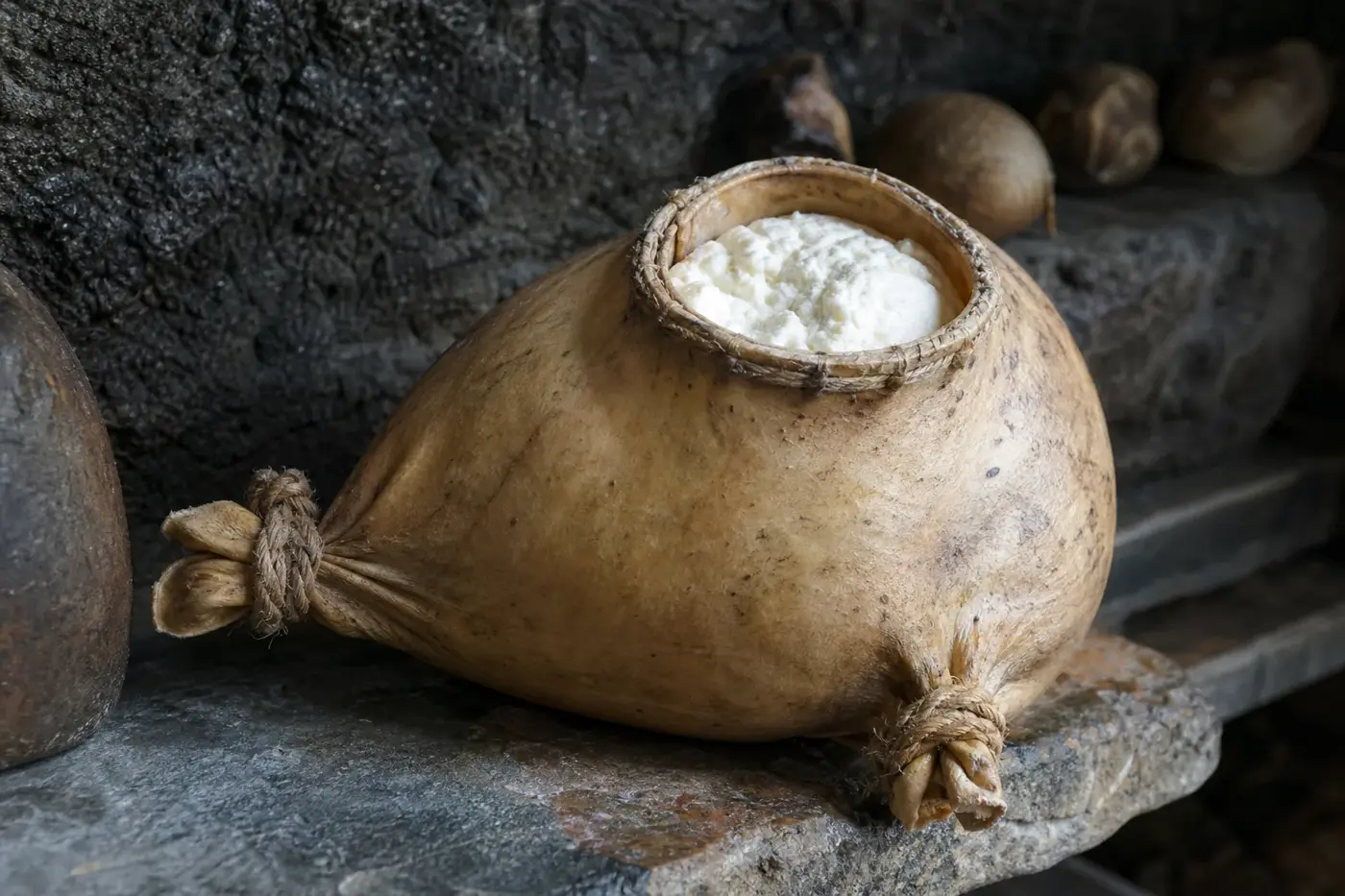
In the mountains of northern Lebanon, a cleaned and salted goatskin waits to be filled. Inside, layers of Darfiyeh may alternate with Arichi, recovered from the whey. Traditionally made with raw goat’s milk, this cheese takes you into a world of mountain goat keeping, hand-worked curd and a skin that exchanges aroma compounds with its contents. The packaging has rather more to do than look presentable. [1][2][3]
| What you might want to know | The detail |
|---|---|
| Names to look out for | Darfiyeh; also Darfiyieh and Darfyeh. [1] |
| Its traditional home | Northern Lebanese mountains, including Ehden and Bcharré. [1] |
| Traditional milk | Raw milk from local Baladi goats. [1][4] |
| Where it ripens | A cleaned and salted goatskin. [2] |
| Time to mature | One to six months in heritage accounts; research studies examined particular ages. [2][3] |
| Texture recorded in research | Semi-hard in the 2008 characterisation study. [3] |
| Pregnancy guidance | UK: NHS guidance on unpasteurised dairy and cheese, November 2026. [8][9] |
Follow the goats into Lebanon’s northern mountains
Begin in Ehden, Bcharré and the neighbouring mountain settlements. This is Darfiyeh’s customary territory, with dry summers and cold winters described in the International Goat Association’s Atlas of Goat Products. The atlas ties its cheesemaking to local Baladi goats and the goat-keeping traditions of these northern Lebanese mountains. [1]
In 2023, researchers took that story into the workplaces of three northern Lebanese producers. They selected experienced artisanal makers, collected Darfiyeh and recorded their practices through interviews and observation. The result was a picture of cheese as people actually made it, including differences between their methods. [4]
When you ask where a Darfiyeh comes from, then, look beyond the name on the label. Place includes the animals supplying the milk, their milking season and the maker’s decisions about draining and maturation. A village and a producer’s name help put your cheese in context. [1][4]
Get to know the goatskin by name
Darfiyeh’s name leads you straight to its vessel. The Atlas of Goat Products suggests that Darfyeh derives from darrif, the goatskin container used to mature cheese for eating during the following winter. Lebanese heritage documentation also calls the skin Dariff: these are transliterations of a local term, not separate cheeses. [1][2]
The skin is no wrapper added just before the cheese leaves the maker. Prepared for the job, it holds the cheese throughout ripening and sits at the heart of Darfiyeh’s identity in these accounts. If you are buying some, ask whether it matured in skin, and for how long. [2]
Find the season behind the milk
Traditional Darfiyeh begins with raw goat’s milk. A 2009 microbiological investigation studied that pairing of unpasteurised milk and goatskin ripening. The later producer study recorded milk from Baladi goats grazing in northern mountain areas. [4][5]
For the producers in that later study, cheesemaking follows the goat-milking season. Maturation carries that milk forward, so cheese eaten after several months began with milk collected earlier in the year. Ask “when was it made?” alongside “how long was it matured?” and you get a clearer picture. [4]
For the wider differences, explore the guide to raw, thermised and pasteurised milk. For the Darfiyeh in front of you, ask the seller which milk treatment was used.
Watch the curd take shape, then follow the whey
First, the milk is filtered and allowed to acidify. Coagulation then turns it into a gel, with rennet, an enzyme preparation that helps milk set, appearing in both the Lebanese heritage account and observed producer practice. The heritage description specifies kid rennet; the later research records microbial rennet among its producers. [2][4]
Next comes the hands-on work of separating curd from whey, the liquid released during cheesemaking. In the Lebanese heritage account, makers break and gather the curd, salt it and leave it to drain further. Only then is it ready for the skin and maturation. [2]
The whey has another part to play. Heating that remaining liquid produces Arichi, which goes into the skin in alternating layers with the cheese. The main curd and material recovered from its whey meet again in the maturation vessel. [2]
You can follow the broader sequence in how cheese is made. Darfiyeh’s distinctive turn comes where these familiar operations lead: into a prepared skin for ripening.
From the maker’s hands to the cave
According to the Society for the Protection of Nature in Lebanon, the goatskin is first cleaned and salted. The leg openings are tied, while the neck stays open for filling. Cheese and Arichi are arranged inside, before the filled skin goes into a humid cave to mature. [2]
The maker’s handling runs through every stage, from casing to curd to filled vessel. Ask who prepared the skin and where the cheese matured. The later field research found differences between producers, particularly in ripening time, so these details help you choose. [4]
On paper, the sequence looks straightforward: milk becomes curd, whey drains away, salt goes in and the prepared skin receives the cheese. In practice, the craft requires control throughout. Preparing the skin belongs to that controlled production process, not to the finishing touches.
Discover what the skin brings to the aroma
Goatskin can take up and release aroma compounds. In a 2008 Darfiyeh research project, researchers examined three production batches at 20, 40 and 60 days. Alongside that work, they exposed goatskin to model aroma compounds in an aqueous system. [3]
The transfer depended on the compounds’ properties and the length of exposure. At the longest exposure, compounds showed a tendency to move from the skin towards the model cheese solution. Under those experimental conditions, the skin interacted with what it held rather than simply containing it. [3]
A model system is simpler than a real cheese, but it establishes a mechanism for that exchange. It helps you understand how the vessel contributes to maturation, alongside the milk, curd preparation and microbial activity that shape finished flavour. The same project described protein and fat breakdown in the cheeses as moderate. [3]
Meet Darfiyeh’s microbial community
There is plenty of microbial life inside Darfiyeh. The 2009 study combined cultivation with molecular identification across three independent batches, finding several groups of lactic acid bacteria and other organisms. Lactic acid bacteria are microorganisms associated with fermentation and acid production. [5]
The later study used targeted DNA sequencing to examine bacterial and fungal communities in samples from three producers. It found differences in the relative abundance of organisms, including bacteria and yeasts. As this was observational research, milk origin, handling and maturation remain intertwined as explanations. [4]
That offers you another way to appreciate the maker’s skill: experienced producers manage a biologically variable process. A microbial survey describes the particular samples examined, not every Darfiyeh you might come across. For the cheese you are buying, the useful details still come from its producer and batch.
Let this batch tell its own flavour story
Semi-hard is the clearest documented texture description, used in the 2008 characterisation study. The Lebanese heritage account also describes cheeses hardening during cave maturation. To find out whether your portion will be relatively yielding or firm, start by asking its age. [2][3]
Taste varies between batches, too. A 2013 investigation made two independent batches of each of four Lebanese goat’s milk cheeses at two locations, then assessed composition, microorganisms and sensory properties. The authors reported significant differences in taste within the cheeses examined. [6]
At the counter, ask about this batch’s colour, firmness, aroma and flavour, and whether those characteristics are expected at its age. When you taste, note the maker and maturation alongside your impressions. That tells you more than asking every Darfiyeh to fit one fixed description.
Give Darfiyeh room on a simple plate
For a Lebanese-style plate, you need little more than flatbread, cucumber, tomatoes, radishes and fresh herbs. Begin with cheese and bread, then bring in the vegetables. You give this particular batch a chance to speak before stronger accompaniments join the conversation.
Offer olive oil separately rather than pouring it over the whole portion. Put olives or pickles alongside so you can judge the combined saltiness yourself. These are serving suggestions, not a documented traditional Darfiyeh recipe.
In the UK, NHS advice is to eat ready-to-eat foods within four hours of taking them out of refrigeration. Put out a small serving and keep the rest chilled. [9]
Take good questions to the counter
Ask for the producer, production date, milk treatment, maturation period and storage instructions. If your cheese is cut or portioned from a larger container, request enough information to identify the batch. The guide to reading a cheese label helps you compare the seller’s account with the packaging.
For UK household storage, the NHS advises keeping chilled ready-to-eat foods at 5 °C or below, separate from raw foods. Follow the label, too. Its general advice is to use opened food within two days unless the packaging says otherwise. [9]
Keep the original instructions with your cheese, especially if you move it into another container. Do not assume an unexpected change in appearance, texture or aroma is normal maturation. Throw it away after its use-by date, even if it looks and smells normal. [10]
For UK consumers, that use-by date is a safety instruction. Government guidance says you should not eat food after it, regardless of normal appearance or smell. [10] For broader handling principles, see storing cheese at home.
This page summarises published guidance from the official sources it cites. It is not medical advice. Guidance differs between countries and changes over time, so check the current source for where you live, and ask your doctor, midwife, pharmacist or dietitian about your own circumstances.
Keep pregnancy and higher-risk guidance close
UK pregnancy advice depends on the cheese and how you prepare it. NHS guidance permits hard cheeses made from unpasteurised milk and gives separate advice for soft cheeses, including cooking some until steaming hot. Check the guidance for the cheese in question. [8]
The NHS identifies pregnant people, newborn babies, people with weakened immunity and older people as groups at increased risk of serious listeriosis. If you are older, or have an immune condition or treatment affecting immunity, seek advice suited to your circumstances. [9]
An appealing aroma tells you something different from food safety guidance. Neither age nor a traditional maturation vessel can settle the safety considerations covered by official advice. [8][9]
Meet Tulum, another cheese with a goatskin story
Certain Turkish Tulum cheeses also mature in goatskin, but what happens inside differs. One controlled Tulum experiment used raw sheep’s milk. Researchers pressed and crumbled the curd, dry-salted and kneaded it, then divided it between goatskin bags and plastic barrels. [7]
A separate Tulum experiment found differences in composition and protein breakdown between cheeses matured in skin and plastic containers. It associated moisture loss with the skin’s porous structure. Those results add to the wider evidence that maturation vessels matter, while describing the particular Tulum cheeses tested. [11]
Darfiyeh’s documented goat’s milk and layering with Arichi give it a production identity of its own. The useful comparison is the vessel itself. You have a shared choice of goatskin, but different milk and curd practices inside it. [2][7]
Questions people ask
Where does Darfiyeh come from?
Darfiyeh comes from the northern Lebanese mountains, including Ehden and Bcharré. It belongs to the region’s goat keeping traditions.
What milk is used to make Darfiyeh?
Traditional Darfiyeh is made from raw milk from local Baladi goats. The page suggests asking the seller which milk treatment was used for a particular cheese.
How is Darfiyeh matured?
Cheese and Arichi are packed into a cleaned and salted goatskin, which is taken to a humid cave to mature. Heritage accounts document maturation periods of one to six months.
Can you eat Darfiyeh during pregnancy?
The NHS permits hard cheeses made from unpasteurised milk and gives separate advice for soft cheeses, including cooking some until steaming hot. Check the NHS pregnancy guidance for the cheese in question.
How can you serve Darfiyeh?
The page suggests serving it with flatbread, cucumber, tomatoes, radishes and fresh herbs. Olive oil can be offered separately, with olives or pickles alongside.
Sources
- International Goat Association, Atlas of Goat Products, “Lebanon: Darfiyieh”, printed pages 112 to 113, edition containing a June 2004 foreword. Retrieved PDF.
- Society for the Protection of Nature in Lebanon, We Are What We Eat: Darfiyeh #MedFoodHeroes, 2020. Retrieved heritage account.
- ResearchGate-hosted author abstract, Valorisation durable des laits de chèvre de la région du Nord Liban. Transformation en fromage “Darfiyeh” et établissement de caractéristiques physico-chimiques et microbiologiques en vue de la création d’une appellation d’origine, doctoral research, November 2008. Full thesis not retrieved.
- Food & Nutrition Journal, Exploring the Microbial Diversity and Bioactivity of Lebanese Artisanal Dairy Products, volume 10, article 321, published 27 January 2025. Producer observations, methods and microbial results.
- Food Microbiology, Bacterial diversity of Darfiyeh, a Lebanese artisanal raw goat’s milk cheese, volume 26, issue 6, pages 645 to 652, 2009. Retrieved abstract, PMID 19527841.
- Journal of Food, Agriculture & Environment, Characterization of four Lebanese artisanal goat milk cheeses: Darfiyeh, Aricheh, Shankleesh and Serdale by physico-chemical, microbiological and sensory analyses, volume 11, issues 3 and 4, pages 97 to 101, 2013. Retrieved publisher abstract.
- Journal of Central European Agriculture, experimental paper on goatskin bags, plastic barrels and Tulum cheese, volume 22, issue 1, 2021, DOI 10.5513/JCEA01/22.1.3051. Materials and methods. Retrieved paper.
- NHS, Foods to avoid in pregnancy, current retrieved version, checked November 2026. Official guidance.
- NHS, Listeriosis, reviewed 10 November 2023, current retrieved version checked November 2026. Official guidance.
- UK Government, Understanding food labelling: Best before and use-by dates, current retrieved version, checked November 2026. Official guidance.
- African Journal of Biotechnology, The effect of different packaging materials on proteolysis, sensory scores and gross composition of tulum cheese, volume 10, issue 21, pages 4444 to 4449, 2011. Retrieved publisher abstract.
This piece combines desk research from Lebanese heritage documentation, producer-observation studies, experimental research and UK official consumer guidance.
Last checked: November 2026
Last checked November 2026.
The editors suggest you read next
Shanklish
The flatbread is out, the tomato and onion are chopped, and Shanklish crumbles into the middle of the plate.