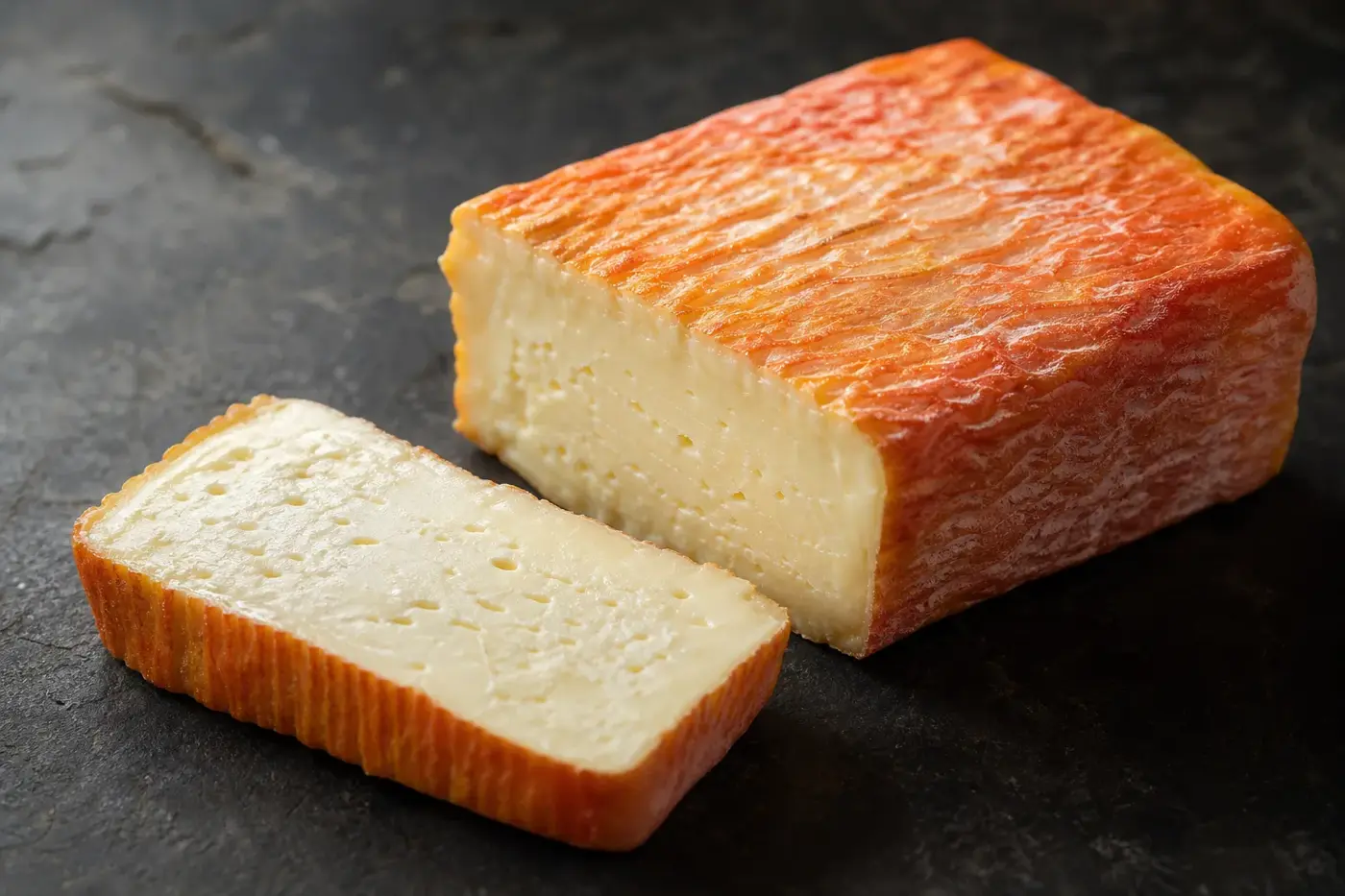
Fromage de Herve
Before your knife reaches the soft centre, the aroma has already introduced itself.
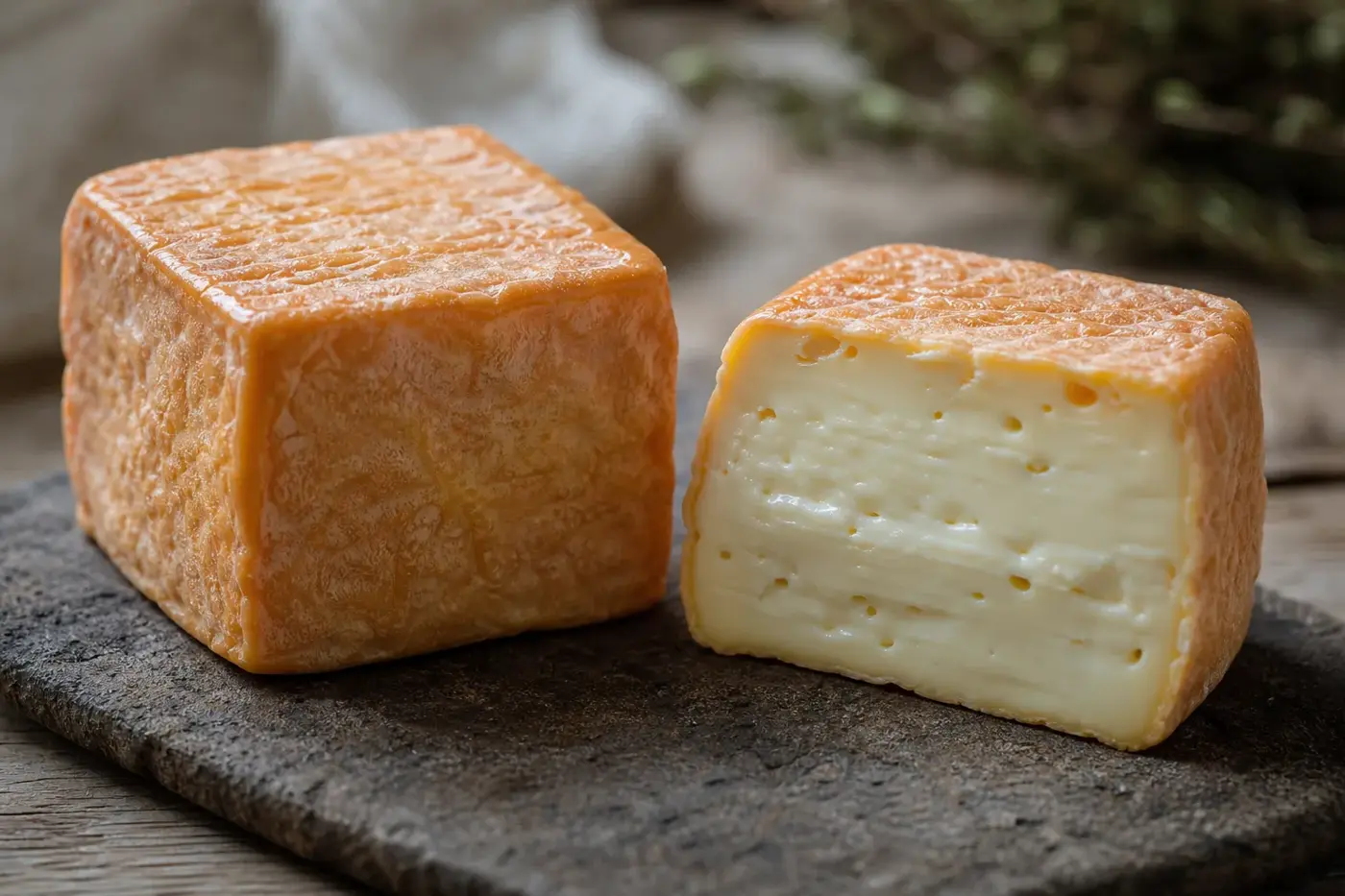
Before your knife reaches the soft centre, the aroma has already introduced itself. Then you notice the orange washed rind. Fromage de Herve does not wait politely to be discovered.[3] Its home is the Pays de Herve in eastern Belgium, among dairy farms, hedged pastures and orchards.[1][2]
| Meet the cheese | What you need to know |
|---|---|
| Familiar and registered name | Fromage de Herve.[4] |
| Country and home region | Belgium, Pays de Herve, province of Liège.[1] |
| Registration authority | European Commission for original EU registration; Defra for the Great Britain register.[4] |
| EU registration date | 2 July 1996, recorded by Defra.[4] |
| EU register ID and current procedural status | Details not supplied here. |
| Great Britain protection | Registered PDO; registration dated 31 December 2020. November 2026 information.[4] |
| Milk | Cow’s milk.[3] |
| Milk treatments permitted by the specification | Details not supplied here. |
| Style and rind | Soft cheese with an orange washed rind.[3] |
| Shape and size | Cubic or rectangular; regional brochure gives weights of 50 to 400 g.[3] |
| Legal minimum ripening | Details not supplied here. |
| Typical ripening | Several weeks; mild and piquant versions.[1][3] |
Follow the hedges into Herve country
Picture yourself among hedges, pastures and orchards near Belgium’s borders with the Netherlands and Germany. This is the Pays de Herve, in Wallonia, placed between the Meuse and Vesdre in regional accounts. Herve itself gives the cheese its name: you are in a borderland of neighbouring towns and farming districts, not an isolated mountain valley.[1][3]
The word for this landscape is bocage: fields divided by hedges, with farm buildings scattered between villages. The Walloon landscape atlas describes the central Pays de Herve as rolling ground shaped by the Berwinne and its tributaries. Pastures and orchards fill a countryside where homes and farms are notably spread out.[2]
The damp soils and undulating ground suit grassland, the atlas explains. It traces the growth of dairying from the sixteenth century, encouraged by nearby urban markets. Farmers had milk to turn into food, and customers within reach.[2]
Remember those orchards when you sit down to eat. Put concentrated apple and pear syrup beside your cheese, and you bring two strands of the same regional food culture onto the plate.[3]
A house, with cheese attached
In 1466, buying a house in the Herve district could bring a distinctly edible obligation: two dozen cheeses. The regional tourism service records this documentary milestone and a similar clause in 1508. A detail to make you read the small print with unusual enthusiasm.[5]
Long before Herve appeared in collections of regional specialities, cheese belonged to household obligations and local economic life.[5] On the farm, its usefulness was straightforward. Transport was slow, and cheesemaking gave milk a longer useful life.
Ripening bought time between milking and eating. That included time for journeys to more distant customers, carrying the farm’s produce beyond its immediate neighbours.[5]
Herve could speak for the town, too. The same historical account describes town authorities presenting cheeses to visiting dignitaries. Here was a farm product with a place in civic life as well as trade.[5]
Today, regional serving literature brings that identity back to your table: Herve, fruit syrup and a cup of coffee. If the powerful smell gives you pause, that traditional combination offers a welcoming way in.[1]
The name to ask for at the counter
Fromage de Herve is the exact registered name. Defra’s official register records its original EU registration on 2 July 1996 and lists it as a registered protected designation of origin, or PDO, in Great Britain. The separate GB registration date is 31 December 2020.[4]
The regional cheese association connects the cheese’s identity with place, milk and method.[1] For the detailed requirements, you need the current specification.
At the counter, the full name tells you more than a familiar appearance. Fromage de Herve identifies this particular regional cheese; “washed rind” describes a much wider family of methods and appearances. Another orange cheese may look similar without sharing its geographical identity.[1][3]
Look for the complete name on the pack, or ask for it when buying a cut piece. For the wider distinction between geographical origin and traditional production, see protected cheese names.
From fresh milk to little blocks
Herve begins with cow’s milk. Regional literature describes a traditional raw-milk method, with milk transferred to a cheesemaking vat after milking. Follow that historical account and you can watch the familiar blocks take shape, stage by stage.[3][5]
First comes rennet, an enzyme preparation that sets the milk into curd. The traditional account specifies calf rennet. The cheesemaker then cuts the curd, separating whey, the liquid portion, from the solids.[5]
Next, the curd needs to drain. In the documented farm method, it goes between dividing boards, is turned in strips, then cut into blocks. Further turning helps the young cheeses lose whey while holding their shape.[5]
Salt follows, either applied to the surface or introduced by immersing the blocks in brine. Then comes ripening, with repeated care of the exterior. Setting, cutting, draining, salting and tending the surface: you see the results of that sequence in every finished block.[5]
For the broader principles, see how cheese is made. When buying, check the milk treatment stated on your individual product. The traditional method described here is a separate matter.
Meet the rind that makes an entrance
That orange rind needs regular attention. The regional production account describes washing each cheese with lightly salted water as it matures. A coloured surface layer develops, traditionally called the morge.[5]
Much of Herve’s character meets you at the surface. The regional brochure describes an orange exterior with powerful aroma and flavour. Producer Terre de fromages evokes its square shape, warm brick colour and distinctive smell.[3][6]
The cheese association also links Herve’s characteristic surface flora with Brevibacterium linens. Traditionally associated with the “red ferment” of this style, it is identified as an important contributor to the cheese’s identity.[3]
Give yourself a moment before deciding that “strong” says it all. Smell the rind, notice how the paste resists your knife, then taste a small piece. Aroma and texture have different things to tell you.
Beyond the orange: your first look inside
The regional brochure’s photographs show a pale interior against that orange rind. Its description gives cubic or rectangular cheeses weighing from 50 to 400 g. These are small blocks with plenty to hold your attention.[3]
“Paste” simply means the body of the cheese inside its rind. In Herve, the soft paste and assertive exterior belong together. Your nose, persuasive though it may be, cannot tell you everything about how the interior will feel.[3]
Ask to see the cut face at the counter, if possible. Tell the cheesemonger whether you want a piece that holds its shape for slicing or one soft enough to spread readily. That gives them more to work with than a request for a particular “strength”.
Doux or piquant: which will you choose?
Two words help you find your way: doux means mild, while piquant signals a more assertive version. Regional sources connect the difference with ripening and the cheese’s treatment during maturation.[1][5]
The cheese association describes piquant Herve as ripened for longer than doux. Its published accounts give differing week ranges. Rather than choosing by a fixed number of weeks, ask about the maturity of the actual cheese in front of you.[1][3]
For your first encounter, try doux and taste it before reaching for syrup. Already fond of forceful washed-rind cheeses? Ask for piquant, and talk through how far that particular piece has developed.
Longer ripening brings a different character, not an automatic improvement. Let your plans for serving guide you. Clean slices and a softer, spoonable portion call for different choices.
Bring it home and serve it thoughtfully
Start with the complete name, then ask about milk treatment, maturity and the producer’s storage instructions. Buying a piece cut and wrapped at the counter? Ask for those details to come home with it; reading a cheese label explains what to look for.
Follow the pack’s storage instructions. The Food Standards Agency’s household guidance for England, Wales and Northern Ireland recommends a fridge temperature between 0 and 5 °C and keeping dairy products refrigerated. Its November 2026 guidance also advises leaving chilled food out for the shortest possible time, with a maximum of four hours.[7]
Plan your serving rather than leaving the whole cheese displayed throughout the meal. Put out the portion you intend to eat and keep the remaining storage instructions with the cheese. For fuller guidance, see storing cheese at home.
Cut small pieces that give you both rind and paste. Taste one plain, then try syrup or bread. You will soon find whether you prefer the sweet contrast or the simpler accompaniment.
Set the table with syrup, bread and coffee
Apple and pear syrup with coffee is a combination specifically recorded in the regional brochure. If you would like an alcoholic pairing, the cheese association also recommends dark abbey beer and Gewürztraminer alongside Herve.[1][3]
Keep your plate simple and your choices open. Put bread beside the cheese and offer syrup separately, starting with a thin smear. You want to explore the sweet and savoury contrast, not cover the cheese completely; taste, then adjust.
Coffee offers you a documented pairing without alcohol. Water is a neutral alternative if you want to concentrate on the differences between mild and piquant pieces.[1]
Give Herve and Limburger room to speak
Curious about tasting Herve beside Limburger? Give each cheese its own space on your plate. There is more to discover if you do not assume one will explain the other.
When choosing your Herve, ask for the complete registered name and whether the piece is doux or piquant. Those concrete details give you a useful starting point for finding the cheese you want.[1][4]
For a tasting comparison, use the same plain bread between samples. Notice aroma, rind, texture and finish separately. Let similarities emerge as you taste, without reducing either cheese to a stronger or weaker version of its neighbour.
General information only, not medical advice: follow the official guidance where you live.
Questions people ask
Where does Fromage de Herve come from?
It comes from the Pays de Herve in the Belgian province of Liège. The region lies near Belgium’s borders with the Netherlands and Germany.
What kind of cheese is Fromage de Herve?
It is a soft cow’s milk cheese with an orange washed rind and a powerful aroma. It is usually cubic or rectangular, with a pale interior.
What is the difference between doux and piquant Herve?
Doux means mild, while piquant describes a more assertive version. The cheese association says piquant Herve is ripened for longer than doux.
What is traditionally served with Fromage de Herve?
The regional brochure records a combination of Herve, apple and pear syrup, and coffee. The cheese association also recommends dark abbey beer and Gewürztraminer.
How should I store Fromage de Herve?
Follow the instructions on the pack. The Food Standards Agency recommends keeping the fridge between 0 and 5 °C and dairy products refrigerated. For England, Wales and Northern Ireland, see the agency’s household guidance.
Sources
- Fromage de Herve ASBL, Informations générales sur le Fromage de Herve AOP, undated, two-page document hosted by the Maison du tourisme du Pays de Herve. Sections on geographical origin, designation, maturation and serving. Source PDF.
- Atlas des Paysages de Wallonie, “Cuvette centrale du Pays de Herve”, pages 128 onwards, extract hosted by the Maison du tourisme du Pays de Herve; edition date not verified. Source PDF.
- Fromage de Herve ASBL, Fromage de Herve, regional promotional brochure, file identified as October 2016. Pages on format, character, maturation, origin and serving. Source PDF.
- Department for Environment, Food & Rural Affairs, Fromage de Herve, official Great Britain protected food name register entry, published 4 January 2021; live entry checked November 2026. Register entry.
- Maison du tourisme du Pays de Herve, Tout savoir sur… Le fromage de Herve, le cidre, le sirop, undated. Historical account and documented traditional farm production sequence. Source PDF.
- Terre de fromages, Du fromage et bien plus, undated producer homepage, checked November 2026. A commercial producer’s description of Herve’s appearance and aroma. Producer source.
- Food Standards Agency, How to chill, freeze and defrost food safely, published 18 December 2017, live guidance checked November 2026; applies to England, Northern Ireland and Wales. Official guidance.
Researched through desk research using the GB register, regional institutional publications, a producer’s published description and official household food-storage guidance.
Last checked: November 2026
Last checked November 2026.
The editors suggest you read next