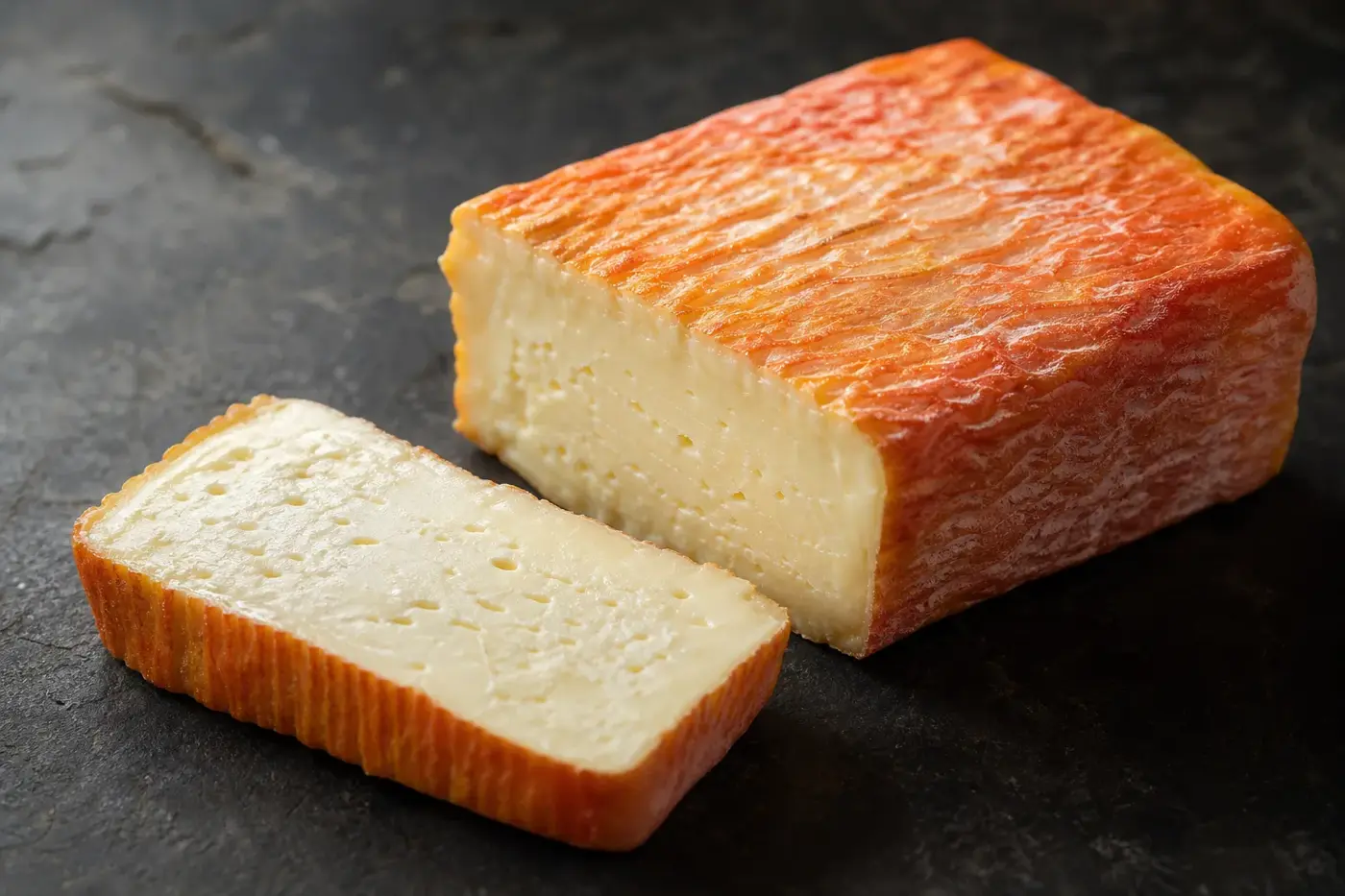
The scent reaches you before the first bite. Beneath Limburger’s moist, pungent rind, the cheese can be surprisingly mild and savoury: an entrance rather louder than the conversation that follows. A microbial community cultivated on this cow’s milk washed-rind cheese creates that aroma. Follow it from historic Limburg to Germany’s Allgäu and Wisconsin, and smell, flavour and birthplace each tell a different part of the story. [1,2,3,4]
| What to know | The details |
|---|---|
| Name | Limburger. [1,2] |
| Milk | Cow’s milk. [1] |
| Style | Washed-rind, soft to semi-soft. [1,2] |
| Where it’s usually made | Belgian origins; Allgäu, Germany; Wisconsin, US. [1,2,3] |
| Shape to look for | Rectangular block or bar. [1] |
| Ripening surface | Yellow to reddish bacterial smear. [1] |
| Milk treatment | Check your product’s label. |
| Coagulant | Rennet in the Bavarian method. [1] |
| EU registration | Limburger: Unconfirmed. |
| Great Britain registration | Limburger: Unconfirmed. |
Take the old road to Limburg
To find Limburger’s homeland, you need a historical map. The name points to the historic Duchy of Limburg, with its origin conventionally placed in the Herve area. Look around Herve and Limbourg in what is now Belgium’s province of Liège, rather than simply towards either of today’s Belgian and Dutch provinces called Limburg. [3,15]
Bavaria’s regional food heritage record links Limburger to the Belgian town and district of Limburg, and connects it with Herve. That shared ancestry is an important part of both cheeses’ stories. Their modern forms, though, are distinct. [1,8]
From Belgian hands to Allgäu and Wisconsin
Around 1830, Belgian cheesemaking expertise helped bring this soft-cheese tradition to the Allgäu, according to Bavaria’s food heritage account. Production took root there and developed into the recognisable German Limburger. What arrived from Belgium became part of the region’s own dairy repertoire. [1]
Across the Atlantic, the story leads you to Wisconsin. Dairy Farmers of Wisconsin, the state’s dairy promotion organisation, traces Limburger’s arrival to Swiss immigrants in the nineteenth century. A local history preserved by the Monticello Area Historical Society records a Limburger factory in southern New Glarus township in 1868. [2,6]
Today, the name tells you more about a style and its history than where your particular packet was made. Look for the maker and origin on the cheese itself. A German block and one from Wisconsin share a name, but each has its own place of production worth noticing. [1,2]
Let your taste buds catch up with your nose
You’ll usually find Limburger as a rectangular block or bar. Its moist, coloured surface looks quite unlike Brie’s white mould coat. Bavaria’s description gives it a yellow to red exterior and a soft interior. “Washed rind” describes that managed ripening surface, even when a technical account calls the cheese rindless. [1,2]
The flavour need not be as forceful as the smell. Dairy Farmers of Wisconsin describes a mild cheese with grassy, tangy and mushroom notes. The Bavarian account emphasises a hearty, piquant character. Treat those descriptions as a range of possibilities, rather than a promise of one fixed flavour. [1,2]
Try a little of the centre, then a bite that includes the surface. You’ll discover differences within the cheese, but this is a tasting exercise, not a safety test. Ask your cheesemonger about the particular batch: its smell cannot predict every mouthful. [2,12]
Watch milk become a familiar block
The Bavarian method begins with cow’s milk, starter cultures and rennet. The cultures acidify the milk, while rennet, a coagulating enzyme preparation, helps turn it into curd. This is the solid material from which cheese is formed. Cutting it releases whey, the liquid portion, before the curds go into moulds. [1]
Turning shapes the young blocks and helps them drain. Next comes salting in brine, followed by controlled ripening conditions where the surfaces receive repeated attention. Making and draining the curd establishes the body of the cheese. Surface ripening develops its characteristic exterior and aroma. [1,2,4]
For milk treatment and the source of the rennet, check your product’s label or ask its maker. If you’d like to follow the process further, how cheese is made takes you through the underlying stages. For a closer look at the coagulant, turn to rennet explained.
There’s a whole community on that rind
Washing keeps Limburger’s surface moist, helping maintain the conditions its ripening community needs. There is more going on here than a coating of Brevibacterium linens. Yeasts and several kinds of bacteria can take part. Organisms already established in a dairy can also differ from the cultures cheesemakers deliberately add. [2,4]
One study of a German Limburger followed 1,114 yeast isolates and 1,201 bacterial isolates, distinguishing them with infrared spectroscopy. The commercial ripening organisms added to the milk did not successfully establish themselves in the resident ripening community. Among the bacteria identified were Arthrobacter arilaitensis and Brevibacterium aurantiacum. [4]
These microbial activities produce both colour and smell, but orange is no strength rating. Laboratory research using nine constructed cheese-rind communities found that different bacterial strains produced different pigmentation and airborne aroma profiles. Researchers measured rind colour and analysed volatile compounds. They found differences even between communities assembled from the same bacterial species. [5]
That experiment used model rind communities, not commercial Limburger. Still, it helps explain why microbial identity and behaviour matter more than the word Brevibacterium alone. A more orange surface cannot tell you precisely how the cheese will smell or taste. The organisms, and what they do together, shape the result. [5]
Find your favourite moment of ripeness
Time changes what you cut and spread, not just what you smell. Microorganisms and enzymes work on the cheese’s constituents, gradually altering texture and flavour. In surface-ripened cheeses, activity at the exterior plays an especially important role. [16]
For a firmer, gentler introduction, ask for a younger example. If you’d prefer something softer and more assertive, choose one that is further developed. Ask the seller to describe its present condition rather than relying on a maturity adjective alone. Maker, age and storage history help explain why two blocks called Limburger can give you different experiences. [1,2,4]
Get acquainted with Fromage de Herve
Fromage de Herve shares Limburger’s story of origins and washed-rind cheesemaking, but it also has a specific registered name. As of November 2026, the Great Britain register lists Fromage de Herve as a Belgian protected designation of origin, or PDO. Its registration under the UK scheme dates to 31 December 2020. [8]
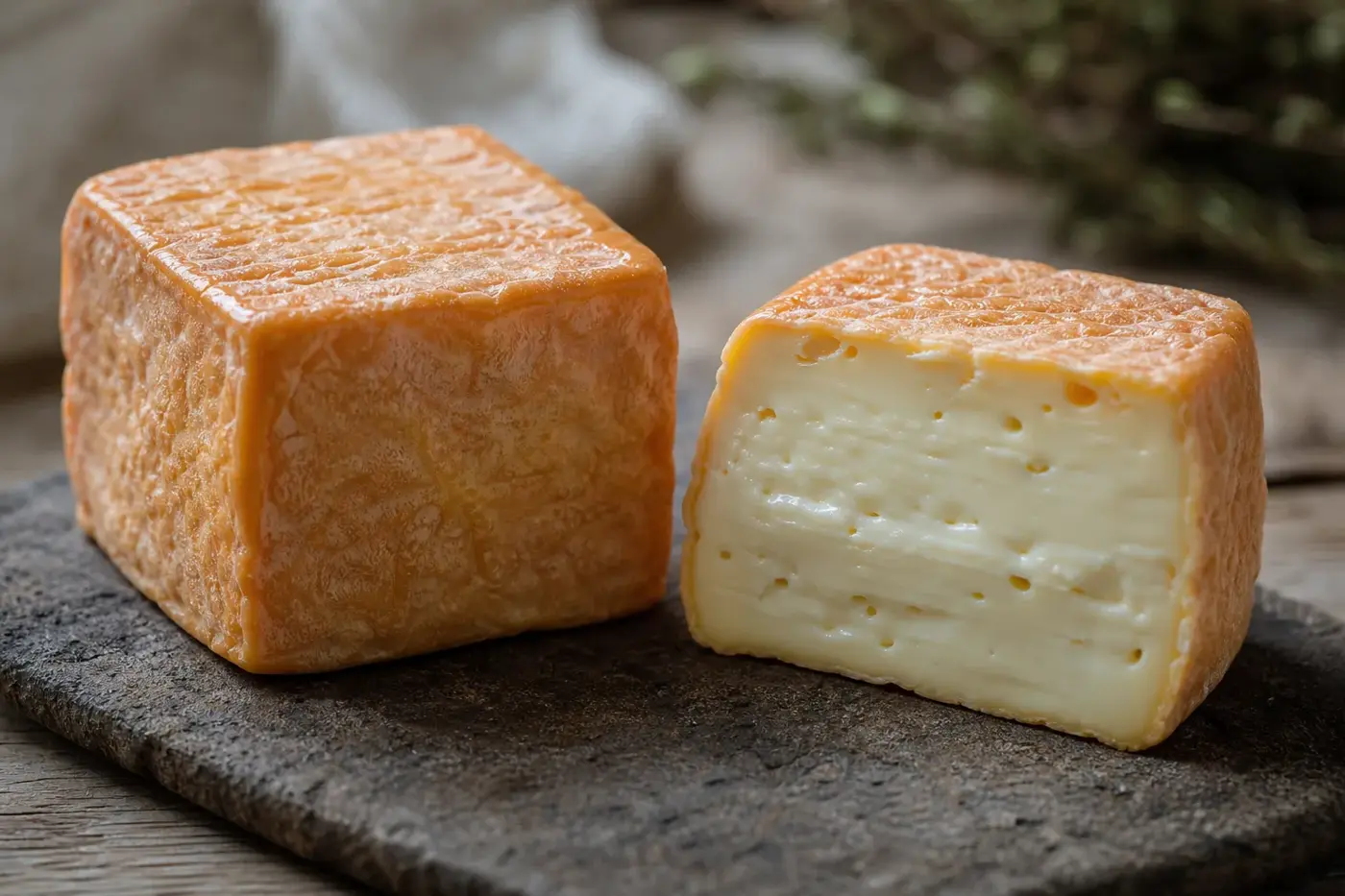
Producer Terre de Fromages describes its Herve as square or cubical, with an orange surface, washed and turned several times a week. The range includes doux and piquant versions. The latter is described as saltier and matured longer, giving you a glimpse of the variation within Herve itself. [7]
That historical connection makes the two cheeses rewarding to compare. Choose by the named product and the eating experience you want, using the registered name and maker’s description to understand your purchase. For the distinction between a cheese name and geographical protection, see protected names explained. [7,8]
Set out the rye bread, onion and beer
Rye bread, raw red onion and mustard make a well-established Wisconsin combination, according to Dairy Farmers of Wisconsin. The organisation also suggests stout, porter and Belgian ale. Start with the bread, then add onion and mustard according to your appetite. This is a direct, savoury way to serve Limburger, with little interest in being dainty. [2]
For your first encounter, keep things simpler. Taste a small piece on bread before introducing the sharper accompaniments. The same industry source suggests strawberry jam as a sweeter alternative to raw onion. Plain crackers and water give you straightforward alcohol-free options when you want the cheese to stay in focus; beer pairings are for adults of legal drinking age, with a small serving. [2]
Choose your block, then give it a good home
Buy the maturity you intend to eat, not simply the packet with the loudest smell. Ask whether the cheese is mild or fully developed, check its milk treatment and ingredients, and keep the storage instructions. If you’re buying a cut portion, ask the seller for those details and the relevant date information. [2,13]
At home, follow the pack’s wrapping and storage instructions. Keep the cheese covered or in a clean container, with its label, rather than leaving the cut face exposed. A separate container also helps stop that pronounced aroma taking over your fridge. [11]
For England, Northern Ireland and Wales, Food Standards Agency guidance as of November 2026 advises keeping the fridge between 0 and 5 °C. Chilled food should spend the shortest possible time out during preparation, with a maximum of four hours. Bring out only the portion you plan to serve, and follow any stricter product instruction. [11]
Different cheeses need different wrapping approaches. For help choosing the right one, you’ll find practical advice in how to store cheese at home.
Know when to throw it away
Limburger’s strong smell and moist smear belong to its ripening character. They cannot establish whether your particular block is fit to eat. For England, Northern Ireland and Wales, the FSA advises against eating food that is obviously rotten or contains unwanted mould. Cutting away the affected part does not guarantee removal of unseen toxins: discard affected soft cheese rather than trimming it. [1,2,12]
In the UK, follow a use by date wherever one appears, even if the cheese looks and smells as expected. UK government guidance distinguishes use by dates, which concern safety, from best before dates, which concern quality. Follow the manufacturer’s instructions after opening, too. [13]
The advice is not the same for every cheese. For those differences, see the separate guide to mould on cheese.
General information only, not medical advice: follow the official guidance where you live.
Questions people ask
Where does Limburger cheese come from?
Its origin is conventionally placed in the Herve area of the historic Duchy of Limburg, in what is now Belgium’s province of Liège. Limburger is also made in Germany’s Allgäu and in Wisconsin.
Does Limburger taste as strong as it smells?
Its flavour can be gentler than its smell suggests. Dairy Farmers of Wisconsin describes it as mild, with grassy, tangy and mushroom notes, while the Bavarian account emphasises a hearty, piquant character.
Why does Limburger smell so strong?
Its aroma comes from microbial activity on the ripening surface. Yeasts and several kinds of bacteria can take part in that community.
What do you eat with Limburger?
Rye bread, raw red onion and mustard are a well established Wisconsin combination. For a simpler first taste, try a small piece on bread.
How should Limburger be stored?
Follow the pack’s wrapping and storage instructions, and keep the cheese covered or in a clean container with its label. For England, Northern Ireland and Wales, the Food Standards Agency advises keeping the fridge between 0 and 5 °C. See its food storage guidance for further advice.
Sources
-
Bavarian State Ministry responsible for food and agriculture, Allgäuer Limburger, GenussErbe Bayern, undated live entry. Regional account of appearance, manufacture, flavour and introduction to the Allgäu.
-
Dairy Farmers of Wisconsin, Limburger, undated live entry. Industry descriptions of flavour, washing, American history and serving combinations.
-
WBEZ, Limburger: This cheese stands alone, but not for long, 12 November 2012. Published reporting on the historical Duchy of Limburg connection and Wisconsin tradition.
-
American Society for Microbiology, Commercial Ripening Starter Microorganisms Inoculated into Cheese Milk Do Not Successfully Establish Themselves in the Resident Microbial Ripening Consortia of a South German Red Smear Cheese, Applied and Environmental Microbiology, 2008. Primary research on German Limburger microbial communities.
-
American Society for Microbiology, Strain-Level Diversity Impacts Cheese Rind Microbiome Assembly and Function, mSystems, 2020. Primary experimental research on nine synthetic rind communities, pigmentation and volatile compounds.
-
Monticello Area Historical Society, New Glarus Wisconsin: Mirror of Switzerland, revised seventh printing, 1995. Local historical account preserved in the society’s digital collection.
-
Terre de Fromages, Qu’est-ce que le fromage de Herve AOP ?, undated live page. Producer’s descriptions of its cheese, washing and maturity variants; a commercial source.
-
Department for Environment, Food & Rural Affairs, Fromage de Herve, Great Britain protected food names register, published 4 January 2021, live record consulted November 2026.
-
European Commission, Geographical indications registers, live guidance and linked eAmbrosia register, consulted November 2026. The linked register did not expose searchable records in the retrieved view.
-
Department for Environment, Food & Rural Affairs, Protected geographical food and drink names, live Great Britain register, consulted November 2026.
-
Food Standards Agency, How to chill, freeze and defrost food safely, GOV.UK live guidance, originally published 18 December 2017, consulted November 2026.
-
Food Standards Agency, Home food fact checker, GOV.UK live guidance, updated 21 August 2026. Section: “Can you still eat food if you remove the mouldy part?”
-
UK Government, Understanding food labelling: Best before and use-by dates, undated live guidance, consulted November 2026.
-
US Food and Drug Administration, Recalls, Market Withdrawals, & Safety Alerts, live portal, consulted November 2026.
-
Wikipedia, Limburger, indexed version retrieved November 2026. Secondary geographical background only, pending replacement with a regional historical source.
-
American Society for Microbiology, Biodiversity of the Bacterial Flora on the Surface of a Smear Cheese, Applied and Environmental Microbiology, 2002. Introduction on surface-ripened cheese and the contribution of microorganisms and enzymes to texture and flavour.
This desk-researched draft brings together regional historical accounts, published microbiology, attributed industry descriptions and official consumer guidance; outstanding publication checks are recorded below.
Last checked: November 2026
Last checked November 2026.
The editors suggest you read next
Fromage de Herve
Before your knife reaches the soft centre, the aroma has already introduced itself.