Giant Cheeses in History: Jefferson, Jackson and Queen Victoria
Step into a Somerset farmhouse’s best parlour and meet its rather imposing occupant.
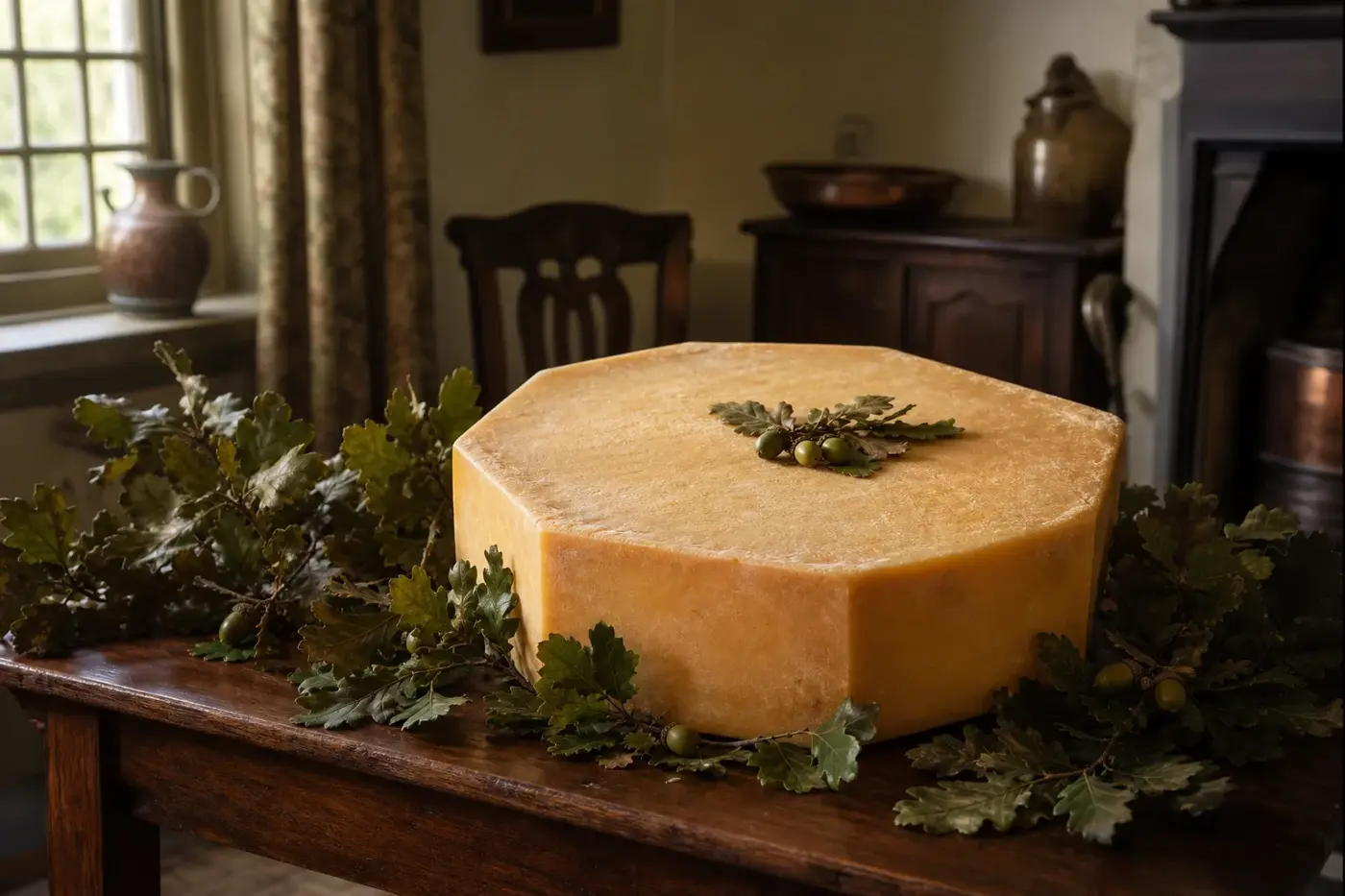
Step into a Somerset farmhouse’s best parlour and meet its rather imposing occupant. An octagonal cheese stands dressed with oak leaves, acorns, the Royal Arms and the words “Victoria Regina”. Fanny Chapman saw it on 3 September 1840, still waiting for its royal audience. Not every parlour guest requires quite so much room.[6]
Across the Atlantic, communities had already sent enormous cheeses to Thomas Jefferson and Andrew Jackson. These gifts carried local pride, political allegiance and celebration towards the centres of power. A later account credits dairy women with Victoria’s cheese, although its familiar billing as a wedding present rests on less certain ground.[1][3][6][7]
Cheshire has something substantial to tell Jefferson
Milk from 900 cows. A large cider press. Those were the resources described in an August newspaper report as Cheshire, Massachusetts, set about its extraordinary cheese in the summer of 1801. Baptist minister John Leland helped organise the work.[1]
There was more at stake than an ambitious piece of dairying. Monticello’s historical account connects the gift with support for Jefferson’s republican politics and religious liberty. Cheshire had something to say, and its farming community chose to say it together.[1]
Those figures come from newspaper reporting, not a surviving manufacturing record. They help you grasp the ambition, but the press and the finished cheese need to stay separate. The equipment’s measurements cannot tell you the cheese’s diameter.[1]
“Jefferson’s cheese” was, above all, other people’s work. The presentation documents credited farmers and the women of their households; Jefferson’s reply praised their domestic skills. He supplied the destination. A farming community supplied the milk, labour and knowledge.[1][2]
An ordinary cheese could have conveyed goodwill. This one invited questions, conversation and written accounts simply by being so conspicuous. Its makers had given their collective achievement a physical scale, and a public message, that demanded attention.
John Leland puts liberty at the heart of the gift
Religious liberty was central to this exchange, not a meaning attached to it afterwards. Leland did more than escort a cheese. He connected a farming community with a president whose principles mattered to it, while the accompanying addresses gave the gift an explicitly constitutional purpose.[1][2]
Jefferson replied to the Cheshire committee on 1 January 1802. He endorsed its understanding of the Constitution as a statement of governmental powers and duties. Voting rights, the prohibition of religious tests and peaceful constitutional amendment were the principles he singled out in his thanks.[2]
He also addressed the donors as working farmers and thanked them for their skill. Useful labour and political principle belonged together in his response. You find something more substantial here than grateful neighbours sending an unusually large present.[2]
The presentation address, quoted in Monticello’s account, emphasised that the cheese had been produced without enslaved labour. This was the donors’ declared account of its making. It was also an important part of the public identity they chose for their gift.[1]
So the cheese carried several messages together: approval of Jefferson, recognition of religious freedom and pride in its makers. Its size catches your attention first. The argument behind it deserves to hold it.
The long road to Jefferson’s door
The cheese began its journey late in November 1801 and reached Washington on 29 December. Monticello traces the route by road to the Hudson, by water through New York and Baltimore, then by wagon to Washington. Its presentation followed on New Year’s Day 1802.[1]
Before anyone could admire the gift, someone had to get it there. Each change between road and water meant transferring an unusually heavy, vulnerable object from one conveyance to another. The journey carried Cheshire’s undertaking, and its makers’ message, beyond the community that had produced it.
Jefferson described the cheese in a letter to Thomas Mann Randolph on 1 January, quoted by Monticello. He put its diameter at approximately 1.33 metres and its thickness at 38 centimetres. Its recorded August weight was about 558 kilograms, or 1,230 pounds.[1]
Keep August beside that weight as you picture it. The figure describes the cheese before the January presentation, not its weight at the president’s door. Even a measurement this memorable needs its date to tell you precisely what it means.
The story did not end with the ceremony. Monticello reports references to the cheese remaining at the President’s House. Its ultimate disposal is less clear, and accounts of it being dumped in the Potomac lack substantiation.[1]
Thomas Meacham gives Jackson a New York spectacle
Thomas Meacham’s offering was heavier still. A December 1835 newspaper report, reproduced in Robert McNamara’s historical account, put it at about 635 kilograms, or 1,400 pounds. Meacham, a dairy farmer associated with Sandy Creek in Oswego County, New York, reportedly used four days’ milk from 150 cows.[3]
Even its wrapper had a public role to play. The same report described Jackson’s likeness and a linked representation of the states decorating it. You have New York dairying presented to a national audience, with agricultural abundance placed firmly in a political setting.[3]
Jackson’s acknowledgement, dated 1 January 1836 and reproduced by McNamara, thanked those involved. He understood the gift as evidence of the prosperity of New York’s dairy farmers. That date matters more than the often repeated shorthand that he received the cheese in 1837.[3]
Receiving it and eating it were separate occasions. The acknowledgement places the gift in Jackson’s possession by 1 January 1836, although it gives no delivery date. The National Archives describes the cheese remaining at the White House for more than a year before public distribution.[3][4]
Meacham’s undertaking found two audiences. The president received the cheese and interpreted its meaning; the wider public encountered its story. Local dairy production had become national news, and the eventual serving would bring it another round of attention.
Washington’s birthday comes with cheese to take home
On Washington’s birthday, 22 February 1837, visitors received portions at a crowded presidential reception. Contemporary accounts reproduced by historical writers place the distribution near the end of Jackson’s presidency. This very public gift finally became something people could carry away.[3][5][8]
Writer Nathaniel Parker Willis left a particularly vivid account, published in Loiterings of Travel in 1840 and reproduced by Kihm Winship. His description brings you into a packed vestibule, with a powerful smell and visitors departing with parcels. In his telling, the cheese was eaten and carried away within two hours, apart from a portion reserved for the president.[8]
Those parcels matter. This was a distribution as well as a feast: visitors took cheese away, rather than necessarily eating it where they stood. The familiar picture of a crowd devouring the whole wheel on the spot compresses a more varied occasion. If you tend to leave a gathering with cheese, you have historical company.[8]
Willis also described generally respectable behaviour. His account offers a counterweight to versions that present the reception as an uninterrupted riot. It is still one observer’s view, shaped by his particular expectations about crowds and social class.[8]
The cheese even entered congressional jokes. The National Archives reproduces a contemporary Vermont Phoenix report about members absent at the cheese feast. It gives you a glimpse of the occasion’s liveliness, though not a precise attendance figure.[4]
A memorable smell, and a history worth untangling
The powerful smell belongs to early accounts, not merely later retellings. Willis made it central to his description of the reception. His deliberately heightened language tells you how he portrayed the occasion, rather than how far the odour travelled.[8]
Pictures ask for a different sort of attention. The White House Historical Association’s discussion of Peter Waddell’s painting explains a reconstructed scene, not an eyewitness record. Its arrangement of people, furnishings and cheese helps you imagine the reception without making it a view from the day itself.[5]
Even institutional retellings differ about how long the cheese stayed. One White House Historical Association account describes two years in the Entrance Hall. The National Archives describes more than a year following acceptance in 1836.[4][5]
The dated events give you the clearest route through the story. Jackson acknowledged the gift in January 1836; the public reception followed in February 1837. Keep those moments separate, and the rounded phrase “two years” need not muddle the chronology.[3][4]
There is plenty to remember without embellishment. A crowd, a conspicuous distribution and a smell that impressed those who described it already make a striking scene. Exact crowd totals and increasingly elaborate accounts of the aftermath need documentary support of their own.
Back in Somerset, a royal cheese waits patiently
For the Somerset cheese, Fanny Chapman is a wonderfully revealing witness. On 3 September 1840, she visited the cheese associated with West Pennard and recorded its octagonal shape, Royal Arms, oak leaves, acorns and “Victoria Regina” inscription. Her diary survives in a modern transcription.[6]
Chapman put its height at approximately 55 centimetres. She also admitted that her party had neither measured its width nor asked its weight. That candour helps you distinguish what her description can tell you from what it cannot.[6]
She understood that the cheese had been made the previous year with milk from 750 cows. Those details were supplied during the visit. The shape and decoration, by contrast, were right in front of her.[6]
And where do you keep a cheese intended for the Queen? Here, the answer was the farmhouse’s best parlour. Chapman was told that a fire had been maintained through winter to help it ripen.[6]
The farmer also discussed a possible procession to London, drawn by eight cows. You can picture the appeal, but he described it as something still to be considered. At the time of Chapman’s visit, the cheese remained in Somerset, its royal journey still ahead.[6]
The wedding present label needs a closer look
Chapman called the cheese a present intended for the Queen. She did not identify a wedding purpose, and her September 1840 entry places it in Somerset, still awaiting presentation. The familiar wedding label asks her diary to tell you more than it does.[6]
John Ashton’s later account gives a presentation date of 19 February 1841. He credits 50 dairy women at West Pennard with making the cheese from a morning’s milk supplied by 737 cows. Its weight, he says, was eleven hundredweight: on the British hundredweight basis, approximately 559 kilograms, or 1,232 pounds.[7]
Both accounts describe a conspicuous Somerset cheese intended for Victoria. Their cow totals differ, and Ashton’s account of a royal presentation does not supply the missing wedding connection. A royal gift is not necessarily a wedding gift.[6][7]
West Pennard’s royal cheese is therefore the clearest identification. Chapman gives you contemporary observation of its appearance and location. Ashton supplies a later narrative of its makers, weight and presentation, while the wedding label still needs stronger contemporary evidence.
The makers deserve equally careful credit. Ashton names a group of dairy women, while Chapman describes meeting a farmer and his nieces. You are seeing different participants and encounters in these accounts, rather than one firmly documented individual cheesemaker.[6][7]
Behind every giant cheese, a great deal of work
Put the reported weights together and you begin to appreciate the organisational challenge. Jefferson’s cheese weighed approximately 558 kilograms in August 1801, Jackson’s 635 kilograms, and Victoria’s 559 kilograms in Ashton’s later account. These figures come from different sources and different stages of the cheeses’ histories. They do not capture a shared moment in production or presentation.[1][3][7]
The milk came together in different ways, too. Jefferson’s cheese drew on community contributions, while Meacham’s used several days’ milk from his dairy. Ashton described a large collective milking in Somerset, bringing another pattern of work into the picture.[1][3][7]
For that Somerset cheese, Chapman reported 750 cows and Ashton 737. Keep each count attached to its account. They are not interchangeable measures of production, however tempting it might be to treat them as such.[6][7]
Gathering the milk was only the beginning. A press, a substantial wrapper, successive stages of transport and a dedicated room all appear in these accounts. Making a cheese, moving it and finding somewhere to keep it were separate undertakings. Each required arrangements of its own.[1][3][6]
Chapman’s visit brings that continuing work particularly close. Ripening occupied domestic space, and the reported winter fire suggests the attention the cheese received while it waited. A ceremonial destination did not remove the practical responsibility of looking after it between manufacture and presentation.[6]
You can explore the ordinary transformations in how cheese is made. What distinguishes these episodes is the scale of organisation around them. Farmers, dairy workers, carriers and hosts all had a part in turning food into a public gesture.
Why you remember a cheese of this size
These cheeses shared an extraordinary scale, but their meanings were distinct. Cheshire’s exchange explicitly connected labour with constitutional principle. Jackson read Meacham’s offering as evidence of dairy prosperity, while West Pennard’s cheese carried royal emblems and the ambition to reach the sovereign.[2][3][6]
Size made dispersed work visible. Milk from numerous animals, and labour across households or dairies, became one object that could travel, attract comment and represent its makers. Agricultural work acquired a physical presence in places of political and royal authority.
Their endings differ, too. Jackson’s public distribution has contemporary witnesses and newspaper traces, while Jefferson’s ultimate disposal remains unsettled. For the Somerset cheese, Chapman’s observation and a later reported presentation have firmer footing than its final fate.[1][4][6][7][8]
That unevenness belongs to the history; it need not spoil your enjoyment of it. These stories endure because agricultural skill briefly occupied presidential and royal space. Once pictured, their best details stay with you: constitutional thanks, visitors carrying parcels, and an octagonal cheese waiting in a Somerset parlour.
Questions people ask
Why was Thomas Jefferson given a giant cheese?
The community of Cheshire, Massachusetts, sent it as a gift connected with support for Jefferson’s republican politics and religious liberty. The presentation address also declared that the cheese had been produced without enslaved labour.
How big was Jefferson’s cheese and how did it reach Washington?
Jefferson described it as approximately 1.33 metres across and 38 centimetres thick. It travelled by road to the Hudson, by water through New York and Baltimore, and finally by wagon to Washington, arriving on 29 December 1801.
Who made Andrew Jackson’s giant cheese?
Thomas Meacham, a dairy farmer associated with Sandy Creek in New York, made it. A newspaper report said he used four days’ milk from 150 cows and that the cheese weighed about 635 kilograms.
When was Jackson’s cheese served to the public?
Visitors received portions at a crowded presidential reception on Washington’s birthday, 22 February 1837. Jackson had acknowledged the gift by 1 January 1836, and the National Archives says it stayed at the White House for more than a year before distribution.
Was Queen Victoria’s giant cheese a wedding present?
Its familiar description as a wedding present remains unverified. Fanny Chapman called it a present intended for the Queen, but did not identify a wedding purpose; in September 1840, it was still in Somerset awaiting presentation.
Sources
[1] Thomas Jefferson Foundation, Monticello. Mammoth Cheese. J. Boehm, October 1997, online version retrieved November 2026. Historical synthesis quoting correspondence and identifying contemporary newspaper sources.
[2] National Archives, Founders Online. III. Thomas Jefferson to the Committee of Cheshire, Massachusetts, [1 January 1802]. From The Papers of Thomas Jefferson, volume 36, edited by Barbara B. Oberg, Princeton University Press, 2009, page 252. Primary document transcription.
[3] Robert McNamara, ThoughtCo. Andrew Jackson’s Big Block of Cheese. Updated 14 March 2021. Secondary account reproducing an 1835 newspaper report, Jackson’s acknowledgement and an announcement of the reception.
[4] US National Archives, Pieces of History. A big cheese for the Big Cheese in 1837. 29 January 2014. Institutional historical account reproducing the Vermont Phoenix, 3 March 1837.
[5] William Seale, White House Historical Association. An Essay on “The Great Cheese” by Peter Waddell. Undated online edition retrieved November 2026. Historical interpretation accompanying a reconstructed painting, with newspaper references.
[6] Fanny Chapman. 1840 Diary, entry for 3 September 1840. The Diaries of Miss Fanny Chapman, modern online transcription. Primary diary text accessed through a transcription rather than the manuscript.
[7] John Ashton. Gossip in the First Decade of Victoria’s Reign. Digital transcription, passage concerning 19 February 1841, printed page 154. Publication year of the transcribed edition not verified. Later historical account.
[8] Kihm Winship, Faithful Readers. Cheese: From Sandy Creek to the White House. 28 November 2012. Secondary compilation reproducing Nathaniel Parker Willis’s Loiterings of Travel and contemporary newspaper accounts.
This desk-researched article compares retrieved correspondence, a contemporary diary transcription, reproduced newspaper and eyewitness accounts, and later historical interpretations.
Last checked: November 2026
Last checked November 2026.
The editors suggest you read next
A History of Cheese: From the First Curds to Global Food
Picture cheese lying beside Bronze Age burials in China's Tarim Basin, surviving for approximately 3,500 years.