Cheese in Ancient Greece and Rome
Step into Polyphemus’s cave and cheese fills the racks.
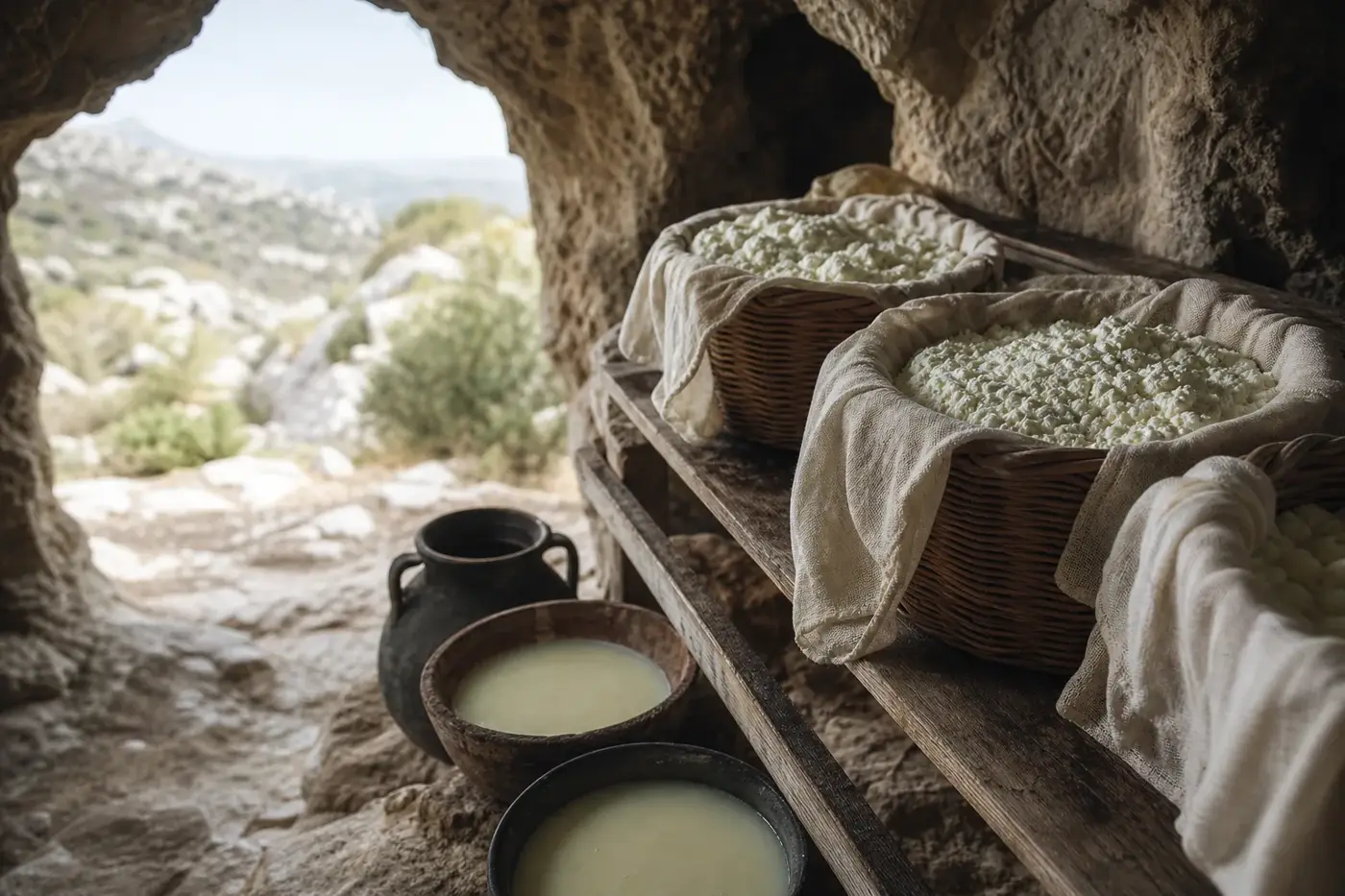
Step into Polyphemus’s cave and cheese fills the racks. Lambs and kids stand in separate groups; vessels hold whey. Then Homer’s Cyclops returns, milks his ewes and goats, and gathers fresh curds into wicker baskets. In the middle of a violent story, you stumble upon the daily business of a dairy. [1]
Follow those baskets and a much bigger world opens up. Cheese in ancient Greece and Rome takes you through pastoral labour, meals, cooking and regional exchange, with poetry, farming manuals and archaeological finds as your guides. No single source gives you the whole picture. Together, they offer something wonderfully rich. [1, 3, 4, 5, 8]
Take the long road from Homer to Rome
Homer’s heroic world lies centuries away from Pliny’s account of regional cheeses. Along the way, you meet Aristotle investigating milk in the fourth century BCE, Cato recording recipes in the second century BCE and Varro writing about farming in the first century BCE. Columella and Pliny describe production and regional reputations in the first century CE, while Varro bridges Republican and imperial farming traditions. [1, 2, 3, 4, 5, 9]
A Greek herdsman, a Roman estate manager and a customer in Rome lived in different food worlds. Bring their evidence together and you find a repertoire of techniques and uses, rather than one universal ancient cheese tradition. The disagreements and gaps matter too. They show you where each view reaches its limits. [1, 3, 5, 9]
Step inside the Cyclops’s orderly dairy
When Odysseus and his companions enter the cave, everything has its place. Cheeses sit on racks, lambs and kids are grouped separately, and vessels contain whey. Polyphemus returns, milks the ewes and goats, and lets their young suckle. He curdles half the milk, gathers it into wicker baskets and keeps the rest to drink. [1]
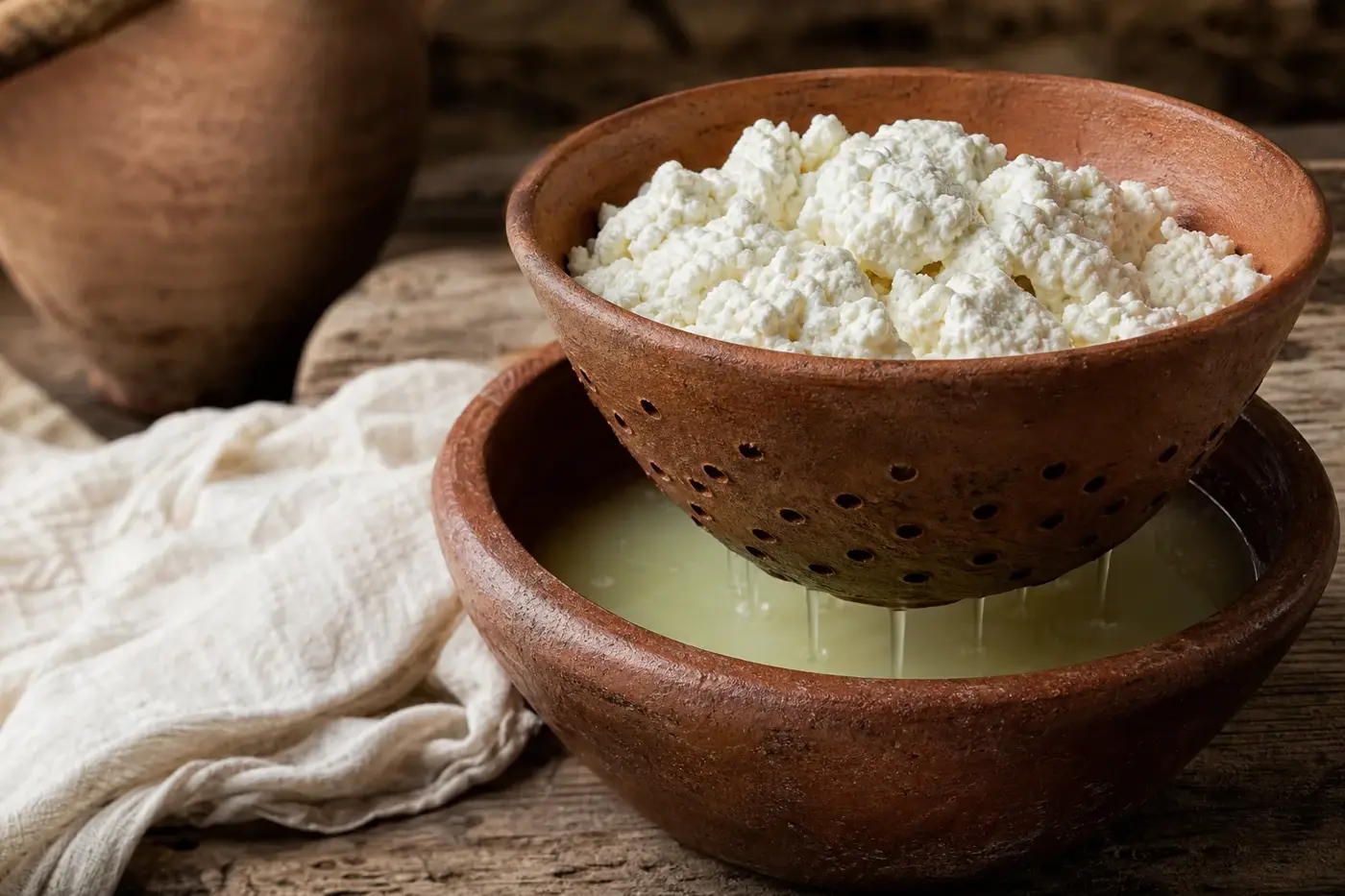
Look closely and Homer gives you two distinct things: curds, the gathered solids, and whey, the liquid left behind. The wicker baskets hold the curds while liquid escapes. But the poem names no coagulant and gives no instructions for salting or ageing. Tempting as it is, you cannot attach a modern cheese name to those baskets. [1]
That orderliness makes the scene more unsettling. The violently inhospitable owner carries out recognisable dairy work. These practical details serve the fiction, rather than turning the poem into a cheesemaking manual. [1]
Let the herd lead you beyond the hillside
Sheep and goats have company here: cattle belong in the picture too. Aristotle names all three among the animals whose milk people use for drinking and cheesemaking. He describes sheep’s milk mixed with goat’s milk in Sicily. He also connects differences in milk supply with the animals and their feeding grounds. [2]
So let your view stretch beyond Homer’s cave, or the familiar small flock on a rocky Mediterranean hillside. Aristotle offers several milk sources, but his selected examples cannot tell you how much each species contributed in most individual places. You have observations to explore, not a regional production census. [1, 2]
Watch the milk turn to curd
Before you can gather curds, the milk must set. Aristotle records both rennet and fig juice as agents of coagulation: the transformation of milk into a gel from which curds can be obtained. He associates rennet with the stomachs of suckling animals. His explanation belongs to ancient natural philosophy, but the different curdling agents preserve valuable evidence of practical cheesemaking. [2]
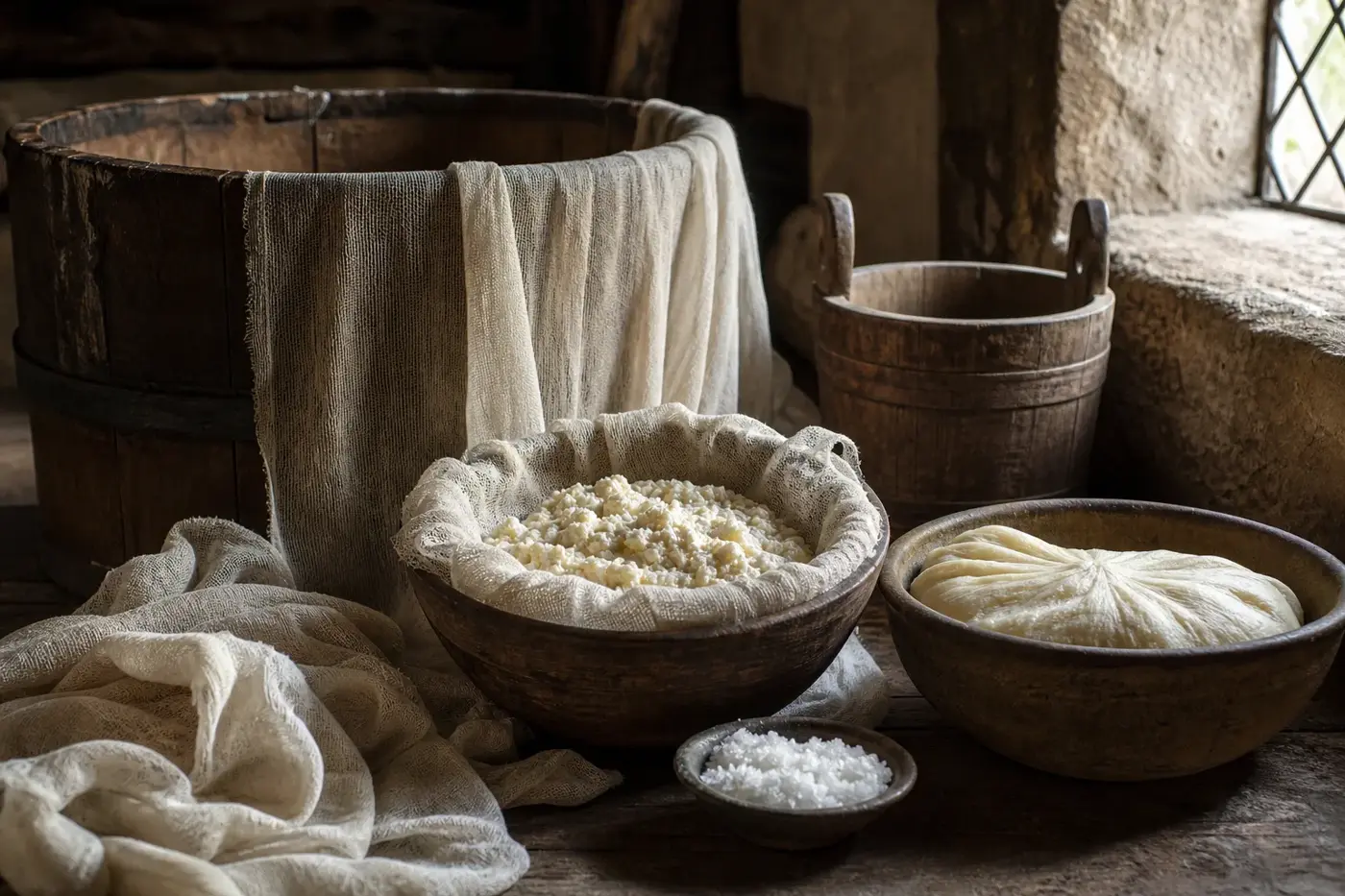
For instructions you can follow more closely, turn to Columella’s On Agriculture, VII.8. He recommends lamb or kid rennet, while also naming wild thistle flowers, safflower seeds and fig sap. Once the milk sets, the curd goes into baskets or moulds. There, the whey can drain away. [3]
Next come weighting, salting and a second pressing, followed by drying on wickerwork. Finding something that thickens milk is only part of the craft. Columella pays close attention to removing liquid and handling the cheese afterwards, and distinguishes cheese made for keeping from cheese intended to be eaten fresh. [3]
For a modern explanation of those stages, explore how cheese is made and rennet explained.
Enjoy it fresh, or put some by?
A good cheese did not always need a long life. Some was meant to be eaten promptly; some was prepared to last beyond the immediate milking. Columella’s salting and drying describe the latter, while Pliny praises certain cheeses specifically when fresh. Keeping quality was only one measure of a cheese’s worth. [3, 5]
Cheese travelled, too. Pliny discusses cheeses associated with several regions and known at Rome, including an overseas cheese from Bithynia. Those names let you follow regional movement and reputation, but they cannot give you a dependable shelf life. He supplies neither standard journey times nor the travelling conditions of individual cheeses. [5]
Fresh, dried and old are therefore more useful descriptions here than modern texture classes. An ancient sentence might give you a cheese’s birthplace but little about its moisture, rind or method of maturation. A place name is not a full tasting note, however much a cheese lover might wish otherwise. [3, 5]
Fancy a little cheese in your wine?
In Book XI of the Iliad, Hecamede prepares Pramnian wine for Nestor and Machaon with grated goat’s milk cheese and barley meal. A bronze grater brings cheese into a drink or mixed preparation. If you were expecting a separate piece alongside the wine, this is quite a change of plan. [6]
This is an epic meal, so the evidence concerns what the poem depicts. Even so, it opens a window onto cheese’s culinary possibilities. Greek literary evidence gives you cheese worked into other foods, as well as the cheeses eaten by Odysseus’s companions. [1, 6]
Cato’s Roman handbook puts that working ingredient into layered cakes and fried preparations. Across his recipes, cheese is pounded, mixed and shaped. There is much more to its kitchen life than a place on the table. [4]
Pull up to Cato’s hearth for libum
For Cato’s libum, you start with cheese, and plenty of it. In On Agriculture 75, he has it pounded thoroughly in a mortar before adding wheat flour, or a smaller quantity of finer flour in the alternative version, followed by an egg. You then have a mixture shaped into a loaf, placed on leaves and baked slowly on a warm hearth beneath a crock. [4]
The proportions leave no doubt about the leading ingredient. The ordinary version contains twice as much cheese as flour by weight; the finer flour version contains four times as much. Cato names neither the cheese nor a measured oven temperature or baking duration. [4]
If you try a modern reconstruction, read the neighbouring recipes without borrowing their ingredients. Honey appears elsewhere in Cato’s cheese cookery, but not in section 75. Nor does that section identify the leaves as bay. Keep those distinctions clear if you present the dish as the ancient author’s recipe. [4]
Meet the herdsmen, then browse Rome’s cheeses
Varro places milk and cheese within a distinct branch of pastoral knowledge. Greek authorities, he observes, had already written extensively about cheesemaking, which he calls tyropoiia. The skill had its own technical literature before Roman farming writers described it. You are joining a conversation already well under way. [9]
He separates the expertise of cultivators from that of herdsmen. Cheese production sits among decisions about livestock and the handling of their products. His handbook’s organisation gives you a clearer view of agricultural management than of the people doing the daily work. [9]
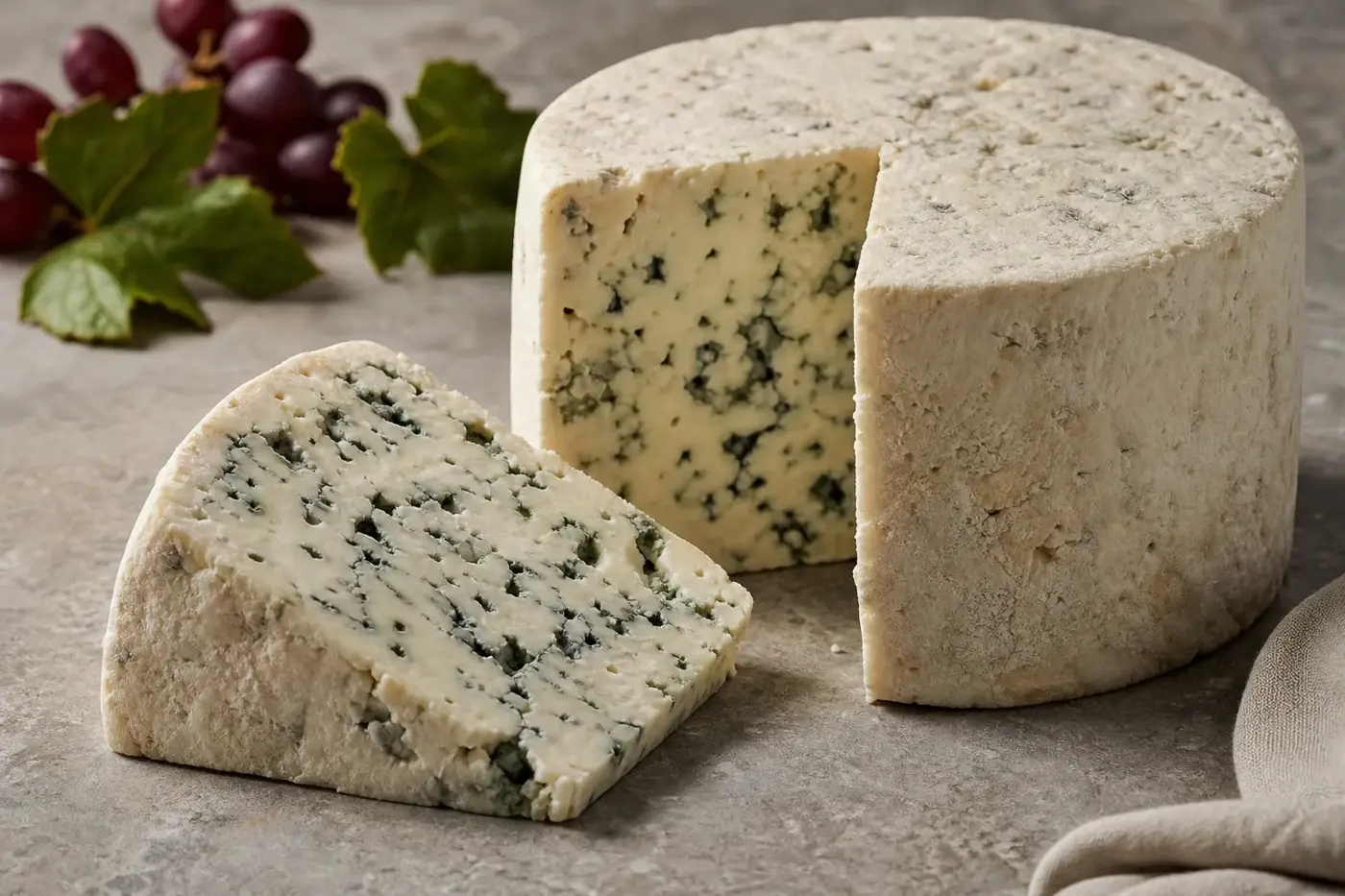
With Pliny, regional names come into view: the Nemausus district, the Alps, Liguria and Umbria. He also praises fresh goat’s cheese whose flavour is enhanced by smoke. These are his judgements, shaped by Rome’s access to regional foods, rather than a picture of everyday provisions in every household across the empire. They bring you closer to the story of exchange and reputation. [5]
See cheese through an ancient physician’s eyes
Open Celsus’s On Medicine II.18 and you find cheese classified as strongly nourishing. Elsewhere in Book II, he assigns it digestive effects. He distinguishes aged cheeses or those with a strong taste from fresh cheese prepared with honey or mead. [7]
Within his medical scheme, processing and maturity matter. Age, strength of flavour and preparation change a food’s place in his classifications. What you encounter here is Roman medical thinking, rather than modern nutritional research. [7]
Listen to what the cooking pots reveal
A 2024 study takes you to Roman pottery from Puig Castellar de Biosca and Guissona in Catalonia. Researchers examined organic residues absorbed into the vessels and found animal and plant products, but no securely identified dairy fats in the pottery tested. These pots offer a different window onto food from the written accounts. [8]
The researchers discuss several possible explanations, including the choice of vessels sampled and the possibility of limited dairy use in those particular cooking practices. Cheese eaten without heating it in pottery could leave a different archaeological footprint from food repeatedly cooked in a pot. What enters the sample helps shape the picture you get of ordinary diets. [8]
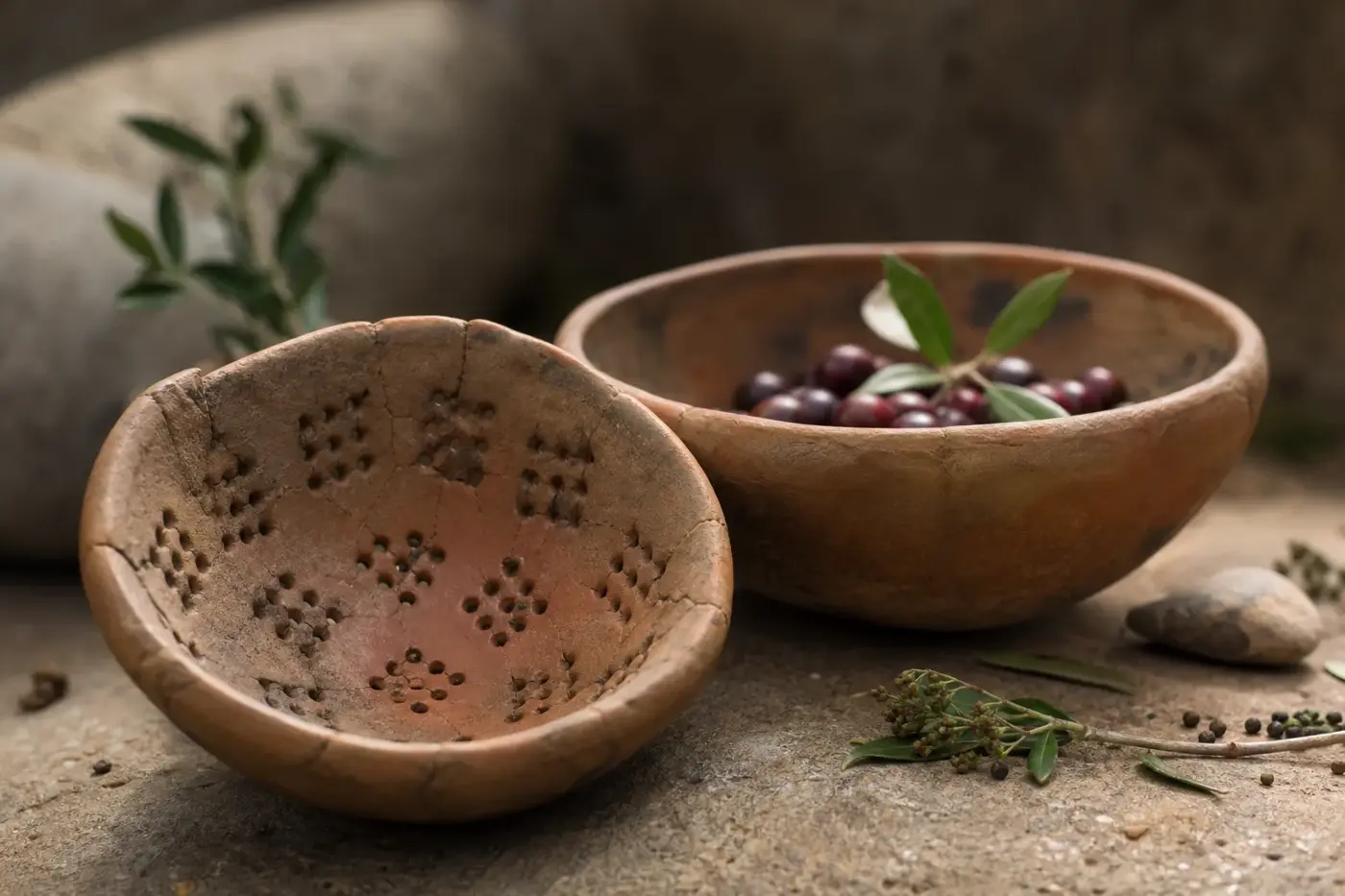
Even a pot full of holes calls for careful interpretation. Ferdière and Séguier’s archaeological survey stresses the need to distinguish cheese strainers from perforated pottery used for other purposes. Holes alone do not establish function: form, context and supporting evidence matter. Keep Homer’s containers in mind, too: wicker, not ceramic. [1, 10]
Recognise the craft without freezing it in time
Choosing milk, inducing a set, separating liquid, shaping, salting, working cheese into other foods: these are the clearest Greek and Roman legacies. Different authors preserve recognisable parts of cheesemaking and cooking, though their levels of detail vary greatly. You can recognise those operations without assuming that everything stayed the same. [2, 3, 4]
Resemblance becomes direct descent only when a documented chain of evidence connects the two. An ancient place name, a basket shape or sheep’s milk gives you somewhere to begin a comparison with a modern cheese. To establish an unchanged recipe, you need the history in between. [1, 3, 5]
When you meet a claim of continuity, ask three questions. Does the ancient passage name the same place, describe the same process and connect to evidence from the intervening centuries? The sources explored here often answer the first two only partially. That intervening history is where your next investigation begins.
Follow your appetite for more cheese stories
- Cheese: The Complete Guide: explore the wider world of milk, methods and cheese traditions.
- How to Tell Cheese Styles Apart: Milk, Rind, Texture and Method: find the words to compare cheeses without assuming a shared history.
Questions people ask
What milk did ancient Greeks and Romans use for cheese?
Aristotle names sheep, goats and cattle as animals whose milk people used for drinking and cheesemaking. He also describes sheep’s milk mixed with goat’s milk in Sicily.
How was cheese made in ancient Greece and Rome?
Aristotle mentions rennet and fig juice as agents for curdling milk. Columella describes draining curds in baskets or moulds, then weighting, salting, pressing and drying cheese intended for keeping.
What was Cato’s libum?
Libum was a loaf made by pounding cheese in a mortar and adding flour and an egg. Cato says to place it on leaves and bake it slowly on a warm hearth beneath a crock.
Did cheese travel around the Roman world?
Pliny discusses cheeses from several regions that were known at Rome, including an overseas cheese from Bithynia. His account does not give standard journey times or the conditions in which individual cheeses travelled.
Were ancient cheeses the same as modern cheeses?
An ancient place name, basket shape or use of sheep’s milk can be a starting point for comparison. Establishing an unchanged recipe requires evidence of the history between the ancient and modern products.
Sources
- Massachusetts Institute of Technology, Internet Classics Archive. Homer, The Odyssey, Book IX, Samuel Butler translation, 1900; digital edition undated. Relevant passage: IX.216 to 249.
- University of Chicago, digital text. Aristotle, History of Animals, Book III, D’Arcy Wentworth Thompson translation, 1910. Relevant passages: III.20 and III.21.
- ReadAncientTexts. Columella, De re rustica, Book VII, VII.8; digital presentation undated. The page provides the ancient text with a machine-generated English translation.
- University of Chicago, LacusCurtius. Cato, On Agriculture, sections 74 to 90, W. D. Hooper and H. B. Ash translation, Loeb Classical Library, 1934. Relevant sections: 75, 76 and 79.
- Attalus. Pliny the Elder, Natural History, Book XI, H. Rackham translation, 1940; digital presentation undated. Relevant passage: XI.97, sections 240 to 242.
- Massachusetts Institute of Technology, Internet Classics Archive. Homer, The Iliad, Book XI, Samuel Butler translation, 1898; digital edition undated. Relevant passage: XI.628 to 641.
- University of Chicago, LacusCurtius. Celsus, On Medicine, Book II, W. G. Spencer translation, Loeb Classical Library, 1935. Relevant passages: II.18.1 to 2 and II.30.2.
- Springer Nature, Archaeological and Anthropological Sciences. “Tracing culinary practices in the western provinces of the Roman Empire using Organic Residue Analysis”, 2024. Relevant sections: study sites, analytical results and discussion of dairy products.
- University of Chicago, LacusCurtius. Varro, On Agriculture, Book II, W. D. Hooper and H. B. Ash translation, Loeb Classical Library, 1934. Relevant passage: II.1, including the distinction between cultivation and herding and the treatment of cheesemaking as specialist knowledge.
- Ferdière, Alain, and Jean-Marc Séguier. “Le fromage en Gaule à l’âge du Fer et à l’époque romaine: état des lieux pour sa production et analyse de sa place dans le monde antique”, Gallia, 77.2, 2020, pages 157 to 229. Published abstract consulted through Dialnet.
This desk-researched article compares ancient literary, agricultural and medical texts with published archaeological research, keeping each source’s purpose and evidential limits distinct.
Last checked: November 2026
Last checked November 2026.
The editors suggest you read next
A History of Cheese: From the First Curds to Global Food
Picture cheese lying beside Bronze Age burials in China's Tarim Basin, surviving for approximately 3,500 years.