The Earliest Known Evidence of Cheesemaking and Surviving Cheese
Peer into the tiny holes of a prehistoric pot from Poland.
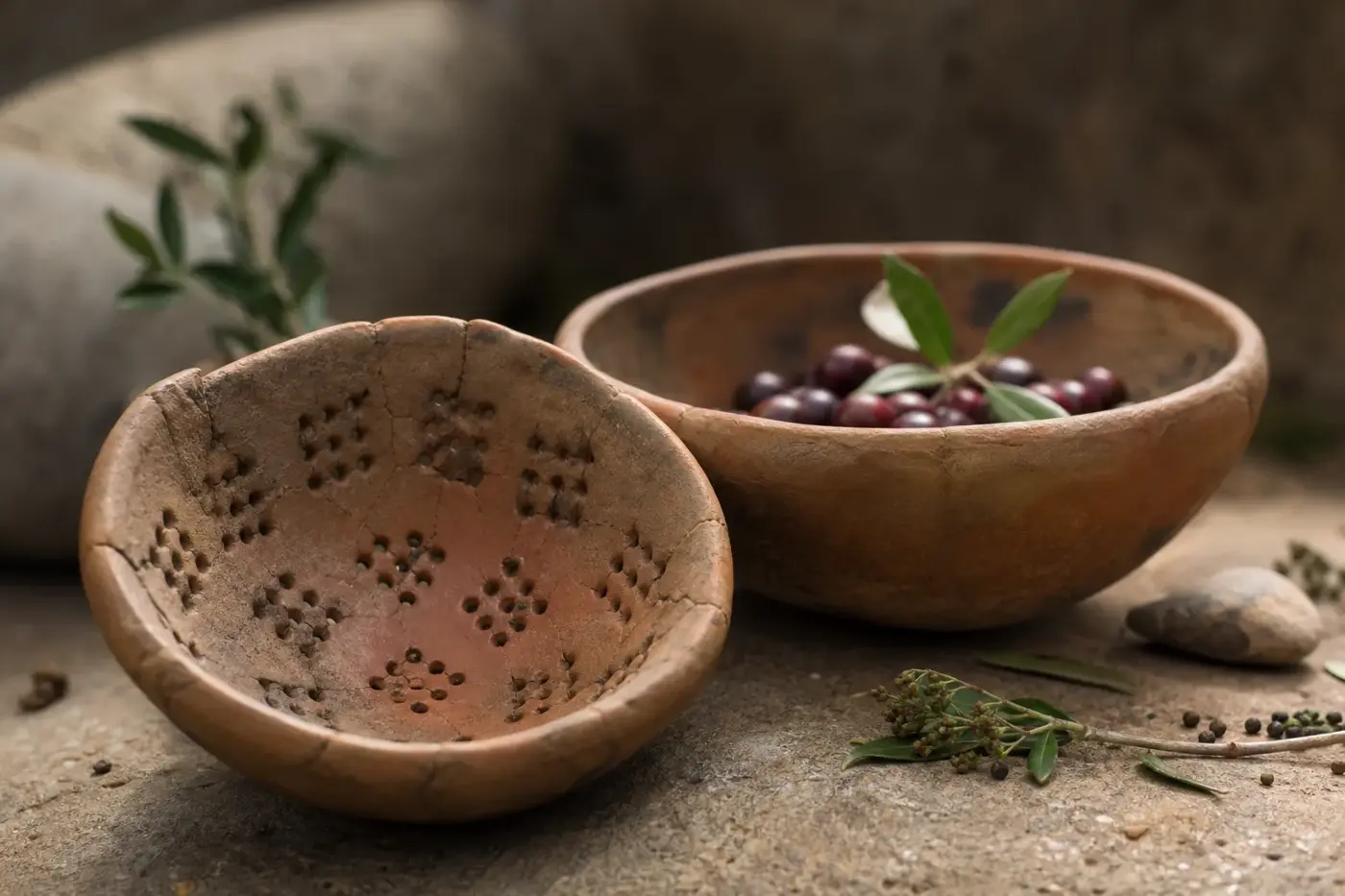
Peer into the tiny holes of a prehistoric pot from Poland. The cheese has gone, but milk fats linger inside the clay, leaving some of the earliest evidence of cheesemaking, from the sixth millennium BCE. Much later, Bronze Age burials at Xiaohe in present day China preserved dried dairy masses beside mummies. One discovery records a process; the other preserves its product.[1,3]
Milk, curds or cheese: follow the clues
Finding milk traces is not quite the same as finding cheese. Archaeologists can establish that people obtained and used milk without knowing exactly what they made. It might have been stored, heated or processed in several ways.[1,2,3]
Cheesemaking takes you a step further. Curd, the coagulated solids, must separate from whey, the liquid released. Surviving cheese offers something different again: actual food material to examine, even if burial has changed its appearance and chemistry.[1,2,3]
Two discoveries can therefore be exceptionally early while answering different questions. A vessel can reveal cheesemaking thousands of years before any surviving lump; preserved food can disclose ingredients and fermentation organisms that pottery residues cannot resolve. Ask what was found, how it was identified and what was actually dated. The biggest age tells only part of the story.[1,2,3,4]
What a broken pot remembers about milk
An ordinary potsherd can hold a surprisingly intimate record of food handling. Unglazed pottery absorbs fats during use, protecting some lipids, the chemical group that includes fats, inside the ceramic long after dinner has disappeared. Researchers extract residues from sampled pottery, then use chromatography and mass spectrometry to separate and identify their components. Suddenly, that broken container has quite a lot to say.[2,6]
One important test measures stable carbon isotopes in two fatty acids, palmitic and stearic acid. Isotopes are forms of the same element with different atomic masses. The relationship between these measurements helps distinguish ruminant dairy fat from carcass fat. Researchers compare the results with reference fats, allowing for biological and environmental influences on their composition.[1,2,6]
Dairy fat tells you that milk products touched the pot. To make a case for cheesemaking, you need another clue. A vessel designed to drain liquid is a promising place to look.[1,2,6]
Kujawy's little holes, and the story they opened
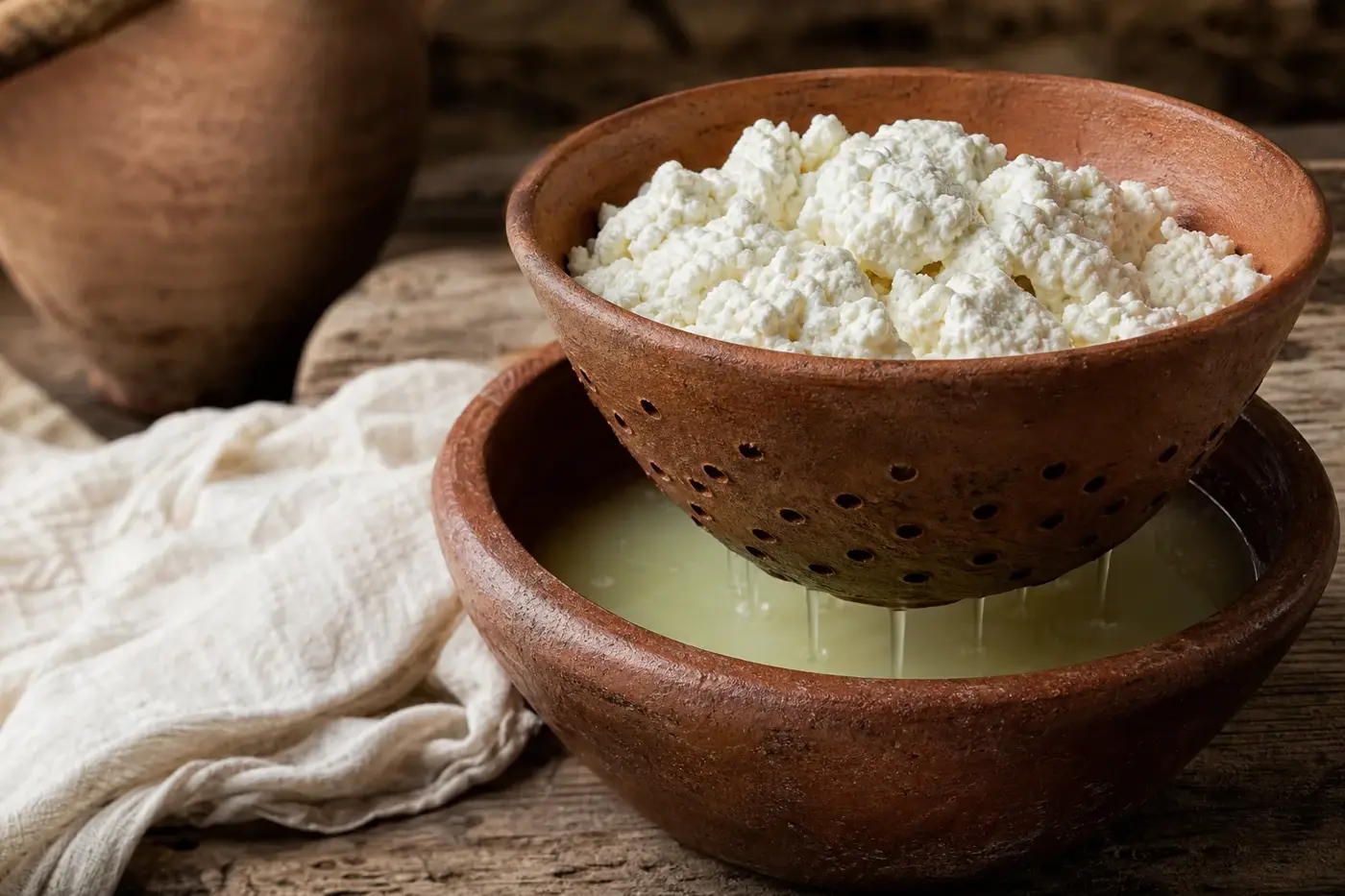
In Kujawy, also called Kuyavia, in present day Poland, Neolithic potters made vessels pierced with numerous small holes. They looked enough like cheese strainers to prompt an archaeological hypothesis decades before chemical testing could support it. The original study, published online in December 2012 and in a 2013 issue of Nature, then found abundant milk fat in these specialised vessels. Their sixth millennium BCE context places them thousands of years before the preserved dairy foods from China and Egypt.[1,7]
Here you have two clues working together: holes suited to draining and chemical evidence of dairy processing. Researchers interpreted that combination as compelling evidence for separating curds rich in fat from whey. A later review also describes dairy residues in bowls from the same regional study, suggesting equipment used alongside the sieves.[1,6]
Other vessel forms held different substances. Compare their shapes and contents, and you begin to see a working activity rather than a collection of fragments. Even in archaeology, a pot should not get a job on looks alone.[1,6]
The evidence strongly supports curd straining, but does not settle the acidification method, any coagulant or the finished cheese's texture. Neither a strainer's shape nor dairy fat alone could settle the question; together, they matter. What survives is equipment associated with cheese carrying milk residues, not a Neolithic cheese. For the modern steps behind separating curd and whey, see how cheese is made.[1,7]
Before the strainers, there was already milk
Follow the milk further back and you travel beyond the Polish strainers. A 2008 study analysed 2,225 potsherds from 23 sites across the Near East and south-eastern Europe. It identified milk use in the seventh millennium BCE, particularly in north-western Anatolia, in present day Turkey.[2]
That established a deep history of dairy processing, although the specific preparations were less securely identified. Geographical differences showed that early farming communities did not all exploit milk in the same way. There was no single dairy story unfolding everywhere.[2]
Fermentation brings another question to the table. Evidence for a fermented dairy food becomes stronger when investigators identify relevant microbial remains alongside milk components, as at Xiaohe. A dairy signal alone tells you about the broader category of milk processing.[2,3,4]
So similar headlines can conceal quite different claims. Handling milk, fermenting it and straining curds each need their own supporting evidence. Keep those claims separate and the history becomes clearer, without making any discovery less important.[2,3,4]
At Xiaohe, the cheese stayed beside the mummies
At Xiaohe cemetery in the Tarim Basin of Xinjiang, present day China, organic masses survived beside Bronze Age mummies. The 2014 protein study gives the cemetery's date range as 1980 to 1450 BCE. Its authors identified the material as kefir cheese, probably made from skimmed ruminant milk. Here you meet preserved dairy matter itself, rather than fat extracted from a vessel that once held it.[3]
The investigation used proteomics, which examines proteins through their constituent peptides, shorter chains of amino acids. It connected milk proteins with a microbial signature of kefir fermentation. That signature included Lactobacillus kefiranofaciens, alongside other lactic acid bacteria and yeasts.[3]
Kefir depends on a partnership of bacteria and yeasts. Finding that partnership reveals something of the fermentation process, not simply the food's dairy origin. The authors interpreted their results as evidence against curdling with ruminant rennet.[3]
Ancient DNA follows kefir's travelling companions
Ancient DNA brought the Xiaohe investigation closer to the organisms that helped make the cheese. The 2024 study recovered it from Xiaohe kefir cheese described as approximately 3,500 years old, taking the work beyond identifying food proteins. The paper reports goat DNA and reconstructs the evolutionary relationships of fermentation bacteria.
Comparisons with modern bacterial genomes led the authors to propose an additional route for kefir's spread from Xinjiang into inland East Asia. They also investigated genetic changes associated with microbial adaptation. You are looking beyond fermentation on a map, towards relationships among organisms that people maintained in their food. Alongside milk use, the Xiaohe samples preserve evidence of a microbial tradition.[4]
Inside the broken jar in Ptahmes's tomb
In the tomb of Ptahmes at Saqqara, Egypt, a broken jar held a solidified whitish mass. Excavators found it during the 2013 to 2014 excavation season, in an area corresponding to a lateral storehouse. The tomb belongs to the thirteenth century BCE.[5]
Canvas associated with the jar offered another clue. Researchers considered it unsuitable for holding liquid, which helped support the interpretation of a solid food. To understand what that food was, though, you need to look inside the material itself.[5]
The analysis, published in 2018, identified nine peptides from milk proteins. These supported cow's milk together with sheep's or goat's milk. The relevant sheep and goat sequences were shared, so the researchers could not distinguish between those species.[5]
The authors described a cheese-like product. Its burial environment, rich in minerals, had altered the material, making proteins more useful for identification than its degraded fats. Dairy chemistry and archaeological context support the conclusion together. The original manufacturing process remains less securely established.[5]
Put the finds together, without muddling the dates
Before you compare the ages, look at what each date belongs to. These are different archaeological materials and contexts. Milk use, curd straining and preserved dairy food tell related stories, but they are not interchangeable.[1,2,3,4,5]
| Find | Reported date | What it tells you |
|---|---|---|
| Northwestern Anatolia | Seventh millennium BCE | Pottery residues show that people used dairy.[2] |
| Kujawy, Poland | Sixth millennium BCE | Milk fats in perforated vessels support curd straining.[1] |
| Xiaohe, China | Cemetery: 1980 to 1450 BCE; DNA study samples: approximately 3,500 years old | Preserved dairy masses were identified as kefir cheese.[3,4] |
| Ptahmes's tomb, Egypt | Thirteenth century BCE | Solid material was identified as a cheese-like dairy product.[5] |
The Polish vessels predate the preserved Xiaohe material by several millennia, and Xiaohe predates the Egyptian find. But a date range for an entire cemetery has a different precision from an approximate age given for analysed samples. Those distinctions matter when you put the discoveries in order.[1,3,4,5]
These finds establish minimum ages for particular practices or surviving foods. They do not give you the year cheesemaking began. However tempting it is to put a birthday candle in the curd, the earlier stages of its development remain beyond the evidence presented here.[1,3,4,5]
What ancient cheese leaves for you to discover
For ancient cheese to survive, conditions have to be exceptional. Xiaohe's dry burial setting preserved organic material; inside pottery, absorbed fats can outlast the food itself. The Egyptian sample shows another possibility: a solid survives while its surroundings transform it chemically.[2,3,4,5,6]
Preservation decides both what reaches the laboratory and which analytical method will be useful. Lipids reveal broad food categories, proteins can identify milk components, and ancient DNA can expose relationships among fermentation organisms. The strongest interpretation brings those results together with the object, its findspot and its dating.[2,3,4,5,6]
What something contains and how old it is remain separate questions. Archaeological context supplies the date range for a vessel or burial, while radiocarbon measurements can date suitable organic material. Identifying dairy molecules establishes what the material contains. To understand where it belongs in cheese's history, you need that scientific identification and its chronological context side by side.[2,3,4,5,6]
Questions people ask
What is the earliest evidence of cheesemaking described on the page?
Perforated pots from Kujawy in present day Poland date to the sixth millennium BCE. Their holes and milk fat residues together support the interpretation that they were used to strain curds from whey.
Where was the ancient surviving kefir cheese found?
It was found beside mummies at Xiaohe cemetery in the Tarim Basin of Xinjiang, present day China. A 2014 study identified the preserved dairy material as kefir cheese, probably made from skimmed ruminant milk.
How do researchers identify ancient dairy products?
Researchers can extract fats absorbed by pottery and compare their chemical signatures with reference fats. They can also examine proteins or ancient DNA in surviving food material to identify milk components and fermentation organisms.
Was milk used before the Polish cheese strainers?
Yes. A study of pottery residues found evidence of milk use in the seventh millennium BCE, particularly in northwestern Anatolia, in present day Turkey. The specific dairy preparations were less securely identified.
What was found in Ptahmes's tomb in Egypt?
A broken jar held a solidified whitish mass identified as a cheese product. Milk proteins supported the presence of cow's milk together with sheep's or goat's milk, although researchers could not distinguish between the latter two.
Sources
-
Nature, Springer Nature: Salque and colleagues, Earliest evidence for cheese making in the sixth millennium bc in northern Europe. Volume 493, pages 522 to 525, 2013; published online 12 December 2012. Publisher abstract, figure descriptions and publication record retrieved. Publisher record.
-
Nature, Springer Nature: Evershed and colleagues, Earliest date for milk use in the Near East and southeastern Europe linked to cattle herding. Volume 455, pages 528 to 531, 2008. Original paper, including methods summary and conclusions. Retrieved paper.
-
Journal of Archaeological Science, Elsevier: Yang and colleagues, Proteomics evidence for kefir dairy in Early Bronze Age China. Volume 45, pages 178 to 186, 2014. Publisher abstract and research highlights retrieved. Publisher record.
-
Cell, Elsevier: Bronze Age cheese reveals human-Lactobacillus interactions over evolutionary history. 2024, DOI 10.1016/j.cell.2024.08.008. Publisher summary and research highlights retrieved. Publisher record.
-
Analytical Chemistry, American Chemical Society: Greco and colleagues, Proteomic Analyses on an Ancient Egyptian Cheese and Biomolecular Evidence of Brucellosis. 2018. Author manuscript held by the University of Trieste. Retrieved manuscript.
-
Journal of Archaeological Science: Reports, Elsevier: Roffet-Salque and colleagues, From the inside out: Upscaling organic residue analyses of archaeological ceramics. Volume 16, pages 627 to 640, 2017. Author manuscript held by the University of Bristol. Retrieved manuscript.
-
Princeton University: Clay pot fragments reveal early start to cheese-making, a marker for civilization. 9 January 2013. Institutional account of the Polish investigation, including comments from a study participant. University account.
-
Chinese Academy of Sciences: Cheese from Mummies' Graves Reveals Secrets of Ancient Fermentation. 27 September 2024. Institutional media account; indexed extract retrieved. Institutional account.
This desk-researched article compares archaeological contexts, residue chemistry, protein identification and ancient DNA findings, distinguishing original research from institutional reporting.
Last checked: November 2026
Last checked November 2026.
The editors suggest you read next
A History of Cheese: From the First Curds to Global Food
Picture cheese lying beside Bronze Age burials in China's Tarim Basin, surviving for approximately 3,500 years.