A History of Cheese: From the First Curds to Global Food
Picture cheese lying beside Bronze Age burials in China's Tarim Basin, surviving for approximately 3,500 years.
Picture cheese lying beside Bronze Age burials in China's Tarim Basin, surviving for approximately 3,500 years. At the Xiaohe cemetery, that unlikely scene became archaeological evidence. Elsewhere, the clues are quieter: milk fat in perforated pots, dairy equipment in account books, curds draining in baskets.[1,3,8,11]
Archaeology puts cheesemaking thousands of years before surviving written accounts. The first maker and method remain unknown, but you can see the attraction: curds could make milk easier to keep and carry. Trade, migration and increasingly controlled production would help take cheese around the world.[1,3,8,11]
Milk becomes something you can carry
Curds gather much of milk's fat and protein into something smaller and more portable. They are the coagulated solids; whey is the liquid that drains away. Removing that liquid concentrates nutrients, while fermentation and further drying can help the resulting food keep.[1,9]
For livestock keepers, this opened a useful possibility. Milk from a productive season could become food for later, or something to carry on a journey. That practical appeal helps explain why cheesemaking endured, even if its earliest inventor and method remain out of reach.[1,2]
You can still recognise the transformation in how cheese is made. Equipment and control have changed enormously, but the thread remains: people learned to repeat a useful process, then adapted it to different animals, places and markets. Follow those adaptations and a way of handling milk becomes a wonderfully varied food.[8,9]
What the pottery has to tell you
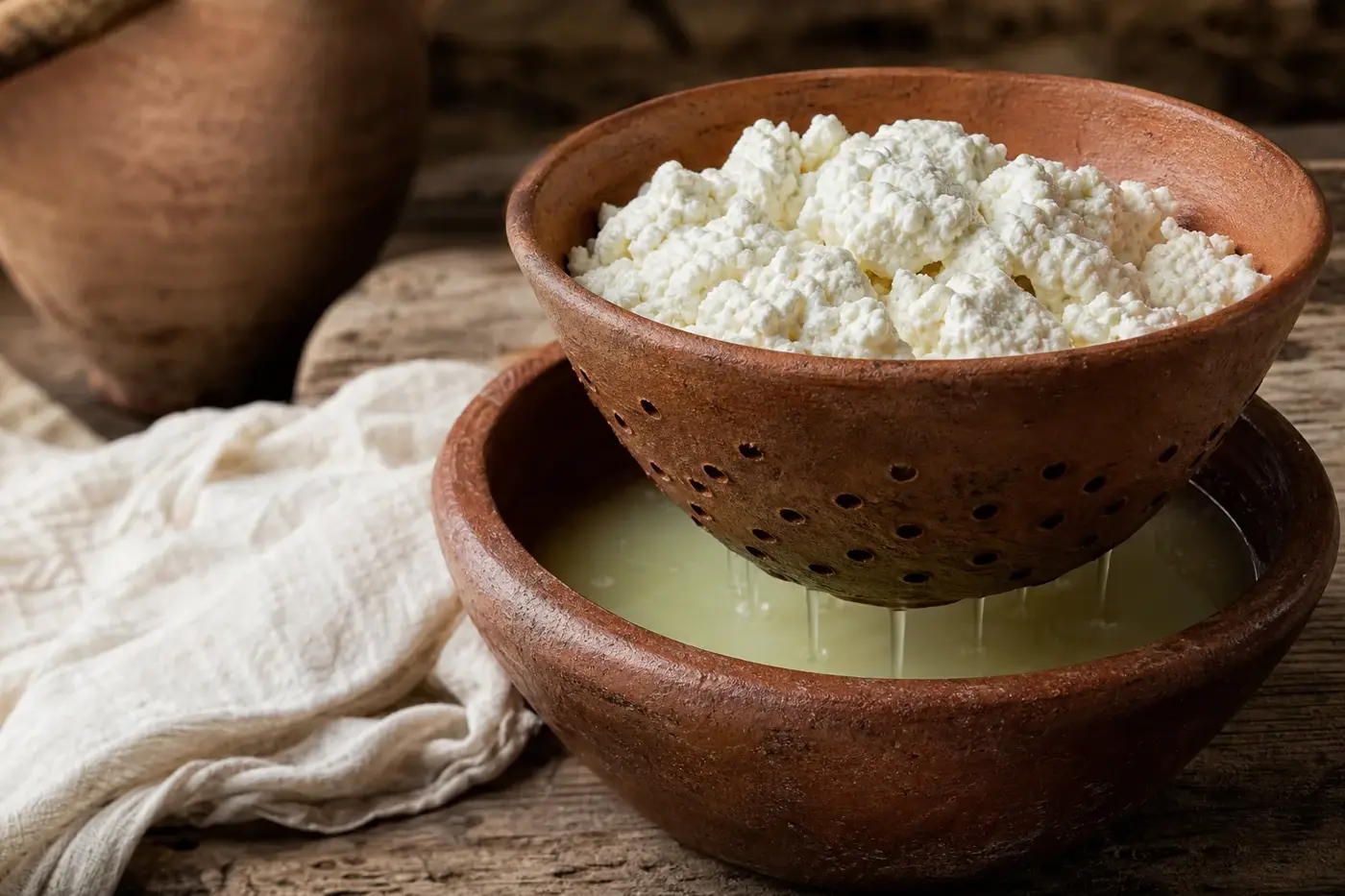
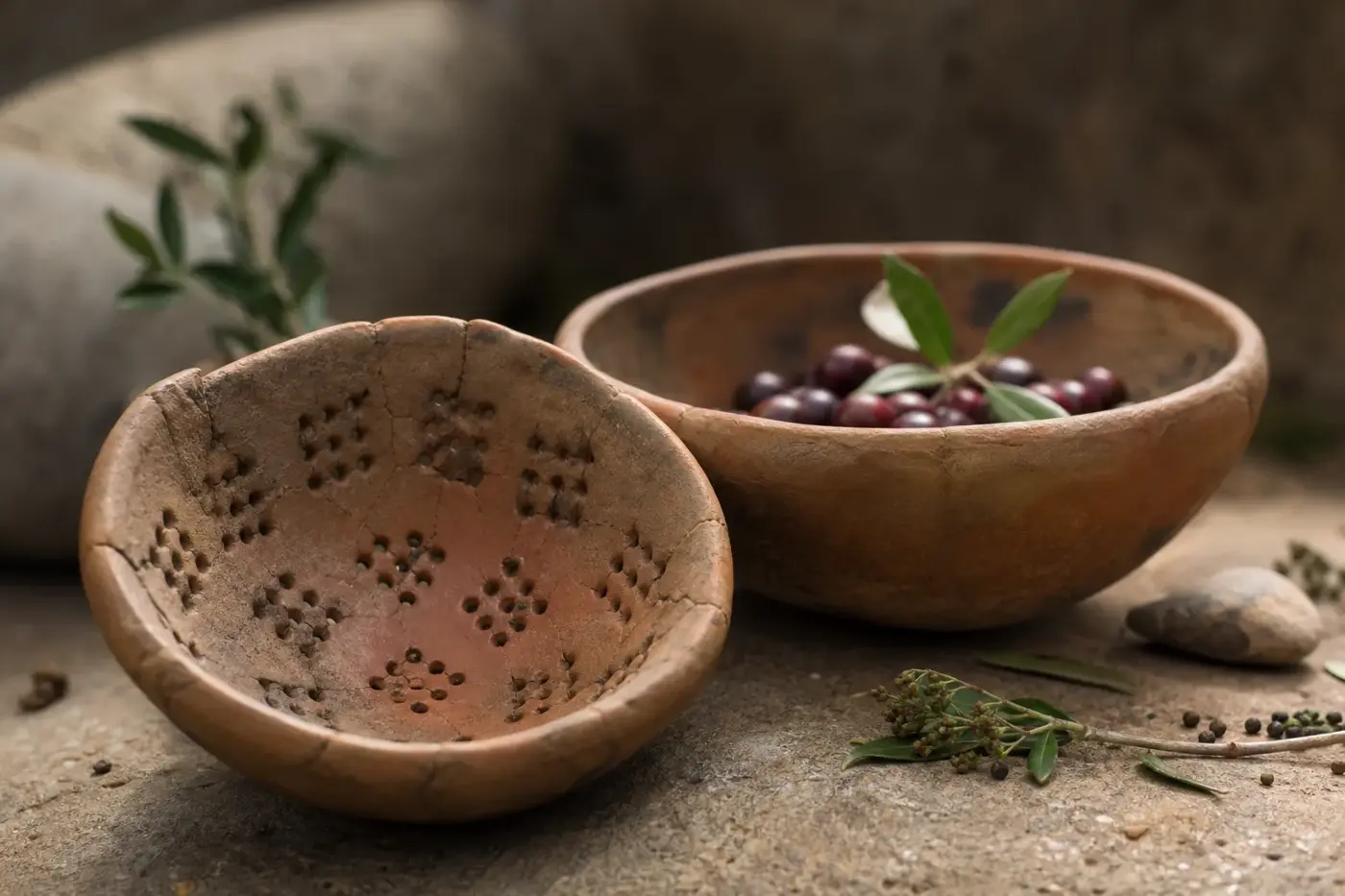
In Kuyavia, in what is now Poland, fragments of perforated pottery bring two clues together. There are milk fats, and holes through which liquid could drain while solids stayed behind. A study published online in December 2012 and in a 2013 journal issue interpreted that combination as evidence of cheesemaking in the sixth millennium BC.[1]
Chemistry tells you most when it agrees with an object's likely function. Milk residue establishes dairy use, but cannot identify the product by itself; holes have several possible uses too. Together, vessel shape, residues and archaeological context make a stronger case for draining curds than any single clue.[1,2]
| The clue | What it tells you | What still needs interpretation |
|---|---|---|
| Milk fats in pottery | Dairy products were handled. | The product and processing method.[1] |
| Milk fats in a perforated vessel | Dairy use consistent with draining curds. | The recipe and cheese's texture.[1,2] |
| Preserved dairy material | The food itself can be sampled. | Its original appearance, flavour and everyday use.[3] |
| Written description | What an author recorded. | How widely the practice was followed.[4,5] |
The researcher who first proposed the Polish sieves as dairy equipment linked their shape with the abundant cattle bones at the sites. Later chemical work added another kind of evidence. An interpretation drawn from objects and their surroundings could now be tested, then strengthened, through analysis.[2]
These finds document early cheesemaking in a particular region, not necessarily the beginning of every cheese tradition. Earlier or parallel practices using perishable equipment could have left much less behind. What survives shapes how much of the story you can recover.[1,2]
A piece of cheese outlasts the centuries
At Xiaohe, researchers could examine preserved food rather than infer dairy processing from a vessel. A 2024 study recovered ancient DNA from cheese approximately 3,500 years old and identified it as kefir cheese. The dairy material had survived alongside Bronze Age burials in China's Tarim Basin.[3]
Its microbes offer another route into the past. Using ancient genetic material, the study investigated relationships between people and the bacteria involved in fermentation. It proposed an additional route by which kefir spread from Xinjiang into inland East Asia. Here, maintained microbial communities tell the story alongside herds, utensils and human movement.[3]
That distinction helps you untangle apparently competing claims about the oldest cheese. Evidence of people draining dairy products can be much older than a surviving piece of cheese: one dates an activity, while the other preserves material for sampling. Neither brings back the original taste of a prehistoric meal, but each opens a different part of its history.[1,3]
Step inside the dairies of Greece and Rome
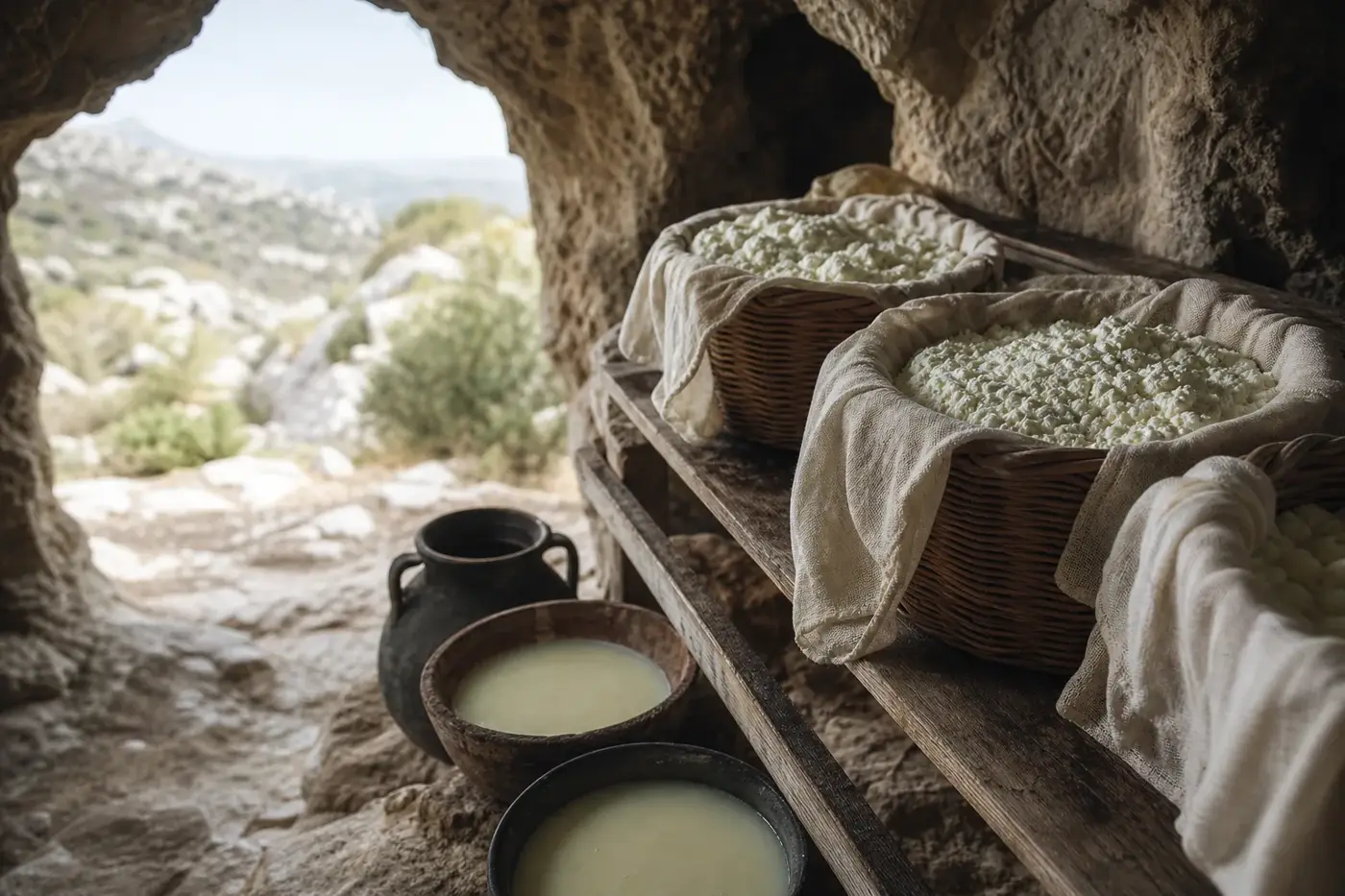
Racks laden with cheeses, separate pens for young animals and vessels containing whey greet visitors to a shepherd's cave in Book IX of the Odyssey. Later, milk is curdled and its solids placed in wicker baskets. You can almost follow the work around the cave: stored cheeses here, draining curds there, equipment close at hand.[4]
These details belong to an imaginative story whose audience could recognise dairy work. The cave's owner is mythical, but its furnishings draw on familiar practice. Alongside archaeological residues and vessels from actual settlements, the passage offers something different: cheesemaking as it appeared within the world of an epic.[1,4]
Roman agricultural writing leaves storytelling for the business of managing land and livestock. The surviving De re rustica belongs to this practical tradition.[5] Such texts show historians how work was organised and how an author expected farming knowledge to pass between people. They prescribe rather than describe every household's habits, but reveal what their writers thought worth teaching and preserving.
Medieval cheese leaves a paper trail
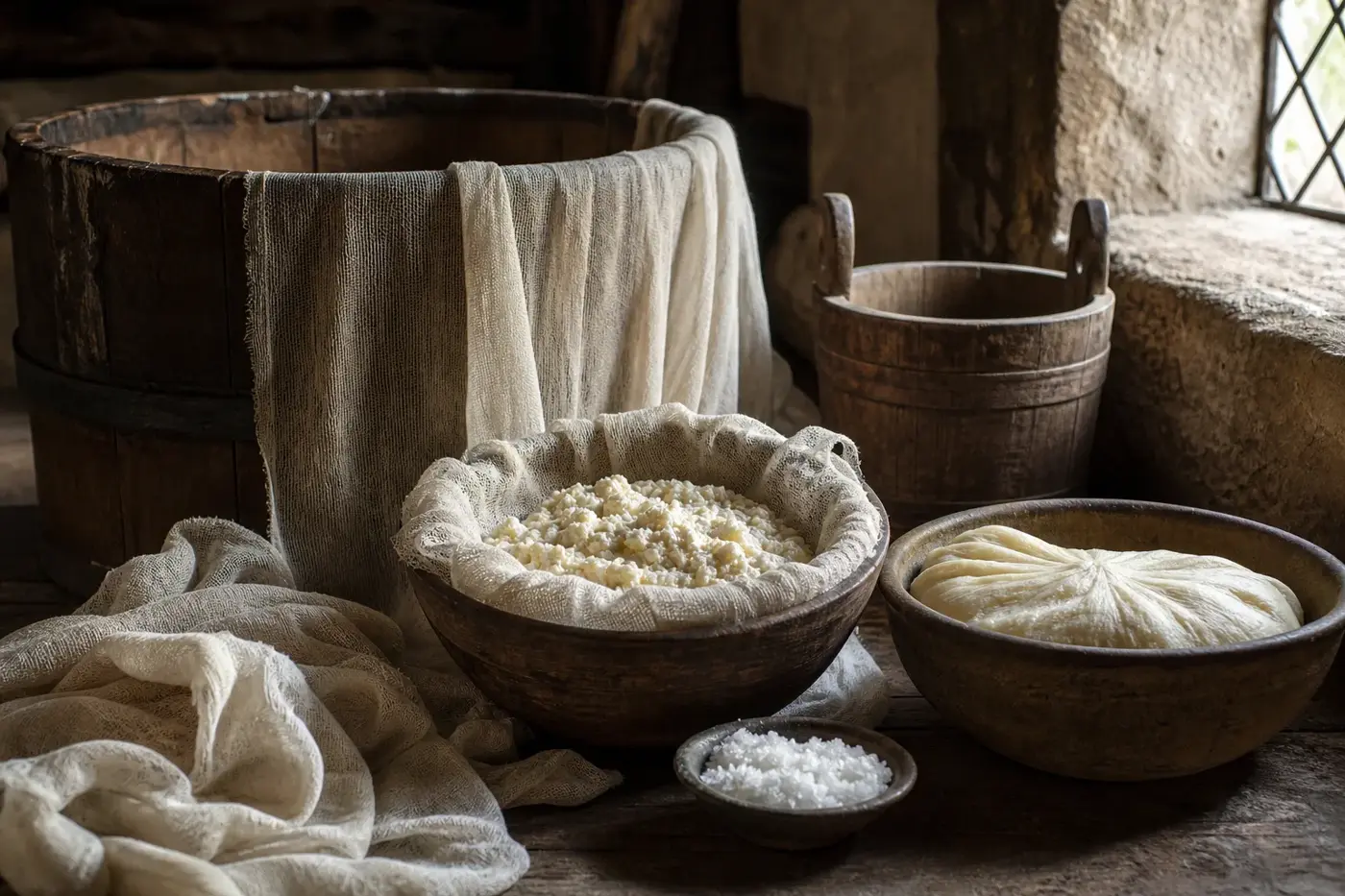
A cheese vat or drying hurdle can tell you more about medieval dairy work than a grand origin story. A documentary study of Durham Cathedral Priory identifies both in surviving accounts, alongside cheese purchases. The hurdle, recorded for 1465 to 1466, gives a small, concrete glimpse of equipment used to handle cheeses.[6]
Account books become more revealing when you consider how a household worked. Food produced on an estate might leave fewer purchase entries than food brought in from outside. The priory's relatively scarce milk purchases therefore belong alongside its livestock and dairy equipment. Quiet accounts may tell you how food was supplied, rather than how little dairy food was eaten.[6]
Surviving monastic records give religious institutions unusual visibility in cheese history. The farms supplying them, and the people doing everyday dairy work, deserve space in the picture too. Documented cheese use illuminates consumption and estate management. Proving that a monastery invented a particular modern cheese needs a separate chain of evidence, connecting the claim across time.[6]
How a place finds its flavour
Regional character grew from repeated decisions: which animals supplied the milk, how curds were drained, where cheeses dried or matured. Working conditions brought the environment into the dairy. Decisions at the vat and during ripening brought the maker's skill. Climate and craftsmanship worked together; neither explains the cheese alone.[7,10]
In Minas Gerais, Brazil, an official cultural publication describes pingo: whey collected from an earlier batch for the next day's cheesemaking. It presents this as knowledge maintained across generations, bringing technique, local conditions and the maker's judgement together. You find regional identity in that daily repetition, not simply in a place name.[7]
Names and methods do not always arrive in the record together. A locality may have made cheese long before anyone wrote down a recognisable variety name; a familiar name may survive even as its method changes. For the differences that reach your plate, cheese styles offer a clearer starting point than an origin legend claiming an unbroken past.[2,7,8]
Cheese packs its bags
Cheesemaking travelled with animals, equipment and people who knew how to turn milk into food. In Brazil, the Minas cultural account connects cattle and Portuguese cheesemaking practices with the development of local farm traditions. Those traditions took shape through adaptation to the region, not the simple reproduction of an imported recipe.[7]
New Zealand's history brings distant buyers into view. A 1937 account of its dairy industry records farm cheesemaking, export experiments and the difficulty of getting dairy produce to faraway markets. Before refrigerated shipping, Australia was an important outlet. In some early ventures, according to that account, cheese proved a better traveller than butter.[11]
These movements were part of colonisation as well as food exchange. Herds, settlements, production systems and overseas demand developed together. The same New Zealand history describes imported American dairy machinery and cheesemaking expertise brought from Britain. An export industry could draw on several sources of knowledge as it took shape somewhere new.[11]
Distance made packing and timing part of the cheesemaker's concerns too. The 1937 account describes export experiments involving manufacture and packing, as well as the voyage itself. Preserving milk was no longer solely a task inside the dairy. Handling, storage and transport formed a chain, with every stage affecting whether food reached its destination.[11]
The much earlier Xiaohe evidence gives Asian fermented dairy its own place in this wider history. Europe's later global trading networks make a substantial chapter, but not the opening one. The story already had multiple regional centres long before those networks developed.[3]
Factories bring cheese to a bigger table
The factory brought milk from several farms into one specialist operation, changing the scale of cheesemaking. The contemporary Book of Cheese, published in 1918, places the development of the American factory system around 1851. It describes rapid expansion in the decades that followed.[8]
The book also says the first American factory operator's identity was not definitely known. What emerges is the spread of a production system, rather than a tidy moment of invention. Its account links factory production with English market demand for larger, more uniform cheeses. Buyers, as well as makers, were shaping what came out of the dairy.[8]
Standardised starter cultures made fermentation more predictable. A starter is a microbial culture added to begin that process. By 1918, technical writing distinguished naturally soured starters from commercial cultures of selected bacteria, available in liquids, powders and other forms. Makers could increasingly choose and maintain the organisms responsible for acid development, bringing another part of production under closer control.[8]
Refrigeration changed where dairy produce could travel. The New Zealand history identifies 1882 as a turning point associated with refrigeration, after decades of export experiments.[11] Controlled cooling also became important within the dairy. A modern scientific review identifies refrigeration, reliable cultures and pasteurisation as major changes in American cheese production, connecting transport and manufacture through greater control of conditions.[12]
Pasteurisation reshapes the work at the vat
Heating milk changed the microbial population available to the cheesemaker. Pasteurisation, a controlled heat treatment, made choosing and adding cultures especially important. Makers also had to consider how treated milk formed curd and developed acidity. Adopting it meant adjusting a process, not simply adding a heating stage.[9]
A United States Department of Agriculture bulletin issued on 30 June 1913 documents experiments in making cheddar-type cheese from pasteurised milk. Comparisons of starter use, curd handling and production schedules reveal makers working through the technical questions. Their aim was repeatable cheese from milk whose properties had changed through treatment.[9]
One setback makes those questions tangible. In June 1910, cheese became gassy and developed unwanted flavour; examination found the same gas-forming organism in both the starter and the cheese. Heating the milk had been one intervention, but organisms introduced afterwards still helped determine the outcome. Microbial management had to extend beyond pasteurisation itself.[9]
Raw milk cheesemaking continued through systems maintaining their own combinations of milk, cultures and local knowledge. The Minas account describes raw cow's milk used alongside repeated reuse of pingo.[7] More recent research into traditional starter cultures explains why continuity matters biologically: repeated cultivation maintains distinctive microbial communities, even as those communities keep changing.[10]
You can explore the treatments in raw milk, thermised and pasteurised cheese. Their history brings heat treatment and microbial management together. Both changed the conditions in which cheesemakers worked, and both required knowledge of what happened to milk as it became curd.[9,10]
When cheese became a national concern
By 30 April 1941, cheese was a matter of British national supply planning. In a parliamentary debate that day, the Ministry of Food explained that it wanted milk available for cheese and condensed milk that would normally have been imported. Drinking milk and manufacturing milk had become connected questions of reserves and distribution.[13]
Rationing also revealed cheese's practical place in working lives. Parliamentary answers in April 1941 describe a supplementary ration for underground miners and agricultural workers because they needed suitable food to take to work. Access to meals, rather than simply the physical demands of their jobs, lay behind that explanation.[14]
The restrictions lasted well beyond the fighting. On 25 January 1954, the government announced that rationing of butter, cheese, margarine and cooking-fat would end on 8 May that year.[15] That announcement shows how far wartime food administration reached into postwar eating. Restoring variety meant more than getting dairies working again: milk supply and distribution still shaped what could be made and eaten.[13,15]
Craft revival, with science at its side
The revival of farmhouse and artisan cheese also meant rebuilding professional networks. The UK's Specialist Cheesemakers Association dates its establishment to 1989. Its stated activities include sharing technical information, helping members solve problems and supporting innovation. Keeping craft alive could mean organised scientific and practical exchange, as well as preserving inherited methods.[16]
That makes a neat division between tradition and science rather unhelpful. Shared methods, training and discussion can help a small dairy keep working; innovation can happen in a farmhouse. Recovering practical knowledge and developing new knowledge are closely connected. Both give makers the understanding they need to carry on.[16]
Industrial production developed alongside this revival. A 2017 scientific review describes how better understanding of starter bacteria supported reliable fermentation and made automation feasible.[12] Large-scale operations and small dairies can use the same microbiology while choosing different equipment, cultures and ways of organising labour. Their knowledge may overlap even when the cheeses they want to make differ.[10,12]
In 2024, a study used genetic analysis and laboratory measurements to examine traditional cheese starter cultures. It found signs of microbial domestication, including reliable acidification and adaptation to the cheesemaking environment.[10] Repeatedly growing a culture over generations can leave biological traces. Modern research reveals them, just as chemical analysis uncovered the dairy history held in ancient pottery.[1,10]
Farm knowledge in Brazil, export systems in New Zealand and ancient fermented dairy in inland Asia all belong to this global history.[3,7,11] They offer different forms of continuity and change, not a single path from simple curds to modern cheese. Methods and foods travelled, while their diversity continued to depend on people adapting them to the places where they worked. There is rather more history on your cheeseboard than its size suggests.[3,7,11]
Follow your curiosity beyond the cheeseboard
- Cheese: The Complete Guide: take your exploration beyond cheese history.
- How Cheese Is Made: From Milk to Cheese: follow the processes behind these changes.
Questions people ask
Where is the earliest evidence of cheesemaking?
In Kuyavia, now in Poland, perforated pottery containing milk fats provides evidence of cheesemaking in the sixth millennium BC. The holes are consistent with draining liquid from curds.
Who invented cheese?
The first maker and method remain unknown. Archaeology places cheesemaking thousands of years before surviving written accounts.
What is the oldest surviving cheese described on the page?
A 2024 study identified cheese found at Xiaohe as kefir cheese approximately 3,500 years old. The researchers recovered ancient DNA from the preserved food.
How was cheese made in ancient Greece?
In Book IX of the Odyssey, a shepherd's cave contains racks of cheeses and vessels of whey. Later in the story, milk is curdled and the solids are placed in wicker baskets.
When did cheese factories develop?
The Book of Cheese, published in 1918, places the development of the American factory system around 1851. It also says the identity of the first American factory operator was not definitely known.
Sources
-
Nature, Earliest evidence for cheese making in the sixth millennium bc in northern Europe, volume 493, 2013, pp. 522 to 525; published online 12 December 2012. Publisher record and abstract.
-
Princeton University, Neolithic Cheese Production, researcher's account of the sieve hypothesis and subsequent residue analysis, undated web edition consulted in 2026. Research account.
-
Cell, Bronze Age cheese reveals human-Lactobacillus interactions over evolutionary history, 2024, DOI 10.1016/j.cell.2024.08.008. Retrieved abstract; full text was unavailable during this research session. Publisher record.
-
Internet Classics Archive, Massachusetts Institute of Technology, The Odyssey, Book IX, digital edition of the English translation. Book IX.
-
LacusCurtius, University of Chicago, Columella: Extant Works (De Re Rustica and De Arboribus), digital edition and editorial introduction, describing the underlying printed editions. Edition introduction.
-
Durham University, Monks and Markets: Durham Cathedral Priory, 1460-1520, doctoral thesis, repository record 1534, especially pp. 76 to 77 and the references to the priory account rolls. Publication year not verified. Repository PDF.
-
Assembleia Legislativa de Minas Gerais, Nossa comida tem história, English-language section “Minas Gerais artisinal cheese”, pp. 139 to 141 in the consulted PDF. Publication year not verified. Cultural publication.
-
The Macmillan Company, The Book of Cheese, 1918, especially sections 57 to 59 and 296 to 297. Digitised by Project Gutenberg. Full text.
-
United States Department of Agriculture, Bureau of Animal Industry, The Manufacture of Cheese of the Cheddar Type from Pasteurized Milk, issued 30 June 1913, especially the sections on bacterial starter and production schedules, pp. 40 to 45. Digitised original bulletin.
-
Nature Communications, Genomic and phenotypic imprints of microbial domestication on cheese starter cultures, published 5 October 2024. Research article.
-
New Zealand Government Printer, A History of the New Zealand Dairy Industry, 1937, especially the chapters covering early expansion, export experiments and factory development. Digitised volume.
-
American Dairy Science Association, A 100-Year Review: Cheese production and quality, Journal of Dairy Science, volume 100, 2017, pp. 9952 to 9965. Historical scientific review. Publisher PDF record.
-
UK Parliament, Hansard, Supply, House of Commons debate, 30 April 1941, especially the Ministry of Food statement on milk allocation and manufacturing reserves. Official debate.
-
UK Parliament, Hansard, Cheese Rationing, House of Commons debate, 23 April 1941, volume 371, columns 151 to 154. Official debate.
-
UK Parliament, Hansard, Fats and Cheese (De-rationing), written answer, 25 January 1954, volume 522, columns 197 to 198W. Official announcement.
-
Specialist Cheesemakers Association, About Us, current institutional account consulted in November 2026. An industry association's statement of its own foundation and activities. Association account.
This piece was researched through archaeological studies, an ancient literary text, documentary scholarship, contemporary dairy publications and official parliamentary records, distinguishing material evidence from interpretation.
Last checked: November 2026
Last checked November 2026.
The editors suggest you read next
The Earliest Known Evidence of Cheesemaking and Surviving Cheese
Peer into the tiny holes of a prehistoric pot from Poland.