Did Monasteries Change Cheesemaking? What the Records Show
Salt, cheese-cloths, cheese-vats, buckets, bowls and rennet.
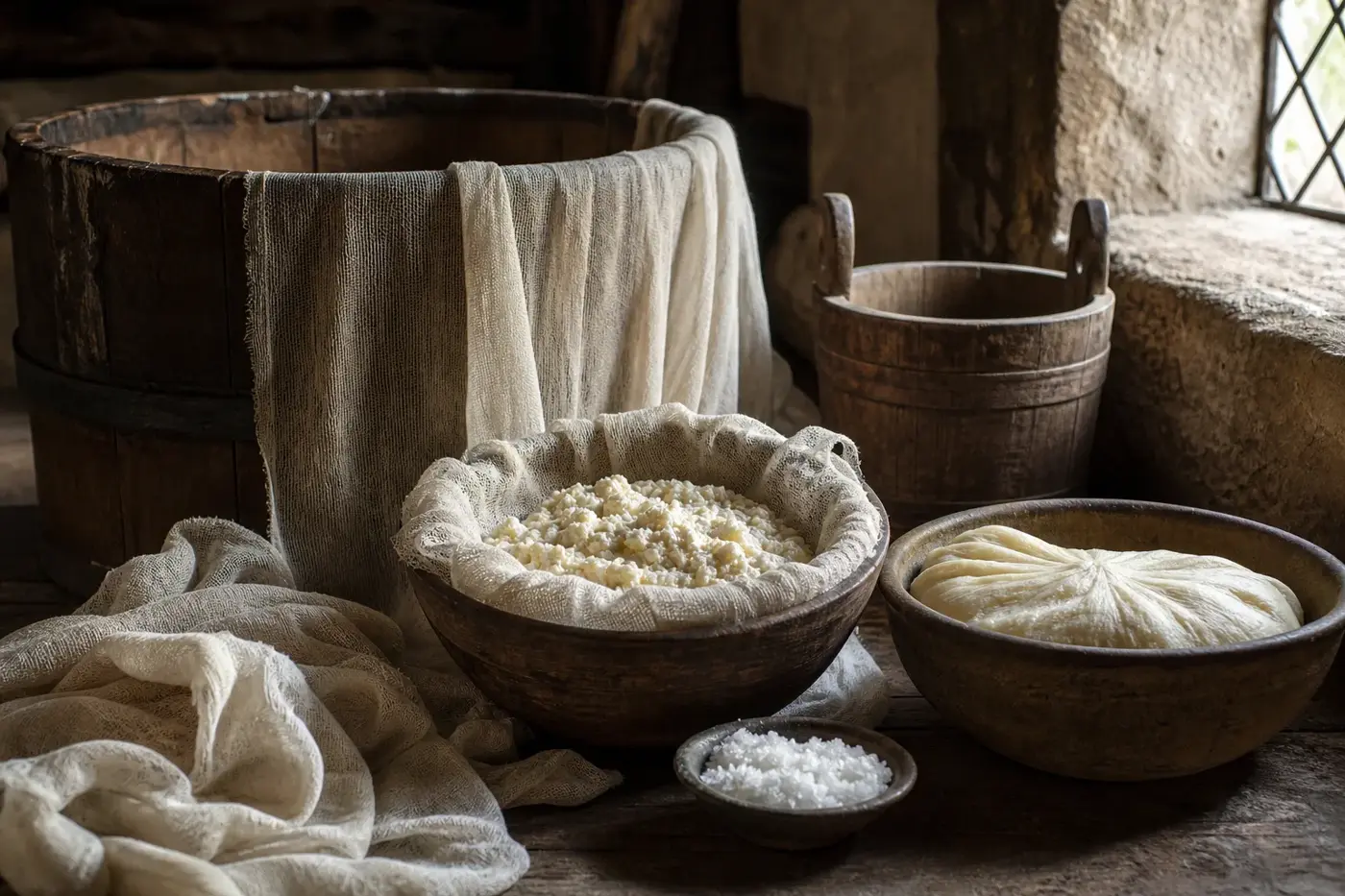
Salt, cheese-cloths, cheese-vats, buckets, bowls and rennet. Read the dairy purchases at Morden in 1348/49, a manor belonging to Westminster Abbey, and you can almost see the work waiting to be done. These ordinary objects tell you more than an invention legend: monasteries organised farms, sustained dairy work and sometimes built ripening facilities and developed cheeses for wider markets. Their clearest documented achievements were practical ones, with plenty of work behind them.[3][10]
Cheese was already an old hand
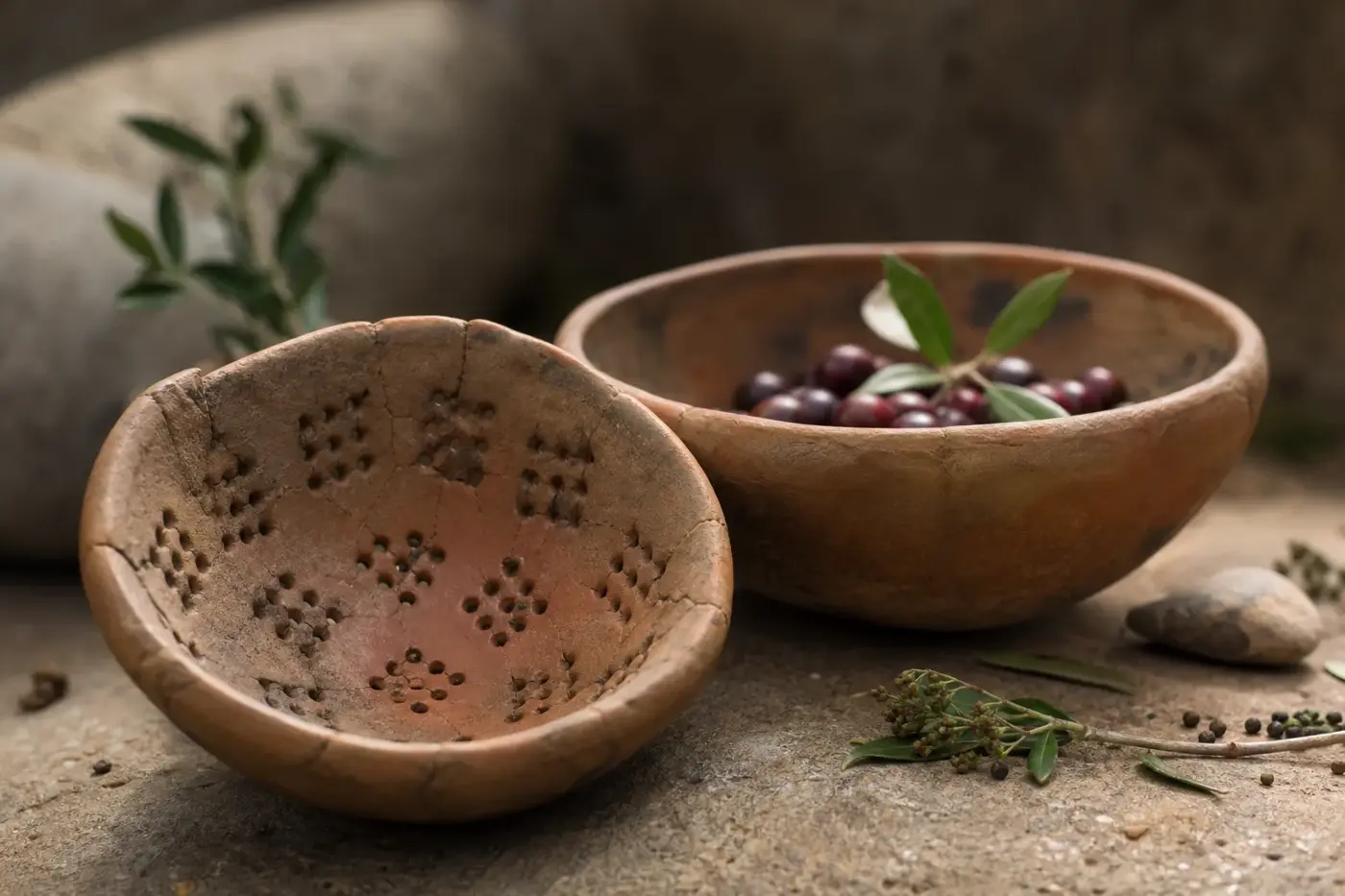
Travel back about 7,200 years, thousands of years before Christian monasteries, and people were already making cheese. Pottery from two Neolithic settlements on Croatia’s Dalmatian coast holds traces of dairy processing. The clues lie in the carbon isotope signatures of fatty acids absorbed into the vessels.[1]
Researchers interpreted residues in particular vessel types, including sieves, as evidence of cheese production. Their argument brings the chemical measurements together with the pots’ shapes and archaeological context. By the time monasteries entered the story, separating milk into curd, the solid fraction, and whey, the liquid, was already a very old human skill. Cheese had quite a head start.[1]
First, feed the community
Picture the daily task of feeding residents, workers and guests. The Rule of Saint Benedict envisages an organised household with a cellarer, kitchens, tools, cultivated ground and hospitality. Dependable food mattered, and livestock belonged in that working economy.[2][4]
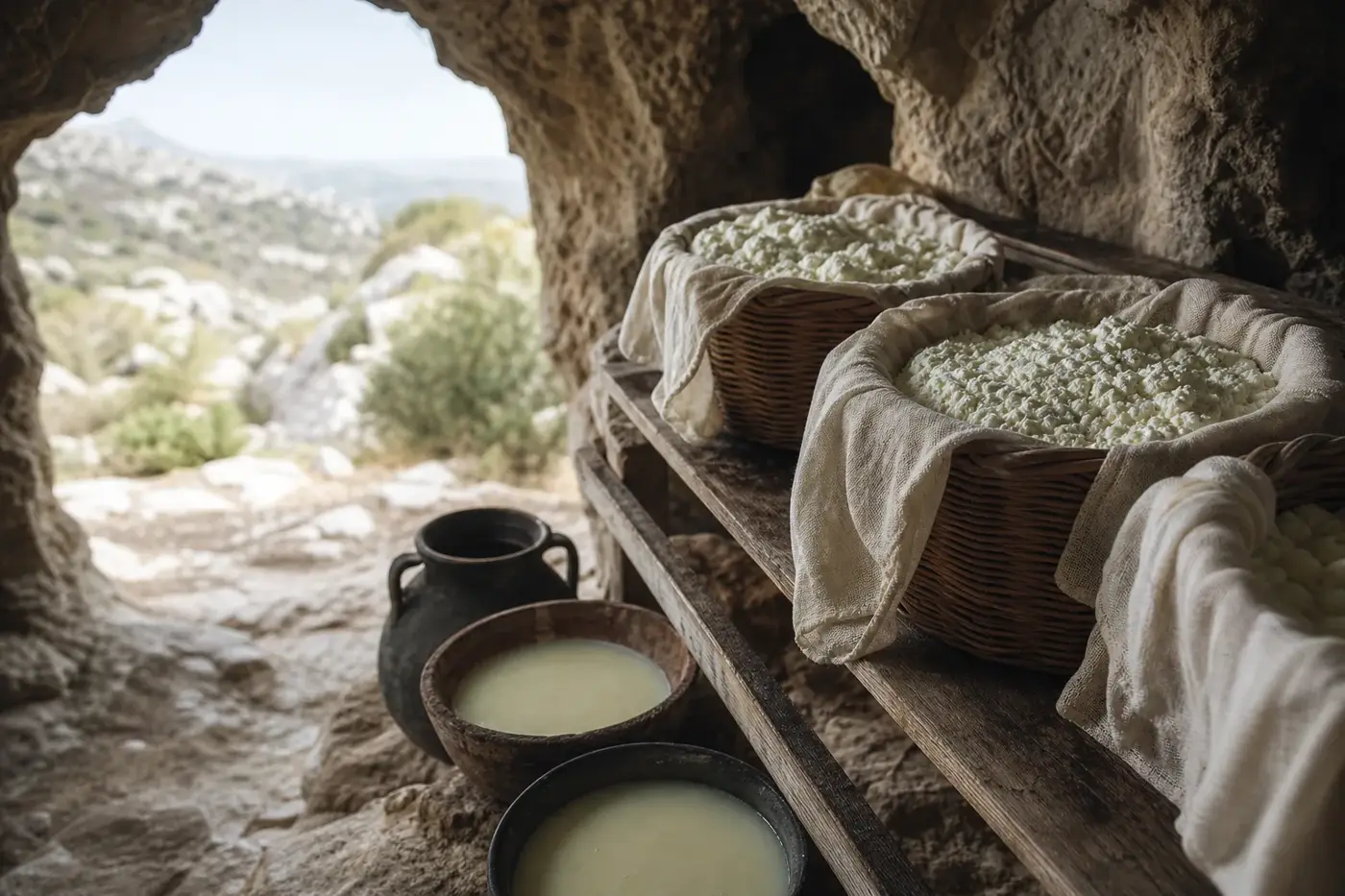
Milk could be drunk or turned into products that lasted longer. Evidence from Danish Cistercian communities describes seasonal milk supplies becoming butter and cheese, a practical answer to a practical problem. Alongside grain and vegetables, a working dairy helped keep the community fed. That is where you find the story’s beginnings, rather than in secret recipes or a special religious reason for making cheese.[2][4]
What Saint Benedict actually put on the menu
Open the Rule of Saint Benedict and you find guidance on food, work and communal organisation, not instructions for your next cheese. Chapter 39 provides for two cooked dishes, with extra fruit or vegetables where available. It restricts the flesh of four-footed animals, with an exception for the sick.[2]
Chapter 48 sets aside time for manual labour and reading, including agricultural work when circumstances demand it. Chapter 66 recommends keeping essential facilities and crafts within the monastery where possible. None of these three chapters specifies a cheese recipe, rind treatment or ageing period. Nor does the Rule require every monastery to run its own cheese dairy.[2]
Follow the shopping into Morden’s dairy
Morden’s account roll brings you closer to the working dairy through its purchases. Alongside the salt, cloths, vats, buckets and bowls bought in 1348/49 came rennet. This substance coagulates milk, bringing its proteins together into curd.[3]
The published study quotes the account’s explanation that the dairy operated for the lord’s profit. Here you have equipment, ingredients and an economic purpose, attached to a particular place and date. What you do not get is the cheese’s flavour, rind, shape or precise manufacturing sequence. The accounts are excellent company until you ask for tasting notes.[3]
Listen to the bones, look at the pots
An abbey’s food story rarely sits neatly in one kind of evidence. Animal bones, vessels and human remains answer different questions. The published investigation of Danish Cistercian food culture brings archaeological finds together with written records, discussing pottery and table equipment along the way. It gives you several routes into everyday eating.[4]
The investigation also reports isotope analyses of human bones from Øm Abbey. These suggest increasing consumption of animal protein during the medieval period. That tells you about diet, not a particular dairy practice: animal protein could reach the table in several forms. The measurement cannot identify cheese, much less a named cheese or recipe.[4]
The richest histories set these different clues beside one another. A cheese purchase records incoming food; rennet and cheesemaking equipment point towards production. A rent clause tells you what a tenant owed, while an account of receipts can tell you what actually arrived. Chemical analysis adds another layer when residues survive in a secure archaeological context.[1][3]
Ownership, manufacture and consumption still need to stay distinct. A monastery might enter a cheese’s history as landlord, buyer or seller, while unnamed people did the milking and curd-making. Keep those roles in view and you get closer to the people whose working days made the dairy possible.[1][3]
When fasting took cheese off the table
You may know the tidy version: monks could not eat meat, so they developed cheese. But fasting could take cheese off the table too. The thirteenth-century discussion of fasting in the Summa Theologiae expressly addresses eggs and milk foods.[5]
It describes a general prohibition during Lent, then explains that customs for these foods during other fasts differ between communities. You are looking at variation, not one dietary timetable for every abbey. Whether dairy reached the table depended on the fast, the community and the period. That makes the familiar origin story rather less straightforward.[5]
Step beyond the walls and into the fields
An abbey’s influence on cheese could begin with land, long before milk reached a vat. Morden’s records distinguish land managed for Westminster Abbey from holdings occupied by tenants who owed rents and services. Even the dairy could be leased, creating another working relationship between the institution and its milk.[3]
Follow only monks at work and you miss the management of land, animals and labour that made production possible. The later Port du Salut account brings surrounding farms into view too. As the cheese business grew beyond the monastery and its immediate district, the abbey supplemented its own milk through organised collections from neighbouring herds.[3][10]
Look for the hands that worked the curd
The institution’s name does not necessarily tell you who made its cheese. English Heritage’s account of women in male monasteries identifies milkmaids among the women employed by religious houses. Paid female labour could therefore support an abbey’s dairy alongside members of the religious community.[6]
A specific example of dairy work by nuns remains an open question here. For any abbey dairy, ask who owned the herd, who supervised the dairy and who actually performed the work. Otherwise, a male institution’s name can hide the people whose labour turned milk into cheese.[6]
Munster: let the landscape lead
For Munster, the landscape gives you a clearer starting point than an invention claim. INAO, France’s official institute for origin and quality, explains the cheese through the Vosges and the two centres reflected in its names. Those are Munster in Alsace and Gérardmer in Lorraine.
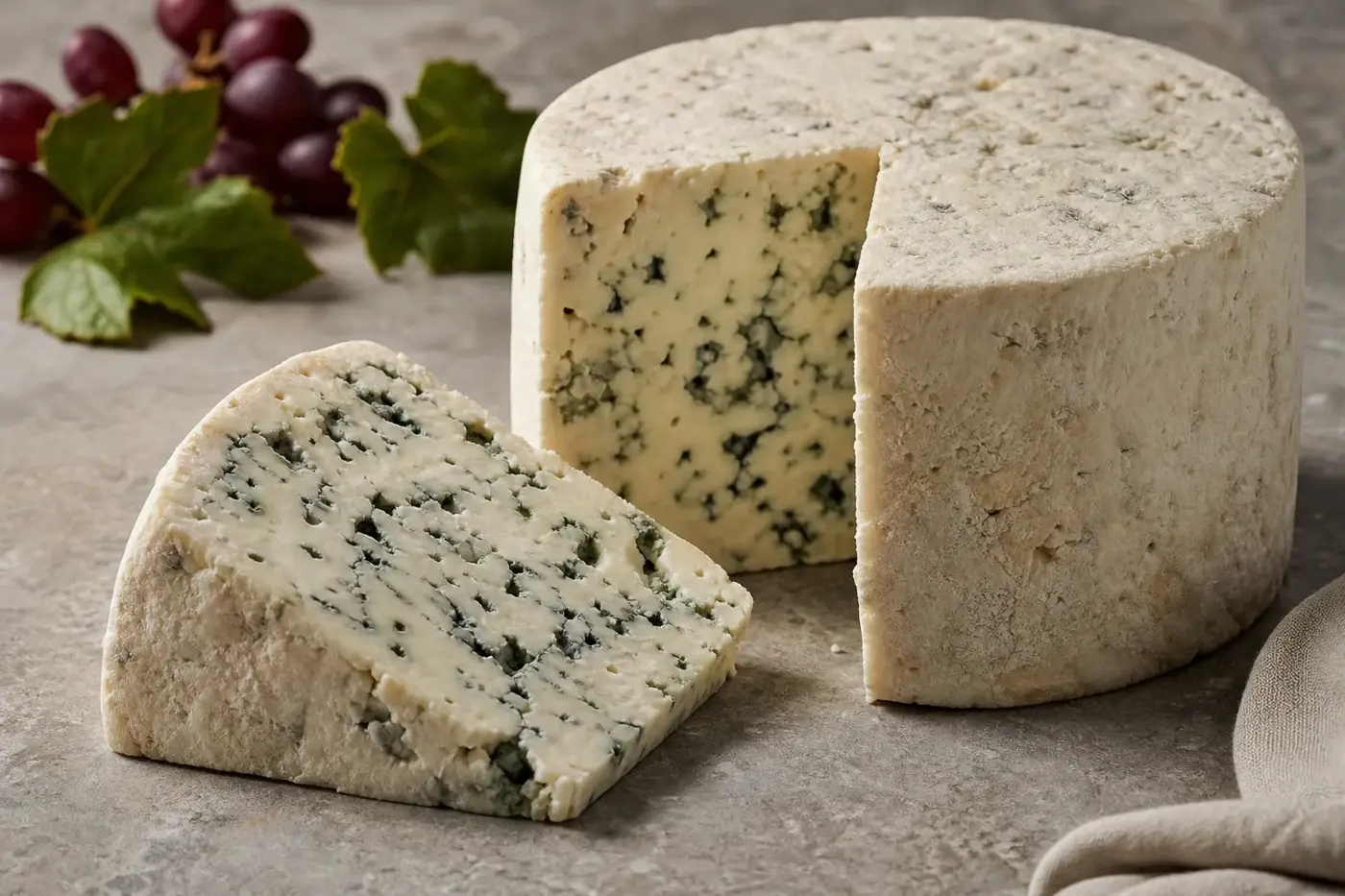
Its account connects humid conditions with the development of ripening skills and the rind’s characteristic colour. These are the particular features of a regional cheese tradition. Munster’s first documented appearance, and whether a religious community invented it, remain unresolved questions. An invention claim needs evidence of the practice, the people responsible and its relationship to cheesemaking elsewhere.
The product specification published in 2018 shifts your attention from a single founder to a chain of expertise. It describes specialist affineurs, the people who mature cheese. They could buy unripened cheeses from remote production areas and ripen them nearer consumers. That division of work connected milk producers, cheesemakers, maturers and markets.[8]
The distinction matters when you tell the cheese’s history. A dated mention establishes that a cheese was present. Establishing invention takes evidence of the technique and the people who introduced it at that particular place. Both achievements deserve attention, but they are not the same achievement.[8]
Port du Salut: a dairy reaches beyond the abbey
At Port du Salut, you can follow a more traceable institutional story. The abbey commemorated the arrival of its returning Trappist community on 21 February 1815. Its retrospective history describes a progression from agriculture to cheesemaking, followed by expansion of the dairy and its markets.[9][10]
The chronology of those developments remains uncertain.[10] Still, the abbey’s account of its own enterprise gives you a sequence of investment, milk collection and wider distribution. Those activities make the community’s contribution tangible. There is more to get your teeth into here than an undated tale of monks discovering a cheese.[9][10]
A contemporary document gives you a firmer foothold. A French circular dated 3 February 1934, reproduced in the Annales des falsifications et des fraudes, describes Port-Salut as a cow’s milk cheese with a washed surface. You have a specific description at a specific moment.[10]
The abbey’s retrospective history goes on to describe a later transfer of the brand and a return to cheese production under another name. The dates and subsequent commercial history leave the relationship between the abbey and later products an open question. The contemporary description and the retrospective narrative each tell a different part of the story.[10]
Four dates and clues to keep beside you
| Date | The record | What it tells you |
|---|---|---|
| 1348/49 | Morden estate account | An abbey estate bought dairy equipment and ingredients.[3] |
| 1815 | Abbey commemoration | The community arrived; this is not a documented cheesemaking start date.[9] |
| 1934 | Contemporary circular | Port-Salut appeared in print with a washed surface.[11] |
| Date uncertain | Abbey’s retrospective history | The abbey recounts a later brand transfer.[10] |
Give the everyday achievements their due
Productive estates, organised dairy work, ripening facilities and routes to wider markets: these were substantial monastic contributions. Preserving or refining a practice is not the same as inventing it. It deserves recognition in its own right, without an invention legend attached.[3][10][11]
A washed rind is a surface treated with moisture during ripening; it cannot identify or date an original inventor. If you want to explore the process, follow how cheese is made. For the history, keep farmers, dairy workers, religious communities and commercial successors in view. Each belongs in the account, credited for the contributions the surviving evidence supports in detail.[3][10][11]
Take your curiosity beyond the monastery
- Cheese: The Complete Guide: find monastic dairying’s place in the bigger cheese story.
- How to Tell Cheese Styles Apart: Milk, Rind, Texture and Method: get to know production methods without confusing them with origin stories.
- How to Read a Cheese Label: untangle a product’s maker, brand and stated origin.
Questions people ask
Did monasteries invent cheese?
No. People were making cheese about 7,200 years ago, thousands of years before Christian monasteries. Monasteries contributed by organising farms, sustaining dairy work and, in some cases, building ripening facilities and developing cheeses for wider markets.
Did the Rule of Saint Benedict require monks to make cheese?
The Rule sets out a pattern of food, work and communal organisation, not a cheesemaking manual. It gives no cheese recipe or ageing period and does not require every monastery to maintain a working cheese dairy.
Who made cheese for monasteries?
The hands making an abbey’s cheese were not necessarily those of monks. English Heritage identifies milkmaids among the women employed by male religious houses.
Did a monastery invent Munster cheese?
The evidence examined on the page does not resolve whether a religious community invented it or when it was first documented. INAO connects Munster with the Vosges and the places reflected in its names: Munster in Alsace and Gérardmer in Lorraine.
What is the connection between Port du Salut and an abbey?
The abbey commemorated the arrival of its returning Trappist community on 21 February 1815 and later described a progression from agriculture to cheesemaking and wider markets. A French circular dated 3 February 1934 described Port-Salut as a cow’s milk cheese with a washed surface.
Sources
- PLOS ONE, Fatty acid specific δ13C values reveal earliest Mediterranean cheese production 7,200 years ago, volume 13, issue 9, 2018. Original archaeological residue research, available through PubMed Central.
- Roman Roads eText, Saint Benedict: The Rule, version 1.0, 2015 electronic edition, particularly chapters 39, 48 and 66. Retrieved edition.
- Merton Historical Society, Medieval Morden: The Manorial Economy, 1280-1500, 2020. Published study incorporating translated account extracts and archival references. Full text.
- Kuml, På munkenes bord: Cisterciensernes mad og madkultur i middelalderens Danmark, volume 69, online publication 2021. Journal record and English summary.
- New Advent, Summa Theologiae, Second Part of the Second Part, question 147, article 8, thirteenth-century text in the English Dominican translation, revised edition 1920. Text.
- English Heritage, Women in Male Monasteries: An Illicit Presence?, undated institutional historical account. Retrieved account.
- Institut national de l’origine et de la qualité, Munster, undated product record, retrieved November 2026. Official record.
- French Ministry of Agriculture, Cahier des charges de l’appellation d’origine protégée Munster ou Munster-Géromé, Bulletin officiel no. 49, 6 December 2018, particularly the geographical-link discussion. Cited here as a dated document. Retrieved specification.
- Abbaye du Port du Salut, Sur les pas des fondateurs, 2015 commemorative account. Abbey account.
- Abbaye du Port du Salut, Et le fromage ?, undated retrospective institutional history. Abbey account.
- Société des Experts-Chimistes de France, Annales des falsifications et des fraudes, no. 302, February 1934, pages 109 to 113, reproducing Circular no. 116, Définition des principales espèces de fromages, dated 3 February 1934. Digitised contemporary publication.
This desk-researched article compares religious instructions, published account extracts, archaeological research, an official product specification and the abbey’s own historical narrative.
Last checked: November 2026
Last checked November 2026.
The editors suggest you read next
A History of Cheese: From the First Curds to Global Food
Picture cheese lying beside Bronze Age burials in China's Tarim Basin, surviving for approximately 3,500 years.