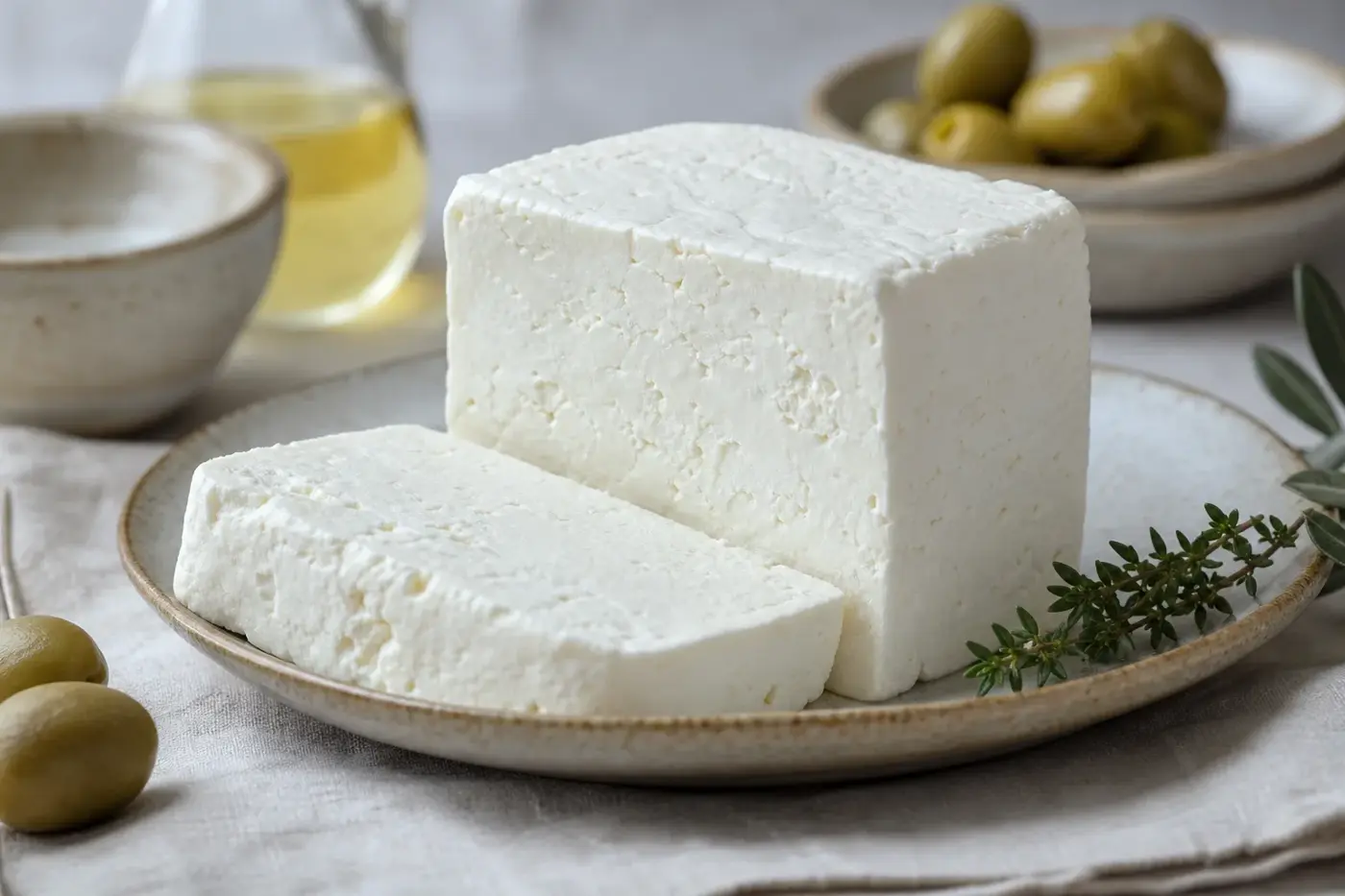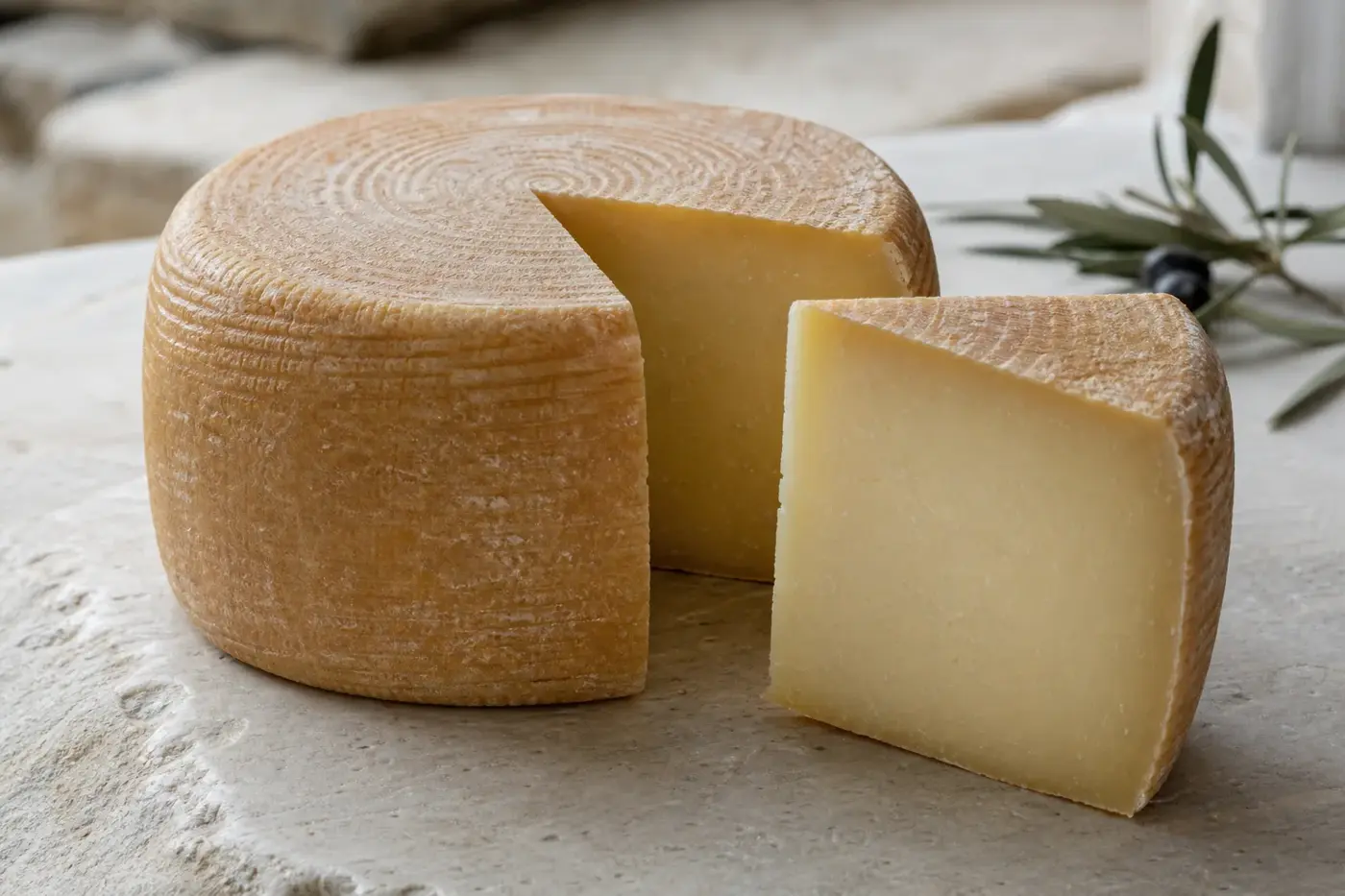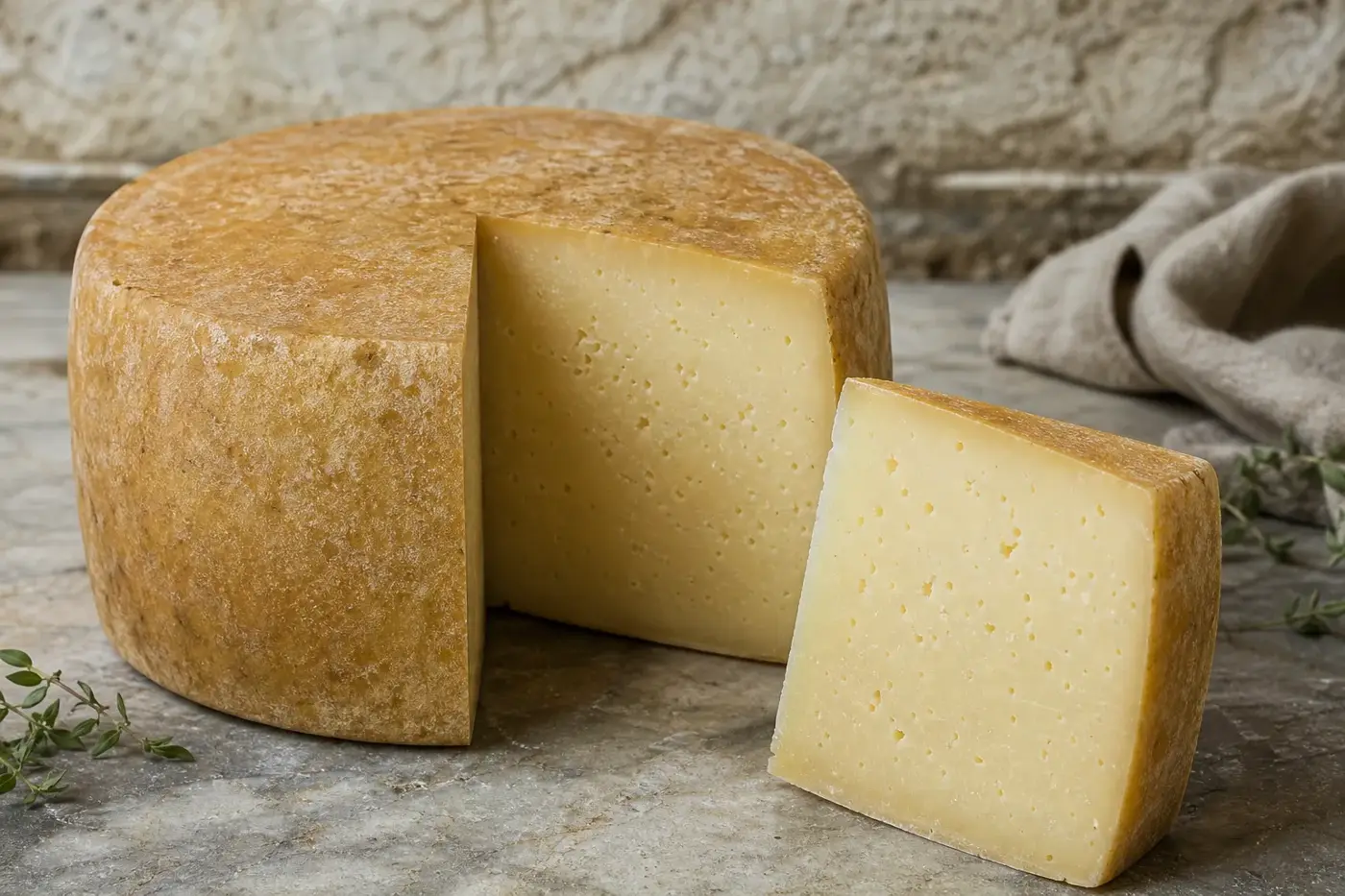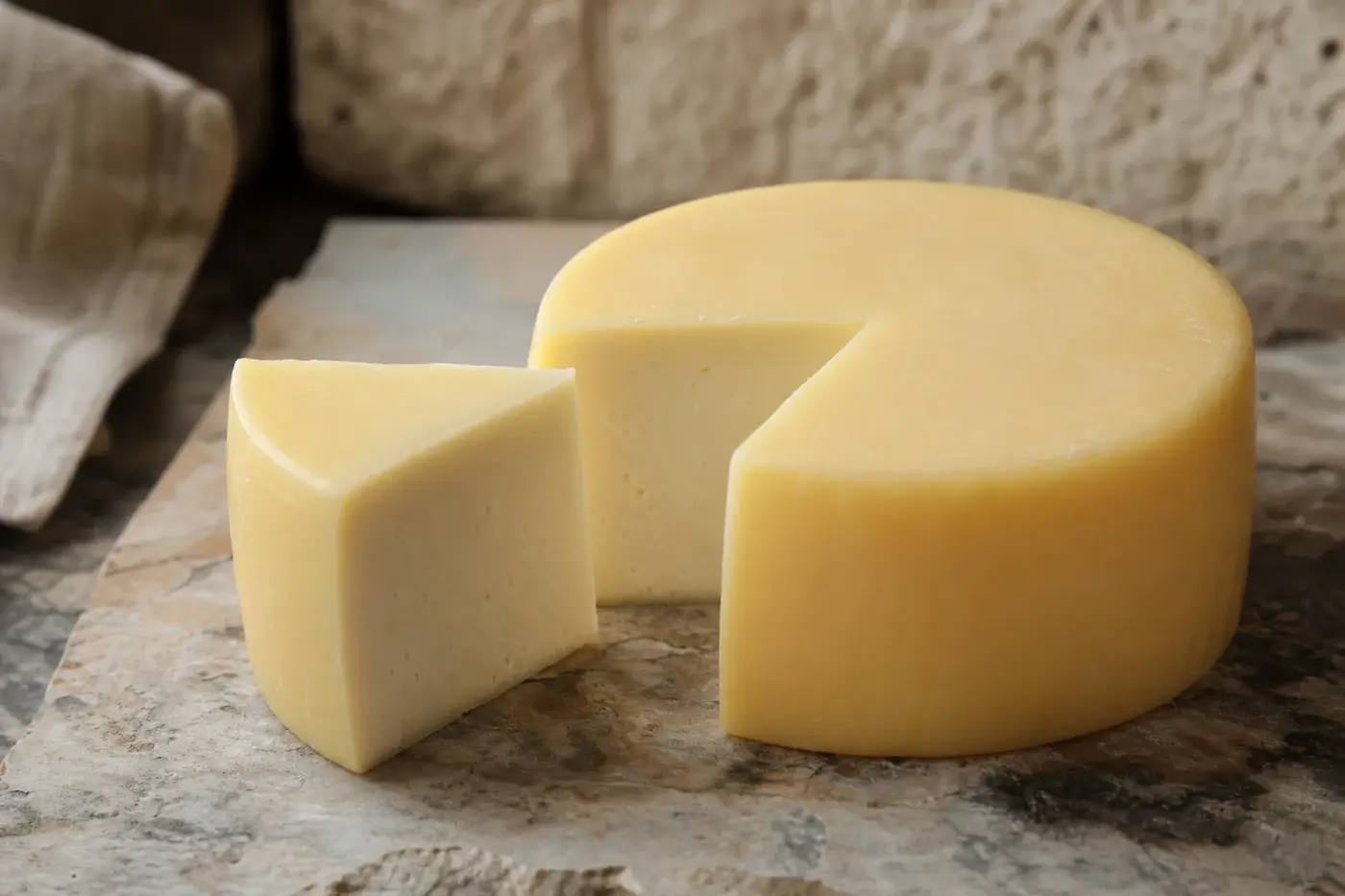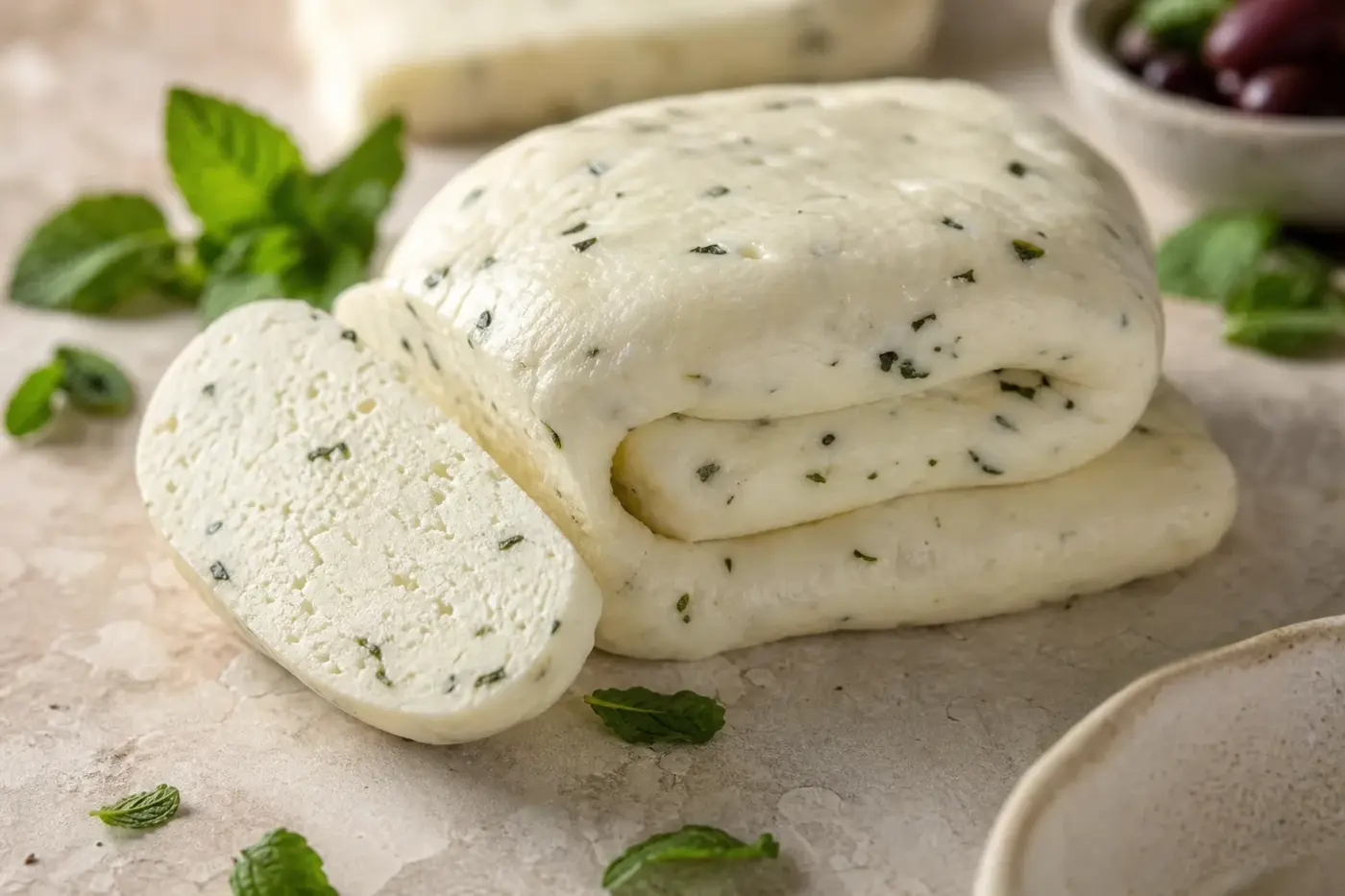
A slice browns on the grill. You take a bite, and it squeaks against your teeth, still proudly holding its shape. Halloumi has a little resistance to offer: relatively low acidity, a calcium-linked protein structure and a defining bath in hot whey give it that springy resilience.[1,2,3]
Pronunciation: /həˈluː.mi/, huh-LOO-mee, in English.[8]
Meet the fresh and mature characters
Fresh halloumi gives you a close-textured, elastic bite, its colour running from white to light yellow. The specification describes aromas of milk, whey and mint. Choose mature halloumi and you get something firmer and saltier, with bitterness and sharpness also described.[1]
The mint is no passing flourish. It belongs in the registered recipe, alongside milk, rennet and salt. That familiar fold also tells you something about the making, although not every piece must have one: the 2023 amendment permits unfolded cheese too.[1,7]
The secret behind a slice that holds its ground
Heat softens halloumi, but it does not spread like a melting cheese. Picture a network of milk proteins enclosing water and fat. Relatively little acid develops during manufacture, helping calcium stay associated with casein, the principal milk protein, and connect that network.[2,3]
Then comes the hot whey bath. The curd, the solid mass separated from liquid whey, is cooked in it. Research on ovine halloumi describes this characteristic stage at 90 to 95 °C, a treatment that helps build the cheese's heat-resistant structure.[3]
A 2025 study in Food Chemistry: X explored how acidity affects cooking behaviour. Researchers tested cow's-milk halloumi-type cheeses at different pH values using microscopy, rheological measurements and frying tests. As pH fell from 6.53 to 5.33, calcium phosphate dissolved and melt flow increased.[2]
Those experimental cheeses differed from the specified Cypriot milk mixture. Even so, the work gives you a direct connection between acidity, mineral balance and what happens when these cheeses meet heat.[2]
That squeak has something to tell you
The sound is your teeth rubbing against halloumi's elastic protein structure. The Cheese Science Toolkit explains that young, low-acid cheeses retain calcium-linked proteins that resist your bite and generate the squeak. As acidification or protein breakdown changes the structure, the sound can diminish.[4]
You are hearing the texture you feel, a cheese with its own modest sound effect. The squeak varies from cheese to cheese because milk composition and manufacture both influence the protein structure.[2,4]
Milk and fat level play their parts, too. A 2009 study compared experimental sheep's- and cow's-milk cheeses at three fat levels, using instrumental texture measurements and trained sensory panellists. The cow's-milk cheeses were squeakier in that experiment, so your ears alone cannot tell you much about the milk mixture.[26]
Give your halloumi its moment on the grill
Because halloumi resists flowing, you can brown its surfaces on a grill or in a frying pan and still have a recognisable slice. Kornos Dairy's product catalogue recommends a medium to high grill and a grilling time of 2 to 3 minutes. Follow your own pack's instructions: that guidance belongs to the maker's products.[2,9]
What the PDO milk rule means for your cheese
The permanent PDO specification requires sheep's milk, goat's milk, or the two combined to exceed cow's milk. PDO means Protected Designation of Origin, linking the registered name to its production area and specification. Eligible halloumi producers have transitional arrangements for meeting that milk-composition requirement.[5,10]
If the mixture on your pack looks different from the permanent rule, the dates matter. Here is how the transition unfolded:
- 9 July 2014: Cyprus decision 326/2014 granted a ten-year transition, subsequently recognised in Article 2 of Regulation 2021/591.[5]
- 8 July 2024: Cyprus adopted RAA 252/2024, extending the transition by five years from 9 July 2024, to July 2029. Its stated application date is 10 July 2024.[10]
- 20 September 2024: the Cyprus decision was published for information in the EU Official Journal as C/2024/5681, under Article 20(7) of Regulation (EU) 2024/1143.[10]
- 15 May to 31 December 2026 inclusive: Cyprus decree K.D.P. 230/2026 sets a transitional minimum of 15% sheep and goat milk combined.[11]
That 15% minimum applies to the specified 2026 period and may change. The decree also provides for continuation unless changed, tied to the extended transition. The permanent requirement remains that sheep and goat milk together exceed cow's milk.[10,11]
Where the halloumi name is protected
The registered name Χαλλούμι (Halloumi) / Hellim has EU PDO protection, with production and packaging in Cyprus. The EU registration was recorded on 13 April 2021. Regulation (EU) 2021/591 was adopted on 12 April and applies from 1 October 2021.[5,6]
Beyond that, you need to distinguish both the territory and the kind of protection involved. This November 2026 picture separates historical registrations and treaty lists from current register status.
| Where you are | Protection or recorded position | Source |
|---|---|---|
| Cyprus | PDO production area; national certification mark reported by the Cyprus ministry. | [5,12] |
| EU | Registered PDO; protection applies from 1 October 2021. | [5,6] |
| Great Britain | No Halloumi, Hellim or Χαλλούμι entry in the GOV.UK GI register. The Cyprus ministry identifies collective mark UK00901082965. | [12,13] |
| Northern Ireland | EU GI protection applies. | [14] |
| Switzerland | No entry in the federal AOP/IGP register or the EU names listed in Annex 12 as replaced by Decision 2/2022. | [15,16] |
| United States | Certification mark 1,591,489 documented in USPTO records. Current registration status: uncertain. | [17] |
| Canada | Absent from the Canadian GI list and CETA Annex 20-A as at 6 November 2026. Trade mark status: uncertain. | [18,28] |
| Australia | Absent from DFAT's dairy GI page for the Australia and EU agreement, which was not yet in force at the November 2026 snapshot. Current GI and trade mark status: uncertain. | [19] |
| New Zealand | Status uncertain. |
Great Britain shows you why the distinction matters: a geographical indication and a collective trade mark are separate rights. The Cyprus ministry identifies EU collective mark 001082965 and UK collective mark UK00901082965 with the Foundation for the Protection of the Traditional Cheese of Cyprus named Halloumi. Live EU and UK register and renewal status in November 2026 remains uncertain.[12]
Collective marks distinguish members' goods under an association's rules. Their protection is assessed through trade mark law, including likelihood of confusion. The PDO's production requirements come instead from its registered specification.[12,20]
The halloumi trade mark cases, explained in order
To follow these cases, you need the names as well as the outcomes. Each decision concerns particular signs, earlier rights and legal tests:
- 13 July 2018, T-847/16, Cyprus v EUIPO: the General Court dismissed Cyprus's challenge concerning COWBOYS HALLOUMI, based on an earlier UK certification mark.[21]
- 23 November 2018, T-417/17, Cyprus v EUIPO: in the fino Cyprus Halloumi Cheese proceedings, the General Court annulled Board of Appeal decision R 2650/2014-4.[22]
- 5 March 2020, C-766/18 P: the Court of Justice set aside the first BBQLOUMI judgment and returned the case for reconsideration. Weak distinctiveness alone could not rule out confusion without the required overall assessment.[20]
- 20 January 2021, T-328/17 RENV: on reconsideration, the General Court again found no likelihood of confusion between HALLOUMI and BBQLOUMI.[20]
- 3 May 2023, T-106/22: the General Court dismissed the Foundation's action concerning its attempt to invalidate BBQLOUMI.[23]
- 9 September 2024, [2024] EWHC 2311 (Ch), Foundation v Fontana Food AB: the High Court rejected appeals concerning GRILLOUMI and GRILLOUMAKI. It upheld the finding that HALLOUMI lacked the relevant collective-mark reputation among the general public.[24]
One further registration needs to stay separate. The old UK certification mark 1451888 was declared invalid, a procedural history recorded in UKIPO decision O/1223/24. It is not the UK collective mark identified above.[25]
Read the label, then choose your halloumi
Start with the milk list. For PDO halloumi made from a mixture of milks, the specification requires them in decreasing order of percentage. The first contributes at least as much as any other listed milk, but it need not account for a majority.[1]
During the specified 2026 transition, you can see cow's milk first on a cheese that meets the temporary milk ratio. The combined sheep-and-goat minimum is 15%. That transitional minimum and the permanent majority requirement are different rules.[10,11]
For the eating experience, first decide between fresh halloumi and mature. For origin and legal status, distinguish the PDO from a collective or certification mark. Then consult the protection record for the country where your cheese is sold.[1,5,12]
General information only, not medical advice: follow the official guidance where you live.
Questions people ask
Why does halloumi hold its shape when heated?
Halloumi develops relatively little acid during manufacture, helping calcium connect its milk protein network. Cooking the curd in hot whey also contributes to its resistance to heat.
What milk is halloumi made from?
Halloumi is made from sheep’s milk, goat’s milk or a mixture of the two, with or without cow’s milk. The permanent PDO specification requires sheep’s and goat’s milk together to exceed cow’s milk. For eligible producers, a transitional minimum of 15% sheep and goat milk combined applies from 15 May to 31 December 2026 and may change.
Can you eat halloumi during pregnancy?
The UK NHS lists pasteurised halloumi among cheeses that can be eaten during pregnancy. Its advice does not specifically address raw milk halloumi. Check the current NHS guidance for details.
How long should you grill halloumi?
Kornos Dairy recommends a medium to high grill and a grilling time of 2 to 3 minutes for its products. Follow the instructions on your own pack.
What is the difference between fresh and mature halloumi?
Fresh halloumi is elastic and has aromas associated with milk, whey and mint. Mature halloumi spends at least 40 days in salted whey and is firmer and saltier, with bitterness and sharpness also described.
Sources
- European Commission, approved standard amendment and single document, PDO-CY-01243-AM02, OJ C 53, 13 February 2023, pp. 5 to 10.
- Food Chemistry: X, “The effect of pH on the microstructure, rheological and functional properties of halloumi-type cheese: pH-structure-function relationships”, volume 32, article 103341, 2025.
- Foods, “Influence of Salting Method on the Chemical and Texture Characteristics of Ovine Halloumi Cheese”, 2019.
- Cheese Science Toolkit, “Squeak”, undated online explanation.
- European Commission, Commission Implementing Regulation (EU) 2021/591 of 12 April 2021, OJ L 125, 13 April 2021.
- European Commission, eAmbrosia record EUGI00000015984, PDO-CY-01243, checked November 2026.
- European Commission, approved standard amendment AM03, OJ C 165, 10 May 2023.
- Cambridge University Press, “halloumi”, Cambridge Dictionary, online edition.
- Kornos Dairy, product catalogue, June 2025. Commercial producer guidance.
- Cyprus authorities, “Decision of the Cyprus authorities to extend the transitional period for compliance with the product specification of the protected designation of origin: Χαλλούμι / Halloumi / Hellim (PDO)”, RAA 252/2024, published as C/2024/5681, 20 September 2024.
- Republic of Cyprus, decree K.D.P. 230/2026 under section 17B, Official Gazette No 6023, Appendix III, Part I, 12 May 2026, pp. 1483 to 1484.
- Cyprus Ministry of Energy, Commerce and Industry, Trade Service, “Trademarks”, undated official statement.
- Defra, Protected geographical food and drink names, Halloumi search, live register, checked 6 November 2026.
- Defra, “Protected geographical food and drink names: UK GI schemes”, guidance updated 8 March 2024.
- Swiss Federal Office for Agriculture, “AOP / IGP: appellations d’origine et indications géographiques”, published 4 July 2025.
- EU and Switzerland Joint Committee on Agriculture, Decision No 2/2022 amending Annex 12, OJ L 317, 9 December 2022.
- USPTO, TTAB proceeding 91248189, opposition filing and accompanying register extract, 2019; extract generated 15 May 2019 for HALLOUMI registration 1,591,489.
- Global Affairs Canada, CETA Annex 20-A, online treaty text.
- Australian Department of Foreign Affairs and Trade, “Dairy geographical indications”, undated online page.
- Court of Justice of the European Union, Press Release No 7/21 concerning T-328/17 RENV, 20 January 2021; includes the procedural history of C-766/18 P.
- General Court, Cyprus v EUIPO, T-847/16, judgment of 13 July 2018.
- General Court, Cyprus v EUIPO, T-417/17, judgment of 23 November 2018, English judgment text within the retrieved record.
- General Court, T-106/22, published judgment summary, judgment of 3 May 2023.
- High Court of England and Wales, Foundation v Fontana Food AB, [2024] EWHC 2311 (Ch), judgment of 9 September 2024.
- UK Intellectual Property Office, decision O/1223/24, 2024, discussion of the earlier HALLOUMI procedural decision.
- Journal of Dairy Science, “The characterization of the physicochemical and sensory properties of full-fat, reduced-fat, and low-fat ovine and bovine Halloumi”, 2009.
- NHS, “Foods to avoid in pregnancy”, last reviewed 15 June 2026.
- Canadian Intellectual Property Office, List of geographical indications, undated, checked 6 November 2026.
This desk-researched article brings together official legal and trade mark materials, and published research on cheese structure.
Last checked: November 2026
Last checked November 2026.
The editors suggest you read next