Kefalotyri
A golden surface, a squeeze of lemon, and cheese softening in the pan: this is Kefalotyri in saganaki mode.
A golden surface, a squeeze of lemon, and cheese softening in the pan: this is Kefalotyri in saganaki mode. Salty and aged, this Greek hard cheese is made with sheep’s milk, goat’s milk or a blend, and is just as useful grated over pasta. You get a firm table cheese with a concentrated savoury edge for cooking, though its character and maturity vary between makers. Quite a useful double life. [1,2,3,5]
A place at the Greek table
Kefalotyri belongs to Greece’s working repertoire of hard cheeses: something you can cut for an appetiser, grate into a meal or bring to the frying pan. The cooperatives of Lamia and Naxos describe cheeses made from sheep and goat milk. On Kefalonia, producer Galiatsatos describes a notably salty version matured in brine. These are regional interpretations, not one uniform cheese. [1,2,4]
For your first encounter, choose according to the job you have in mind. A piece for grating and a slab for frying can come from the same wheel, but the cut you ask for makes a practical difference.
Get to know the milk
Read the milk blend rather than guessing. Exarchos declares more than 90% pasteurised sheep’s milk and less than 10% pasteurised goat’s milk for its Kefalotyri. Lamia and Naxos identify both species without giving proportions on their product pages. These declarations describe particular cheeses, so compare the ingredients on the actual packs. [1,2,3]
Milk treatment and rennet deserve separate questions. Rennet is the coagulant that sets milk into curd; “traditional rennet” tells you less than a clear declaration of its source. Ask the maker if that matters to your choice, and consult how to read a cheese label for the wider checklist. [1,4,5]
Take a look inside the wheel
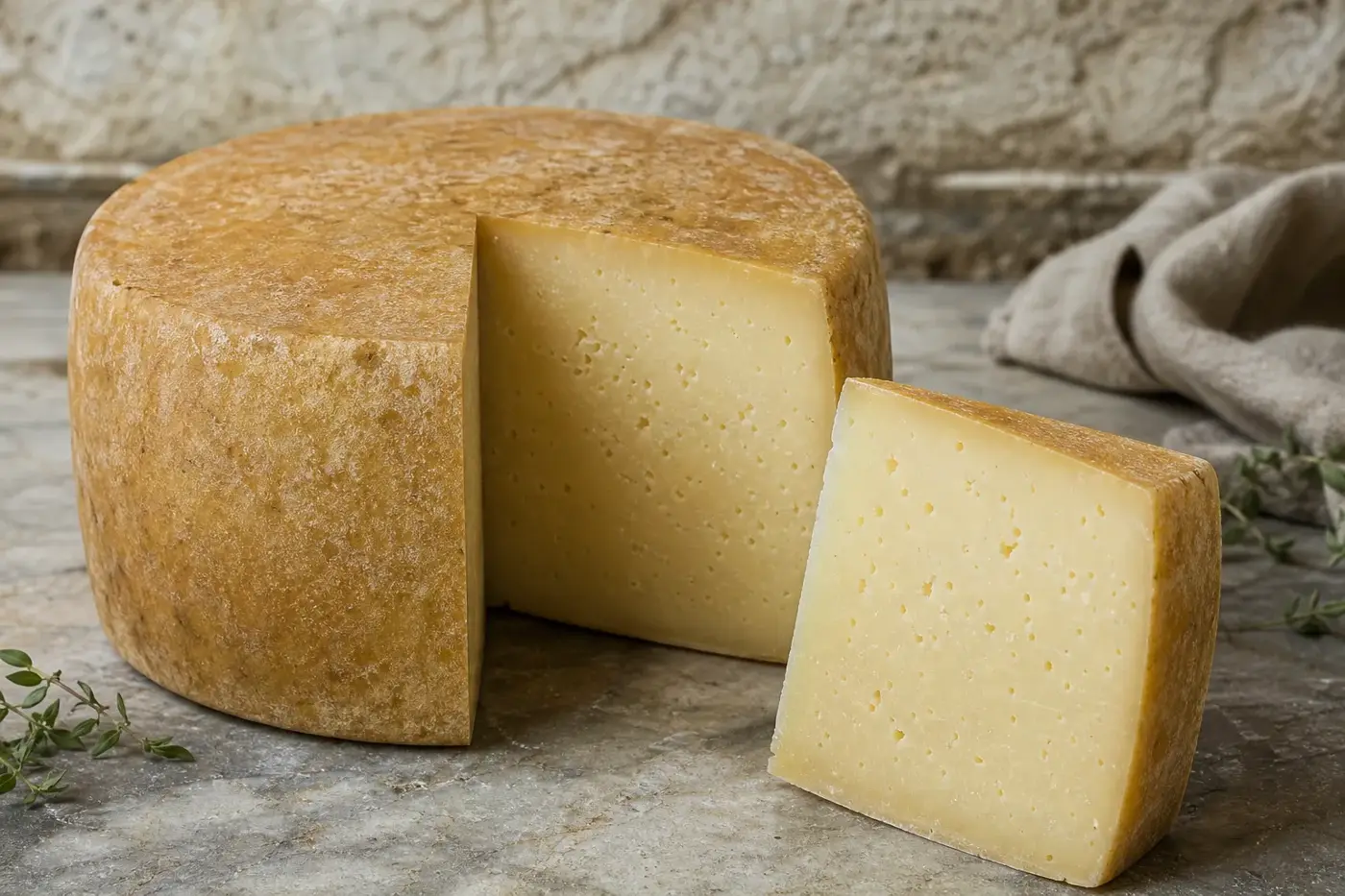
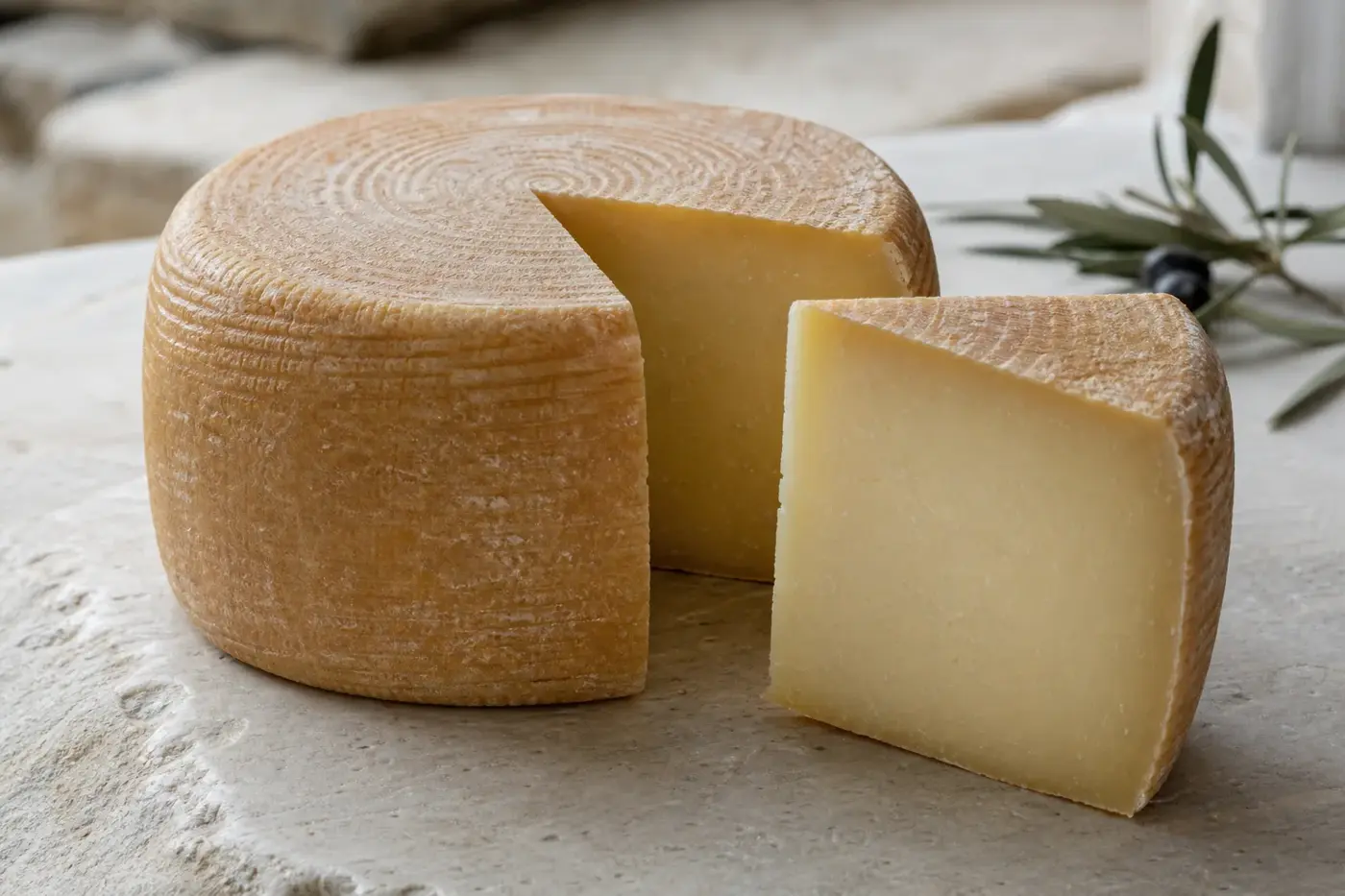
A whole Kefalotyri is typically round, with a firm outer rind and a pale yellow interior. Naxos describes its version as hard and yellow, with a thin, hard skin, and lists several wheel sizes. Lamia also describes a hard, yellowish cheese. Ask to see the cut face and compare its colour and texture with the maker’s description, but do not judge maturity by colour alone. [1,2]
Ask whether the outside is natural rind or carries a coating, and whether the maker recommends removing it. For cooking, trimming the hard edge can give you a more even slice or finer grating. Keep the cheese’s own skin distinct from any wrapping when preparing your wedge.
From milk to a mature wheel
An academic account published by the American Society for Microbiology describes a cooked, pressed curd process. The set milk is cut into small particles, stirred and heated. The curd, the solid part separated from the liquid whey, is collected in moulds and pressed. Brining and repeated dry salting follow, with ripening continuing in cooler storage. [5]
Maker accounts bring you closer to the cheese on the counter. Lamia specifies a minimum maturation of three months for its product. Galiatsatos describes its Kefalonian cheese as traditionally maturing in brine for at least six months. Use the maker’s stated age when choosing between individual products. [2,4]
You can explore the broader stages in how cheese is made. For Kefalotyri, the useful point is that cutting, heating, pressing and salting build a cheese suited to firm slices and grating. [5]
Find your level of salt and savouriness
Salt and savouriness are your starting points. Lamia calls its cheese salty and spicy; Naxos uses spicy and savoury, while Exarchos also emphasises a salty, spicy character. These are the makers’ descriptions. Here, “spicy” means a piquant cheese flavour, not added chilli. [1,2,3]
Maturity matters because texture and flavour develop during ripening. For the table, ask for a piece that still cuts cleanly; for grating, ask about a drier, firmer example with a more pronounced flavour. Consider age alongside the maker’s tasting description. The longest maturation does not automatically win the cheese counter. [5]
Choose the right piece for your plans
Start with the label: maker, milk species, treatment and any stated maturation period. If you are buying a cut piece, ask which wheel it came from and whether the cheesemonger can give its age. That tells you more than “Greek hard cheese”, which leaves rather a lot to the imagination. [1,2,3,4]
For saganaki, ask for an intact slab you can cut evenly, rather than a narrow, broken wedge. For pasta, a smaller piece is convenient to hold against a grater. For the table, ask how readily that particular cheese slices and whether its saltiness is gentle or assertive. These questions help even when its age is unavailable.
Read the pack’s storage and date instructions before taking it home. Choose an amount you can use under those instructions, especially if the cheese is already grated or cut into small pieces. [10,13]
Put it to work in pasta and pies
Grating is one of Kefalotyri’s simplest uses. Lamia recommends it over pasta and in pies and pizza; Exarchos suggests spaghetti, pies and other dishes. Try it over a tomato sauce, adding a little and tasting before deciding whether you need more cheese or salt. [2,3]
For a pie, my suggestion is to make it the assertive part of the filling rather than automatically replacing every other cheese. You can grate it through vegetables or scatter it over a baked dish. Keep the original recipe’s quantities and cooking instructions as your framework, and consider the cheese before adjusting the seasoning.
Give saganaki its golden surface
Kefalotyri’s firmness makes it a useful choice for saganaki. You are aiming for a browned surface around cheese that has softened in the pan. The Greek National Tourism Organisation’s published method uses slices about 1 cm thick, moistened with cold water, coated in flour and fried in olive oil until golden on both sides. Lemon provides the finish. [6]
Olympus, a commercial cheese producer, similarly describes moistening and flouring the cheese, then shallow frying over medium heat and turning it to colour both sides. It advises serving immediately because the cheese becomes hard as it cools. Start with an even slab: it is easier to turn than several fragile fragments. [7]
Bring out the bread, fruit and wine
My simplest serving suggestion is bread, a few thin pieces of Kefalotyri and fresh fruit. Try pear or grapes, whose juicy sweetness contrasts with the cheese’s salt. Plain bread lets you notice the maker’s piquant character. For fried cheese, lemon is the accompaniment in the tourism organisation’s recipe. [1,2,6]
For adults of legal drinking age who choose wine, my starting point would be a dry white with noticeable acidity, such as Assyrtiko, or a dry rosé alongside bread and cheese. These pairing suggestions offer contrast with a salty, savoury cheese. Pour a small serving; water or sparkling water with lemon is an equally useful accompaniment.
If you would like to explore those contrasts, visit cheese and wine pairing. You can compare the effects of acidity, sweetness and intensity more deliberately.
Keep it well, and know when to discard it
For home storage, follow the packet first. In England, Wales and Northern Ireland, the Food Standards Agency advises a fridge temperature between 0 and 5 °C and keeping dairy products refrigerated. Food Standards Scotland advises keeping food covered and the fridge below 5 °C. A maker’s narrower instruction still matters: Exarchos specifies 2 to 4 °C for its Kefalotyri. [3,10,11]
Keep your cut piece covered and follow the stated instructions after opening. The FSA distinguishes use by dates, which concern safety, from best before dates, which concern quality. It says that smell cannot establish the safety of food carrying a use by date. [11,12,13]
Look for mould, an altered texture or an unexpected spoiled smell. In England, Wales and Northern Ireland, the FSA’s household advice as at November 2026 says food that is obviously rotten or contains mould should not be eaten. Follow that guidance rather than trying to rescue affected cheese by frying. See how to store cheese and mould on cheese for fuller guidance. [12]
Get acquainted with Kefalograviera and Graviera
Kefalograviera is a separate name. As at November 2026, its entry in the Great Britain protected food names register records Κεφαλογραβιέρα / Kefalograviera as a registered protected designation of origin. That record belongs to Kefalograviera. When shopping, use the full name on the label when asking what you are buying. [9]
Graviera deserves its own label reading too. Exarchos sells a Graviera separately from its Kefalotyri, although both declare a sheep and goat milk blend. Shared milk species tell you only part of the story. Ask for the named cheese in a recipe, then choose any replacement according to saltiness, firmness and how it behaves when heated. [3,8]
The tourism organisation lists all three as options for fried saganaki. That shared use explains why you may meet them together in cooking advice. It also gives you a practical substitution for that particular dish. [6]
General information only, not medical advice: follow the official guidance where you live.
Sources
[1] E.A.S. Naxos. Naxos Kefalotyri, undated producer description, retrieved November 2026. Milk, rind, sensory description, formats and maturation.
[2] Agricultural Cooperative of Lamia. L’ ami Kefalotyri Cheese, undated producer description, retrieved November 2026. Ingredients, sensory description, culinary uses and product minimum maturation.
[3] Exarchos. [Kefalotyri](../kefalotyri/), undated producer specification, retrieved November 2026. Declared milk proportions, pasteurisation, ingredients, character, uses and refrigeration.
[4] Galiatsatos Dairy. Kefalotyri cheese from Kefalonia, undated producer account, retrieved November 2026. Milk, traditional rennet and its account of brine maturation.
[5] American Society for Microbiology. The Microfloras of Traditional Greek Cheeses, Microbiology Spectrum, volume 2, issue 1, 2014, section “Kefalotyri”. Academic account of milk sources, regional variation, manufacture and ripening.
[6] Greek National Tourism Organisation. Culinary brochure, recipe headed [Saganaki](../saganaki/), 2018 edition. Published culinary method and cheese options.
[7] Olympus UK. Saganaki with Kefalotyri OLYMPUS, undated commercial producer recipe, retrieved November 2026. Preparation and immediate serving advice.
[8] Exarchos. [Graviera](../graviera/), undated producer specification, retrieved November 2026. Separately named product and declared milk blend.
[9] Department for Environment, Food & Rural Affairs. Κεφαλογραβιέρα / Kefalograviera, Great Britain protected food names register, published 2021, checked November 2026. Registered name and PDO status.
[10] Food Standards Agency. How to chill, freeze and defrost food safely, 2017, current retrieved text, November 2026. Applies to England, Northern Ireland and Wales.
[11] Food Standards Scotland. Storing food safely, undated consumer guidance, retrieved November 2026. Covered storage and fridge temperature.
[12] Food Standards Agency. Home food fact checker, updated 21 August 2026. Sections on dairy foods, sensory checks and mould. Applies to England, Northern Ireland and Wales.
[13] UK Government. Understanding food labelling: Best before and use-by dates, current retrieved text, November 2026. Date marks and storage instructions.
Researched by comparing producer descriptions and published culinary methods with academic accounts, the Great Britain register and official UK household food guidance.
Last checked: November 2026
METADATA
- Content ID: A349
- Body word count: 1,569, manually counted as rendered text after the H1 and before Sources, excluding reference numbers and Markdown syntax.
- Meta title: Kefalotyri: Greek hard cheese, cooking and storage
- Meta description: Meet Kefalotyri, the salty Greek hard cheese for grating and saganaki. Learn how makers differ, what to buy and how to serve and store it.
- Suggested slug: kefalotyri-cheese-cooking-guide
- Aliases: Kefalotyri; Kefalotiri; Κεφαλοτύρι; κεφαλοτύρι
- Original contribution: Desk research synthesising maker-specific milk declarations, maturation accounts and culinary uses into a task-based choosing guide.
- Publisher: detimiL gnitekraM latigiD citegrenyS
- Author and reviewer: Assigned by the publisher before publication.
- Freshness: Check safety, protection and product declarations at least every six months.
- Featured image: REAL PHOTO REQUIRED. A licensed or permitted photograph of an identified Kefalotyri wheel and cut wedge, showing the rind and interior. Record maker, cheese identity, permission and any coating visible.
- Featured image alt text: written by the editor from the supplied photograph
EVIDENCE LOG
For the editor, removed before publication. Sources below refer to the numbered Sources entries. Retrieval checks were undertaken on 7 November 2026.
-
Identity, milk and regional examples: Sources [1] to [5]. Read the Naxos product description, Lamia description and ingredients, Exarchos ingredients, Galiatsatos description and the academic section “Kefalotyri”. Maker statements remain attributed. Source [5] supports sheep milk, goat milk or mixtures; the contemporary examples cited declare mixtures.
-
Product-specific milk proportions and treatment: Source [3], ingredients passage. Supports more than 90% pasteurised sheep milk and less than 10% pasteurised goat milk for that product only. No general legal permission or mandatory proportion is inferred.
-
Rennet: Sources [1] and [4], milk and ingredient passages; source [5], manufacture account. “Traditional rennet” does not establish animal species, vegetarian suitability or certification. Those claims are omitted.
-
Wheel, rind and interior: Sources [1] and [2], product descriptions and formats. Support wheels, a hard yellow or yellowish cheese and Naxos’ thin, hard skin. The compact-face wording is a qualitative buying description, not a measured texture classification. Universal rind edibility and coating claims are withheld.
-
Manufacture: Source [5], “Kefalotyri” manufacture paragraphs. Read the sequence covering coagulation, cutting, heating, moulding, pressing, brining, dry salting and cooler storage. Technical settings are omitted because this is an explanatory guide, not a manufacturing method.
-
Ageing: Source [2], minimum maturation field; source [4], traditional brine maturation passage. These establish different producer accounts. They do not establish a universal legal minimum. No national compositional limits are published.
-
Sensory character and maturity: Sources [1], [2] and [3], maker descriptions; source [5], introductory and ripening passages. Sensory terms are attributed. Suggestions about selecting a sliceable or drier piece are editorial buying advice, not recorded tasting results or a claim that age predicts quality.
-
Choosing and cooking: Sources [2] and [3], culinary recommendations. Support pasta, pies and other cooked uses. Tomato sauce, vegetable fillings and incremental seasoning are clearly editorial suggestions. No site recipe trial is claimed.
-
Saganaki: Source [6], recipe headed “Saganaki”, and source [7], preparation passage. Read the slice thickness, wetting, flouring, frying, turning, lemon and immediate serving instructions. The Olympus ingredient quantity appears anomalous and is not reproduced. The article summarises methods rather than supplying a standalone recipe.
-
Pairings: Sources [1] and [2] support the underlying salty, piquant character; source [6] supports lemon with saganaki. Bread, fruit, wine and alcohol-free choices are labelled editorial suggestions. No tasting session or experimentally verified pairing is implied.
-
Storage: Source [10], “Chilling food”; source [11], covered storage and temperature bullets; source [3], refrigeration declaration. Preserve the different agency wordings and jurisdictions. No invented after-opening shelf life is given.
-
Date marks and spoilage: Source [12], dairy sensory checks and mould question; source [13], date-mark sections. Household mould advice is used. Commercial cheese-recovery guidance is not substituted for household advice.
-
Kefalograviera: Source [9], registered name, status and protection fields. Confirms the Great Britain record checked in November 2026. The page says its specification is unavailable there. The article does not transfer this registration to Kefalotyri.
-
Graviera distinction: Sources [3] and [8], separately named producer products and ingredients; source [6], alternative cheeses in saganaki. Supports distinct product names and a shared culinary application. No universal Graviera specification or protection claim is made.
-
EU register retrieval: The European Commission’s eAmbrosia interface was opened but returned no readable records in this session. No positive or negative registration conclusion for Kefalotyri was established. The fact box consequently says “Not verified”.
-
Recall retrieval: The FSA alerts index was opened. A complete name-specific and batch-specific check, including Greek official notices, was not completed. No recall clearance is claimed.
Flags
-
LEGAL UNCHECKED, A349: Current EU registration status for Kefalotyri was not established from readable eAmbrosia records. The current Greek statutory standard and registered Kefalograviera specification were not retrieved and read. Before publication, the editor must verify these official texts, resolve the two unverified fact-box fields and strengthen the specification-based distinction where appropriate. No unsupported legal conclusion should be inserted.
-
SAFETY UNCHECKED, A349: The official household guidance was retrieved, but the required human safety review and complete jurisdiction-specific recall checks remain outstanding. The editor must assign the reviewer, complete the official alert checks and approve the storage and spoilage wording before publication.
Last checked November 2026.
The editors suggest you read next