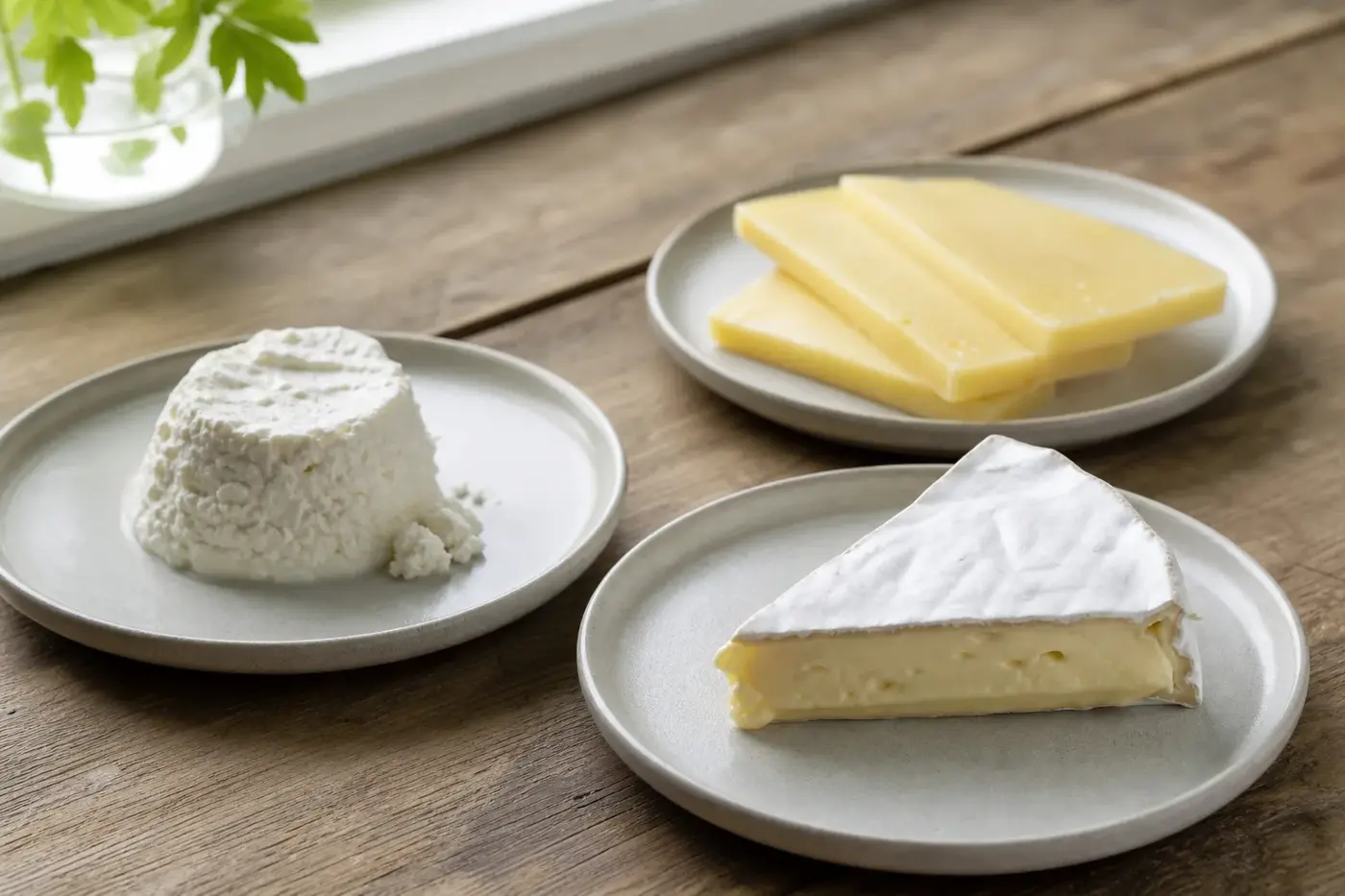
How to Describe Cheese: Flavour, Aroma and Texture
You take a bite.
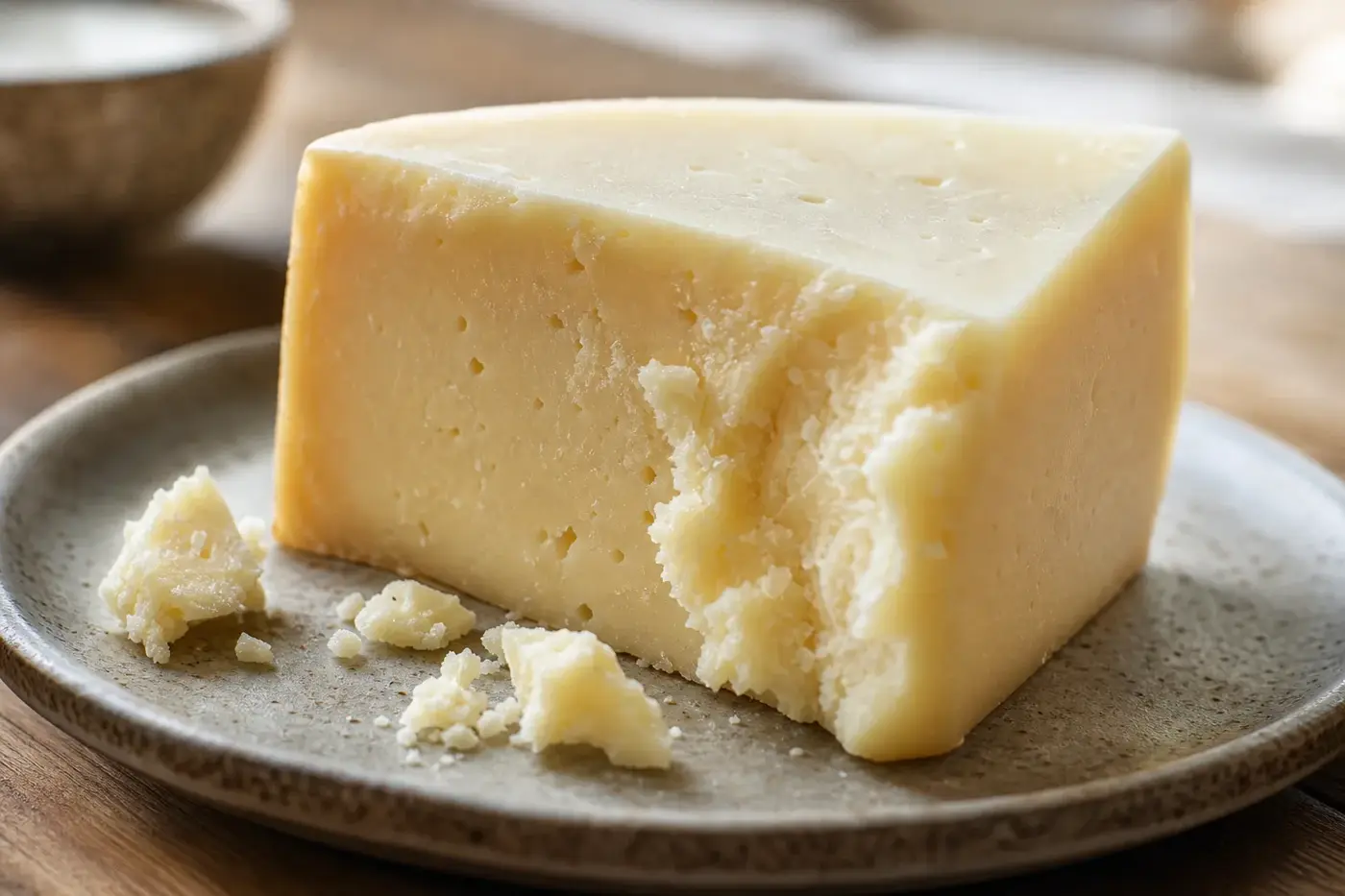
You take a bite. The cheese breaks into moist crumbs, then turns smooth as you chew. One mouthful, two textures, and already you have something worth putting into words.[1,4]
Start there: notice what happens, then reach for familiar language. “Milky, lightly sour and crumbly” gives someone something to imagine. “Nice” is friendly but unhelpful; “strong” needs to explain itself.
Find words you can almost taste
Choose an everyday comparison, add its intensity, then describe the texture. Think fresh milk rather than dairy, toasted hazelnut rather than complex, and breaks into moist crumbs rather than interesting. You are describing a mouthful, not auditioning adjectives.
Keep description separate from preference. A pronounced earthy aroma might delight you; a delicate milky one might appeal more. Either deserves a clear description, and “reminds me of” leaves room for someone else to experience it differently.
Give your nose a place at the table
Something you experience “in the mouth” may actually be an aroma. Smell reaches your nose by two routes. Sniffing brings airborne aroma compounds from outside, called orthonasal smell; during eating, volatile compounds reach it from your mouth, called retronasal smell.[2]
Taste is your response to substances that stimulate your taste organs; aroma concerns smell. Flavour brings together taste, smell and chemical sensations such as pungency. ISO sensory vocabulary separates them because calling everything “taste” loses useful detail about what you experience.[1]
Your senses interact, too. In controlled human experiments using taste and aroma mixtures, followed by a beverage and custard, adding sugar increased the perceived intensity of certain aromas. Keep the categories separate in your notes, even though they arrive together in your mouth.[2]
Let each basic taste speak for itself
Sweetness, saltiness, sourness, bitterness and umami are the five established basic tastes. Human sensory studies assess them separately, using reference substances such as sugar, salt, citric acid, quinine and monosodium glutamate. Give each its own space when you describe your cheese.[3]
- Sweetness: the basic taste of sugar. Keep actual sweetness separate from an aroma that reminds you of caramel or sweet cream.[3,5]
- Saltiness: the taste associated with table salt. “Lightly salty” and “pronounced saltiness” give you more to go on than “well seasoned”.[3]
- Sourness: the acidic taste familiar from lemon juice or plain yoghurt. “Lactic tang” suggests cultured dairy; “sour” names the taste itself.[3,5]
- Bitterness: think of the bitter edge of tonic water. Describe it as slight, dominant or lingering, rather than reaching for “bitter” whenever you dislike something.[3]
- Umami: a savoury basic taste, often compared with the depth of broth. Keep it distinct from saltiness, and note both when you notice both.[3,4]
Follow your nose from milk to mushrooms
Begin with a broad family, then narrow the comparison as far as your memory takes you. The American Cheese Society lexicon uses familiar references for fruit, nuts, earth and broth. The Academy of Cheese dairy lexicon distinguishes fresh milk, cultured dairy and butter.[4,5]
| Aroma family | What it might remind you of | Ask yourself |
|---|---|---|
| Milky | Fresh milk, warm milk, fresh cream | Fresh or cooked?[5] |
| Buttery | Fresh butter, cultured butter | Fresh or fermented?[5] |
| Fruity | Apple, pear, pineapple | Orchard or tropical fruit?[4] |
| Nutty | Hazelnut, toasted nuts | Raw or toasted?[4] |
| Earthy | Mushrooms, moist soil | Mushroom-like or soil-like?[4] |
| Savoury | Broth, meat stock | Brothy or meaty?[4] |
These are prompts, not a checklist to complete before you earn another bite. If “fruity” fits but “pineapple” feels forced, stay with fruity. “Faint” or “pronounced” can be more useful than a precise comparison you would struggle to recognise again.
Write in terms of resemblance: “reminds you of toasted nuts” gives you an impression to discuss. It also keeps an aroma comparison separate from information about ingredients. For that, you need the product label.
Help “strong” tell you something useful
Character answers “what does it resemble?” Intensity answers “how much do you notice?” ISO defines intensity as the magnitude of a perceived sensation, so attach it to an individual attribute rather than the whole cheese.[1]
A strong aroma need not mean a salty or sour taste. Try “pronounced earthy aroma, slight saltiness”. Give “sharp” the same attention: do you mean acidic, bitter, pungent or simply intense? Choose the more precise word whenever you can.[1,3]
For everyday comparisons, keep to the same small scale: low, medium or high. Score aroma, acidity and saltiness separately. This helps you organise your notes; it is not a professional grading system.
Follow the texture through each bite
Texture changes as you handle and chew a cheese. It includes mechanical properties, particle size and surface qualities, perceived through touch and sometimes sight or sound. ISO 11036 provides a framework for describing and comparing it; for everyday notes, separate appearance, resistance to pressure and what happens during chewing.[1,6]
| Word | What to look for |
|---|---|
| Smooth or rough | Look at the visible surface or cut face. |
| Crumbly | Breaks into pieces rather than bending. |
| Springy | Gives under pressure, then recovers towards its original shape. |
| Creamy | Feels smooth and readily spreadable in your mouth. |
| Grainy | Small particles remain noticeable as you chew. |
| Melting | Seems to soften and lose structure in your mouth. |
These plain-language prompts draw on sensory vocabulary and cheese texture descriptions.[1,4] Try putting them in sequence: “firm at first, then breaks into fine crumbs”. A cheese can crumble when broken and become smooth during chewing. Each word catches a different moment.
Give “creamy” a specific job, too. Do you mean an aroma resembling cream, a smooth texture or a coating left in your mouth? Choose one, or describe each separately. To connect these observations with broader categories, see how to tell cheese styles apart.
Put warmth and tingling in their own words
Chemical warmth, burning and tingling are sensations, not extra basic tastes. The term is chemesthesis: chemically induced sensations such as these, with relevant signals from your mouth and nose carried by the trigeminal nerve. Human experiments distinguish the effects of capsaicin, the pungent substance in chilli, from the basic tastes.[1,3]
Keep “warming” and “prickling” separate from “sour” and “bitter” in your notes. Record a drying mouthfeel separately as well. Then locate the sensation: on your tongue, across your mouth or in your throat. That gives someone more to imagine than gathering every forceful sensation under “strong”.
Discover what ripening brings to the mouthful
Ripening changes a cheese’s structure and the compounds involved in its taste and aroma. Proteolysis breaks proteins into smaller peptides and amino acids, contributing to structural changes and supplying compounds involved in taste and aroma development. Moisture matters, too: you need different words for a dry, resistant body and a moist, yielding one.[4,7]
Lipolysis breaks down fat, releasing free fatty acids that contribute to flavour and can become further aroma compounds. In an experimental study of enzyme-modified cheese, researchers measured protein and fat breakdown alongside volatile compounds. They used those measurements to investigate the effects of different lipase treatments.[8]
These processes help explain why your description changes with maturation, though age alone cannot predict flavour. Note the stated age alongside what you notice in the cheese. For the production background, see how cheese is made.
Build a description you can picture
A useful note gives each sensation its place. These invented examples bring the vocabulary together as hypothetical observations. They do not describe named cheeses or reported tastings.
- “Low-intensity milky aroma, a light sour taste and a moist texture that breaks into soft crumbs.”
- “Medium-intensity toasted-nut aroma, moderate saltiness and a firm paste that becomes smoother during chewing.”
- “Pronounced earthy aroma, slight saltiness and a soft paste, with a more resistant centre.”
Each description attaches intensity to something specific. Add a finish, meaning what remains after the mouthful, when it helps you distinguish two samples. “A lingering sour taste” or “a brief savoury finish” catches that last impression. Give your personal liking a separate sentence.[4]
Leave notes your future self will thank you for
Use one line per sample: cheese and maker; date; stated age if available; aroma and its intensity; basic tastes; texture; finish; personal preference. Note whether your sample includes the rind, so you can compare like with like. Keep the same headings whenever you return.
Write your own words before discussing the cheese with someone else. Then compare one attribute at a time: which sample seems more acidic, which is springier, which has the more persistent aroma? Use the separate tasting guide for the full tasting method, and how to store cheese at home for storage advice.
Know what ammonia can and cannot tell you
An overpowering ammonia aroma deserves attention, not the description “very mature”. The American Cheese Society associates excessive ammonia aroma with over-ripening in soft-ripened cheeses. It treats this as a quality defect.[4]
For UK readers, the Food Standards Agency says smell cannot detect the organisms that cause food poisoning. It advises against eating food after its use by date, even if it looks and smells fine. Follow the storage instructions and consult the FSA guidance, dated here November 2026.[9]
The FSA distinguishes this from judging the quality of foods carrying a best before date, where sensory cues can be useful.[9] Consult its current guidance rather than relying on this page’s November 2026 reference, and turn to cheese food safety for the wider distinction between quality and safety.
General information only, not medical advice: follow the official guidance where you live.
Questions people ask
What is the difference between taste, aroma and flavour?
Taste is the response to substances that stimulate the taste organs, while aroma concerns smell. Flavour brings together taste, smell and chemical sensations such as pungency.
What are the five basic tastes in cheese?
The five basic tastes are sweetness, saltiness, sourness, bitterness and umami. Umami is a savoury taste often compared with the depth of broth, and it is distinct from saltiness.
How can I describe the texture of cheese?
Notice its appearance, its resistance to pressure and what happens as you chew. For example, a cheese might be firm at first, then break into fine crumbs.
Does the age of a cheese tell you how it will taste?
Age alone cannot predict flavour. Ripening changes the structure of cheese and compounds involved in its taste and aroma, so the page suggests recording the stated age alongside what you notice.
Is cheese with an ammonia smell safe to eat?
The American Cheese Society associates excessive ammonia aroma with over-ripening in soft-ripened cheeses and treats it as a quality defect. The Food Standards Agency says smell cannot detect the organisms that cause food poisoning and advises against eating food after its use by date, even if it looks and smells fine. Check its current guidance at https://www.food.gov.uk/print/pdf/node/271.
Sources
-
International Organization for Standardization. ISO 5492:2008, Sensory analysis, Vocabulary, second edition, 2008, with Amendment 1:2016; and ISO 18794:2025, Coffee, Sensory analysis, Vocabulary, second edition, 2025. The publicly indexed terminology in the latter reproduces relevant ISO 5492 definitions, including taste, flavour, texture, trigeminal sensation and intensity. ISO 5492 publication record; ISO terminology preview.
-
Chemical Senses, Oxford University Press. Enhancement of Retronasal Odors by Taste, volume 37, issue 1, 2012, published online in 2011. Primary human sensory experiments using taste and odour mixtures, a beverage and a custard dessert. Full text.
-
Chemosensory Perception, Springer Nature. Peri-threshold Trigeminal Stimulation with Capsaicin Increases Taste Sensitivity in Humans, published online in 2021. Primary human research measuring recognition thresholds for five basic tastes with and without capsaicin. Research article.
-
American Cheese Society. Cheese and Dairy Product Lexicon and Glossary, version 2, PDF update dated May 2025. An industry sensory reference, including aroma families, texture, finish and excessive ammonia as a defect. Lexicon.
-
Academy of Cheese. Structured Approach to Tasting Cheese: Dairy Lexicon, undated document retrieved from its May 2026 upload. Educational reference distinguishing milk, soured dairy, milk fats, sweet dairy and savoury dairy. Dairy lexicon.
-
International Organization for Standardization. ISO 11036:2020, Sensory analysis, Methodology, Texture profile, second edition, May 2020. Public scope and publication record. Standard record.
-
Korean Journal for Food Science of Animal Resources. Effects of Proteolytic and Lipolytic Enzyme Supplementations on Lipolysis and Proteolysis Characteristics of White Cheeses, 2018. Primary experimental research on enzyme supplementation during cheese ripening. Full text.
-
Molecules, MDPI. Chemical and Flavor Characteristics of Enzyme-Modified Cheese Made by Two-Stage Processing, 2022. Primary experimental research measuring proteolysis, lipolysis and volatile compounds. Full text.
-
Food Standards Agency, United Kingdom. Best before and use-by dates, official consumer guidance, publication revision not specified in the retrieved PDF. Sections “Best before dates are about quality” and “The sniff test”, checked November 2026. Official guidance.
This piece was researched from published sensory terminology, cheese education references, primary experimental research and official UK food safety guidance.
Last checked: November 2026
Last checked November 2026.
The editors suggest you read next
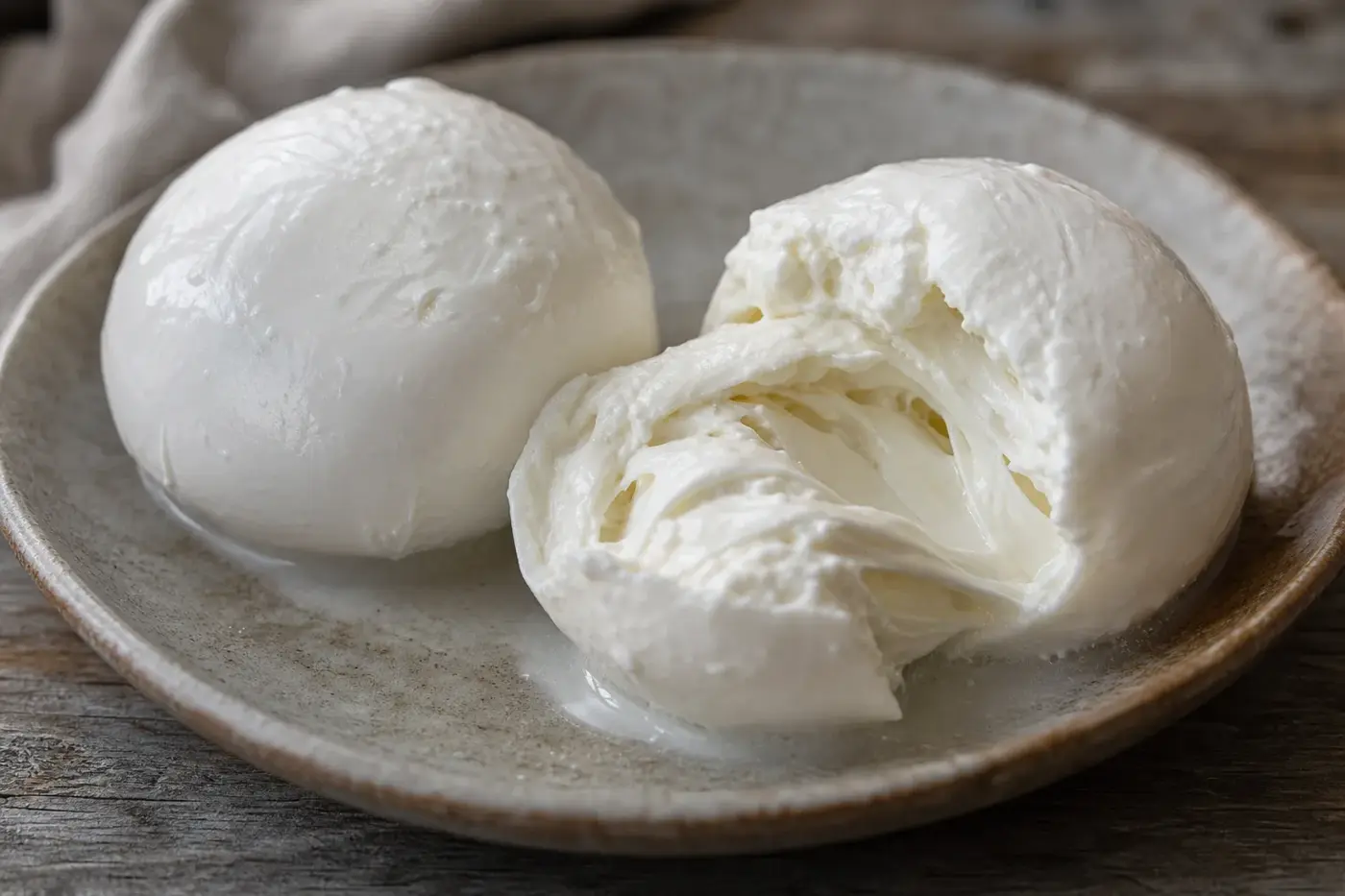
Mild or Strong Cheese? Where Beginners Should Start
Pull apart fresh mozzarella and you find soft, elastic layers, with a little milky liquid tucked between them.