Is Cheese Gluten Free?
You cut the bread, reach for the cheese and pause, the same knife still in your hand.
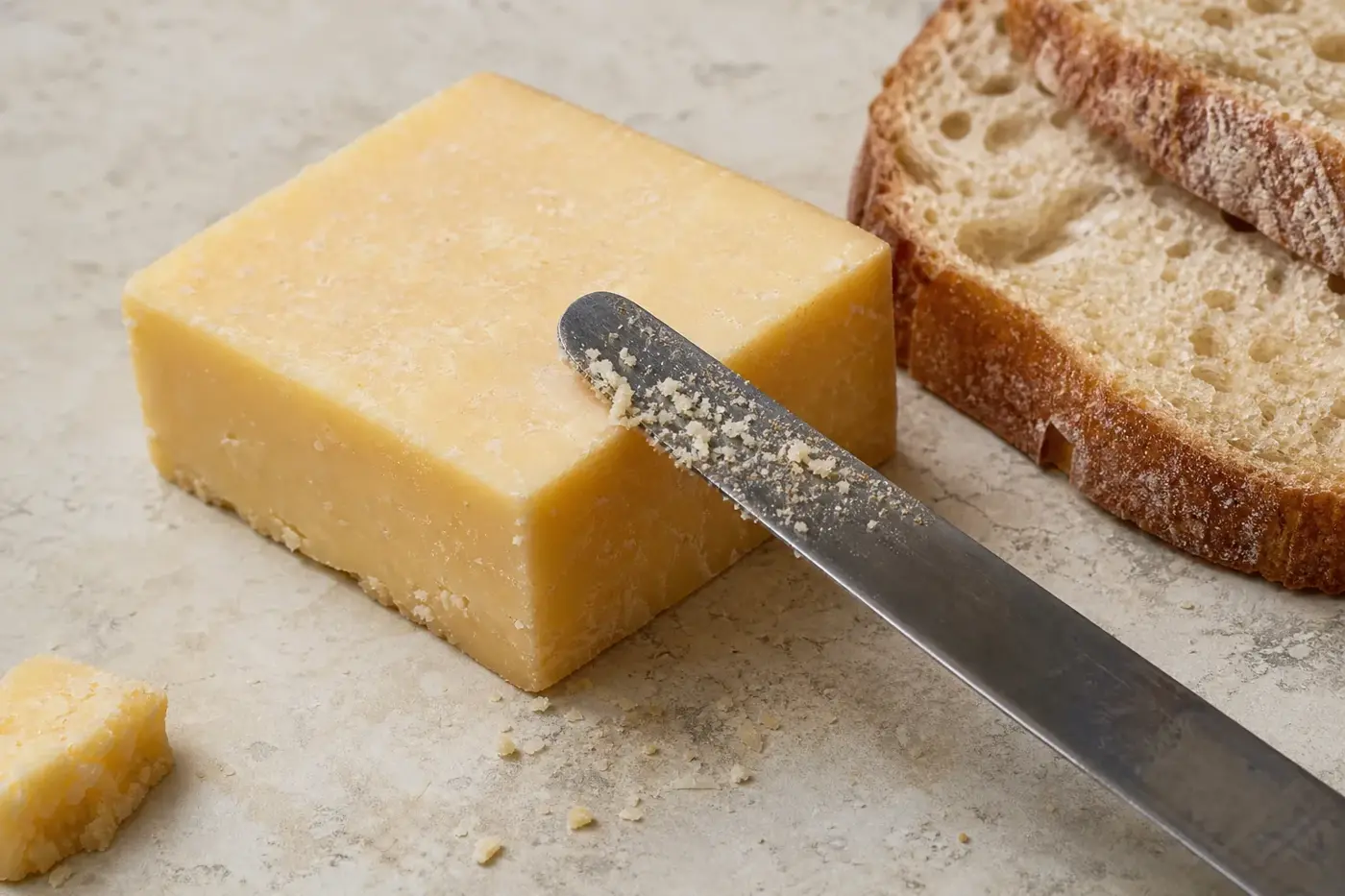
You cut the bread, reach for the cheese and pause, the same knife still in your hand. That small movement can carry gluten across. Cheese itself is generally gluten free: milk, cultures, rennet and salt, its usual ingredients, do not normally contain gluten. What happens next matters, from added ingredients to preparation, cutting and serving.[1,2]
Start with the recipe, not the handsome rind
Hard, soft or mature? Fine things to ponder at a cheese counter, especially if you have already been pondering for some time. But they tell you less about gluten than the recipe does. Milk and salt are not cereal ingredients, and the cultures and rennet normally used in plain cheese do not make it a gluten-containing food.[1,2]
The NHS includes most dairy products, including cheese, among foods naturally free from gluten. Anything added needs its own look, whether that is a coating, flavouring or accompaniment. You cannot read a finished food’s ingredients by looking at it.[1,2]
Explore how cheese is made for the making process. For gluten, follow the ingredients all the way to your plate.[1,2]
This page summarises published guidance from the official sources it cites. It is not medical advice. Guidance differs between countries and changes over time, so check the current source for where you live, and ask your doctor, midwife, pharmacist or dietitian about your own circumstances.
Gluten, lactose and milk protein: untangling the three
These names can get tangled, but they mean different things. Gluten is a cereal protein, lactose is the sugar in milk, and milk proteins are another component again. Knowing which one you need to avoid matters.[3,4,5]
The NHS describes coeliac disease as an autoimmune condition in which eating gluten damages the small intestine. Lactose intolerance means difficulty digesting lactose. Milk allergy involves a reaction to milk proteins.[3,4,5]
A gluten free cheese can therefore still contain both milk protein and lactose. Cambridge University Hospitals' milk allergy guidance distinguishes lactose-free dairy products from products suitable for milk allergy. Goat's and sheep's cheese are not safe substitutes if you have cow's milk allergy; a clinician or dietitian can advise on your circumstances.[5]
For a fuller explanation, visit cheese allergy versus lactose intolerance. Before you remove additional foods from your diet, ask your clinician or dietitian which restriction applies to you.[4,5]
With coeliac disease, follow the knife too
For people with coeliac disease, NHS advice is to exclude gluten for life. A suitable recipe is only the beginning. Food can become contaminated when gluten free and gluten-containing foods are prepared together or served with the same utensils.[2,3]
You will often hear this called cross contact: gluten reaches food without being an intended ingredient. That brings the cheese counter and your table into the picture, not just the ingredients list.[2,3]
The NHS also says intestinal damage can happen without noticeable symptoms. Choose using ingredient and handling information, not whether your last serving seemed to cause symptoms.[2,3]
Blue cheese: the story behind the bread warning
If you have heard warnings about blue cheese mould grown on bread, the testing context is useful. According to available testing reported by the US National Celiac Association, blue cheese is unlikely to contain gluten above 20 parts per million. That includes cheese made with cultures grown using gluten-containing materials, the concern behind those familiar warnings.[1]
Give blue cheese the same attention as any other cheese. Read the current product information, look for added ingredients and ask the maker about anything unclear. For a blue cheese dressing or dip, check the whole product, including flavourings and thickeners.[1]
Look at the rind, then all the extras
A handsome rind can command your attention. So can biscuit pieces: cheese lovers are not always immune to a little embellishment.
Beer, breadcrumbs and biscuit pieces bring questions that plain cheese does not. The NHS identifies barley as an ingredient in most beer. It also lists ordinary bread, biscuits and crackers among foods to avoid on a coeliac diet unless they are gluten free versions.[2,3]
Ask about beer used to wash a rind or stirred into a cheese spread, and cereal coatings on cheese portions. If you fancy a sweet flavoured cheese, check whether its biscuit pieces contain wheat and whether an oat coating is explicitly gluten free. Ingredients on the outside count just as much as those running through the middle.[2,3,6]
Flavourings need a closer read, too. UK allergen guidance gives barley malt extract and wheat starch as examples where the cereal must be identified and emphasised. Look for the cereal’s name: savoury, smoky and seasoned cannot tell you which cereal is present.[7]
Grated cheese and spreads: read before you rule out
Processing does not automatically introduce gluten. The National Celiac Association advises checking added seasonings, thickeners and anti-caking ingredients in products such as spreads, dips and grated cheese. A longer ingredients list is a reason to read, not to dismiss the whole category.[1]
For grated cheese, check the anti-caking ingredient and any cereal allergen declaration. An anti-caking ingredient alone does not mean gluten is present.[1]
With a cheese sauce, croquette or ready meal, check every part, from sauce and coating to filling and garnish. The NHS specifically highlights sauces and processed foods as places where labels need attention.[1,2]
Let the UK label help you choose
Start with the cereal names. On prepacked food sold in the UK, regulated allergens used as ingredients must stand out in the ingredients list, for example in bold. For gluten, check the allergen information for wheat, barley, rye, oats and their hybridised strains.[7,8]
Spelt and khorasan are types of wheat. The Food Standards Agency says their wheat origin must be clear.[7,8]
At a cheese counter, ask about the exact cheese you want, including its coating and added ingredients. UK rules require allergen information for loose food too. Cheese cut and wrapped after you choose it belongs to a different packaging category from food packed on the premises before selection.[8,9]
Food prepacked for direct sale must have an ingredients list with allergens emphasised. For the other details on your pack, turn to how to read a cheese label.[8]
‘Gluten free’ and ‘may contain’: what each tells you
In the UK, a gluten free claim means the food as sold to the final consumer contains no more than 20 mg of gluten per kilogram of food. That is equivalent to 20 parts per million. The limit applies to the finished food, not a serving size or the percentage of wheat in the recipe.[6]
The governing instrument is Regulation (EU) No 828/2014, in its assimilated form in Great Britain and EU form in Northern Ireland. Making the claim is voluntary; meeting its conditions is compulsory whenever it is used. The regulation sets separate conditions for very low gluten, which is a different claim.[6,7]
A may contain wheat statement, or similar precautionary wording, signals possible unintended cross contact rather than a deliberate ingredient. Government guidance confirms that precautionary allergen labelling is voluntary. Its absence alone therefore cannot tell you how a cheese was handled.[8,10]
You may also see gluten free and may contain wheat together. The FSA explains that food can meet the gluten limit yet still pose a risk to people allergic to other wheat proteins. If you manage a cereal allergy, you need advice specific to that allergy as well as checking the gluten claim.[7]
Give your cheese a clean journey to the board
A bread knife, cracker crumbs on a board, shared counters and slicing equipment can all transfer material from gluten-containing food. At the counter, ask about the cheese itself and the equipment used to cut, weigh and wrap it.[2,11]
At home, Coeliac UK recommends cleaning surfaces and utensils with hot soapy water or a dishwasher with suitable detergent. It also calls for clean cutlery in shared spreads and separation of gluten free ingredients during storage and preparation.[11]
Bring those principles to your cheese board. Start with clean equipment and keep ordinary bread and crackers away from the cheese portion.[11]
In a restaurant, ask about the whole plate, including toast, crumb toppings, chutney, sauces and preparation. UK businesses must provide allergen information for non-prepacked food. If staff cannot clarify ingredients or handling, ask them to check with the kitchen before you order.[9,12]
Your checklist, from cheese counter to table
Buying cheese for someone with coeliac disease? Follow this sequence, bringing together NHS advice on avoiding gluten, UK allergen information requirements and Coeliac UK's practical guidance on preventing cross contact.[2,8,11]
-
Get to know the exact food. Is it plain cheese, flavoured cheese or a prepared dish? At a counter, ask to see the original product information rather than relying on the name on a handwritten ticket.[1,8]
-
Read the pack you are taking home. Check for cereal ingredients, a gluten free claim and any precautionary statement. Include the flavour variant in your check: information for another cheese in the same range is not a substitute.[7,8,10]
-
Tell staff what you need. Say the meal is for someone with coeliac disease. Ask them to check ingredients and preparation, including shared utensils, bread and coatings. If the first answer is uncertain, request clarification from the person responsible.[9,12]
-
Set aside a separate portion. Follow Coeliac UK's cleaning and separation guidance: put the cheese on a clean plate with clean utensils before serving ordinary bread or crackers. Keep its accompaniments separate and check their ingredient information too.[11]
-
Keep that portion separate as you serve. Give it its own knife, and do not move that knife between cheese and ordinary bread. For cheese spreads, use clean cutlery every time so crumbs do not travel back into the tub.[11]
-
Clear up uncertainty before eating. Ask the supplier or restaurant to confirm missing ingredient or handling information. If they cannot, choose something they can explain clearly. Take questions about individual dietary decisions to your dietitian.[2,12]
These gluten checks sit alongside the usual requirements to keep cheese correctly chilled and follow its label. For that separate task, see cheese food safety. Whenever you change the cheese, flavouring or accompanying food, return to the product information.[2,8,11]
Questions people ask
Is plain cheese gluten free?
The NHS lists most dairy products, including cheese, among foods naturally free from gluten. Its usual ingredients are milk, cultures, rennet and salt, but added ingredients and handling can change the answer. See the NHS guidance on coeliac disease for more information.
Can blue cheese contain gluten from mould grown on bread?
The US National Celiac Association reports that blue cheese is unlikely to contain gluten above 20 parts per million, including when cultures were grown using materials containing gluten. Check current product information and any added ingredients, and see the association's guidance.
Is grated cheese gluten free?
Processing does not automatically introduce gluten. The National Celiac Association advises checking added seasonings, thickeners and ingredients used to prevent caking. See its guidance and check the product's cereal allergen declaration.
What does gluten free mean on a UK cheese label?
A gluten free claim means the finished food contains no more than 20 mg of gluten per kilogram, or 20 parts per million. The claim is voluntary, but its conditions are compulsory whenever it is used.
How can gluten get onto cheese?
A knife used for bread, crumbs on a board or shared slicing equipment can transfer material from food containing gluten. Coeliac UK recommends cleaning surfaces and utensils with hot soapy water or in a dishwasher with suitable detergent, and keeping gluten free ingredients separate. See Coeliac UK's guidance on preventing cross contact.
Sources
-
National Celiac Association. Is cheese safe for people with celiac disease? Current web guidance, accessed November 2026. Primary patient organisation guidance from the United States. Source.
-
NHS. Coeliac disease: Treatment. Current web edition, accessed November 2026. Source.
-
NHS. Coeliac disease: Overview. Reviewed 31 March 2023; accessed November 2026. Source.
-
NHS. Lactose intolerance. Reviewed 8 July 2026. Source.
-
Cambridge University Hospitals NHS Foundation Trust. Milk allergy. Current patient information edition, accessed November 2026. Source.
-
European Commission. Commission Implementing Regulation (EU) No 828/2014 of 30 July 2014 on the requirements for the provision of information to consumers on the absence or reduced presence of gluten in food. Article 3 and Annex; applicable from 20 July 2016. Great Britain text on legislation.gov.uk and EU text on EUR-Lex, accessed November 2026.
-
Food Standards Agency. Food allergen labelling and information requirements technical guidance. Current web edition, accessed November 2026, particularly paragraphs 29 to 31 and 65 to 69. Source.
-
GOV.UK. Understanding food labelling: Allergen labelling. Current web edition, accessed November 2026. Source.
-
European Parliament and Council. Regulation (EU) No 1169/2011 on the provision of food information to consumers. Assimilated text, Articles 21 and 44, accessed November 2026. Article 21 and Article 44.
-
GOV.UK. Food labelling and packaging: Precautionary allergen labelling (PAL). Current web edition, accessed November 2026. Source.
-
Coeliac UK. Cooking at home. Current web edition, accessed November 2026. Source.
-
GOV.UK. Eating out or ordering food when you have an allergy: What restaurants and takeaways must tell you about allergens. Current web edition, accessed November 2026. Source.
Researched through UK legislation, NHS and government guidance, Coeliac UK's practical guidance and the National Celiac Association's published cheese advice.
Last checked: November 2026
Last checked November 2026.
The editors suggest you read next