A little liquid from yesterday’s cheese goes into the next batch. For some artisanal Jben makers in northern Morocco, saved whey carries fermenting organisms from one cheese to another. The maker’s hands and habits keep that connection going.[1]
Follow that liquid and you begin to understand Jben. This fresh North African cheese takes its character from the milk, the curdling agent and the draining. You are meeting a family, with distinctly different Moroccan and Algerian members, not a single recipe with a very large address book.[1][2][3]
| Field | What to know |
|---|---|
| Name | Jben; you will also find J’ben in research publications.[1][3] |
| Family | Fresh cheeses, with methods that vary by maker and region.[1][2][3] |
| Documented milks | Cow’s and goat’s milk in Morocco; sheep’s milk also appears in Algerian traditions.[1][2][4] |
| What curdles it | Animal rennet, plant coagulants and acidification.[1][2][3] |
| Places to explore | Northern Morocco; Maghnia, Nedroma and Aïn Sefra in Algeria.[1][2][3] |
| Pregnancy guidance | UK: see NHS guidance, checked November 2026.[6] |
Meet the maker behind the name
To get to know Jben, start with the people and places making it. Moroccan research describes fresh cheeses made from cow’s milk, goat’s milk or a mixture of both. In Algerian studies, you find cheeses coagulated with thistle and a cow’s milk version made with an animal coagulant called el Hakka.[1][2][3]
That is only the beginning. The organisms acidifying the milk, the use of a starter and the amount of draining all help shape the curd. Beneath one familiar name, you can find noticeably different consistencies and levels of acidity.[1][4]
The research record places Jben in both Morocco and Algeria. When you encounter a particular cheese, look for its regional description and listen to the maker’s account. Ask which milk went into it, how that milk was treated and what made it curdle.[1][2][3]
Northern Morocco: a little of the last batch lives on
Goat farming predominates in the northern Moroccan region examined in a study published in 2025. For their experimental Jben, the researchers chose goat’s milk. They explored traditional production and ways to make its results more consistent.[1]
Some artisanal producers save whey from an earlier batch. Released as milk separates into curd, this liquid can carry a community of fermenting organisms into the next cheese. What happens in one batch therefore helps shape the next.[1]
A defined starter culture offers another route: a preparation of selected microorganisms. The 2025 research explored cultures isolated from Moroccan Jben itself. The aim was greater control while retaining organisms associated with the cheese, rather than replacing local fermentation with an unrelated model.[1]
Find the pleasure in white curd and fresh tang
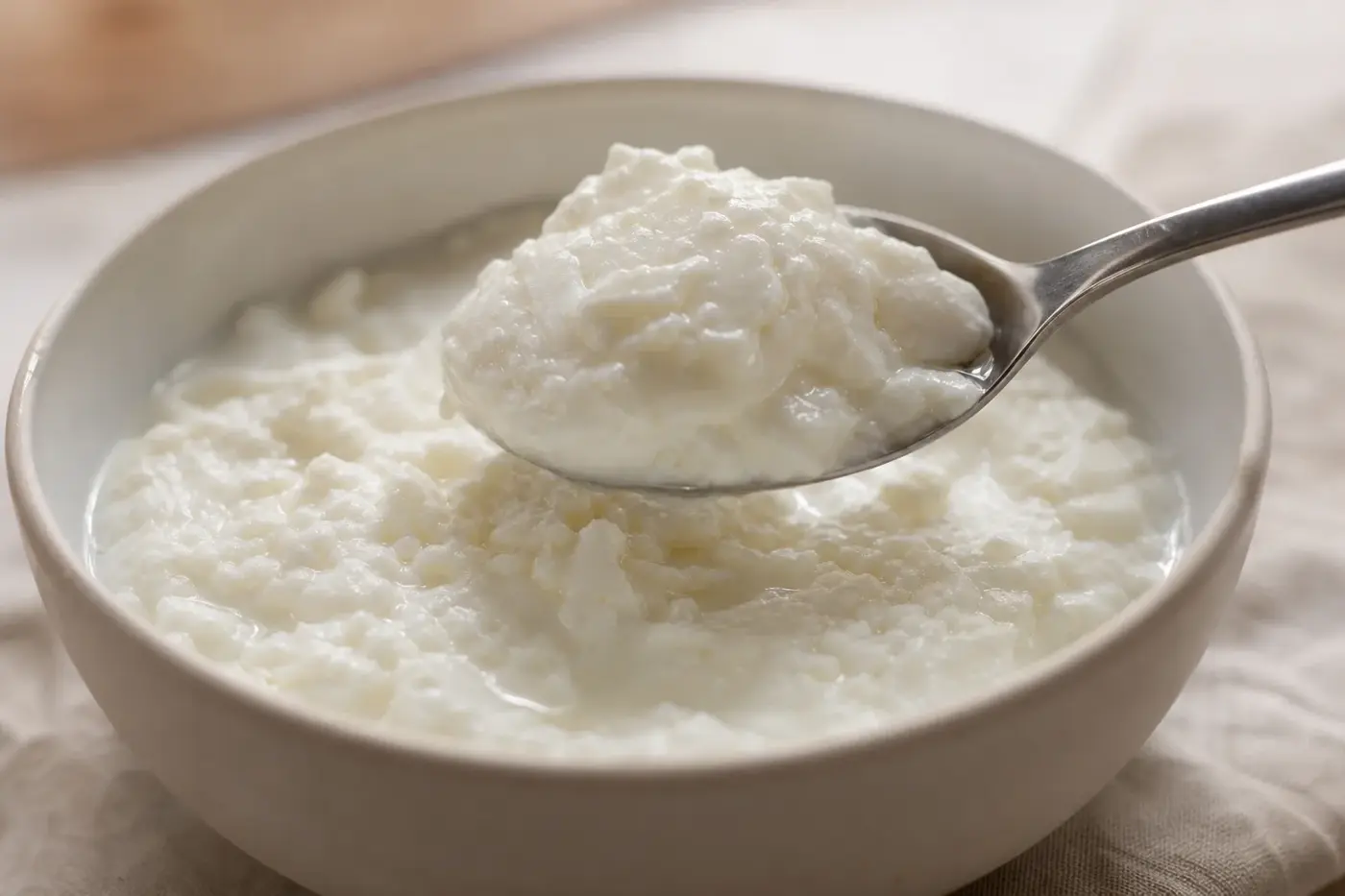
There is no developed rind to explore here. Jben’s character lies in its fresh white curd. Look at how much moisture it holds, whether it keeps its shape when served and how far its acidity has developed.[2][4]
That fresh acidic flavour comes from lactic acid, produced as bacteria ferment the milk, according to Algerian production research. “Mild tang” gives you a starting point, not a promise. A Moroccan investigation published in 2024 found differences between cow’s milk, goat’s milk and mixed-milk samples, with variation within each group too.[2][4]
Draining makes a difference you can see on your plate. As whey leaves, the balance of liquid and solids shifts: one cheese may be spoonable, another sliceable. For the bigger picture, explore how to distinguish cheese styles.
Which milk made your Jben?
Do not assume that Moroccan Jben means goat’s milk. Cow’s milk, goat’s milk and mixtures of the two are all well documented. The 2024 investigation examined all three categories.[4]
Sheep’s milk belongs in the wider North African story too. The Algerian thistle-coagulation study describes traditional Jben made from raw sheep’s, cow’s or goat’s milk. For the experiments themselves, though, the researchers used pasteurised cow’s and goat’s milk, an important distinction when you read the findings.[2]
Then you reach Aïn Sefra, where one account describes raw cow’s milk coagulated with el Hakka. Keep that local detail in view. It is a specific production account, not a recipe for every cheese called Jben.[3]
Watch the milk gather into curd
First comes milk preparation, then curdling and draining, followed by whatever shaping or salting the maker uses. During coagulation, milk proteins join together into a gel. The resulting curd holds some liquid while the rest escapes as whey.[1][2]
Acid and enzymes can share the work. Bacteria produce acid and change the milk’s acidity; a coagulant supplies enzymes that act on its proteins. Rennet is an enzyme preparation used for this purpose, and documented Jben production includes both animal and plant preparations.[1][2]
In the Algerian thistle-flower research, the experimental milk was pasteurised before selected bacteria and plant extract went in. The curd then drained in perforated moulds. These supported it while whey escaped, rather than producing a hard, pressed cheese.[2]
Ask the individual maker about salting and final presentation. The broader literature records variations in salt use, while the original studies describe different combinations of milk, culture and coagulant. You can follow the underlying stages in how cheese is made.[1][2][5]
Local cultures, different ways of making
Traditional Jben has no single, unchanging method. Some Moroccan producers carry whey forward from an earlier batch; the 2025 pilot study compared selected local bacterial cultures with a whey-based control. Those findings concern experimental production, not a process shared by all commercially packaged Jben.[1]
For a packaged cheese, turn to the manufacturer’s milk treatment, ingredients and storage instructions. Packaging alone tells you little about whether fermentation began spontaneously, with retained whey or with a selected culture.[1][8]
Thistle flowers or animal rennet? Get to know the difference
Moroccan production accounts document both calf rennet and an aqueous extract of Cynara cardunculus flowers, commonly called cardoon or wild thistle. The name Jben cannot tell you which went into your cheese. For that, you need the maker’s details.[1]
The Algerian plant-coagulant study investigated dried Cynara cardunculus flowers. Their milk-clotting activity comes from enzymes, including cardosins, that act on milk proteins. Plant origin does not mean acid alone is doing the work: this is enzymatic coagulation.[2]
Aïn Sefra offers a contrasting tradition. Researchers there documented el Hakka, an animal preparation associated with the abomasum, the digestive stomach compartment, of a young lamb or kid. The study examined sixteen cheeses produced in winter and summer.[3]
If you are vegetarian, ask the maker directly which coagulant was used. Neither a traditional name nor a goat’s milk description settles the question. The guide to rennet takes you through the main distinctions.
Let Jben have the first word
Start with Jben and bread, adding olive oil or spices alongside if you wish. Keep the accompaniments separate at first. That way, you can taste the cheese and decide how much seasoning its acidity and salt actually need.
This is a serving suggestion, not a household ritual claimed for every place that makes Jben. The point is to give the cheese the first say. Even a much-loved bottle of olive oil can wait its turn.
Let the texture choose the bread and presentation. Spoon a softer curd alongside pieces of bread, or divide a firmer drained cheese into portions. There is no need to expect every Jben to appear as an identical neat round; work with the consistency in front of you.
Look past the fresh-cheese family resemblance
Method and moisture tell you more than appearance alone. Jben belongs to the broad family of fresh curd cheeses. Their character is largely established by curdling and draining before extended maturation.[1][2]
Even within Jben, there is a substantial difference between thistle-coagulated Algerian examples and el Hakka-coagulated cheese from Aïn Sefra. Call either simply “like cottage cheese” and you lose something important. The coagulant and local production help define the cheese too.[2][3]
If you are substituting Jben in a dish, assess that particular cheese’s salt, acidity and moisture. Another familiar fresh cheese may do a similar culinary job. That does not make it the same regional food.
Choose with care, then keep it chilled
Before you choose Jben, establish the milk species, pasteurisation, ingredients, storage instructions and date by which it should be used. Ask the seller for any missing details. The cheese label guide helps you separate product descriptions from the practical information you need at home.[6][8]
Keep it chilled. The Food Standards Agency advises households in England, Northern Ireland and Wales to keep their fridge at 5 °C (41 °F) or below.[7] Its refrigeration guidance specifically includes dairy products and foods bearing a use-by date, so minimise your cheese’s time outside the fridge.[7]
Once you open it, follow the product’s instructions. The NHS advises using opened food within two days unless the packaging says otherwise, while still observing its use-by date. If the manufacturer gives a shorter instruction, follow that.[9]
Use-by and best-before dates do different jobs. UK government guidance identifies the first with safety and the second with quality. Do not eat food after its use-by date or rely on its smell to judge whether it remains suitable.[8]
This page summarises published guidance from the official sources it cites. It is not medical advice. Guidance differs between countries and changes over time, so check the current source for where you live, and ask your doctor, midwife, pharmacist or dietitian about your own circumstances.
Raw milk and pregnancy: understand your risks
Unpasteurised milk and dairy products made from it can carry Listeria, according to the NHS. Pregnant people, newborn babies, people with weakened immunity and older people face a greater risk of serious illness.[9]
For pregnancy, the UK NHS lists pasteurised soft cheeses, including cottage cheese, cream cheese and goat’s cheese without a white coating, among its permitted choices. It also lists hard cheeses made with unpasteurised milk among foods that can be eaten during pregnancy. Soft cheeses identified as unsuitable should be cooked until steaming hot throughout.[6]
Check the milk treatment of the actual Jben you are considering. Compare it with the current NHS pregnancy guidance.[6]
For children, the NHS says babies can eat pasteurised full-fat cheese from six months and advises checking cheese labels for pasteurisation. Its dairy guidance also identifies children, pregnant women, older people and people who are unwell as particularly vulnerable to food poisoning.[10]
Milk treatment matters, and so does handling. NHS guidance brings food choice together with refrigeration, separation of raw and ready-to-eat foods, handwashing and use-by dates. For advice on your own circumstances, consult your doctor, midwife or dietitian and the official guidance where you live.[9]
Questions people ask
Where does Jben come from?
Jben is a family of fresh North African cheeses documented in Morocco and Algeria. Its milk, curdling method and consistency vary by region and maker.
What does Jben taste and feel like?
Jben has a fresh white curd and can have a mild tang, although its acidity varies. Depending on how much whey drains away, it may be spoonable or sliceable.
Is Jben vegetarian?
Jben can be made with animal or plant coagulants, so its name alone does not answer the question. Ask the maker which coagulant was used.
How should Jben be stored?
The Food Standards Agency advises households in England, Northern Ireland and Wales to keep their fridge at 5 °C or below. The NHS advises using opened food within two days unless the packaging says otherwise, while still observing the date by which it must be used.
Can I eat Jben during pregnancy?
The NHS lists pasteurised soft cheeses, including goat’s cheese without a white coating, among its permitted choices during pregnancy. Check the milk treatment of the particular Jben against the current NHS pregnancy guidance at https://www.nhs.uk/pregnancy/keeping-well/foods-to-avoid/.
Sources
- Mljekarstvo. “Evaluating autochthonous lactic acid bacteria for the production of Moroccan Jben cheese”. Original research, volume 75, issue 2, pages 78 to 90, 2025. Full paper.
- Journal of Food Science and Technology. “Technological characterization and sensory evaluation of a traditional Algerian fresh cheese clotted with Cynara cardunculus L. flowers and lactic acid bacteria”. Original research, volume 56, pages 3431 to 3438, 2019. Full paper.
- Asian Journal of Dairy and Food Research. “Characterization of Jben: Microbiological and Physicochemical Analysis of Traditional Raw Cow’s Milk Cheese with Dried Lamb Rennet from Ain Sefra, Algeria”. Original research, volume 44, issue 3, pages 356 to 361, 2025; first published online December 2024. Article.
- World Journal of Microbiology and Biotechnology. “Analysis of the bacterial diversity in Moroccan Jben cheese using TTGE, DGGE, and 16S rRNA sequencing”. Original research, volume 40, article 157, 2024. Publisher’s abstract retrieved. Article record.
- Journal of Ethnic Foods. “Review of the main traditional cheese-making in the Mediterranean basin”. Review article, volume 12, article 31, 2025. Used for the attributed serving examples. Article.
- NHS. “Foods to avoid in pregnancy”. Live guidance, version retrieved November 2026. Guidance.
- Food Standards Agency. “How to chill, freeze and defrost food safely”. Published 2017; live version retrieved November 2026. Applies to England, Northern Ireland and Wales. Guidance.
- GOV.UK. “Understanding food labelling: Best before and use-by dates”. Live version retrieved November 2026. Guidance.
- NHS. “Listeriosis”. Reviewed November 2023; live version retrieved November 2026. Guidance.
- NHS. “Dairy and alternatives in your diet”. Reviewed December 2023; live version retrieved November 2026. Guidance.
Researched through published cheesemaking studies, an attributed culinary review and current UK official consumer guidance.
Last checked: November 2026
Last checked November 2026.
The editors suggest you read next