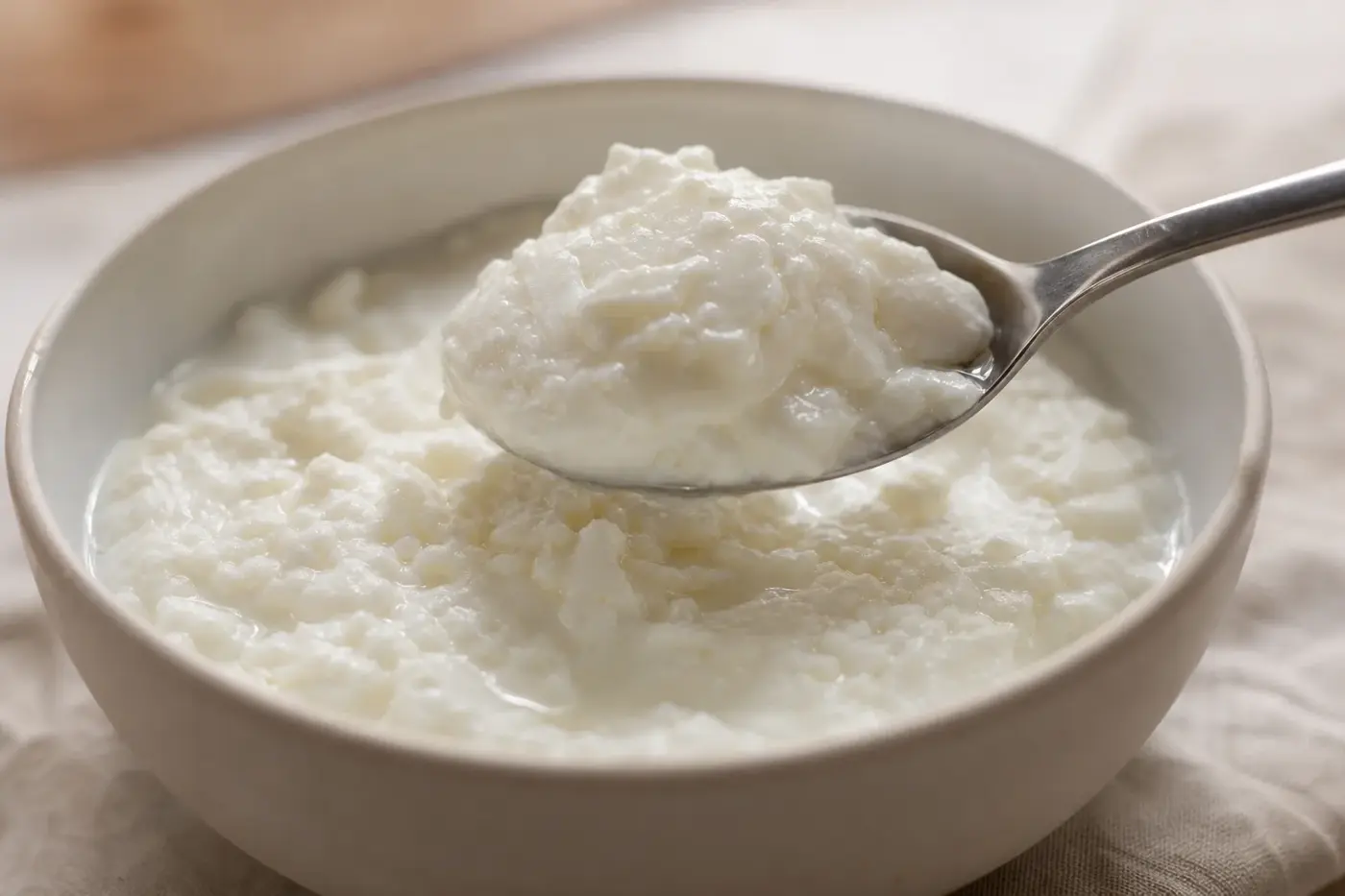
Before dinner, you may need to grind the cheese. In Algeria’s Ahaggar, Tuareg cheesemakers turn fresh milk, chiefly goat’s milk, into small, flat cheeses, setting the curd and draining it on mats. Dried into a provision with a dark surface, Takammart belongs to a pastoral life in the Sahara, where keeping milk matters as much as producing it.[1][2]
| Your questions | What the accounts tell you |
|---|---|
| What is it called? | Takammart; plural recorded as tikammarin.[1] |
| Where is it traditionally made? | Ahaggar, also called Hoggar, southern Algeria.[1][3] |
| Which milk goes into it? | Mainly whole goat’s milk in the FAO account.[1] |
| How is the milk treated? | Raw, without heat treatment.[1] |
| What sets the milk? | Dried kid’s abomasum, the stomach compartment supplying animal rennet.[1] |
| What shape and size can you expect? | Small, flat squares, recorded at 15 to 90 g.[1] |
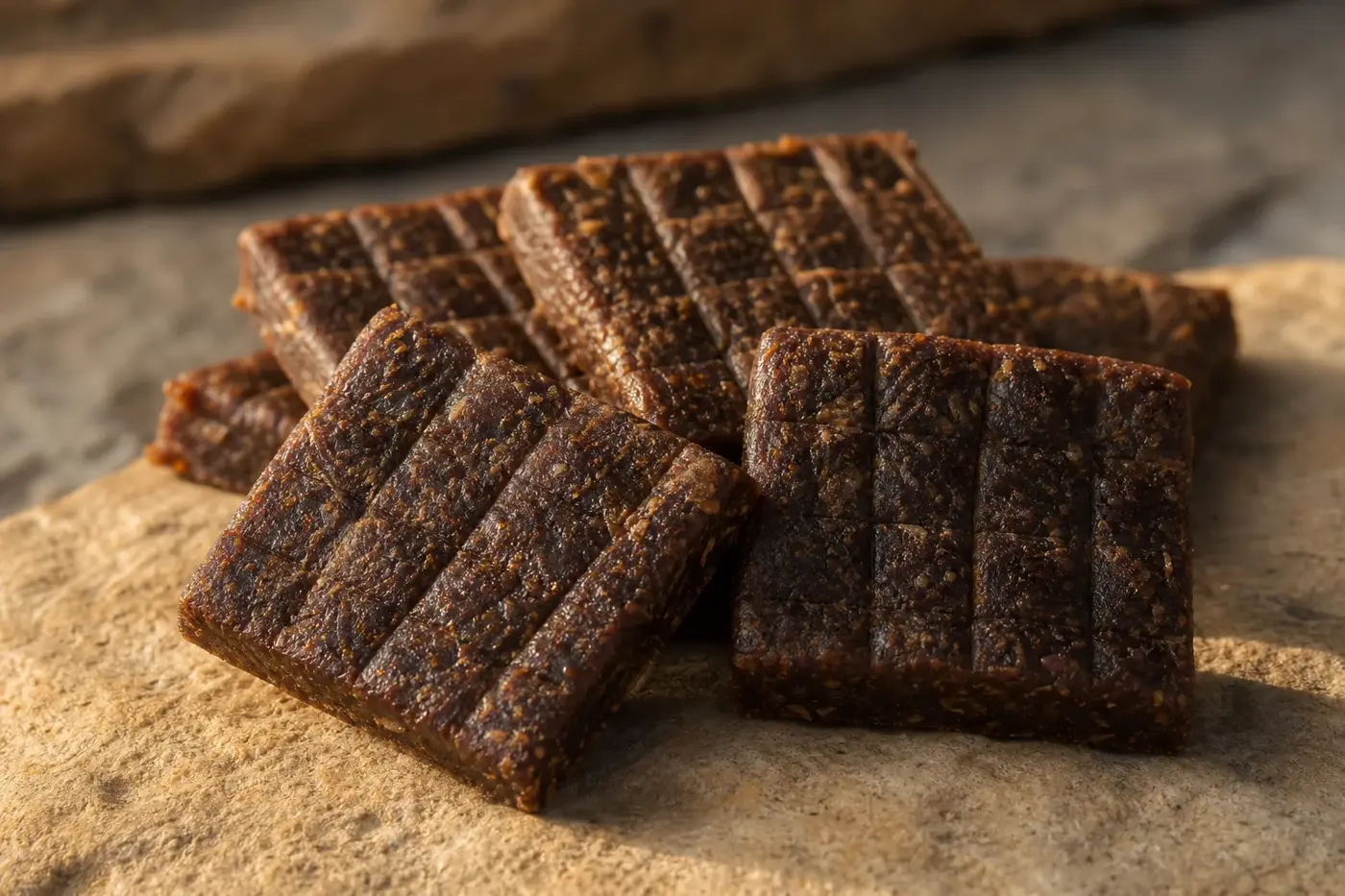
| What does it look and feel like? | Dark brown, scored surface; very hard when dried.[1] |
| Registered name, authority and register ID | Not established here |
| Legal minimum ageing | Not established here |
Into the Ahaggar, beyond the dunes
Picture the Sahara, but leave room for mountains. A field study published in 1954 describes the Ahaggar’s rugged uplands, dry river valleys and grazing shaped by irregular rain. Water and pasture determine where pastoral households can camp and how far their animals can range.[2]
Here, making milk last has a clear purpose. The same study records cheese as food for journeys and the hot season. It distinguishes fresh milk set with animal rennet from another cheese made by heating buttermilk; Takammart takes the fresh milk route.[2]
Those two methods give you a glimpse of household choices. One preserves whole milk as cheese. The other lets the household extract butter first, then turn the remaining liquid into cheese: two ways of making a milk supply go further.[2]
A name with several spellings, a question about milk
Follow Takammart through written accounts and you will meet several spellings. The FAO uses Takammart and tikammarin; the earlier ethnographic study records takamart and tikmaren. A 2019 review of Algerian dairy traditions uses Takemmart within its Takammart section, associating the cheese with the Hoggar around Tamanrasset.[1][2][3]
Goat’s milk is the clearest documented starting point for the Algerian cheese. A development handbook also describes cow’s and sheep’s milk being mixed with goat’s milk in Hoggar cheesemaking. It gives no separate Takammart formula for each combination.[4]
A mixed herd, though, is not an ingredients list. Several species may supply milk without all contributing to a cheese bearing this name. If you have a particular piece in front of you, the useful question is simple: which milk did the maker use?
If you want to untangle milk treatments too, see raw, thermised and pasteurised milk. That is a separate question from which animal supplied the milk.
The dried stomach that gets things started
The traditional coagulant comes from a young goat’s stomach. The development handbook describes keeping dried stomach pieces, then adding them to fresh milk in a large wooden vessel. It calls the resulting set mass akrou.[4]
This is coagulation: milk setting into curd, its solid part. Animal rennet does the work here, unlike the heating of buttermilk recorded for the neighbouring cheese tradition.[2][4] The distinction tells you both what goes into the vessel and how the cheesemaker obtains that solid mass.
There is practical knowledge in both steps: keeping a usable coagulant, then putting it to work in fresh milk. To follow the wider transformation, explore how cheese is made. For the enzymes behind the setting, see animal and other rennets.
A ladle, a mat and a pair of skilled hands
Once the milk has set, the cheesemaker lifts out the curd with a ladle. The handbook describes portions going onto a mat, where they are worked by hand to release liquid. The maker shapes them into small, flat cheeses before drying.[4]
That escaping liquid is whey. At this stage, the curd is still soft, so the hands have two jobs: shaping it and helping moisture leave. The shape is not merely a finishing touch; making it is part of the transformation.[4]
Some details remain open here, including the precise mat material, the drying sequence and their effect on flavour. Keep those questions separate from the steps described in the accounts.
The essential sequence is setting, ladling, draining, shaping and drying. Alongside milk and rennet, the mat has a practical role. It supports the soft curd as the cheesemaker works it towards something solid enough to carry.[3][4]
Put the spreading knife aside
Small, flat, very hard, with a dark surface: hold that image in your mind. It is the strongest published description of finished Algerian Takammart.[1] If you were picturing a soft goat’s cheese with a spreadable centre, your spreading knife can have the evening off.
The detailed character of the paste and flavour remains open here. So does the effect of plant material used in production.
Texture gives you a firmer guide to how it is eaten. The handbook describes younger dried pieces being bitten or crunched; further drying makes them hard enough to need grinding before they go into food.[4] Pounding, rather than slicing, may be the next step, and that hardness is central to the cheese’s place at the meal.
Packed for the journey
Dried cheese needs somewhere to go. In the historical pastoral system described by the FAO, wide-opening goat skins served as storage containers, while larger animal skins provided wrapping.[1] Keeping and carrying were part of the cheese’s story, not an afterthought.
Drying removes moisture and produces the hard provision recorded in these historical accounts.[1][2][4] It also changes how you prepare the next meal: a piece you could once bite eventually needs reducing to powder. The way the cheese keeps and the way it is prepared belong together.
These accounts describe technique and adaptation, not safe storage times or conditions for a modern product. If you are handling an individual cheese today, establish exactly what you have. Then obtain the maker’s storage instructions.
At the table, a bite or a spoonful
You might meet Takammart as something to bite, or as an ingredient to grind. The Algerian account describes eating dried cheese directly while it remains biteable, then powdering harder pieces and mixing them with other foods.[4] Grinding is part of its documented life at the table.
A regional ethnographic account records a cold preparation called aγgera or erélé. It brings together churned milk, water, millet flour, powdered cheese, powdered dates and a little Cayenne pepper. Powdered cheese is named as an ingredient, but not Takammart alone.[5]
Turn to the Malian account and the name becomes tikomart. A Slow Food and FAO project report describes it being pounded, soaked in tea or mixed into millet porridge.[6] These are Malian uses of a related named cheese, not a fixed recipe for Algerian Takammart.
Together, the accounts put dried cheese in both meals and drinks. Eating a piece on its own is only part of the picture. Your cheeseboard is not the whole cheese universe: reduced to powder, this cheese joins other ingredients in a different kind of preparation.
Watch the hands, not just the tools
Recognising set curd, lifting it cleanly, working out liquid, judging its progress as it dries: much of the skill lies in handling.[3][4] The equipment is modest. The cheesemaker needs to understand how the material changes, and what to do next.
The Malian project report specifically describes women ladling and hand shaping tikomart. It places dairy processing within a wider knowledge of livestock, milk and seasonal food supplies.[6] That is a record of practice in Mali, not a description of every Tuareg household.
The regional ethnographic account gives you another glimpse of that knowledge through a detailed vocabulary for milk in different conditions. It also records wooden vessels and specialised dairy utensils.[5] Cheese belongs to this larger household repertoire alongside drinking milk, churned milk and butter, each with its own place in handling and using milk.
Finding Takammart: start with the maker
Start with provenance, rather than spelling alone. Ask the person supplying your cheese these practical questions:
- Where was it made?
- Which milk species were used?
- Who made it, and when?
- Is it intended for eating directly, grinding or another preparation?
- What storage instructions accompany this batch?
Outside the production region, establish the product’s identity before arranging a purchase. A familiar-looking spelling tells you less than a maker’s name, a locality and a clear account of production. Those details help identify the particular cheese in front of you.
For household handling in England, Wales and Northern Ireland, consult the Food Standards Agency’s current guidance.[7] If you live elsewhere, turn to the national food authority for your country.
Need help making sense of the information supplied with your cheese? See how to read a cheese label. For household storage principles and their jurisdiction-specific sources, continue to how to store cheese at home.
General information only, not medical advice: follow the official guidance where you live.
Questions people ask
Where does Takammart come from?
Takammart is associated with the Ahaggar, also called Hoggar, in southern Algeria. The mountain region lies within the Sahara.
What milk is Takammart made from?
The FAO account describes mainly whole goat’s milk, used raw without heat treatment. A handbook also describes cow’s and sheep’s milk being mixed with goat’s milk in Hoggar cheesemaking, but does not give a separate Takammart formula for each combination.
How is Takammart made?
Fresh milk is set with animal rennet, traditionally from a young goat’s stomach. The curd is ladled onto a mat, worked by hand to release liquid, shaped into small, flat cheeses and dried.
How do you eat Takammart?
Younger dried pieces can be bitten or crunched. As they dry further, they become hard enough to require grinding before being mixed with other foods.
How should Takammart be stored?
The historical accounts do not give safe storage times or conditions for a modern product. Obtain the maker’s instructions for the individual cheese and, in England, Wales and Northern Ireland, consult the Food Standards Agency’s current guidance.
Sources
[1] Food and Agriculture Organization of the United Nations. The technology of traditional milk products in developing countries. FAO Animal Production and Health Paper 85, 1990. Part B, section 1.12, “Takammart”. Official text.
[2] Geografisk Tidsskrift. “Some Aspects of the Problem of Nomadic Cattle Breeding among the Tuareg of the Central Sahara.” Volume 53, 1954. Regional geography, pastoral conditions and cheese discussion. Journal text.
[3] Journal of Ethnic Foods. “Traditional dairy products in Algeria: case of Klila cheese.” Volume 6, article 7, 2019. Section “Takammart”. A literature review, not a new Takammart production study. Published article.
[4] GRET. Créer une Petite Fromagerie. Expériences et Procédés. 1994. Section “Transformation traditionnelle chez les éleveurs touaregs”, including “Le tikammarin”. Historical handbook reproduced in the CD3WD archive. Archived text.
[5] Encyclopédie berbère. “Lait”. Volumes 28 and 29, 2008, pages 4322 to 4330; electronic edition 2013. Regional ethnographic account drawing on the author’s Ahaggar research. Publisher’s PDF.
[6] Slow Food, Slow Food Foundation for Biodiversity and FAO. Promoting origin-linked quality products in four countries. Mid-term Progress Report, reporting period January 2010 to February 2011. Mali, section “Tikomart”. Project report.
[7] Food Standards Agency. How to chill, freeze and defrost food safely. Published 18 December 2017. Applies to England, Northern Ireland and Wales. Section “Chilling food”. Official guidance.
This desk-researched account compares historical ethnography, technical descriptions and regional food documentation, keeping Algerian evidence separate from related Malian practices.
Last checked: November 2026
Last checked November 2026.
The editors suggest you read next