Watch the salt go into the milk. The rennet has to wait its turn. With Egyptian Domiati, that order matters; in Algeria, klila can dry into hard pieces before returning to the cooking pot, while fresh Moroccan jben takes a softer route straight to the table.[1][2][3][5]
Each is an answer to a familiar question: what shall you do with the milk? Across North Africa, you find salted white cheeses and cheeses matured for stronger flavour. Follow them from one community to another and the methods change, sometimes without crossing a border.[1][2][3][5]
Five countries, a whole world of cheese
Here, North Africa means Morocco, Algeria, Tunisia, Libya and Egypt. Across these five countries, the business of producing milk and the techniques used at home vary considerably. Names travel, too: jben and klila appear in accounts from both Morocco and Algeria, but place and maker shape what those names mean.[1][2][4]
Look beyond the name and ask about the milk. Moroccan jben is documented with cow and goat milk; Algerian research records cow, sheep and goat milk across different traditional cheeses. In Egypt, buffalo milk becomes particularly significant, including alongside cow milk in Domiati. These are individual choices, not a four-species blend shared across the region.[1][4][5]
The season has a say before anyone reaches for salt or a mould. Conditions affect milk availability and the pace of spontaneous fermentation; Moroccan research records seasonal differences in fermentation time. Drying offers another way forward, carrying surplus milk beyond the moment it was produced.[2][3]
Moroccan jben: one name, several ways to make it
Soft, homogeneous and mild: that is the jben described in an FAO record covering Benslimane, Skhirat and Ain Aouda. The method uses cow or goat milk, heating, added culture and rennet. That last ingredient is a preparation containing enzymes that set milk into a gel.[1]
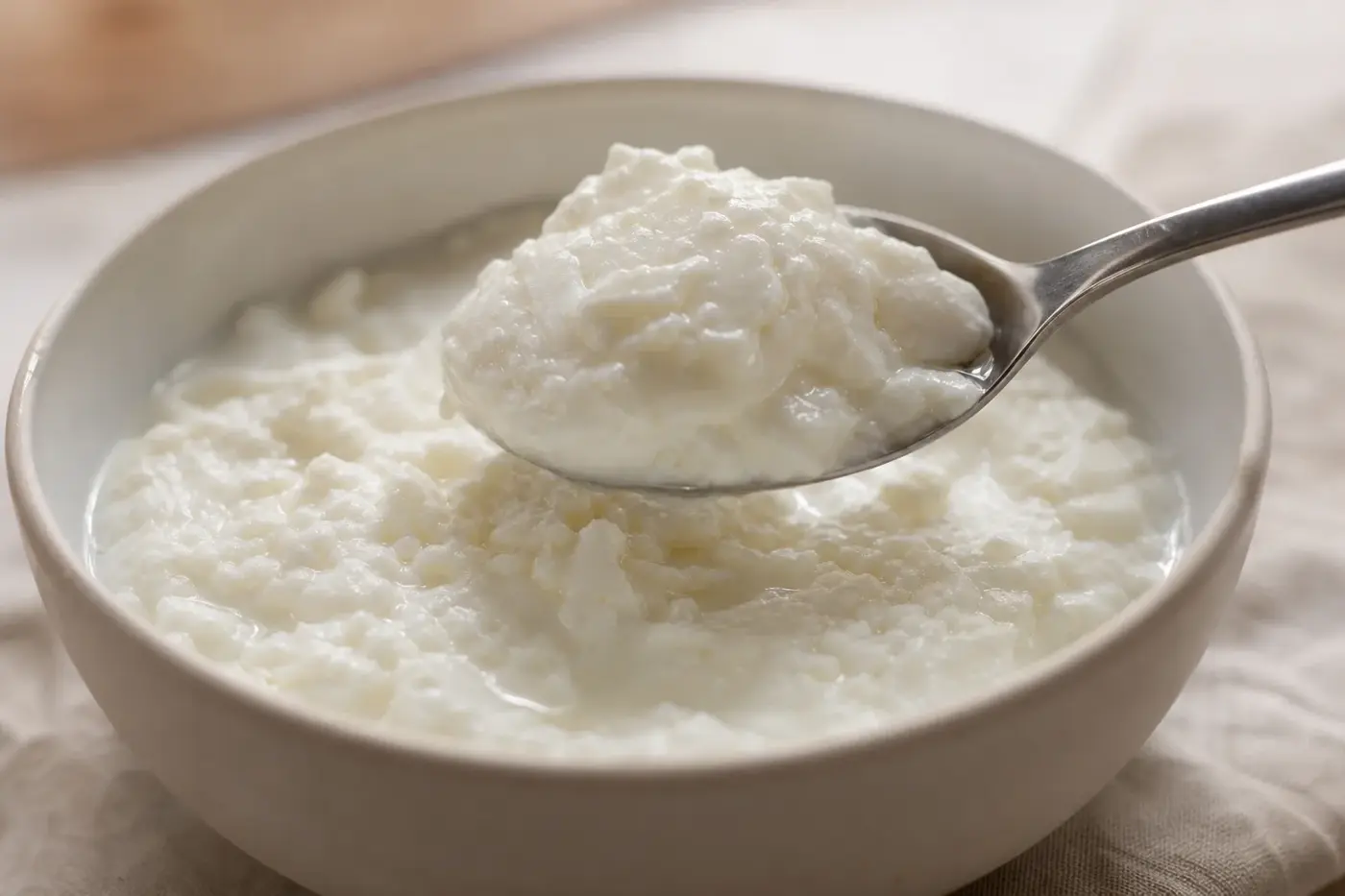
Elsewhere in accounts of Moroccan dairy practice, the milk takes another route. Acidified milk drains through cloth, leaving curd, the solid portion, behind as whey, the liquid, runs away. Salt appears particularly in northern Moroccan versions. Both accounts describe fresh jben, but the name leaves plenty of room for difference.[3]
On a farm in Hjar Nhal, near Tangier, you get a closer view. Researchers made five experimental batches with goat milk: four received selected bacterial cultures, while one used whey as a traditional inoculum. A separate Moroccan study investigated pasteurised jben made with selected cultures and rennet.[6][7]
Two cheeses labelled jben, then, need not have the same acidity, firmness or milk treatment. A name badge only tells you so much. Ask where yours was made and how the milk was treated; the distinctions in raw, thermised and pasteurised cheese will help you understand the answer.[1][3][6][7]
Algerian klila and Bouhezza: into the pot or the bag?
Picture klila going into couscous, berkoukes or bread. A field study in Guelma and Souk Ahras interviewed 200 people and analysed eight klila samples. Respondents described dried klila in couscous and berkoukes, and fresh klila worked into traditional breads including m'laoui and kessra.[2]
Before the cooking comes a household sequence, each stage leading to the next. Milk ferments, then is churned to remove butter. The remaining lben is heated to help separate the curd, which drains into fresh cheese. Dry it further and you have hard pieces ready to return to the cooking pot later.[2]
Bouhezza takes another route, with a bag doing two jobs: draining and ripening. Salted fermented milk is added progressively, so fermentation and drainage develop together. Unlike klila, the curds are not taken out and dried separately.[4]
The accounts describe an acidic, salty cheese, with red pepper providing the finish in particular preparations. If you are comparing the two, keep that bag in mind. This is a different method, not simply another way to dry the same curd.[4]
Egypt: make room for Domiati, Roumy and mish
Domiati carries its association with Damietta in its name, although it is made much more widely in Egypt. Its distinctive move comes early: salt arrives before rennet. Original experiments used both cow and buffalo milk to measure how salt affected coagulation, drainage and yield.[5][9]
Fresh Domiati is soft and rather salty, according to the LACTIMED dairy-sector report. Give it time to ripen and acidity increases, while its close texture can become slightly flaky. You get different eating experiences from fresh and matured versions, with variation between dairies too.[9]
For a firmer contrast, turn to Roumy. You may also see Romy or Rumi, while scientific literature frequently calls it Ras: a hard, wheel shaped Egyptian cheese.[9][10] Pressing, salting and maturation give it a structure quite unlike fresh Domiati, with a flavour the literature describes as sharp and salty.[9][10]
Mish follows fermentation down another path. Egyptian research describes karish, a fresh drained cheese, pickled with salt and other ingredients, sometimes including spices and older mish as an inoculum. The resulting cheese is yellowish brown. Household mixtures account for the different formulations gathered under the name.[10]
Tunisia and Libya: beyond the fresh curds
An older FAO technical inventory records sheep-milk kashkaval production in Tunisia. Published in 1990, it places this cheese in the pasta filata family, where the curd is heated and worked into a cohesive mass. Alongside fresh draining and whey recovery, you have another technique to look out for.[1]
For the wider picture encompassing Tunisia and Libya, keep cheese and fermented milk distinct. Across the region, lben and rayeb refer to fermented milks in the sources discussed here. Draining or further processing turns them into a distinct product.[3]
Follow the curd through salt, cloth and time
To understand these cheeses, follow what happens to the curd. Warm conditions help explain why preservation matters, but each method changes the result differently. Klila can be eaten fresh, and Domiati can be sold before extended ripening. Neither drying nor long fermentation tells the whole regional story.[2][5][9]
| Method | What happens to the cheese | Where you find it |
|---|---|---|
| Draining | Liquid whey drains away from the curd | Moroccan jben.[3] |
| Salting before coagulation | Salt goes in before the milk sets | Egyptian Domiati.[5] |
| Drying | Fresh curd becomes hard, dry pieces | Algerian klila.[2] |
| Ripening in a vessel | Fermentation and drainage happen together | Algerian Bouhezza.[4] |
| Ageing a pressed cheese | Maturation develops a hard wheel | Egyptian Roumy.[9][10] |
Bring bread and let the cheese lead
Bread and cheese need little introduction at the table. The Egyptian LACTIMED report records white cheese eaten with bread, making a simple meal. Algerian fieldwork shows another relationship with grain: klila goes into bread dough or a cooked couscous dish. Your cheese need not sit politely on the sidelines.[2][9]
At home, try fresh bread, sliced tomatoes and cucumber with a fresh or brined cheese. The vegetables bring crispness and leave you room to appreciate the cheese, without several accompaniments competing for attention. Start simply, then let the particular cheese and your taste guide what comes next.
Buying in Britain: get to know your cheese
Before a regional name wins you over, read the product details. Check the country of manufacture, milk species, milk treatment, ingredients and storage instructions. If you are buying unpackaged cheese, ask the retailer for the same information, plus when it was opened or cut and how long you should keep it.
Use how to read a cheese label when comparing packs, especially when several white cheeses carry broad descriptions. Then choose for the meal you have in mind. Fresh jben offers a soft accompaniment, brined Domiati a salted white cheese, and aged Roumy a firm cheese to slice.[1][9]
For household storage in England and Wales, the Food Standards Agency advises a fridge temperature between 0 and 5 °C and following the packaging instructions. The same guidance applies in Northern Ireland. This is the November 2026 guidance.[11]
Bring out only what you intend to serve. Follow the FSA guidance on keeping chilled food out of the fridge during preparation. You can find further detail in how to store cheese at home.[11]
This page summarises published guidance from the official sources it cites. It is not medical advice. Guidance differs between countries and changes over time, so check the current source for where you live, and ask your doctor, midwife, pharmacist or dietitian about your own circumstances.
Pregnancy and higher risk: find the right guidance for your cheese
During pregnancy, both cheese type and milk treatment matter. The NHS guidance for November 2026 says you can eat hard cheeses such as Cheddar even when made with unpasteurised milk. It also lists pasteurised soft cheeses such as feta among suitable choices.[12]
The guidance advises against mould ripened soft cheeses with a white rind and soft blue cheeses, even if pasteurised, unless cooked until steaming hot. It also advises against soft cheeses made with unpasteurised milk unless thoroughly cooked. Those distinctions matter more than a broad regional label.[12]
If you are choosing soft jben or white brined cheese during pregnancy, establish the milk treatment and product type first. Match those details to the guidance. Older people and readers with weakened immunity should ask their healthcare professional about their circumstances; the cheese food safety guide offers a route into the relevant official advice.[12]
Three questions worth taking to the cheese counter
Which place, which milk and which method? Take those questions to your retailer and you will get further than a name alone allows. Names cross borders while techniques change between neighbouring households. Jben alone appears in accounts of cloth-drained acid curds, rennet-assisted production and experiments with selected cultures.[1][3][6][7]
Keep the dates and locations attached to those accounts, too. A household survey captures uses and practices; a controlled cheese trial and an older technical inventory answer different questions. Read them together and North African cheese comes into clearer view, in all its variety, with room for a stronger local record where it is still needed.
Questions people ask
What is Moroccan jben made from?
An FAO record describes jben made with cow or goat milk around Benslimane, Skhirat and Ain Aouda. Another account describes acidified milk drained through cloth, with salt recorded particularly in northern Moroccan versions.
How is Algerian klila made and eaten?
Milk is fermented and churned to remove butter, then the remaining lben is heated and drained to make a fresh cheese. Klila can be dried into hard pieces for cooking, or used fresh in traditional breads.
What makes Egyptian Domiati distinctive?
Salt is added to the milk before rennet sets the curd. Domiati is associated with Damietta and has been made with cow and buffalo milk.
How are Roumy and mish different?
Roumy is a hard, wheel shaped Egyptian cheese with a sharp, salty flavour. Mish is a fermented cheese made by pickling fresh drained karish with salt and other ingredients, sometimes including spices and older mish.
Can I eat soft North African cheese during pregnancy?
NHS guidance distinguishes between cheese types and milk treatments, and advises against soft cheeses made with unpasteurised milk unless thoroughly cooked. Check the product type and milk treatment against the NHS pregnancy guidance.
Sources
- Food and Agriculture Organization of the United Nations. The technology of traditional milk products in developing countries. FAO Animal Production and Health Paper 85, 1990. Entries 4.12, Jben, and 4.13, Kashkaval. Technical inventory.
- Livestock Research for Rural Development. Contribution on the characterization of Klila, a traditional cheese in east of Algéria. Volume 27, article 83, 2015. Original questionnaire survey and sample analysis. Study.
- National Research Council, National Academies Press. Applications of Biotechnology in Traditional Fermented Foods, chapter 10, Moroccan Traditional Fermented Dairy Products, 1992. Research account of Moroccan fermentation and draining practices. Book extract.
- Journal of Ethnic Foods. Review of the main traditional cheese-making in the Mediterranean basin. Volume 12, article 31, 2025. Sections on Morocco, Algeria and Tunisia. Review.
- Journal of Dairy Research. 429. Studies on Egyptian Domiati cheese. Volume 17, issue 3, pages 312 to 328, October 1950. Original research; publisher's extract retrieved. Article and extract.
- Mljekarstvo. Evaluating autochthonous lactic acid bacteria for the production of Moroccan Jben cheese. 2025. Original experimental study, including the farm location, five-batch design and cheesemaking method. Full text.
- Actes de l'Institut Agronomique et Vétérinaire Hassan II. Préparation du jben pasteurisé à l'aide de levains lactiques sélectionnés. Volume 15, issue 3, 1995. Experimental production study; abstract retrieved. Article record and abstract.
- International Dairy Journal. Formation and dynamics of aroma compounds during manufacturing-ripening of Bouhezza goat cheese. 2022. Publisher search extract retrieved; full article access unsuccessful. Publisher record.
- LACTIMED. Developing the typical dairy products of Alexandria and Beheira: Diagnosis and local strategy. March 2014. Dairy-sector field report, including Egyptian cheese descriptions and production accounts. Report.
- African Journal of Food Science. Microbial safety and biodiversity of bacterial communities in traditional Egyptian cheese types. 2022. Original study of commercial cheeses, with background descriptions of Romy and mish. Full text.
- Food Standards Agency. How to chill, freeze and defrost food safely. Published 18 December 2017; live guidance checked November 2026. Applies to England, Northern Ireland and Wales. Official guidance.
- NHS. Foods to avoid in pregnancy. Live guidance checked November 2026. Section on cheese, milk and other dairy. Official guidance.
This desk-researched article compares original studies, an agricultural technical inventory and regional research accounts, with British handling and pregnancy advice checked separately against official guidance.
Last checked: November 2026
Last checked November 2026.
The cheeses of North Africa
The editors suggest you read next
French Cheese: The Complete Guide
Picture Normandy’s pastures, then follow the milk towards the Loire’s goat dairies, the Jura’s shared cheesemaking traditions and the sheep country of the Pyrenees.