Nabulsi
Sweet pastry gives way to syrup, then a warm heart of salty white cheese.
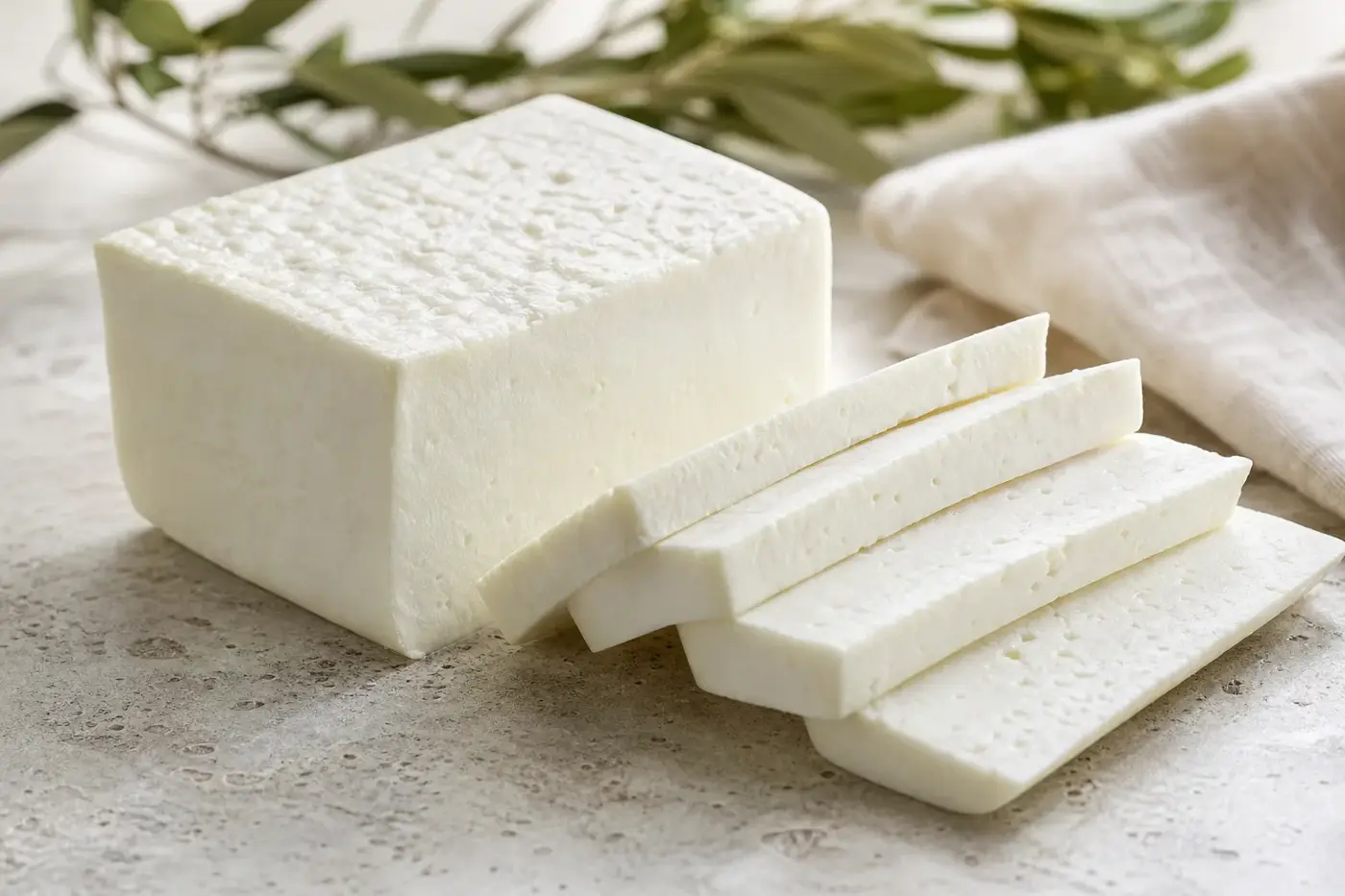
Sweet pastry gives way to syrup, then a warm heart of salty white cheese. In Nablus, that is Nabulsi’s moment in knafeh. You will find it just as much at home on the Palestinian breakfast table: firm, preserved in brine and traditionally associated with sheep’s and goat’s milk. How you prepare it determines whether it belongs beside bread or inside something sweet. [1,2]
| At a glance | What to know |
|---|---|
| Name | Nabulsi, also written Nablusi. [3] |
| Traditional home | Nablus, Palestine. [1] |
| Milk | Traditionally sheep’s or goat’s; mixtures and cow’s milk versions are documented. [2,3] |
| Shape and texture | White, rindless rectangular blocks, firm enough to slice. [1,2,4] |
| How it sets | Rennet-set. [2] |
| How it keeps | Salt, heating and brine. [4,5] |
Pull up a chair in Nablus
Start in Nablus, the cheese’s essential culinary setting. An-Najah National University’s guide to Palestinian food names Nabulsi as the cheese in the city’s knafeh, describing it as white, salty and semi-hard. That local account places it firmly in Palestinian food culture, while production research records its wider presence in neighbouring countries. [1,4]
At breakfast, you might welcome its pronounced salty bite. After desalting, the same cheese can become the filling in sweet pastry. A block ready for bread may still need preparation before dessert: being invited to both courses does require a change of outfit. [1,4,6]
Get to know that salty white block
Those rectangular blocks take shape at the press. Palestinian production research records pressing the curd into blocks, while the university’s food guide describes the finished cheese as white and semi-hard. When you heat it, it softens. [1,2]
Salt makes the strongest first impression in the published Palestinian description. Taste beyond that first encounter and look for the milky character underneath. Distinguishing the dairy flavour from the strength of the brine helps you judge how much desalting your dish needs. [1,6]
Some versions bring aromatics, too. A 1986 production experiment documented the traditional use of mahaleb and mastic resin in the boiling brine, then tested adding them to the milk for more even flavour distribution. They are part of a documented production tradition, but check your pack’s ingredients to see whether they feature in your cheese. [5]
Find out which milk is in your Nabulsi
Sheep’s and goat’s milk are the traditional choices, but you will also find cow’s milk and mixed-milk versions. An An-Najah research project made Nabulsi from pasteurised cow’s milk in Tulkarem. A Jordanian experiment compared sheep’s milk, cow’s milk and three blends of the two. [1,2,3]
The Jordanian study used instrumental colour measurements and texture-profile analysis, with two experimental replicates. Milk choice affected colour, while desalting had a substantial effect on texture. For your kitchen, the useful lesson is to judge the cheese after preparation as well as straight from the pack: milk species alone cannot tell you how it will behave. [3]
Follow the curd from cloth to brine
Nabulsi has its shape before the heating begins. The basic sequence is setting, draining, pressing, salting and heating, followed by storage in brine. Rennet, the enzyme preparation that sets milk, produces the curd; whey is the liquid released when that curd is cut and drained. [2,4]
In the traditional sequence described in dairy research, the curd drains in cloth and is pressed before being cut into small blocks. Those pieces are salted, boiled in brine, then cooled and packed with brine. By the time they reach the hot brine, the blocks have already taken shape. [4]
Before you plan your dish, look separately at the milk treatment and the finished cheese’s preparation directions. Heating during cheesemaking is a production step; instructions for heating your purchased cheese tell you what to do in your kitchen. They answer different questions, and how cheese is made takes you through the wider sequence.
Discover what salt and heat do behind the scenes
Salt helps shape Nabulsi, not just season it. The early production experiment found that salting the curd during cutting and turning accelerated whey separation and spread salt more uniformly. The eventual texture reflects how water leaves the curd, not simply how firmly it is pressed. [5]
Heat treatment, brine concentration and storage conditions work together to preserve the cheese. In a 2014 experiment, microbial levels changed with heating treatment, salt concentration and storage duration; salt concentration also affected sensory scores for appearance and texture. These findings concern controlled manufacturing, so follow the finished product’s storage instructions at home. [7,8]
Bring a slice to breakfast, then try the pan
Begin with a slice and some bread. Breakfast and snacking are documented uses in dairy research, so taste a little together before preparing more. Decide whether that level of salt suits your meal; in a sandwich, Nabulsi brings seasoning of its own. [4]
You can also take it to the pan: An-Najah’s guide records frying Nabulsi. If you are planning a cooked filling, try a small piece before committing the whole block. Consider it a rehearsal, with the usual cook’s privilege of eating the evidence. [1]
Check that piece for saltiness and decide whether it needs more desalting. Adjust your other salty ingredients afterwards, once you know what the cheese contributes. Let the block in front of you guide the dish rather than assuming a standard salt level.
Save a place for Nabulsi in knafeh
Knafeh brings Nabulsi together with pastry and syrup. The Palestinian tourism body for Bethlehem describes the dessert as a Nablus speciality made with white cheese, vermicelli dough, syrup and pistachios. An-Najah’s guide names Nabulsi as the cheese used in the city’s knafeh. [1,9]
Soaking reduces the salt that reaches that sweet filling. Taste with your destination in mind: cheese for a savoury table and cheese for dessert call for different judgements. A slice that tastes pleasantly salty beside bread may need further soaking before it balances a syrup-soaked pastry. [3,6]
Let your dish guide the soaking
Start with the preparation directions on your pack. This guidance brings together the seller’s documented water-soaking method and official refrigeration advice for England, Wales and Northern Ireland, as at November 2026. Follow the instructions for the particular product you have bought. [6,8]
Let those instructions and the cheese’s taste guide you towards the stopping point. Published preparation schedules describe particular cheeses; you need to judge whether this portion now suits breakfast, a savoury filling or knafeh. Desalting changes texture as well as flavour, so notice its firmness alongside its saltiness. [3,6]
See how Nabulsi, Akkawi and Halloumi meet the heat
The clearest distinction is when the cheese is heated, and what surrounds it. The research methods below show those differences in manufacture. Look separately at each producer’s milk choices, salt levels and finished textures. [4]
| Cheese | When heating happens in the cited method | Source |
|---|---|---|
| Nabulsi | Shaped, salted blocks are heated in brine before packing. | [4] |
| Akkawi | Pressed portions go into brine without post-press heating. | [4] |
| Halloumi | Pressed cheese is heated in whey, then salted. | [4] |
If you are substituting, begin with the job your cheese needs to do. A breakfast slice and a pastry filling ask different things of salt and texture. Prepare a small portion of the replacement first, then judge it in the intended dish before using the rest.
Give your Nabulsi a good fridge routine
The product’s storage instructions come first, including directions for use after opening. In England, Wales and Northern Ireland, the Food Standards Agency advises keeping a home fridge at “5 °C or below”. [8]
Note when you open the pack and keep its label, so you still have the storage directions and date. For canned cheese, official guidance advises moving the remaining contents into a covered storage container after opening, then refrigerating. [8]
Use-by dates concern safety, not guesswork. UK government guidance says to follow storage instructions and avoid eating food after its use-by date. For the broader routine, turn to how to store cheese at home. [10]
Get clear answers about rennet
If you have vegetarian or religious dietary requirements, establish which coagulant your particular product uses. If its description simply says “rennet”, ask the manufacturer for the source. Confirm that the answer applies to this cheese and market.
Look at the precise product scope of any certification, too. Keep your enquiry specific: milk species, milk treatment, coagulant and added spices are separate details to establish. The rennet explainer covers the terminology, while how to read a cheese label helps you make sense of the rest of the pack.
General information only, not medical advice: follow the official guidance where you live.
Questions people ask
What does Nabulsi cheese taste like?
Nabulsi is salty, white and firm enough to slice. It softens when heated.
How is Nabulsi prepared for knafeh?
Soaking reduces the salt in Nabulsi before it is used as a sweet filling. Follow the product’s preparation directions and check both saltiness and firmness, as desalting changes texture too.
How is Nabulsi different from Akkawi and Halloumi?
In the cited production methods, Nabulsi blocks are heated in brine before packing, while Akkawi enters brine without heating after pressing. Halloumi is heated in whey and then salted.
Is Nabulsi suitable for vegetarians?
Nabulsi is set with rennet, but the coagulant used in a particular product needs checking. If the label simply says rennet, ask the manufacturer for its source and confirm that the answer applies to that cheese and market.
How should Nabulsi be stored?
Follow the product’s storage instructions, including any directions for use after opening. In England, Wales and Northern Ireland, the Food Standards Agency advises keeping a home fridge at 5 °C or below; check its guidance for more information.
Sources
- An-Najah National University, International Office. Guidebook, 2022, Palestinian food section. Local institutional account describing Nabulsi’s milk, saltiness, texture, heating uses and connection with Nablus knafeh. University guidebook.
- An-Najah National University repository. Formulation of low-sodium Nabulsi cheese by using potassium, research project abstract, 7 January 2021. Documents experimental production in Tulkarem using pasteurised cow’s milk, rennet, cloth drainage and rectangular moulding. Research record.
- Mutah University research, published in Current Research in Nutrition and Food Science. Quality of White-Brined Nabulsi Cheese Made with Different Proportions of Sheep’s and Cows’ Milk, volume 11, number 1, 2023, pages 88 to 110. Original study.
- Victoria University. The Effect of Sodium Chloride Substitution with Potassium Chloride on Chemical, Physical and Microbiological Characteristics of Mediterranean Cheeses, doctoral thesis, June 2013. Production descriptions and original experimental papers on Nabulsi, Akkawi and Halloumi. University repository thesis.
- University of Jordan research, recorded by FAO AGRIS. Toward improving the traditional method of producing boiled brined white cheese (Nablusi cheese), Dirasat, volume 13, issue 5, 1986, pages 19 to 29. Authors’ abstract retrieved through the agricultural research record. Research abstract.
- Watany Palestinian Products. Mashmuluh Nabulsi Cheese, product preparation and storage information, undated, retrieved November 2026. Commercial seller’s instructions, used as product-specific evidence. Product information.
- University of Jordan and collaborating universities, published in International Journal of Dairy Technology. Influence of storage, brine concentration and in-container heat treatment on the stability of white brined Nabulsi cheese, volume 67, issue 3, 2014, pages 427 to 436. Publisher’s abstract. Research record.
- Food Standards Agency, GOV.UK. How to chill, freeze and defrost food safely, published 18 December 2017, live guidance retrieved November 2026. Applies to England, Northern Ireland and Wales. Official refrigeration guidance.
- Joint Services Council for Tourism Development in Bethlehem Governorate. Kenafeh, undated, retrieved November 2026. Palestinian tourism account of the Nablus speciality and its components. Palestinian culinary account.
- UK Government. Understanding food labelling: Best before and use-by dates, live guidance retrieved November 2026. Official date-label guidance.
Researched through Palestinian institutional accounts, original dairy research, a documented commercial preparation method and official household food-storage guidance.
Last checked: November 2026
Last checked November 2026.
The editors suggest you read next
Akkawi
Breakfast bread on one side, syrup-soaked kanafeh on the other: Akkawi looks quite comfortable between the two.