Israeli Cheese
Bread in hand, you have a pleasant decision to make.
Bread in hand, you have a pleasant decision to make. At an Israeli breakfast, fresh white cheese sits beside chopped vegetables and olives, ready to spread, spoon or eat between mouthfuls of salad.[1] Follow the sheep and goat milk north to Safed and the story deepens: HaMeiri’s family dairy dates its beginnings to 1840, when its account records a family arriving from Persia. The city’s name still greets you at the cheese counter as Tzfatit.[8]
No single grand wheel presides over Israeli cheese culture. This is not a table waiting for a cheese board to arrive. Its character comes from dairy’s everyday place in meals, where local Palestinian and wider Levantine traditions meet Jewish foodways from several regions and a substantial modern dairy industry.[1]
| Your country guide | What to know |
|---|---|
| Main dairy milks | Cow, sheep and goat milk appear separately in Israeli agricultural statistics.[2] |
| Places to begin | Safed and the Galilee; the Golan dairy sector; goat cheesemaking in the Negev.[3][4] |
| Industry information | The Israel Dairy Board publishes farming information and a dairy directory.[3][5] |
| Guide date | November 2026 |
Pull up a chair for breakfast
Fresh dairy takes an unusually prominent seat at the daily meal. Rather than a selection built chiefly around matured wheels, you find spreadable white cheeses beside cottage cheese, cultured milk products and salt-brined cheeses. Each has a purpose: something to spread, something to spoon, something to slice or crumble.[1]
Start with that plate, rather than a ranking of celebrated cheeses. Smooth white cheese offers something quite different from a salty brined piece, while labneh belongs to the fermented yoghurt tradition. A look at cheese styles and methods helps you look beyond their shared colour.
“Israeli cheese” describes a country’s cheese culture, not a claim that everything on the table originated within the modern state. The interest lies in how regional foods, immigrant traditions and commercial dairying meet. Follow those strands separately and you give both your breakfast and the communities behind it their proper place.[1]
Follow the milk from Galilee to the Negev
Your dairy map begins in northern cheesemaking centres and stretches south to goat farms. The Israel Dairy Board’s directory places producers around Safed in the Galilee, at Lotem and Rosh Hanikra, and in Katzrin in the Golan. Farther south, you reach Kornmehl Goat Cheese Farm in the Ramat Negev area.[3]
Use those locations as starting points, not a league table of production or regional shares. The Central Bureau of Statistics records cow, sheep and goat milk separately, a useful distinction in an industry often discussed principally through its cows. Those agricultural tables provide the statistical framework; for the milk in your particular cheese, ask for the dairy’s own records.[2]
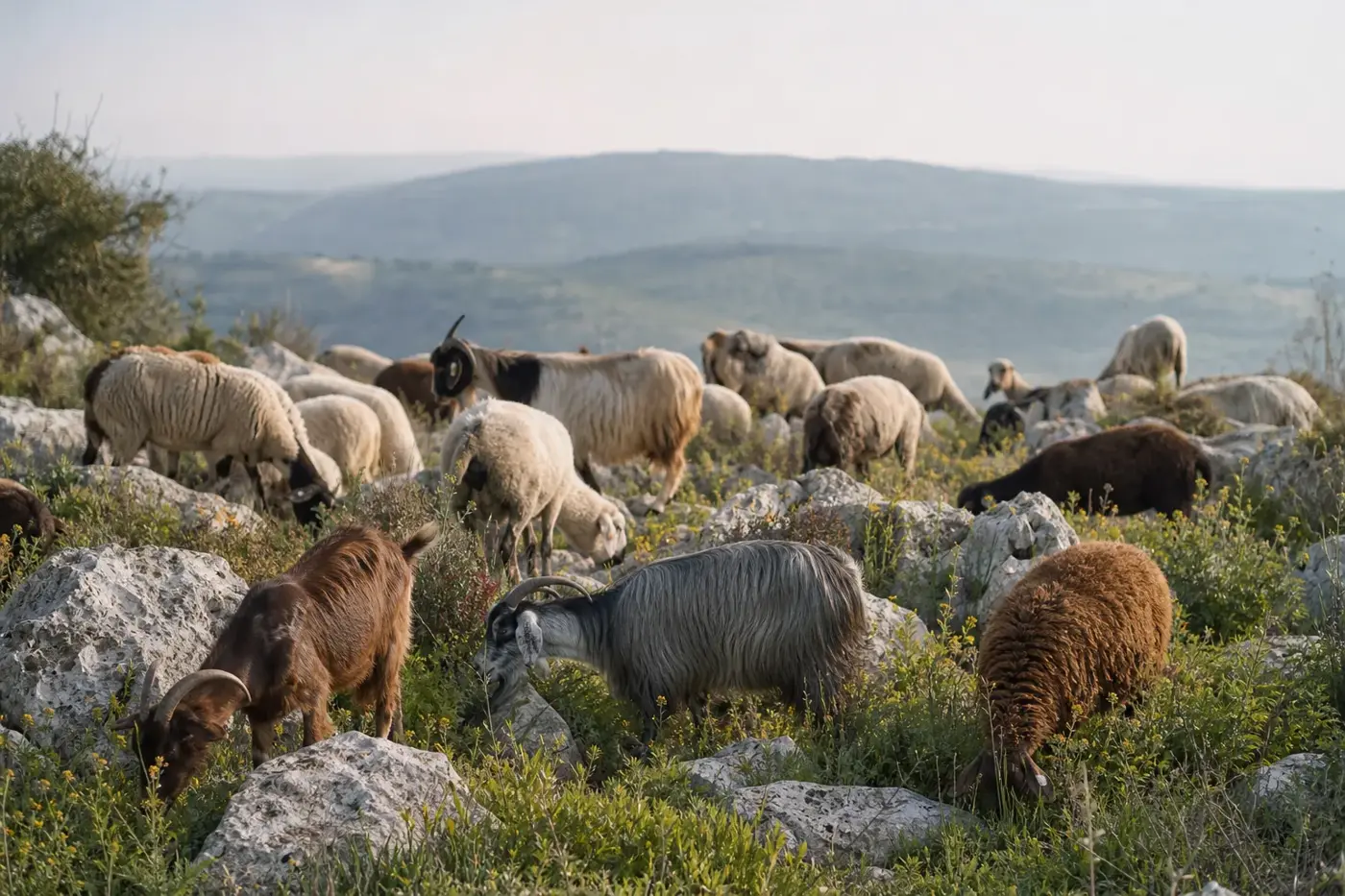
Sheep and goat farms do not all follow the same routine. The Dairy Board describes traditional grazing flocks alongside intensive systems associated with agricultural settlements. Sheep and goats share the collective name “small ruminants”, but that does not give them one universal way of being farmed.[5]
At Kornmehl, the southern landscape comes into sharper dairy focus. The farm describes a hilltop setting in the Negev Highlands, with its goats’ milk processed in its own dairy. Its published range includes fresh and matured goat cheeses, giving you a clearer connection between herd, milk and dairy than the broad label “desert cheese”.[4]
Get to know the cheeses by name
Tzfatit: let Safed introduce itself
Ask for Tzfatit and you are already saying something about place. The name derives from Safed, whose Hebrew name is Tzfat; you may also encounter Tsfatit or the English name Safed cheese. Published accounts describe a salty, semi-hard cheese originally made from sheep’s milk, while one published account describes HaMeiri’s version as salty and smooth.[6][7]
HaMeiri dates its family dairy to 1840, connecting its beginnings with a family arriving from Persia. The business says it has made cheeses from small-ruminant milk ever since. That family history has its own value, separate from the question of who first invented the style.[8]
The name offers you a tradition to explore, rather than a complete specification. Milks and textures can differ under the Tzfatit name. Ask the maker to describe the particular cheese in front of you.
In Safed, that connection between cheese and place has a physical setting. HaMeiri’s visitor material describes a dairy building across four levels, with a tour joining family history, the cheese’s name and an audiovisual account of production. You can ask there how today’s product relates to the older local style.[9]
Cottage cheese, labneh and good breakfast company
Visible curds, drained yoghurt and brined white cheese can share a breakfast table quite happily. They are not, however, doing the same job: cottage cheese has distinct curds, labneh is strained yoghurt, and Bulgarian-style cheese belongs to the brined white-cheese repertoire. Kashkaval brings the broader Balkan cheese tradition to the table.[1][10][11]
| Name to look for | What sets it apart | A useful counter question |
|---|---|---|
| Cottage cheese | Fresh cheese with visible curds | Plain or flavoured? |
| Labneh | Salted yoghurt concentrated by draining whey.[10] | Which milk, and loose or formed into balls? |
| Bulgarian-style brined cheese | Part of Israel’s brined-cheese repertoire.[1] | Where was it made, and which milk was used? |
| Kashkaval | A name used across several Balkan traditions.[11] | What does the maker say about milk, maturation and use? |
With labneh, you begin with yoghurt. Draining removes whey, the liquid from the fermented milk, and concentrates what remains. That differs from coagulating milk with rennet, a milk-clotting preparation; explore both routes through how cheese is made and rennet explained.[10]
Keep those names distinct as you taste or shop. Labneh, cottage cheese and brined cheese may all be white dairy foods, but their descriptions are not interchangeable. A familiar style name cannot tell you every product’s farm, country of manufacture or milk species either: begin with the actual label and the producer’s declaration.
Meet the people behind your breakfast plate
This table has regional foundations as well as immigrant influences. Describe it solely as an immigrant invention and you leave Palestinian food traditions out of the story. Tracing their contribution calls for direct historical or ethnographic evidence, since foods eaten together today can have very different origins.
Jewish communities brought their own dairy customs and preferences. A published account of Israeli cuisine connects Bulgarian-style cheese’s popularity with immigrants from Bulgaria, while HaMeiri’s family history records a Persian connection in nineteenth-century Safed. One story follows a food preference; the other follows a particular dairy.[1][8]
Eastern European dairy pastries and cheese-filled blintzes add another strand, especially around Shavuot. The National Library of Israel’s teaching material introduces the festival’s dairy customs through cheese, cheesecake and blintzes. These overlapping household traditions tell you more than the idea of a single national recipe book.[12]
At the counter, try two questions: who makes this cheese, and how does the seller’s household eat it? You are asking about different things. A maker’s production record establishes ingredients and process; a family account explains a serving custom that may change from one household to another.
Look a little closer at the place name
Safed’s dairy history gives its cheese a meaningful connection with the city. Legal geographical protection is a separate matter. That depends on a register entry, its current status and the jurisdiction where it operates.[8][13][14]
The Israel Patent Office publishes a procedure for registering Israeli appellations of origin. Its service description links a product’s geographical name with qualities or characteristics attributable to that environment. WIPO explains the territorial nature of appellations of origin and geographical indications, and provides the Lisbon Express international database.[13][14]
| Protection question: November 2026 | Status |
|---|---|
Read a dairy’s origin account alongside its manufacturing address. A place in a cheese name, a family connection and a geographical registration each tell you something different. For the wider picture, turn to protected names explained.
Take your appetite from breakfast to the bakery
Breakfast gives you the simplest introduction: bread, vegetables and several dairy foods, combined on your plate however you please. Variety matters more than counting cheeses, a rare invitation to put away the cheese lover’s mental checklist. A smooth spread, distinct cottage-cheese curds and brined cheese each bring a different texture to the same bread and vegetables.[1]
Next, turn towards the bakery counter. Tel Aviv’s market material includes bourekas among its characteristic foods, while the National Library’s Shavuot resources document the festival’s association with cheesecake and blintzes. Visit both a bakery and a dairy counter and you can begin to see those different strands.[12][15]
For a salad, ask the seller to suggest a local brined cheese, then establish where it was made. Bulgarian-style cheese made in Israel and cheese imported from Bulgaria have different manufacturing histories. On your plate, they may still be eaten in much the same way.
Shavuot’s dairy customs have a long memory
Dairy eating at Shavuot is centuries older than modern Israeli dairy advertising. Historical research published by the Schechter Institute identifies evidence in medieval European texts. These include a French discussion from around 1270 and Provençal sources from around 1300.[16]
Several explanations accompany this longstanding Jewish custom. Some connect milk and honey with the language used to describe Torah; another familiar account links dairy eating with the preparations required after receiving the dietary laws. The historical record preserves that variety, rather than offering you one settled explanation of how it all began.[16]
Ask clearly about kosher dairy
Kosher certification concerns ingredients, preparation and production arrangements, not simply the country where cheese is made. OU Kosher explains that its certification reviews raw materials, equipment and facilities as well as the finished product. Check the certifier’s requirements for the cheese’s ingredients and production.[17]
For a particular cheese or dairy meal, confirm the current certificate, the certifying authority and precisely what is covered. A producer’s location, a Hebrew label or the word “traditional” does not establish certification. OU’s published explanation offers you an introduction to what certification examines.[17]
Travel from Ottoman Safed to the modern dairy
Safed’s story begins before the modern state. HaMeiri’s stated foundation date, 1840, follows the city’s earthquake of 1837, and its history describes cheese production continuing within the family. That account places one strand of cheesemaking firmly in nineteenth-century Ottoman Safed.[8]
Commercial dairying brought a different scale. Tnuva’s United States website uses the phrase “since 1926”. Alongside the Dairy Board’s account of farming systems, that history helps you understand how longstanding family businesses and large processors belong to the same dairy culture.[5][18]
Today’s directory adds specialist dairies across northern communities, central agricultural settlements and the Negev. Think of this history as layers rather than replacements. Local pastoral practices, family dairies, immigrant food preferences and organised commercial production all have a place in the picture.[3][5][8]
Plot your own cheese trail
In Jerusalem, begin with Mahane Yehuda. YallaBasta offers a market map, food tours and practical information to help you locate the area and organise your visit. Ask individual sellers which Israeli cheeses they currently stock.[19]
In Tel Aviv, start your enquiries with Carmel Market and Levinsky Market. YallaBasta’s websites cover both, with shop and tour information. As you taste, ask for the maker and manufacturing location, particularly where local and imported cheeses share a counter.[15]
For the Galilee, HaMeiri in Safed publishes a visitor programme combining history and cheese tasting. Contact the dairy before travelling to confirm booking, language and accessibility. The Dairy Board also lists Shirat Roim Dairy at Lotem; ask the dairy directly whether visitor tastings are currently offered.[3][9]
Before building your itinerary, check operators’ current arrangements, your government’s travel advice, transport and accessibility. Ask separately about visiting a shop, attending a tasting and entering production areas, because these are different visits. Confirm holiday arrangements and any kosher requirements directly, and check your destination’s current import rules before taking cheese across a border.
Questions people ask
What is Tzfatit cheese?
Tzfatit takes its name from Safed, whose Hebrew name is Tzfat. It is described as a salty, semi hard cheese originally made from sheep’s milk.
How is labneh made?
Labneh starts with salted yoghurt. Draining removes whey and concentrates what remains.
What cheeses are eaten at an Israeli breakfast?
Spreadable white cheeses may sit alongside cottage cheese and cheeses kept in brine. They are served with foods such as chopped vegetables, olives and bread.
Why are dairy foods eaten at Shavuot?
Several explanations accompany the custom. Some connect milk and honey with language used to describe Torah, while another links dairy eating with preparations after receiving the dietary laws. The historical record does not establish one settled explanation.
Is Israeli cheese automatically kosher?
Kosher certification is not determined simply by the country where a cheese is made. OU Kosher explains that certification reviews raw materials, equipment and facilities as well as the finished product. For a particular cheese, check the current certificate, the certifying authority and what is covered.
Sources
- Wikipedia contributors, Israeli cuisine, undated live article, retrieved November 2026. Used for the overview of the dairy repertoire and the attributed Bulgarian immigrant connection. Read at en.wikipedia.org
- Israel Central Bureau of Statistics, Agricultural Statistics Quarterly, October-December 2024, 2025, tables distinguishing cow, sheep and goat milk. Read at cbs.gov.il
- Israel Dairy Board, Dairies in israel, undated live directory, retrieved November 2026. Read at israeldairy.com
- Kornmehl Farm, Welcome, undated producer website, retrieved November 2026. Producer statements about location, herd, processing and cheese range. Read at kornmehl.co.il
- Israel Dairy Board, Sheep and Goats, undated industry account containing historical production information, retrieved November 2026. Read at israeldairy.com
- Wikipedia contributors, Tzfatit, undated live article, retrieved November 2026. Read at en.wikipedia.org
- Safed.co.il, The HaMeiri Cheeses, undated published account, retrieved November 2026. Read at safed.co.il
- HaMeiri Cheese, About us, undated producer history, retrieved November 2026. Read at hameiri-cheese.co.il
- HaMeiri Cheese, Visitor centre, undated operator information, retrieved November 2026. Read at hameiri-cheese.co.il
- Cheese.com, Labneh, undated reference entry, retrieved November 2026. Read at cheese.com
- Wikipedia contributors, Kashkaval, undated live article, retrieved November 2026. Read at en.wikipedia.org
- National Library of Israel, Shavuot customs worksheet, undated educational resource, retrieved November 2026. Read at processing.nli.org.il
- Israel Patent Office, Application for registration of an appellation of origin originating in Israel, undated administrative guidance, retrieved November 2026. Read at gov.il
- World Intellectual Property Organization, Lisbon: The International System of Appellations of Origin and Geographical Indications, live explanatory resource, and Lisbon Express, retrieved November 2026. Read at wipo.int ; Read at lisbon-express.wipo.int
- YallaBasta, Tel Aviv food tours and market information, undated operator website, retrieved November 2026. Read at en.shuktlv.co.il
- Schechter Institute of Jewish Studies, Why is it customary to eat dairy foods on Shavuot?, Sivan 5776, 2016. Read at schechter.ac.il
- Orthodox Union, What does kosher certified mean?, undated certifying-authority explanation, retrieved November 2026. Read at oukosher.org
- Tnuva USA, Home, undated company website, retrieved November 2026. Company attribution used for its stated beginning in 1926. Read at tnuvausa.com
- YallaBasta, Mahane Yehuda market, undated operator website, retrieved November 2026. Read at en.machne.co.il
Researched through agricultural statistics, producer and visitor records, religious scholarship, certification guidance and reference sources, with outstanding primary-source checks recorded below.
Last checked: November 2026
Last checked November 2026.
The cheeses of Israel
The editors suggest you read next
French Cheese: The Complete Guide
Picture Normandy’s pastures, then follow the milk towards the Loire’s goat dairies, the Jura’s shared cheesemaking traditions and the sheep country of the Pyrenees.